
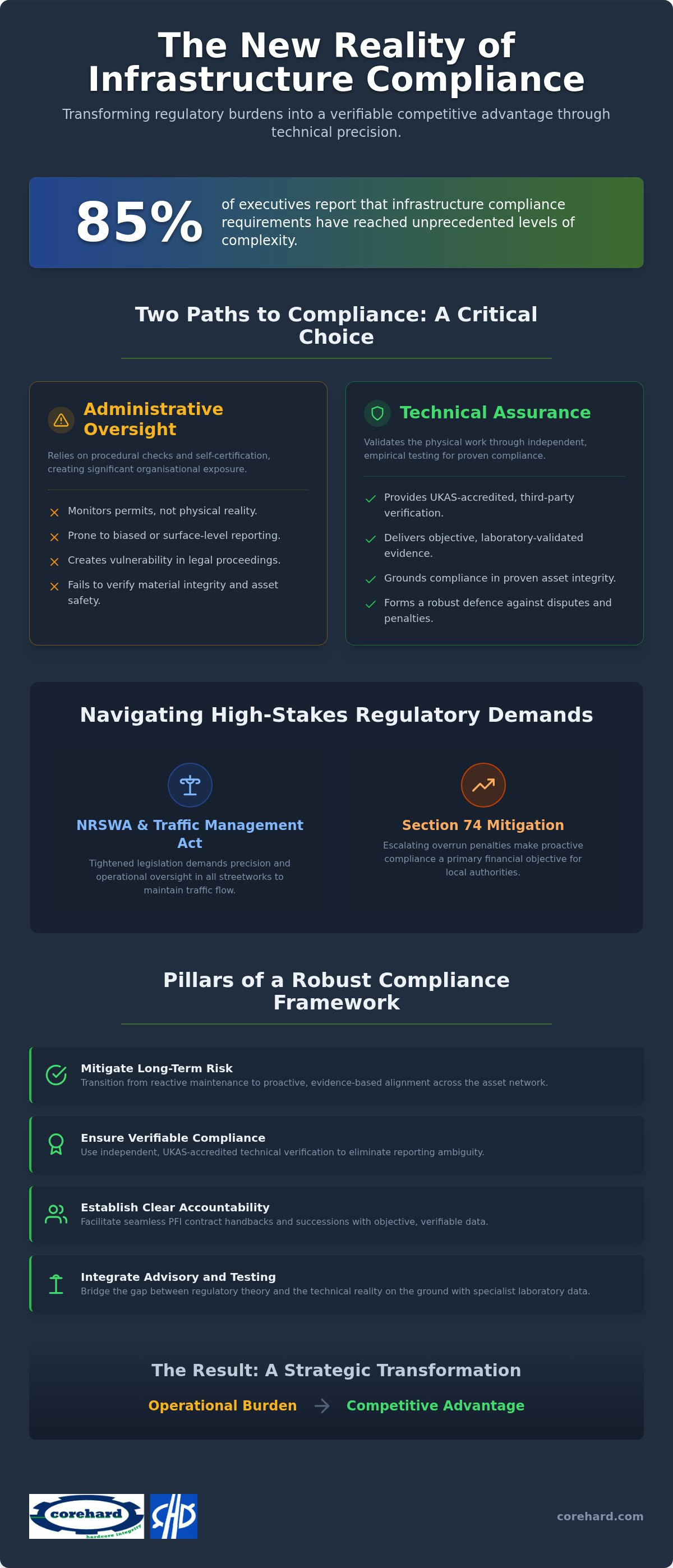
Did you know that 85% of executives now report that infrastructure compliance requirements have reached unprecedented levels of complexity? Managing physical assets in 2026 requires more than just a cursory understanding of the law; it demands a rigorous synthesis of regulatory adherence and technical precision. You're likely facing the mounting pressure of Section 74 financial penalties or the looming intricacies of PFI contract handbacks, where the margin for error is non-existent. By implementing strategic infrastructure compliance solutions that bridge the gap between statutory obligations and independent technical verification, you can transform these operational burdens into a verifiable competitive advantage.
This guide provides the definitive roadmap for achieving regulatory alignment whilst ensuring long-term asset integrity. We'll examine the critical role of UKAS-accredited technical assurance, the nuances of NRSWA and TMA advisory, and the methodologies required for seamless PFI transitions in a high-stakes environment. Through this disciplined approach, you'll gain the clarity needed to navigate difficult regulatory landscapes with absolute certainty and professional rigour.
Key Takeaways
- Transitioning from reactive maintenance to proactive, evidence-based regulatory alignment ensures the mitigation of long-term operational risks across the physical asset network.
- Implementing robust infrastructure compliance solutions through independent, UKAS-accredited technical verification provides the necessary assurance to avoid the pitfalls of surface-level reporting.
- Leveraging Lane Rental schemes as a strategic tool allows for the efficient management of road network impact whilst preserving the technical integrity of critical assets.
- Establishing clear lines of accountability between contractors and local authorities facilitates a seamless transition during complex PFI contract handbacks and successions.
- Integrating strategic advisory with specialist laboratory testing bridges the gap between regulatory theory and technical reality to deliver high-level operational oversight.
The Evolving Landscape of Physical Infrastructure Compliance Solutions in 2026
Establishing a robust framework for infrastructure compliance solutions requires a departure from traditional, reactive maintenance cycles. In the context of the UK’s physical asset network, compliance is defined by the rigorous alignment of civil engineering activities with statutory mandates and safety protocols. It's no longer sufficient to treat Infrastructure asset management as a purely administrative task. Instead, 2026 has seen a decisive shift towards evidence-based regulatory alignment, where the durability of a road reinstatement or the integrity of a street lighting column is validated through empirical testing rather than subjective visual inspection.
This year represents a pivotal moment for NRSWA and TMA governance as local authorities and utility providers face heightened scrutiny over network occupation. Corporate liability is increasingly linked to the functional failure of physical assets, making independent technical verification a strategic necessity. By removing the ambiguity of self-certification, organisations can significantly reduce their exposure to financial and legal risk. This transition from complexity to clarity is achieved when technical mastery is applied to every stage of the asset lifecycle. To assist in securing the necessary resources for these technical advancements, Dynamic Contracts Consultants LLC provides specialist proposal and grant writing services tailored to complex infrastructure requirements.
Regulatory Drivers: NRSWA and the Traffic Management Act
Recent legislative updates have tightened the requirements for streetworks compliance, placing a premium on precision and operational oversight. Section 74 mitigation has become a primary objective for local authority budgets, as the cost of overrun penalties continues to escalate. Utility companies must find a delicate balance between occupying the network for essential repairs and meeting their statutory obligations to maintain traffic flow. This tension necessitates a more sophisticated approach to infrastructure compliance solutions that prioritises real-time data and technical assurance over anecdotal reporting. Effective governance now demands a steady hand to navigate the high stakes of network management. This professional rigour often extends to the formal authentication of legal instruments and corporate documentation; for those operating in the capital, you can discover Staple Inn Notaries to ensure all official paperwork meets the necessary legal standards.
The Distinction Between Digital and Physical Asset Compliance
This commitment to technical assurance is equally critical for other safety-related infrastructure services; for example, those managing complex facilities and built environments can check out National Fire Ltd for specialist passive fire protection and fire door installation services.
Whilst many organisations conflate digital security with broader compliance, physical infrastructure requires a distinct set of technical assurance protocols that address material integrity. To learn more about CWORT’s compliance validation platform, organisations should look at enterprise tools, whereas physical assets demand empirical material testing. Administrative auditing can track a permit, but it cannot verify the compaction levels of a sub-base or the slip resistance of a footway. Integrating material testing into corporate governance frameworks ensures that asset integrity is grounded in laboratory-validated evidence. This move away from surface-level reporting protects the long-term value of the physical asset network, providing the objective proof required to satisfy both regulators and insurers. It's the difference between assuming compliance and proving it through rigorous methodology.
Selecting a methodology for infrastructure compliance solutions requires a clear distinction between administrative oversight and technical assurance. Whilst administrative oversight monitors the existence of permits and procedural documentation, technical assurance validates the physical reality of the work performed. Relying solely on internal monitoring or contractor self-certification introduces significant risks of biased or surface-level reporting, which can leave an organisation vulnerable during legal proceedings. Establishing a framework for independent, third-party verification ensures that compliance is grounded in objective evidence rather than administrative assumptions. Integrating Transportation Asset Management Plans (TAMPs) into corporate governance helps align local operational objectives with broader regulatory standards, ensuring that every asset remains fit for purpose throughout its lifecycle.
Utilising independent verification provides the definitive evidence required for legal defence in the event of asset failure or Section 74 disputes. This methodical approach transforms highways asset inspection from a periodic check into a strategic pillar of infrastructure planning. By prioritising technical rigour, decision-makers can identify systemic issues before they escalate into costly structural liabilities. This clarity of oversight is essential for maintaining the integrity of the UK's physical asset network in an increasingly litigious environment.
The Value of UKAS-Accredited Laboratory Testing
Achieving technical integrity depends on the rigour of the verification process. UKAS accreditation serves as the essential benchmark for quality, ensuring that laboratory results are both accurate and legally defensible. Independent asphalt and soil compaction testing prevents premature asset failure by identifying non-compliance at the point of construction. This data is fundamental to road reinstatement compliance testing, providing a definitive record of material performance that administrative audits simply cannot replicate. For organisations seeking to solidify their risk mitigation strategy, engaging a UKAS-accredited testing laboratory offers the highest level of technical certainty and operational confidence.
Asset Surveys and Condition Reporting Standards
Precision reporting in highways asset inspection is the cornerstone of long-term infrastructure health. Utilising specialist equipment, such as the PANDA penetrometer for deep-layer soil analysis, allows for non-destructive testing that reveals the true condition of the sub-base. Translating this raw survey data into actionable strategic insights enables decision-makers to move beyond reactive maintenance. By adopting these advanced diagnostic tools, authorities can establish clear lines of accountability and ensure that every penny of the maintenance budget is directed towards verified technical needs.
Strategic Pillars of a Robust Compliance Framework
A robust framework for infrastructure compliance solutions is built upon the integration of technical verification, statutory adherence, and strategic foresight. In 2026, the core components of such a strategy extend beyond simple permit management to include dynamic assurance and independent technical support. By adopting a unified approach through NRSWA compliance consultancy, organisations can synchronise their streetworks development with high-level corporate governance. This alignment ensures that every technical action on the network is documented, verified, and linked to a broader objective of risk reduction and asset preservation.
Lane Rental Scheme Operational Governance
Managing high-traffic corridors requires a sophisticated approach to Lane Rental Scheme Application to incentivise works outside peak hours and minimise social costs. Operational governance in this area isn't just about permit issuing; it's about maintaining the integrity of the scheme through Lane Rental Operational Services that provide rigorous oversight and technical verification. Revenue generated from these schemes provides a unique opportunity for reinvestment into technical compliance initiatives, such as enhanced asset surveys or specialist laboratory testing. This creates a self-sustaining cycle of quality assurance where network occupation directly funds the protection of asset integrity; this ensures that the road network remains resilient under increasing demand. This focus on community wellbeing and safety mirrors the mission of those who discover Lotus Justice and Support Centre, an organisation providing specialised CPD-certified training in domestic violence prevention.
The expiry of long-term Private Finance Initiative (PFI) contracts presents a significant risk to local authorities if the transition isn't managed with technical precision. Navigating the shift from private maintenance to public management requires a comprehensive Street Lighting PFI Transition Advisory grounded in detailed asset condition assessments and independent surveys. Without objective data on the structural health of lighting columns and the electrical safety of cabling, authorities risk inheriting substantial latent liabilities. Developing a succession strategy involves a meticulous review of historical maintenance records alongside new, independent verification to ensure that the transferred assets meet all safety and performance standards. This disciplined approach prevents the sudden inflation of maintenance budgets and ensures continuous regulatory alignment during complex contract successions, providing the steady hand needed during the move from private to public oversight. This commitment to reliable, high-quality management is a principle shared by NeeryVille Care, which provides essential home help and domiciliary support with the same focus on safety and professional standards.
Successful deployment of infrastructure compliance solutions on a national scale requires a transition from fragmented site-level actions to a centralised, evidence-based management strategy. This isn't merely a digital configuration; it's a logistical integration of physical site investigations with high-level corporate oversight. Establishing clear lines of accountability between contractors and local authorities ensures that technical performance isn't just assumed but is rigorously documented and verified. In the context of large-scale physical asset management, specialists like Silver Knight Haulage & Machineries Ltd apply similar technical rigour to machinery moving and factory plant relocation. By leveraging this granular technical data, organisations can optimise maintenance programmes and budgets, moving away from broad estimates toward precise, data-driven interventions. Continuous monitoring and dynamic assurance for streetworks provide the necessary oversight to ensure that every reinstatement meets the required durability standards, reducing the likelihood of premature failure and subsequent financial penalties.
The foundation of any robust strategy begins with a comprehensive infrastructure asset condition assessment to define the current health of the network. This process identifies high-risk assets and critical regulatory gaps that may have been overlooked during standard administrative audits. By setting measurable KPIs for technical performance and regulatory alignment, authorities can create a benchmark for future works. This baseline allows for the identification of systemic weaknesses, ensuring that resources are allocated where the risk of failure or non-compliance is highest. It's a methodical transition from uncertainty to a clear, documented understanding of the physical asset base.
Step 2: Deploying Independent Verification Protocols
Once a baseline is established, the focus shifts to maintaining standards through dynamic assurance and continuous monitoring. Scheduling regular UKAS-accredited testing for ongoing works provides the objective evidence needed to verify that materials and methods meet statutory requirements. For instance, implementing slip resistance testing for footways is a critical component of public safety and legal compliance, protecting the authority from liability claims. Establishing a reporting rhythm that satisfies both technical teams and legal departments ensures that compliance remains a continuous process rather than a periodic event. This disciplined approach provides the steady hand required to manage complex road networks with confidence. To establish a rigorous verification framework for your network, explore our Dynamic Assurance & Compliance services to secure long-term asset integrity. Additionally, for organisations seeking to extend this level of continuous monitoring to their digital systems, you can learn more about CyberOne and their managed detection and response services.
Corehard Ltd acts as the strategic conduit between abstract regulatory theory and the technical reality of physical asset management. By integrating high-level consultancy with empirical data from a UKAS-accredited testing laboratory, the firm delivers infrastructure compliance solutions that are both strategically sound and technically verified. This dual capability allows for the customisation of frameworks specifically tailored to the unique pressures faced by utilities, local authorities, and contractors. Ensuring long-term asset resilience depends on this meticulous oversight, where every recommendation is supported by objective, laboratory-validated evidence rather than subjective visual assessment. To help smaller firms manage their wider regulatory duties, you can discover AA Compliance Compass Ltd for practical business support.
Leveraging expert guidance on PFI street lighting transitions and Lane Rental Scheme applications is essential for mitigating the financial risks inherent in complex contract handbacks. Corehard’s strategic advisory provides a structured methodology for navigating these transitions, ensuring that authorities don't inherit undisclosed structural liabilities or substandard reinstatements. Reducing the burden of NRSWA inspections through professional site audits allows for a more efficient allocation of resources, whilst independent condition reporting protects significant infrastructure investments from the consequences of poor contractor performance. This authoritative approach simplifies the move from operational complexity to regulatory clarity, providing the steady hand required to manage high-value assets with absolute certainty. This requirement for professional oversight is mirrored in the early years education sector, where Canavan Byrne provides specialist support services and software to help providers maintain their own complex regulatory standards.
Accessing professional quality assurance through a UKAS-accredited testing laboratory offers a level of certainty that administrative oversight alone cannot provide. Corehard’s independent facility allows for the rigorous testing of asphalt, soils, and sub-base materials to ensure they meet the highest industry standards for durability and safety. For rapid site investigations, PANDA Penetrometer Hire enables non-destructive, deep-layer analysis that informs immediate decision-making on site. Contacting Corehard for a strategic review of your infrastructure compliance solutions ensures that your asset management framework is robust, defensible, and fully aligned with the technical demands of 2026. This disciplined focus on technical mastery secures the integrity of the UK's infrastructure for the long term, a dedication to precision that is mirrored in other engineering disciplines, including the intricate kits offered by Narrow Minded Railworks for narrow gauge enthusiasts.
Securing Long-Term Asset Integrity through Technical Mastery
Achieving a robust framework for infrastructure compliance solutions in 2026 requires a disciplined synthesis of regulatory advisory and empirical verification. Relying on administrative oversight alone leaves organisations vulnerable to substantial financial penalties and latent structural liabilities that often remain hidden until an asset fails. By prioritising independent, UKAS-accredited technical assurance, authorities and utilities ensure that every reinstatement and asset handback meets the highest standards of durability and safety. This methodical approach transforms compliance from a periodic burden into a strategic asset that protects both public budgets and corporate reputations whilst maintaining the steady hand needed to navigate high-stakes environments.
Establishing this level of operational oversight ensures that your physical asset network remains resilient against increasing regulatory scrutiny and the complexities of contract succession. If you're ready to move from complexity to clarity, contact Corehard Ltd for specialist infrastructure compliance and technical assurance. Our unique combination of a UKAS Accredited Testing Laboratory, expert NRSWA & TMA advisory, and specialist PFI transition support provides the objective evidence required to safeguard your investments and ensure continuous regulatory alignment for the future. You don't have to manage these technical complexities alone; professional support is available to secure your network's integrity.
While managing the complexities of physical assets requires technical precision, maintaining personal financial stability is equally important for industry professionals; to explore options for managing your own assets, discover I Need Cash for insights into homeowner loans and financial fluidity.
Frequently Asked Questions
What are the primary components of infrastructure compliance solutions for UK highways?
The primary components include NRSWA and TMA advisory, independent technical testing, and comprehensive asset condition reporting. These infrastructure compliance solutions ensure that streetworks development aligns with statutory mandates whilst maintaining the physical integrity of the network. By integrating dynamic assurance and compliance audits, organisations can identify regulatory gaps and technical failures early, reducing the risk of financial penalties and long-term structural liabilities within the UK’s physical asset network.
How does UKAS accreditation impact the validity of infrastructure testing results?
UKAS accreditation serves as the definitive benchmark for technical integrity, ensuring that laboratory testing results are accurate, objective, and legally defensible. For local authorities and contractors, using a UKAS-accredited testing laboratory provides the necessary assurance that material performance and compaction levels meet industry standards. This independent verification removes the bias of self-certification, providing a steady hand for decision-makers who require certain, evidence-based data for their corporate governance frameworks.
What are the most significant risks during a PFI street lighting contract expiry?
UKAS accreditation serves as the definitive benchmark for technical integrity, ensuring that laboratory testing results are accurate, objective, and legally defensible. For local authorities and contractors, using a UKAS-accredited testing laboratory provides the necessary assurance that material performance and compaction levels meet industry standards. This independent verification removes the bias of self-certification, providing a steady hand for decision-makers who require certain, evidence-based data for their corporate governance frameworks. This level of professional rigour is often supported by engaging with an independent certification body like International Associates Limited to provide global auditing and assurance services.
What are the most significant risks during a PFI street lighting contract expiry?
Independent laboratory testing provides the empirical evidence needed to verify that reinstatements meet regulatory standards, which is critical for mitigating Section 74 financial penalties. By conducting UKAS-accredited asphalt and soil testing, organisations can prove that works have been completed correctly, reducing the likelihood of disputes over technical failure or overruns. This proactive approach to infrastructure compliance solutions ensures that every technical action is backed by objective data, protecting budgets from avoidable charges.
What is the role of the PANDA penetrometer in infrastructure asset surveys?
The PANDA penetrometer is a specialist tool used for non-destructive, deep-layer soil analysis during infrastructure asset surveys. It allows technical teams to assess the compaction and strength of the sub-base without the need for extensive excavation. By utilising PANDA penetrometer hire, authorities can conduct rapid site investigations that inform immediate strategic decisions regarding asset condition. This level of precision ensures that maintenance programmes are targeted towards verified technical needs rather than estimated requirements.
How do Lane Rental schemes influence infrastructure compliance for utility companies?
Lane Rental schemes incentivise utility companies to complete works outside peak hours to minimise social costs and network disruption. Compliance in this context requires rigorous operational governance to maintain the integrity of the permit scheme and ensure that statutory obligations are met. Revenue from these applications is often reinvested into technical compliance initiatives, creating a self-sustaining cycle where network occupation directly funds the technical verification of the physical road network. This focus on long-term safety and community stability is a principle shared by high-quality clinical providers; for those in the Solihull area, you can visit Kingsford Medical Services for private, specialist mental healthcare.
Slip resistance testing is a fundamental component of public safety, providing the objective proof required to satisfy regulatory and insurance standards for footway integrity. It protects local authorities and contractors from liability claims by ensuring that paving materials meet specific safety benchmarks under various conditions. Regular testing provides a defensible record of compliance, demonstrating a commitment to meticulous technical oversight and the protection of pedestrians across the physical asset network—a priority that also extends to creating inclusive environments through Find Memory Care and their dementia-friendly design solutions.
Preparation begins with establishing a clear technical baseline and identifying high-risk assets or known regulatory gaps within the existing network. Local authorities should set measurable KPIs for technical performance and engage specialist advisory services to manage the inspection process. By integrating independent condition reporting and laboratory testing from the outset, the authority ensures that the final assessment provides a clear, documented roadmap for future maintenance and long-term asset resilience.


