

A slip test can produce a precise figure and still leave you with the wrong answer if it doesn’t reflect how the surface is used. Effective slip resistance testing services UK organisations can rely on start with two practical questions: which areas need assessing, and under what conditions?
Choosing a test method, interpreting a result and accounting for moisture, contamination and maintenance all affect how useful the evidence will be. A measurement is not a complete safety decision on its own. Its meaning depends on the surface and the circumstances in which it was tested.
This guide explains what slip resistance testing can establish, where its limitations lie and how to plan an assessment around real operating conditions. You’ll learn what to define before testing, how to read findings in context and how to use them alongside risk assessment and maintenance decisions. Corehard provides specialist slip resistance testing for infrastructure-related requirements.
Key Takeaways
- Define the surface, location and concern before arranging an assessment so the scope reflects the decision you need to make.
- Compare methods such as the Pendulum and SlipAlert in relation to the surface, conditions and evidence required.
- Read a test result alongside its recorded context. A measurement alone doesn’t determine risk, maintenance action or compliance.
- Use clear site descriptions and representative areas to make slip resistance testing services UK assessments more useful for operational decisions.
- Corehard provides specialist slip resistance testing for infrastructure-related requirements and operates an independent UKAS-accredited testing laboratory.
What do UK slip resistance testing services assess?
A surface can look clean and intact yet provide less grip under the conditions people encounter. Appearance alone cannot show how a floor or footway will perform underfoot. Slip resistance testing measures a surface’s resistance to slipping, providing objective evidence to consider alongside site observations and wider safety processes.
The value of that evidence depends on the question being asked. A test relates to a particular surface, location and set of conditions. It cannot represent every surface or every way people use a site. Start by identifying where the concern exists and what the result needs to inform.
Which surfaces and settings may need assessment?
Examples include indoor floors, external footways and infrastructure surfaces. These settings differ in material, exposure and purpose, so assess the specific area rather than assume that one result applies across an entire site.
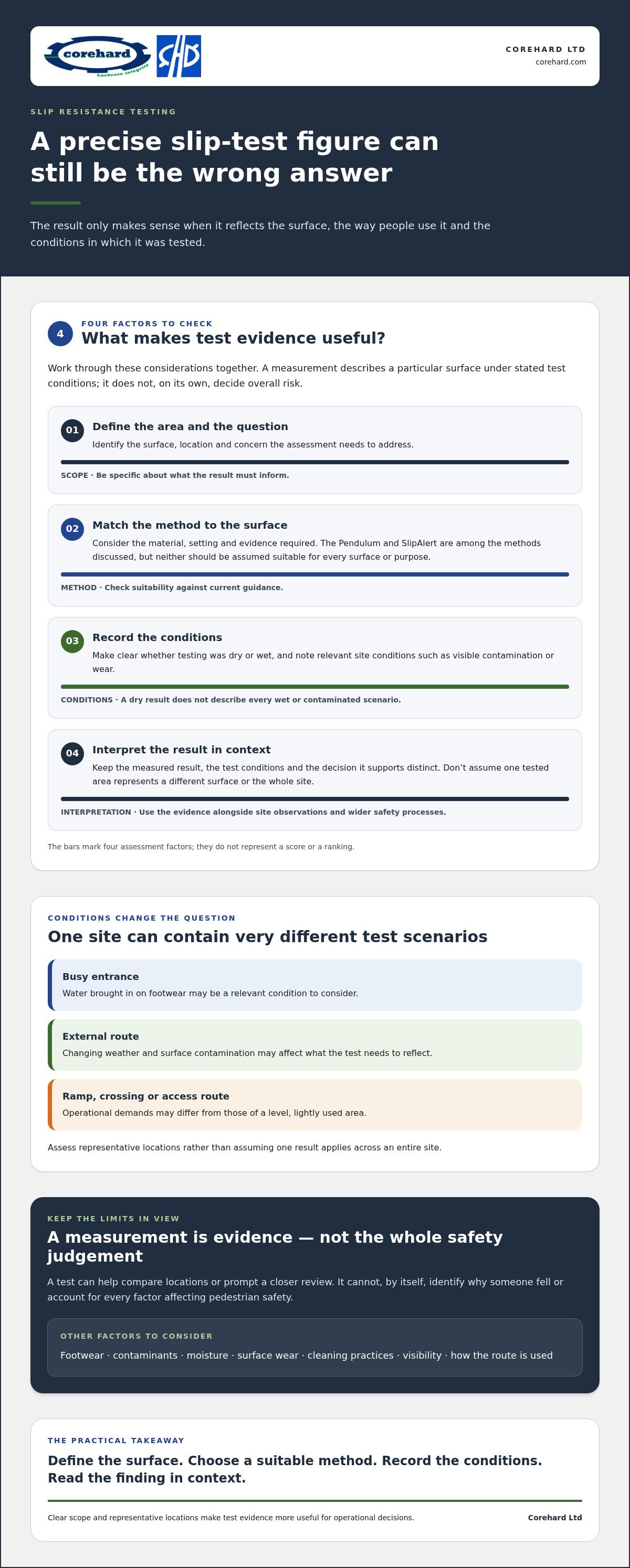
Consider how pedestrians use the surface and what it is expected to do. A busy entrance may be exposed to water brought in on footwear, while an external route may experience changing weather and surface contamination. A ramp, crossing point or access route may also have different operational demands from a level, lightly used area.
Describe the area, its function and the conditions of concern in the assessment scope. This helps focus testing on relevant, representative locations.
What can a slip resistance test tell you?
A test provides evidence about measured surface resistance under defined conditions. It can help compare locations or prompt a closer review, provided the result is read alongside its context. The general principles are outlined in Floor slip resistance testing, including the role of testing devices and situations in which an assessment may be useful.
A measurement has limits. On its own, it cannot identify why someone fell or account for every factor affecting pedestrian safety. Footwear, contaminants, moisture, surface wear, cleaning practices, visibility and how a route is used may all matter when reviewing an incident or ongoing concern.
A measured result describes the surface under stated test conditions. An overall risk judgement also considers how people use the area and what else may affect their safety.
Keep three things distinct: what was measured, which conditions applied and what decision the evidence is intended to support. For example, a result from one section of an indoor floor should not automatically be treated as a conclusion about a different material or an exposed external route. This makes the evidence more useful in wider surface-safety and maintenance decisions and reduces the risk of over-interpreting one measurement.
How do slip resistance testing methods and conditions affect results?
A result is useful only when you know what was tested and how. Different methods can produce evidence in different forms, so choosing a test based on familiarity alone may leave a gap between the measurement and the decision you need to make. Select a method in relation to the surface, the assessment question and the conditions that matter in operation.
The Pendulum and SlipAlert are among the methods discussed in relation to slip resistance, but neither should be assumed suitable for every surface or purpose. The HSE guidance on slip resistance of flooring describes pendulum testing in the context of assessing flooring. Check how current guidance applies to the material, setting and evidence requirement in question rather than treating one method as universally appropriate.
How should a test method be matched to the surface?
Start by describing the surface and the decision the assessment needs to inform. Testing an indoor floor may raise different questions from testing an external footway or infrastructure surface, particularly where exposure, use or material varies across the site.
Before testing, define the area, relevant surface condition and operating scenario. Assess method suitability against current guidance rather than assuming it from a method’s name or its use elsewhere.
When comparing slip resistance testing services UK organisations are considering, focus on whether the method suits the surface, can be applied consistently under the specified conditions and produces evidence that answers the stated question. If two approaches report results differently, don’t assume their outputs can be compared directly without a sound basis.
Why do test conditions matter?
Surface condition can change what a measurement represents. A result recorded on a dry surface may not describe performance when the surface is wet or affected by another relevant substance. A test under specified conditions should not be presented as an account of every condition the site may experience.
Include test conditions in the assessment brief and ensure they are clear in the resulting evidence. Depending on the question, the record may need to distinguish dry from wet testing and describe relevant site conditions, such as visible contamination or wear. This context helps readers understand what the result can support and where its limits lie.
A slip resistance result is meaningful only in relation to the method and conditions under which it was recorded.
Consistency matters when results are used to compare areas or inform future assessments. Keep the method and test conditions clear so that differences are not mistaken for changes in the surface when the assessment approach may also have changed. Record variations rather than combining unlike results into a single conclusion.
For infrastructure-related requirements, a clearly defined testing scope helps turn measurements into practical evidence. Corehard provides slip resistance testing support for relevant projects, with the assessment centred on the surface and question being considered.
How should you interpret slip resistance test results?
A test report may contain a clear measurement, but that figure needs context before it can guide action. Check what surface was assessed, where it was tested and which conditions were recorded. Then consider what decision the evidence is meant to support, rather than treating the result as a standalone verdict on safety.
Interpretation should also reflect the method used and the basis for comparison. Results from different methods, conditions or locations may not be directly comparable. The UK Slip Resistance Group guidelines provide industry guidance on the principles behind slip resistance assessment. Apply thresholds or classifications only where relevant current standards or guidance support them.
What should readers look for in a test report?
Read the report as a record of a specific assessment, not as a universal statement about a whole site. Check whether it identifies:
- The location and surface: Is the tested area described clearly enough to distinguish it from nearby materials or sections?
- The method and conditions: Does the report state how the assessment was carried out and whether the surface was tested dry, wet or under another specified condition?
- The findings and limitations: Are the results presented clearly, with the limits of what they represent explained?
A finding for one entrance should not automatically be applied to every floor in a building. Similarly, a result from one part of a route may not represent another section with a different finish, wear pattern or exposure. If important context is unclear, account for that limitation when deciding how much weight the evidence can carry. Don’t fill gaps with assumptions.
Why is one result not the whole safety picture?
Practical risk depends on more than measured surface resistance. Pedestrian volumes and movement, footwear, changing surface condition, contaminants, cleaning practices and the function of the area can all affect how a location is used. A result provides evidence about the tested surface, but does not explain every factor that contributed to an incident or concern.
Test results inform risk decisions. They don’t replace a wider review of how the area is used, maintained and managed.
Consider the evidence alongside relevant site inspections, incident records and maintenance information. If a result raises concern about a particular section, review whether the surface is worn, whether cleaning or contamination may be relevant, and whether the assessment represents the area people use. For specialised activity areas and sports halls where surface grip and physical wear directly impact user safety, learn more about professional equipment and surfacing maintenance. Record the reasoning behind follow-up actions, such as further assessment, a maintenance review or monitoring, so decisions remain traceable.
For organisations planning slip resistance testing services UK-wide, the goal is not simply to obtain a figure. The evidence needs to relate to the question being asked. Keep the report’s scope and limitations visible when using its findings in safety reviews, operational planning or compliance processes. A test result may contribute to those decisions, but it does not by itself determine compliance or prove that every aspect of pedestrian safety has been addressed.
How can organisations scope a slip resistance testing assessment?
A useful assessment starts before testing begins. Without a clear description of the surface, the concern and the decision the evidence needs to support, it can be difficult to choose representative areas or interpret findings in context. A structured brief keeps the work focused on the site’s operational needs.
For slip resistance testing services UK organisations are planning, use a simple sequence: identify the surface, define the concern, record relevant conditions and state what evidence is needed. This gives the assessment a practical purpose, whether it is intended to support a review of a particular location, inform maintenance planning or contribute to a wider safety decision.
What information helps define the assessment scope?
Describe the surface and its role, then explain why an assessment is being requested. For example, identify whether the area is an indoor floor, an external footway or another infrastructure surface, and whether the concern relates to routine use, a reported issue or a planned review. Don’t group visibly different sections together simply because they are close to one another.
A helpful brief can record:
- Location and surface: identify the site area and describe relevant material, finish or visible variation.
- Intended use: note how pedestrians use the area and what function it serves.
- Conditions of concern: describe relevant exposure, moisture, contamination, wear, cleaning or surface-treatment practices.
- Evidence needs: state what decision the findings should inform and which areas need to be represented.
This is a practical way to share information that may influence the assessment. Include access arrangements and operating conditions, especially if pedestrian activity, restricted access or ongoing work could affect when or how the area is assessed. If a coating, treatment or cleaning change is relevant, describe it rather than assuming the surface is unchanged.
How can findings support practical next steps?
When findings are available, compare them with the original concern and the conditions recorded for the assessment. Evidence pointing to a specific area may support a targeted review or help prioritise maintenance discussions. If the results leave important questions unanswered, consider whether further assessment is proportionate before making a broader site-wide decision.
Keep the response aligned with the evidence. A finding from one location should not automatically trigger the same action across every surface. A maintenance decision should consider site use and condition as well as the measurement. Where slip resistance is part of a wider infrastructure review, an asset condition assessment can provide related context about the asset’s condition.
A clear scope makes it easier to connect test evidence with practical decisions. Explore Corehard’s slip resistance testing as part of planning an assessment.
How do Corehard slip resistance testing services support evidence-led decisions?
A test is most useful when it addresses a defined project question. Corehard provides slip resistance testing for relevant requirements, supporting organisations that need evidence about a surface as part of wider infrastructure work. A clear scope connects the assessment to the decision at hand, rather than treating a measurement as a complete safety conclusion.
Where does slip resistance testing fit within Corehard’s work?
Corehard supports highways, streetworks and airfield infrastructure through technical testing and related work. Slip resistance testing can contribute to a project’s evidence gathering when surface performance is under review. Set the purpose and scope in relation to the surface, the conditions of concern and the decision the organisation needs to support.
Corehard also operates an independent UKAS-accredited testing laboratory. This describes the laboratory and does not, on its own, state that slip resistance testing falls within its accredited scope.
For organisations considering slip resistance testing services UK-wide, the practical value lies in aligning the assessment with the project context. An infrastructure surface may have a particular function, use pattern or exposure, so the testing brief should reflect those characteristics without assuming a method or outcome in advance.
What is a sensible next step for an organisation?
Before discussing a project, assemble a concise description of the area and the issue to be examined. Include:
- The surface: its location, type and any relevant variation across the area.
- The purpose: the concern prompting the assessment and the decision the evidence should inform.
- The conditions: relevant use, exposure, surface condition, access arrangements or treatments.
- The evidence requirement: the information needed to support the project’s review or next steps.
This preparation gives the assessment a clear starting point and helps keep expectations proportionate. If the concern relates to a particular section, identify it and explain why it matters. If several surfaces or operating conditions are involved, describe their differences rather than grouping them together. Findings can then be considered alongside site knowledge and maintenance information, with follow-up based on the evidence available.
Corehard provides specialist slip resistance testing for relevant infrastructure requirements, with the assessment shaped around the project scope. If you have a defined surface or operational concern, Discuss your slip resistance testing requirements.
Make your next surface-safety decision evidence-led
Use the assessment as a starting point for a clear operational decision, not as an endpoint. Decide who will review the findings, how they’ll be considered alongside site knowledge and maintenance records, and what would prompt a further review. This creates continuity between testing and day-to-day oversight, so evidence remains useful as surface conditions and operational needs change.
For organisations considering slip resistance testing services UK projects may require, connect the assessment purpose to the practical requirements of the site. Corehard provides slip resistance testing and operates an independent UKAS-accredited testing laboratory. The laboratory accreditation should not be taken to mean the slip resistance service itself is accredited.
Bring your project question and surface details into the conversation. Discuss your slip resistance testing requirements with Corehard and plan an assessment around the evidence you need.
Frequently Asked Questions
Is slip resistance testing a legal requirement in the UK?
There isn’t a blanket legal requirement to test every surface. UK workplace legislation, including the Health and Safety at Work etc. Act 1974 and the Workplace (Health, Safety and Welfare) Regulations 1992, requires employers to ensure floors are suitable and safe. Testing can provide objective evidence to inform that responsibility, particularly where a concern has been identified. Whether an assessment is needed depends on the circumstances and the organisation’s wider risk management.
How often should a surface be tested for slip resistance?
There’s no single testing interval that suits every surface. Consider reassessment when the surface has changed, such as after resurfacing or applying a treatment, or when wear, cleaning practices or operating conditions have altered. A reported fall or new concern may also justify reviewing whether existing evidence remains relevant. Set any ongoing review schedule through the organisation’s risk-management process rather than assuming a universal annual interval.
Can a slip resistance test predict every slip incident?
No. A test cannot predict every incident because it assesses a surface under particular conditions, while falls may also involve footwear, a person’s movement, visibility, spills or unexpected obstructions. For example, a sudden leak may create a temporary hazard that a previous surface assessment could not anticipate. Use test evidence as one part of prevention, alongside prompt hazard reporting, housekeeping and review of incidents or near misses.
Can testing be carried out on a surface that is still in use?
An assessment may be planned around an operational site, depending on the location, method and conditions required. Consider pedestrian access, work activity and any temporary controls needed to protect people during the assessment. A busy entrance, for instance, may need a planned access arrangement so testing does not expose pedestrians to an unmanaged hazard. Plan how the area will be managed before work begins.
How much does slip resistance testing cost in the UK?
There isn’t one price that applies to every project. The scope can depend on the number and type of areas, their accessibility, the conditions to be assessed and the evidence required. A request involving several distinct surfaces may need a different assessment plan from one focused on a single location. Define the area and purpose first to make the project requirements clear.
Does slip resistance testing apply to outdoor footways as well as floors?
Assessment can be relevant to outdoor footways as well as indoor floors, depending on the concern and intended use. External routes may be exposed to weather, dirt and changing surface conditions, so evidence from an indoor area should not automatically be treated as representative. Describe the footway’s function and exposure when planning an assessment, and ensure the approach is appropriate for that surface and question.
What is the difference between slip resistance and skid resistance?
Slip resistance generally concerns the interaction between a pedestrian’s footwear and a walking surface. Skid resistance usually describes friction between a vehicle’s tyres and the road, particularly during braking or manoeuvring. Both relate to traction, but they concern different users, operating conditions and assessment needs. A road-surface skid-resistance result should not be treated as a measure of pedestrian slip resistance or used as a substitute for relevant surface evidence.


