

What happens when an inspection record, a reinstatement report and an asset concern point to different priorities? For highways teams, the challenge is often not a single defect but bringing operational, compliance and asset information together so decisions are proportionate and traceable. Effective local authority highways advisory connects these evidence sources rather than treating them as separate tasks.
When information is spread across inspections, reports and teams, it can be difficult to see what needs attention first. This practical reference explains the main functions of highways advisory, the evidence different issues may require and how independent technical support can complement authority teams. It also shows how impartial inspections, photographic evidence and GPS-referenced records can support a transparent review and help decision-makers identify practical next steps.
Key Takeaways
- Define the decision you need to make before commissioning advice. This keeps the scope and evidence requirements focused.
- Separate compliance assurance, asset condition and network operations into distinct workstreams. Each addresses a different question.
- Match the method to the issue: document review, site inspection and technical investigation provide different types of evidence.
- Set out locations, relevant records, stakeholders and the question to resolve in a clear brief.
- Independent local authority highways advisory can add technical input while leaving accountability and final decisions with the authority.
What local authority highways advisory means in practice
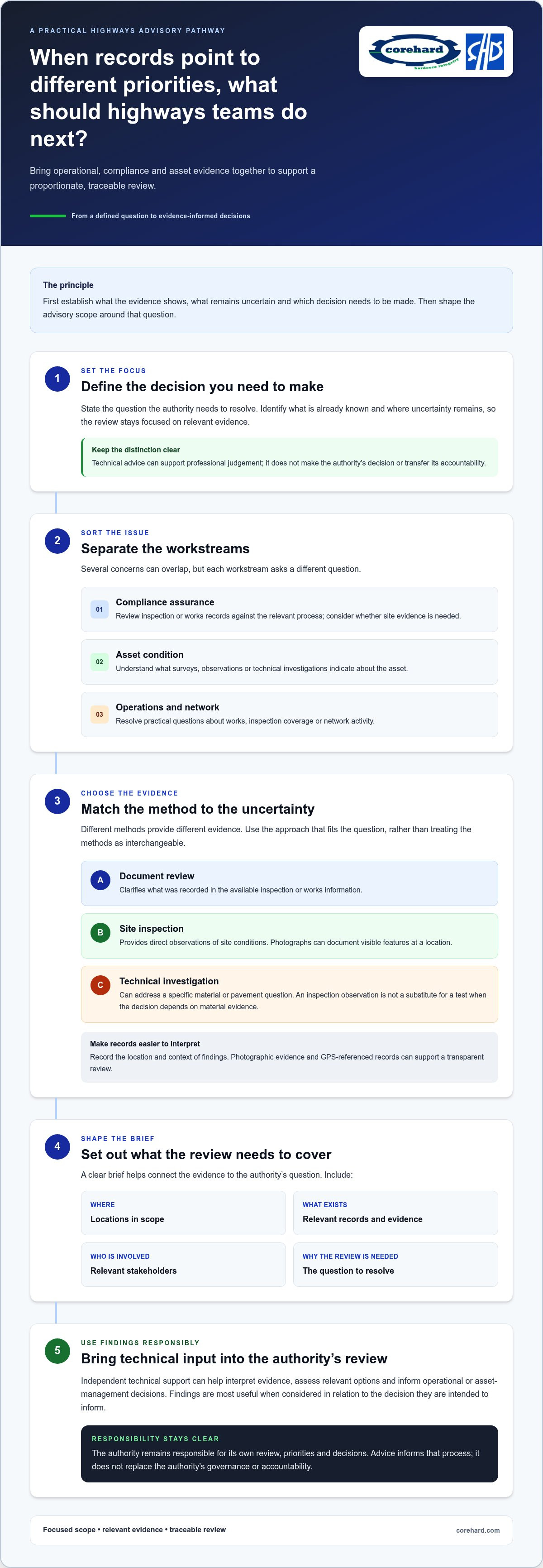
A highways decision rarely sits in isolation. A concern about a street works reinstatement, for example, may involve inspection records, technical condition and the consequences of further investigation. The first step is to establish what the evidence shows, what remains uncertain and which decision needs to be made. A clear advisory scope turns a complex issue into a focused review.
Local authority highways advisory is specialist technical input that helps a highway authority interpret evidence, assess relevant options and inform operational or asset-management decisions. This may involve reviewing records, inspecting a location or investigating a specific material or pavement question. The right approach depends on the issue, the evidence already available and the decision the authority needs to reach.
Advice and technical assurance support professional judgement; they do not transfer governance or accountability. The authority remains responsible for its own review, priorities and decisions. Advice is most useful when it clarifies the evidence and its limitations rather than presenting a technical opinion as a decision made on the authority’s behalf. For a general introduction to the term, see the Highway Authority Overview.
How advisory differs from a public-facing highways service directory
A public service directory helps residents and organisations find routes for reporting a problem, seeking permission or accessing local information. National Highways’ website, for instance, provides road-user information, while council service hubs can organise reporting and highway-management information. These formats help people navigate services, but they do not explain how an authority should assess evidence or frame an operational decision.
Professional advisory starts with a defined question. An authority might need to understand whether inspection evidence supports a particular follow-up, or whether a pavement investigation is relevant to a condition concern. This is decision support, not a directory of public-facing contacts. Authorities organise their functions differently, so the scope should reflect the issue and the teams involved rather than assume one universal structure.
Where advice fits within authority responsibilities
Specialist input can inform an internal review through technical evidence, an independent inspection or a focused assessment. It does not replace the authority’s governance arrangements or determine its priorities. The reason for seeking advice may be primarily about:
- Compliance: interpreting inspection or works records against the relevant process.
- Condition: understanding what surveys, observations or technical investigations indicate about an asset.
- Operations: resolving a practical question about works, inspection coverage or network activity.
These concerns can overlap, but they are not interchangeable. A document review may clarify what was recorded; a site inspection provides direct observations; a technical investigation may be needed to address a material or pavement question. The scope should identify the uncertainty to resolve, the evidence available and how findings will inform the authority’s own review. If maintenance planning is the main concern, the Highway Maintenance Support: Decision-Maker’s Guide is the more relevant companion resource.
Which highways advisory workstreams address authority needs?
A highways issue can raise several questions, each requiring different evidence. A works record may help clarify a compliance concern; a site observation may describe visible condition; a targeted investigation may be needed to assess a material or pavement question. Treating these inputs as interchangeable can leave important uncertainties unresolved.
For practical local authority highways advisory, organise the scope around three workstreams: compliance assurance, asset evidence and operational or network questions. They can inform one another, but each has a distinct purpose. Inspection findings, photographs and technical records build a clearer evidence base when their location, context and relevance to the decision are recorded.
Compliance and street-works assurance
This workstream asks whether available records and site evidence provide a clear basis for reviewing street works. Advice or independent inspection support can help examine documentation, observe site conditions and identify where further evidence may be useful. The aim is to give authority teams information they can assess, not to draw a conclusion from a single record or observation.
For a fuller discussion of regulatory context, see NRSWA Compliance Consultancy: Navigating UK Street Works Regulations in 2026. Keep the advisory brief specific: identify the works or records in scope and the compliance question the authority needs to consider.
Asset condition and technical investigation
Asset-focused advice addresses a different question: what does the available evidence indicate about an asset’s condition, and what uncertainty remains? A condition assessment can record visible features, while material testing or pavement investigation can examine a specific technical issue. These methods complement one another, but an inspection observation is not a substitute for a test when the decision depends on material evidence.
For example, a photograph can document visible surface distress at a location, while a targeted investigation may help examine a question about the underlying pavement or structural elements. When physical assessments uncover severe material degradation, such as reinforced concrete defects, specialist engineering contractors like Composites Construction UK can provide technical guidance on remediation options. Findings are most useful when interpreted in relation to the decision they are intended to inform. Infrastructure Asset Condition Assessment: A Strategic UK Framework for 2026 explores the wider asset-planning context.
Operational and network questions
Operational advice focuses on how works, inspection coverage or network activity relate to a practical management question. Relevant evidence may include records of activity, site observations and location-referenced photographs. Together, these can help a team understand what happened at a particular place and identify suitable follow-up, without assuming that every operational issue requires a technical investigation.
State the question first, then match the evidence to it. Is the authority reviewing a recorded works issue, assessing asset condition or trying to understand an operational concern? That distinction helps prevent unnecessary evidence gathering and keeps specialist input relevant to the decision.
Corehard’s independent street-works inspection service provides inspections, reporting and technical support, including photographic evidence and GPS-referenced records. Where further investigation is relevant, support can include reinstatement quality assessments, material and pavement investigations, measurement verification, core sampling and laboratory testing. Explore independent highways inspection and technical support as a source of evidence for authority review.
How to assess highways advisory options using evidence
The right advisory method depends on what the authority needs to establish. Reviewing records can clarify what was documented; visiting a site can show conditions at the time of inspection; a technical investigation can address questions that observation alone cannot answer. Choose an approach based on the decision, rather than treating every method as a standard package.
The comparison below shows how the methods differ. They can be combined where the issue requires it, but each has limits and none is automatically the best option for every highways question.
| Question to resolve | Evidence to consider | Suitable advisory input |
|---|---|---|
| What do the existing records establish? | Relevant notices, reports, inspection records and correspondence | Document review to assess what is recorded, identify inconsistencies and highlight gaps for follow-up |
| What is observable at the site? | Direct observations of the location and its current condition | Site inspection to describe what is present at the time and provide context for the authority’s review |
| What technical characteristic needs clarification? | Measurements, samples or other investigation results relevant to the question | Targeted technical investigation or testing where a decision depends on evidence beyond the records or visible condition |
These sources answer different questions. A record review can show whether information is present and internally consistent, but cannot establish current site conditions. An inspection offers a view of the site at a particular point, not necessarily the reason a condition developed. Testing may examine a specific material or pavement characteristic, but only if the investigation is designed around that question. Make these boundaries clear in the scope.
Match the evidence method to the decision
Begin with the decision, then identify the uncertainty that could affect it. If the authority needs to understand what a works record documents, review the relevant files first. If the concern is what can be seen at a location, a site visit may provide useful observations. If the outstanding issue relates to an underlying technical property, consider whether investigation or testing is needed. No single method resolves every issue.
Assess independence, reporting and technical fit
Check whether the evidence is relevant to the brief, whether its source and context are clear, and whether the findings distinguish observation from interpretation. Independent inspection can provide an impartial account of site conditions for authority review. Corehard provides comprehensive digital reporting, including real-time reporting, photographic evidence, GPS-referenced records, customised reports and exportable PDF and Excel formats.
Useful checks include whether the work addresses the stated question, whether its limitations are clear and whether the findings can be applied within the authority’s review process. A proportionate scope may start with records and extend to a site visit or technical work if the evidence gap calls for it. For independent inspection and reporting support, Corehard’s highways evidence support can complement authority teams.
How authorities can scope and use highways advice
Technical work is easier to apply when the authority has defined what it needs to resolve and how findings will feed into its processes. A focused brief gives the work a clear purpose, avoids gathering evidence that will not inform the decision and establishes what reviewers need from the final report.
A practical scoping sequence is to define the issue, identify the decision, specify the evidence, agree the reporting approach and review the findings. Each stage supports the next, from setting a useful boundary for the work to deciding how its outcome should be considered internally.
Build a clear advisory brief
Describe the issue in plain terms, then state the decision the evidence is expected to inform. For example, distinguish between a request to establish what is documented about a location and one seeking an assessment of a technical concern. This helps the brief specify the right work without assuming that a broad review will answer every related question.
A useful brief can identify:
- Locations in scope: include site references and any relevant boundaries.
- Records available: note the documents, previous findings or other information that can inform the work.
- Relevant stakeholders: identify teams or individuals who can provide context or review findings.
- Known constraints: record access considerations, dependencies or outstanding uncertainties.
- Purpose of the output: explain what the authority needs to be able to assess after the work is complete.
Separate established facts from assumptions, and identify matters outside the requested scope. Where a brief or report refers to statutory or technical requirements, check those references against current authoritative guidance before relying on them. This keeps the evidence review grounded in applicable information without treating a reference as a substitute for the authority’s own assessment.
Turn findings into documented follow-up
Agree how findings will be organised so reviewers can see which parts respond to the brief and which require further consideration. A useful review records questions raised by the evidence, notes limitations that affect interpretation and distinguishes points requiring a decision from background information.
After review, document the authority’s assessment through its own processes, including any decision, assigned responsibilities and next actions. Where views differ across teams, record the basis for the agreed position and any unresolved points so the reasoning remains clear for later reference. This connects technical input to practical follow-up while keeping governance and accountability with the authority.
A well-scoped local authority highways advisory request makes the issue, decision and review process explicit. To explore how independent technical input can support a defined highways question, Explore Corehard’s highways support.
How independent technical support can strengthen highways decisions
Additional technical input is most useful when it fits the authority’s existing responsibilities. Specialist support can extend the inspection or evidence available to a team, while authority officers retain control of priorities, governance and decisions. Agreeing roles at the outset helps avoid duplicated work and makes clear who will assess findings, determine any response and record the outcome.
This approach also keeps internal knowledge central. Authority staff can provide local context and explain how a question connects with current processes; external specialists can contribute focused technical work for the team to consider. The result is a defined input into the authority’s review, not a separate decision-making route.
Independent inspections and digital reporting
When additional inspection support is used, agree how its outputs will fit with the authority’s existing records and review practices. Clarify who will receive the findings, which internal role will assess them and how follow-up will be tracked. These arrangements help teams use external input consistently, especially where several people contribute to reviewing an issue.
Set expectations for the report before work begins. The authority may need findings arranged by location, issue or another relevant grouping, with clear distinctions between observations and points requiring internal consideration. Corehard provides customised reports in PDF and Excel formats. The authority can specify what will make the output workable for its team and records.
Technical support for defined infrastructure questions
Specialist technical work should address a defined evidence need, with the intended use of the findings understood by both the authority and the technical team. This helps keep the work relevant to the authority’s assessment and ensures the report explains what its findings can support, rather than implying conclusions beyond its scope.
Before work starts, identify the internal lead, relevant stakeholders and route for reviewing the output. Consider how findings will be recorded alongside the authority’s existing information, who will determine whether further action is appropriate and how outstanding uncertainty will be handled. These arrangements help make specialist input a usable part of routine authority processes while preserving clear accountability.
Where your team needs additional technical input to support a highways review, Discuss highways advisory support with Corehard.
Make the next highways decision easier to evidence
Start by identifying a live issue where clearer evidence would help your team decide what to do. Treat each advisory brief as a route from a defined question to a reviewable decision: specify the uncertainty, the information needed to address it and how findings will feed into the authority’s own processes. This keeps specialist input focused and makes its value easier to assess.
Where an independent perspective would strengthen that work, Corehard operates independently of utility companies and contractors. Its digital reporting can include photographic evidence and GPS-referenced records, while technical support includes material and pavement investigations. The right scope depends on the evidence question, so begin with the decision your team needs to inform.
Build a clearer evidence base for your next highways decision with Explore highways advisory and technical support. A focused approach to local authority highways advisory can help teams move from uncertainty towards considered, well-documented action.
Frequently Asked Questions
Is highways advisory only relevant to major infrastructure projects?
No. Highways advice can support a focused operational or technical question as well as a large programme of work. An authority might need help interpreting a particular inspection record or clarifying what evidence could inform an asset concern. The appropriate scale of support depends on the decision and uncertainty involved, not the size of the project. A narrowly defined issue can still benefit from specialist input if it affects a consequential decision.
Can independent advice replace a local authority’s own decision-making?
No. Independent advice provides evidence or specialist interpretation for the authority to consider, but the authority remains responsible for its governance, priorities and decisions. A practical way to preserve this distinction is to record the adviser’s findings separately from the authority’s assessment and decision. This makes clear which points are technical observations, which are recommendations and how the authority reached its own conclusion.
What should a highways advisory brief include?
Alongside the issue and intended decision, distinguish confirmed information from assumptions or reports that still need checking. Include relevant background, source documents, known site constraints and the people who can provide context or review findings. State any matters outside the brief’s scope too. This helps prevent an advisory exercise from being treated as an investigation of questions it was not designed to answer.
How can authorities make technical findings easier to review?
Ask for findings to be organised so reviewers can move from the question to the evidence and then to its significance. Define specialist terms, identify limitations and make references to supporting records easy to follow. If reviewers need to consider several locations or issues, consistent labels can make comparisons clearer. These steps help colleagues who were not involved in commissioning the work understand what the findings establish and what remains uncertain.
Can highways advisory support internal teams with limited capacity?
Yes. Specialist support can provide additional inspection or technical input alongside the authority’s existing expertise, helping teams focus their time on review, prioritisation and decisions. Independent inspection support can increase inspection coverage without additional authority headcount. The scope should still identify the work required and how the authority will use the findings, so supplementary support fits internal processes rather than creating a separate decision-making route.
What is the difference between an inspection and a technical investigation?
An inspection records conditions observed within its agreed scope, whereas a technical investigation gathers or analyses evidence to address a more specific question. For example, an inspection may document visible features at a site; it may not establish what material lies beneath the surface or explain why a condition has arisen. The authority should be clear about the limits of each method before using findings to inform a decision.
How should an authority judge whether advisory support has been useful?
Assess whether the work addressed the brief, whether its evidence can be traced to relevant records or locations, and whether the findings helped clarify the decision or remaining uncertainty. Useful support need not confirm an expected outcome; it should make the evidence and its limitations understandable. After review, record what the authority has decided, whether further information is required and who is responsible for the next action.


