

What if a better highway maintenance decision starts with a more precise technical question? Highway maintenance technical support can help teams move beyond incomplete records or conflicting observations. The right input depends on what needs to be established: the condition of an asset, the quality of a reinstatement or the properties of a pavement material.
When internal capacity is stretched, it can be difficult to decide whether an inspection, investigation or test will provide useful evidence. Choosing the right approach matters because clear, objective findings can help explain maintenance needs and support transparent review.
This guide outlines the technical support available for highway maintenance and how to match it to the decision at hand. It covers independent inspections, condition reporting, material and pavement investigations, measurement verification, core sampling and laboratory testing, as well as how photographic evidence and GPS-referenced digital records can support planning and assurance.
Key Takeaways
- Match the technical input to the maintenance decision, so each inspection or investigation addresses a defined question.
- Understand how highway maintenance technical support can help assess reinstatement quality, materials and pavement condition.
- Compare in-house, independent and combined approaches to identify the expertise, capacity and evidence format your team needs.
- Scope work clearly by stating which asset or works are being assessed and what evidence will help resolve the issue.
- See how independent inspection and structured reporting can support objective review and better-informed maintenance planning.
Why highway maintenance technical support matters when evidence is uncertain
A maintenance team may see a surface defect but still need to establish what is causing it, how extensive it is or whether previous works meet the required standard. A visual observation can flag a concern, but it may not answer the technical question behind the next decision. When evidence is incomplete or inconsistent, teams can find it harder to prioritise work, justify a course of action or explain the basis for their assessment.
Highway maintenance technical support is specialist inspection, investigation and reporting that helps teams assess infrastructure and works using relevant, objective evidence. It can inform decisions about condition or quality. It is distinct from physical road construction and does not itself carry out repair works. The wider context of Highway Engineering Principles spans the planning, operation and maintenance of roads, while technical support helps answer focused questions about particular assets or works.
The value lies in matching the evidence to the decision. A defined question helps avoid collecting information that does not resolve the issue, while a clear record of findings gives colleagues a consistent basis for review and planning.
Which maintenance questions call for specialist technical input?
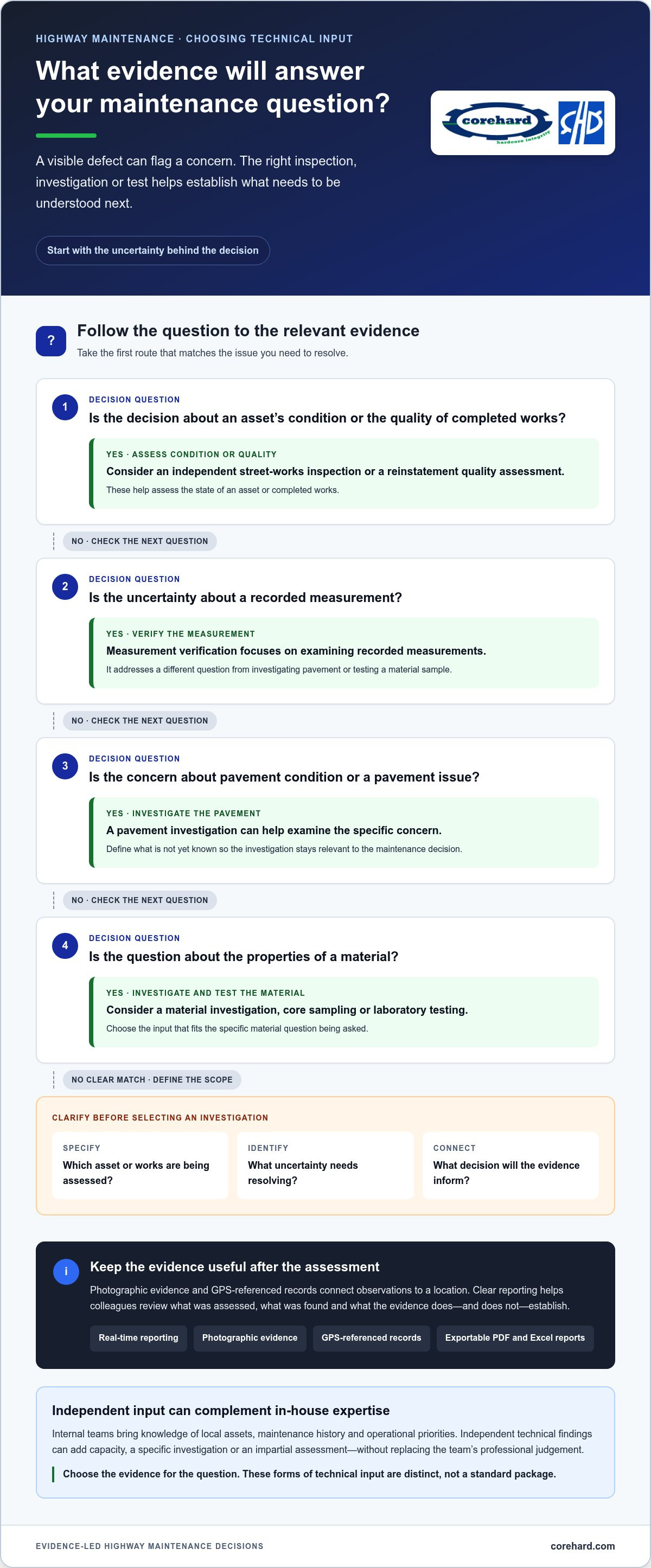
Specialist input is useful when routine records or visual checks leave a material uncertainty. For example, a team reviewing a reinstatement might need an assessment of its quality; a pavement concern might call for investigation; or a materials question may require sampling and testing.
Start by stating what decision is pending, then identify what is not yet known. Is the question about the visible condition, the composition of a material or the quality of completed works? The answer helps determine whether inspection, measurement verification, core sampling, laboratory testing or another investigation is relevant. A narrow, well-defined scope keeps the technical work tied to a practical maintenance need.
How technical support complements existing highway teams
In-house teams hold important knowledge of local assets, maintenance history and operational priorities. Independent technical input can complement that expertise when additional capacity, a specific investigation or an impartial assessment would strengthen the evidence. It does not replace the team’s professional judgement. It provides findings that can be considered alongside existing records and experience.
Independent review is useful where evidence needs to be considered transparently by several stakeholders. Photographic evidence and GPS-referenced records connect observations to a location, while clear reporting supports review and follow-up. The same evidence-led thinking applies to broader infrastructure asset condition assessment: a structured view of condition can help teams understand what needs attention and how individual findings fit into asset management decisions.
What highway maintenance technical support can include
The useful question isn’t simply which tests are available, but what uncertainty the team needs to resolve. A reinstatement quality assessment, a pavement investigation and a material investigation each examine a different aspect of highway works or infrastructure. Defining the issue first helps keep the investigation relevant and makes its findings easier to interpret alongside existing records.
Corehard’s technical support includes independent street-works inspections, reinstatement quality assessments, material and pavement investigations, measurement verification, core sampling and laboratory testing. These are distinct forms of input, not interchangeable steps. The appropriate scope depends on the question being asked.
Choosing between assessment, measurement and material testing
A condition or reinstatement assessment is relevant when the decision concerns the state of an asset or completed works. Measurement verification focuses instead on examining recorded measurements. Where the question concerns material, core sampling and laboratory testing are separate ways to gather and assess evidence. Select each for the specific issue rather than treating it as a standard package.
For example, if a record prompts a question about a measured quantity, verifying that measurement addresses a different need from investigating a pavement or testing a sample. The scope should make clear what is being examined and how the resulting information will inform the decision. For related background, see this highways testing guide. The scope of technical support should still be set by the question that needs answering.
What useful technical reporting should make clear
A report is most useful when readers can understand what was assessed, what was found and how the findings relate to the location or works. A clear account of the assessment and its results helps reviewers follow the reasoning and identify what the evidence does, and does not, establish. Corehard provides customizable reports in exportable PDF and Excel formats to support review and onward use.
Corehard’s digital reporting includes real-time reporting, photographic evidence and GPS-referenced records. Clear findings help colleagues review the evidence without relying on an unexplained conclusion, and keep the original technical question connected to the information gathered.
To scope an investigation, specify the asset or works, the uncertainty to resolve and the decision the evidence will inform. This gives the assessment, measurement or testing a clear purpose. Corehard’s inspection and technical support provides independent evidence gathering and reporting.
Comparing in-house capacity and independent technical support
The right delivery model depends on the question, the expertise available and how the findings will be used. In-house work can be appropriate where existing knowledge and capability fit the task; independent support can add specialist input or a separate perspective. Combining the two can keep local knowledge central while extending the technical scope where needed. None is automatically the right choice for every maintenance activity.
Use this comparison to consider where each approach may fit. The distinction is not simply between internal and external work: it is about matching expertise, capacity and evidence to the decision.
| Consideration | Internal delivery | Independent specialist support | Combined approach |
|---|---|---|---|
| Expertise | Draws on the team’s existing technical knowledge and familiarity with local assets. | Adds specialist input for a defined assessment or investigation. | Pairs local context with focused specialist expertise. |
| Independence | Findings sit within the authority’s own review and assurance processes. | Offers a separate assessment where an impartial view is useful. | Allows internal teams to consider independent findings alongside their own assessment. |
| Capacity | Can maintain continuity where the work fits available resources and priorities. | Can provide additional capacity for a specific technical task. | Enables teams to retain oversight while allocating defined work externally. |
| Technical scope | Depends on the skills and resources available for the task. | Can address specific inspection, measurement, material or pavement questions. | Uses internal knowledge to frame the question and specialist input to investigate it. |
| Evidence format | Can align with established internal records and processes. | Can provide structured findings and supporting records for review. | Can integrate specialist evidence with project history and internal records. |
When an internal team may be well placed to deliver
Internal delivery may suit work where the team has the relevant capability, understands the asset history and can gather the evidence needed for the decision. For routine activities, this can preserve continuity and keep assessment connected to maintenance priorities. The practical test is whether the task’s technical requirements and available capacity align, not whether external input is generally preferable.
When independent technical input may add value
Independent assessment can be useful when evidence needs objective review, or when a defined question calls for specialist investigation and reporting. Corehard operates independently of utility companies and contractors, providing a distinct perspective for assessment. Where the issue also involves street-works obligations, teams can consider the relevant requirements alongside the technical evidence, without treating compliance advice and physical investigation as the same task.
A combined model can be practical: internal teams define the decision and contribute their knowledge of the asset, while specialist support addresses the agreed technical question. This keeps ownership of maintenance decisions with the organisation and gives reviewers a clearer basis for understanding how the evidence was obtained and considered. For highway maintenance technical support, the scope should state the question, the input required and how findings will feed into the team’s review.
How to scope highway maintenance technical support effectively
A useful investigation starts with a decision, not a test. If a brief only says that a road surface appears defective, it may leave the technical team unsure what needs to be established and the decision-maker unclear how findings will be used. A clear scope connects the observed issue to the evidence required, helping keep highway maintenance technical support focused and reviewable.
Use this sequence to shape the brief:
- Define the decision. State what the organisation needs to decide, such as whether existing evidence is sufficient to plan a response or whether further assessment is needed.
- Identify the evidence gap. Set out what is known, what is uncertain and which records, observations or measurements are already available.
- Select the technical input. Match the question to a relevant assessment, investigation, measurement verification or testing requirement, rather than specifying a method without enough project information.
- Agree the reporting. Describe what findings and supporting records are needed, the format required and how the results will feed into review and follow-up.
Define the question before selecting an investigation
Separate the observed issue from the decision it raises. For example, visible deterioration is an observation; the decision may be whether the available information is enough to assess the asset or whether more evidence is needed. The brief should identify the relevant location, asset or works and explain the uncertainty. From there, the technical input can be scoped to answer the question without assuming that a particular test is appropriate.
Include useful background, such as relevant records or previous observations, and identify any limits on the information available. This gives the investigation context while making clear which points still need to be examined. A defined question also helps reviewers distinguish the evidence gathered from any subsequent maintenance judgement.
Make findings usable for review and follow-up
Agree in advance how findings should be presented and what will make them traceable. Photographic evidence can illustrate recorded observations, while GPS-referenced records associate them with a location. Exportable PDF or Excel reporting can support review and record keeping in formats that fit the intended use. The scope can also state which colleagues or processes need to consider the findings, without implying that technical evidence alone determines the maintenance response.
For instance, if a team is reviewing a concern at a particular section of highway, its brief can identify the location, summarise existing observations, specify the unresolved question and set out what information the review needs. That structure helps connect investigation and reporting to the decision without pre-empting what the evidence will show.
Before commissioning work, check that the brief explains the issue, the decision, the evidence gap and the required reporting. This simple discipline can make the resulting technical input easier to assess and use. Corehard provides independent technical support for defined inspection and investigation requirements.
How Corehard supports evidence-led highway maintenance decisions
Technical findings are most useful when they relate directly to a maintenance decision. Corehard supports highway teams with independent input for assessing street works and investigating defined technical questions, helping decision-makers consider the evidence alongside their asset knowledge and operational priorities.
Independent Inspection. Reliable Evidence. Better Outcomes. This reflects a practical approach: understand what the team needs to establish, provide relevant technical input, and give decision-makers a basis for their own assessment. Corehard operates independently of utility companies and contractors, offering an impartial perspective for independent review.
From inspection and investigation to reportable evidence
Corehard carries out inspections and technical investigations within the agreed scope, then presents findings for consideration by the responsible team. The value of this work depends on its relevance to the question: an assessment should help clarify the issue under review, not extend into conclusions beyond the evidence gathered. This keeps the technical input focused and supports a considered maintenance response.
Independent evidence can also give teams a defined reference point as they review options, document their reasoning and decide whether further action is appropriate. The maintenance decision remains with the organisation, informed by its priorities and the technical information available.
Next steps for authorities and infrastructure teams
Start by identifying the decision that needs support and the uncertainty standing in its way. Then consider whether an independent inspection or technical investigation would address that gap. This helps teams assess Corehard’s support against a specific requirement, rather than treating technical input as a general substitute for internal expertise or judgement.
For example, a team reviewing an unresolved street-works concern can frame the issue and the decision it needs to make before defining the technical input required. That gives the work a clear purpose and helps keep findings relevant to the team’s review. The evidence can inform maintenance planning without predetermining the outcome.
For a defined requirement, Corehard’s independent support services provide inspection and technical investigation capabilities to inform decision-making.
Make your next maintenance decision easier to evidence
A useful next step is to take one unresolved maintenance decision and write down what needs to be decided, what information is already available and what remains uncertain. That short exercise can reveal whether the gap is about asset condition, completed works or another technical question, and help your team focus any further investigation where it can inform a real decision.
Over time, applying this discipline can help create a more consistent basis for reviewing maintenance needs across projects. The aim isn’t to commission specialist input for every task, but to identify where highway maintenance technical support could add relevant evidence, clarify an assessment or help your organisation explain its reasoning. Keep the decision and the evidence requirement at the centre of the brief.
When your team has a defined question to resolve, explore Corehard’s independent highway technical support and consider how its services could support your requirements. A clear question is a constructive starting point for better-informed planning.
Frequently Asked Questions
What does highway maintenance technical support include?
Highway maintenance technical support is commissioned against a specific evidence need, rather than as a general instruction to investigate a road. In practice, the brief should identify the location or works, relevant records already held, the unresolved point and who will use the findings. This makes it easier to distinguish the requested technical work from broader maintenance planning and to judge whether the response addresses the original question.
When should a highway authority seek independent technical support?
Consider it when the available information leaves a material question unresolved, when records appear inconsistent, or when a decision would benefit from an impartial review. Before commissioning input, note which sources disagree and what the authority needs to establish. This helps keep the request proportionate and makes it clearer whether the work should examine an existing assessment, gather further evidence or address a specific technical uncertainty.
Can technical support help assess road reinstatement quality?
Yes. To make an assessment useful, identify the reinstatement and the particular concern that prompted the review, rather than asking only for a broad judgement. Include relevant information about the works and explain what decision the assessment will inform. The resulting findings can then be considered with the authority’s records and wider context; an assessment provides evidence, but does not itself undertake remedial work.
What is the difference between pavement investigation and core sampling?
A pavement investigation is the broader enquiry into a pavement-related question, while core sampling is a specific evidence-gathering activity that may form part of that enquiry. The practical distinction is whether the brief asks for an investigation of the issue or specifically identifies sampling as relevant. The question should guide the scope: sampling should not be assumed to answer every pavement concern, and the purpose of any sample should be clear.
How can technical reports support highway maintenance decisions?
Use a report as a point of reference during internal review: compare its findings with the original question, identify what the evidence establishes and record any uncertainty that remains. This can help colleagues follow how technical information was considered without treating a report as the decision itself. If the findings leave a key issue unresolved, the team can identify that gap explicitly before deciding whether further assessment is warranted.
Does highway maintenance technical support include road construction?
No. Technical support concerns inspection, assessment, investigation and testing; it does not include physically constructing or repairing a road. This distinction matters when planning work, because evidence gathering and delivery of a maintenance intervention are separate activities. If subsequent physical repairs or infrastructure works require specialist transport and lifting plant, check out Bewlake Lift & Haul Ltd. A technical assessment may inform the organisation’s next decision, but it should not be treated as the construction work or as confirmation that a repair has been completed.


