

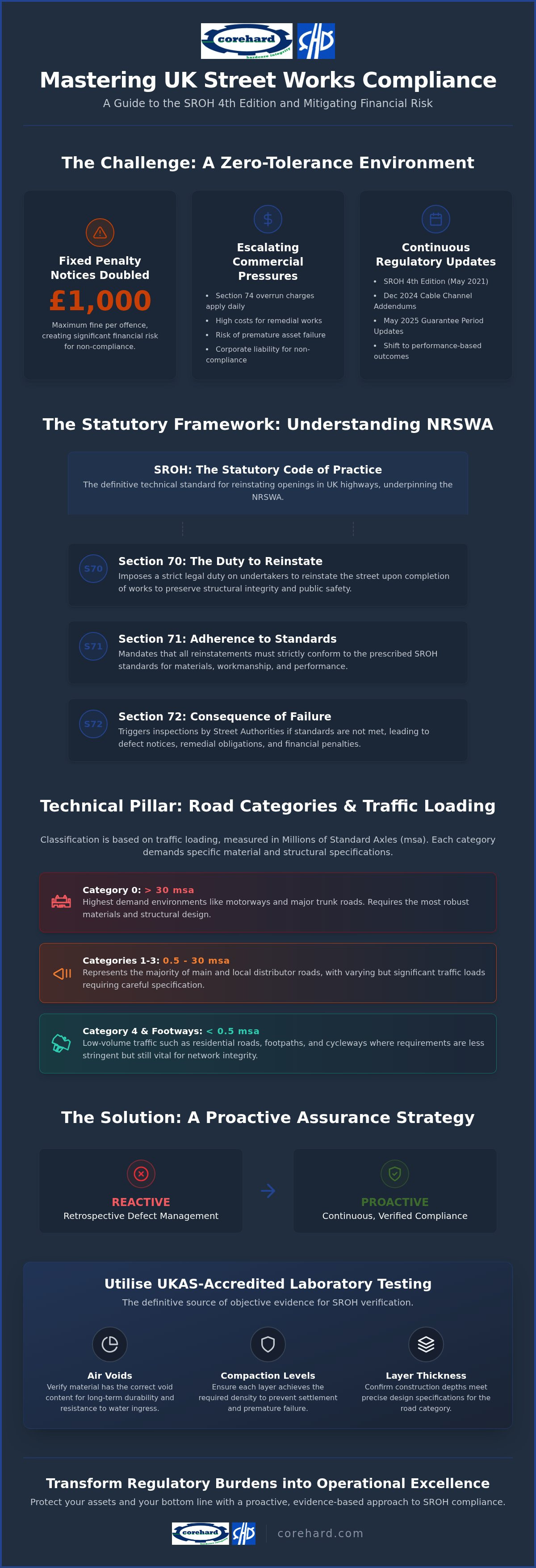
The doubling of Fixed Penalty Notices (FPNs) to a maximum of £1,000 per offence marks a definitive shift towards a zero-tolerance environment for non-compliant street works. You likely understand that managing the complexities of the sroh (Specification for the Reinstatement of Openings in Highways) is no longer just a technical requirement, but a vital commercial safeguard against escalating Section 74 overrun charges and the high remedial costs of premature asset failure. It's a significant challenge to ensure every reinstatement aligns perfectly with the 4th Edition 2020 standards, particularly as new December 2024 addendums regarding cable channels and updated May 2025 guarantee periods continue to reshape the regulatory landscape.
This guide provides the technical clarity needed to transform these regulatory burdens into a streamlined framework for operational excellence. You'll discover the precise standards and statutory obligations required to ensure your reinstatements meet national UK compliance frameworks, effectively reducing your corporate liability through verified quality control and rigorous material testing. We will examine the nuances of road categories, material specifications, and the strategic importance of UKAS-accredited laboratory evidence in securing long-term asset integrity and full NRSWA alignment.
Key Takeaways
- Navigating the statutory requirements of the 4th Edition sroh to ensure full alignment with NRSWA mandates and mitigate the risk of doubled Fixed Penalty Notices.
- Identifying the specific reinstatement demands for Road Categories 0 to 4 and non-carriageway assets to ensure precise material selection and application.
- Implementing rigorous performance monitoring for surface regularity and skid resistance to protect highway integrity and reduce long-term remedial expenditure.
- Adopting a proactive dynamic assurance strategy to shift from retrospective defect management to a model of continuous, verified compliance.
- Utilising UKAS-accredited laboratory testing as a definitive source of objective evidence for air voids, compaction levels, and layer thickness.
Understanding SROH: The Statutory Framework for UK Street Works
The Specification for the Reinstatement of Openings in Highways, universally known as the sroh, functions as the definitive statutory code of practice underpinning the New Roads and Street Works Act 1991 (NRSWA). Its primary purpose involves establishing a uniform set of technical standards that ensure any excavation within the public highway is restored to a condition that preserves both structural integrity and public safety. Whilst the document has undergone several iterations, the transition to the Fourth Edition in May 2020, which achieved full statutory status on 10 May 2021, represents a significant shift towards performance-based outcomes. By governing the technical interface between Street Authorities and Statutory Undertakers, the sroh provides the necessary framework to protect high-value assets managed by entities such as National Highways and local councils. It's a system designed to ensure that the road's lifespan isn't shortened by utility interventions.
The Legal Context of NRSWA Section 70 and 71
Statutory obligations for highway reinstatements are anchored in Sections 70 and 71 of NRSWA. Section 70 imposes a strict duty on undertakers to reinstate the street following the completion of works, whilst Section 71 mandates that such reinstatements must adhere to the prescribed sroh standards for materials and workmanship. Failure to align with these requirements triggers Section 72 inspections, which often lead to costly defect notices and remedial obligations. The financial risk of non-compliance has escalated significantly; Fixed Penalty Notices (FPNs) doubled on 5 January 2026, with maximum penalties reaching £1,000 for certain offences. These penalties, combined with Section 74 overrun charges that now apply to every day of delay, including weekends and bank holidays, make rigorous adherence to the statutory framework a commercial necessity. It isn't just about following rules; it's about protecting the bottom line.
Key Changes in the SROH Fourth Edition
Adopting the Fourth Edition introduced a more flexible, innovation-friendly approach to street works. Instead of relying solely on prescriptive method statements, the current sroh emphasises performance-based outcomes, allowing for the introduction of new materials and techniques such as micro-trenching and large-diameter coring. Recent updates, including the May 2025 clarification on guarantee periods, provide much-needed certainty regarding when a reinstatement's guarantee should be reset following remedial works. This shift from technical rigidity to operational clarity empowers contractors to utilise modern cold-lay materials whilst maintaining the high standards required to prevent premature asset failure. It's a framework that rewards precision and evidence-based quality control over traditional, less efficient methods.
Technical Pillars of Reinstatement: Categories and Materials
Precision in highway reinstatement begins with an accurate classification of the asset, a process governed by the traffic loading it must sustain over its design life. The sroh dictates that every reinstatement must be engineered to withstand the specific stresses of its environment, primarily measured in millions of standard axles (msa). This metric defines the hierarchy of road categories, ensuring that the structural design of the opening matches the surrounding pavement's capability. Without this initial alignment, even high-quality materials will fail to prevent premature subsidence or cracking.
Road Categories and Traffic Loading
Category 0 roads represent the most demanding environments, typically carrying over 30 msa and requiring the most robust material specifications and thickness. Conversely, Category 4 roads serve low-volume traffic under 0.5 msa, where the technical requirements are less stringent but still vital for maintaining local network integrity. Determining the correct category in a live project environment requires a meticulous review of local authority records and traffic data. If you're uncertain about asset classification, seeking expert NRSWA & TMA advisory can prevent the costly error of under-specifying a reinstatement. Traffic loading influences every layer of the build, from the depth of the sub-base to the specific binder course used to distribute weight effectively.
Footways, footpaths, and cycle tracks present their own unique demands. Whilst they don't face the same msa loading as carriageways, they require specific attention to surface regularity and skid resistance to ensure pedestrian and cyclist safety. The Highway Authorities and Utilities Committee (HAUC) provides ongoing guidance on these nuances, helping practitioners navigate the transition between different asset types and their respective reinstatement profiles.
Material Compliance and Specification S6
Achieving long-term stability necessitates a focus on the structural layers, including the sub-base and base. Specification S6 serves as the mandatory guide for material quality, detailing the required properties for all bituminous and cementitious mixtures used in highway reinstatements. Modern street works increasingly utilise innovative cold-lay materials and techniques like micro-trenching to improve efficiency and sustainability. This commitment to environmental standards often extends to the responsible disposal of site waste, where services from Tired Tyres ensure that scrap rubber and industrial materials are managed correctly. However, these materials must still meet the rigorous performance criteria set out in the sroh to avoid premature failure. Whether using traditional Hot Rolled Asphalt (HRA) or advanced geosynthetics to reinforce the sub-structure, every component must be verified against Specification S6 to ensure it provides the necessary load-bearing capacity and durability.
Measuring the long-term success of a reinstatement requires an objective assessment against the performance criteria defined within the sroh, ensuring that the highway's functional characteristics, specifically its safety and durability, aren't degraded by the intervention. A critical component of this framework is the guarantee period, which mandates that the undertaker remains responsible for the reinstatement's performance for two years, or three years in the case of deep excavations exceeding 1.5 metres. This duration provides a sufficient window for any latent defects, such as cumulative settlement or material failure, to manifest and be rectified at the undertaker's expense. It's a standard that prioritises asset longevity over temporary fixes.
Surface Regularity and Intervention Limits
Surface profile standards are designed to maintain a seamless transition between the new work and the existing highway to protect vehicle suspension and pedestrian safety. Practitioners must manage three primary metrics: edge depression, crowning, and surface regularity. Edge depression, the vertical displacement at the join, must not exceed specific technical tolerances, which typically range from 10mm to 15mm depending on the specific road category and edge type. Similarly, crowning, where the reinstatement sits higher than the surrounding surface, must be controlled to prevent drainage issues or trip hazards. Using a standard 2-metre or 3-metre straightedge allows for the precise identification of these deviations. When a profile exceeds these limits, it moves from an acceptable as-laid condition to an intervention level, requiring immediate remedial action to avoid Section 72 defect notices and potential fines.
Skid Resistance and Texture Depth
Maintaining the safety characteristics of the road surface is a non-negotiable requirement, necessitating that the reinstatement provides skid resistance consistent with the surrounding pavement. This factor is determined by the Polished Stone Value (PSV) and Aggregate Abrasion Value (AAV) of the constituent aggregates used in the surface course. High-stress sites, such as approaches to crossings or sharp bends, demand aggregates with superior PSV ratings to withstand the polishing effects of heavy braking and turning. Verifying these properties often requires UKAS accredited highways testing to provide the objective evidence necessary for compliance. Failure to match the skid resistance of the existing surface creates a safety risk and a significant liability for the undertaker if an incident occurs.
Identifying cumulative settlement is essential for assessing the structural health of the reinstatement over its guarantee period, particularly when considering the "bad ground" clause. This clause provides a necessary protection for undertakers when the underlying subgrade is naturally unstable or has been compromised by external factors. If an undertaker can demonstrate that the failure results from these pre-existing conditions rather than poor workmanship, their liability for remedial works may be mitigated. This highlights the importance of conducting thorough site surveys and condition reporting before works commence to establish a baseline of the existing asset's health.
Implementing an SROH Compliance and Assurance Strategy
Transitioning from reactive defect management to a model of proactive dynamic assurance is a strategic imperative for organisations seeking to mitigate the heightened financial risks associated with modern street works. By embedding sroh standards into broader infrastructure asset condition assessments, managers ensure that utility reinstatements don't become the weak link in complex projects, such as PFI street lighting transitions or airfield maintenance. This integrated approach treats every opening as a critical component of the wider highway network rather than an isolated repair, ensuring that short-term utility works don't compromise the long-term structural integrity of the asset.
Dynamic Assurance and Compliance Auditing
Establishing a rigorous, data-driven inspection regime throughout the works lifecycle allows for the early identification of systemic failures in contractor performance. Independent compliance audits provide the objective oversight necessary to reduce Section 74 exposure by ensuring that works are completed correctly the first time. Professional advisory services play a pivotal role here, particularly in large-scale utility rollouts where the volume of reinstatements often overwhelms internal oversight capabilities. By identifying patterns in non-compliance, organisations can implement targeted training for site supervisors, ensuring they possess the technical competence to apply sroh operational principles on the ground. This transition from technical complexity to operational clarity is essential for maintaining a steady hand over difficult regulatory environments.
Managing the Handback Process
Maintaining accurate, verifiable records for the duration of the two-year or three-year guarantee period protects the Street Authority's interests and ensures accountability. The "Condition at end of guarantee period" inspection serves as the final gateway to verifying the asset's health before the undertaker's liability expires. Engaging in strategic NRSWA compliance consultancy provides the expert oversight needed to navigate these technical handovers with confidence. This meticulous process ensures that any latent defects are identified and rectified whilst the responsibility still rests with the undertaker, preserving the highway for its intended design life. Securing your network against these liabilities requires a disciplined approach to oversight, making our specialist Dynamic Assurance & Compliance services a vital component of any risk-mitigation strategy.
The Role of UKAS Accredited Testing in SROH Verification
Achieving full alignment with the sroh requires moving beyond visual inspections towards a regime of empirical verification. Whilst the specification provides the technical blueprint for reinstatements, objective evidence is required to confirm that the as-laid asset meets the mandated performance criteria. Corehard’s UKAS Accredited Testing Laboratory provides this critical layer of oversight, functioning as the definitive source of truth for both contractors seeking to demonstrate quality and local authorities requiring assurance of asset integrity. By replacing subjective assessments with laboratory-certified data, organisations can navigate the transition from technical complexity to operational certainty with absolute confidence.
Technical Laboratory Support for Highways
Verifying the structural integrity of a reinstatement involves a meticulous analysis of material properties that cannot be assessed through surface observation alone. Core sampling of bituminous materials allows for the precise measurement of air voids, compaction levels, and layer thickness, ensuring the build matches the design requirements for the specific road category. Excessive air voids are particularly hazardous, as they facilitate water ingress and accelerate freeze-thaw degradation, leading to premature failure. Beyond the surface, utilising advanced tools such as the PANDA penetrometer enables the assessment of sub-base stability and soil compaction in situ. This level of technical rigour is consistent with the high standards required for airfield infrastructure testing, where the consequences of material failure are similarly severe. Our laboratory services ensure that every layer of the reinstatement, from the sub-grade to the surface course, provides the necessary load-bearing capacity.
Evidence-Based Risk Mitigation
Protecting an organisation against the financial impact of disputed defect notices requires a robust trail of UKAS-accredited documentation. In an environment where Fixed Penalty Notices have doubled and Section 74 charges apply to every day of delay, having independent verification of material compliance is a vital commercial safeguard. These reports confirm that the aggregates used meet the specific Polished Stone Value (PSV) and Aggregate Abrasion Value (AAV) requirements of the road category, effectively mitigating liability in the event of safety-related incidents. Objective evidence derived from UKAS-accredited laboratory testing remains the only certain method to prove definitive sroh alignment in the event of a regulatory dispute. By integrating these testing protocols into the works lifecycle, managers can resolve conflicts with Street Authorities through evidence rather than negotiation, sharpening operational delivery whilst protecting long-term corporate interests.
Securing the Future of Highway Asset Integrity
Mastering the technical and regulatory landscape of street works requires a definitive shift from reactive repair to a disciplined strategy of verified quality. We've examined how the 4th Edition sroh mandates performance-based outcomes that demand precise material selection and rigorous surface monitoring across all road categories. By adopting a model of dynamic assurance, organisations can effectively neutralise the escalating risks of doubled Fixed Penalty Notices and the high remedial costs associated with premature asset failure. Achieving this level of operational clarity relies on objective evidence, ensuring that every reinstatement contributes to the longevity of the UK's strategic infrastructure rather than compromising it.
Corehard provides the steady hand needed to navigate these high-stakes environments, offering a UKAS Accredited Testing Laboratory and expert NRSWA & TMA compliance advisory to support national strategic infrastructure. Our methodology simplifies complex transitions, giving you absolute control over your regulatory obligations and technical delivery. Contact Corehard today for expert SROH advisory and UKAS-accredited testing services and ensure your street works meet the highest standards of national compliance. We look forward to helping you protect your assets with precision and authority.
Frequently Asked Questions
What is the SROH Fourth Edition and when did it become mandatory?
The 4th Edition of the sroh is the current statutory code of practice for UK street works, officially replacing the 3rd edition on 10 May 2021. It introduces performance-based standards and accommodates modern techniques like micro-trenching. This version remains the definitive framework for all utility companies and entities conducting excavations in public highways. Adhering to these updated guidelines is mandatory to ensure reinstatements meet national compliance levels and avoid doubled Fixed Penalty Notices.
How do road categories 0-4 affect the reinstatement requirements?
Road categories are determined by traffic loading measured in millions of standard axles (msa), with Category 0 representing high-traffic routes and Category 4 serving low-volume local roads. These classifications dictate the specific material types, layer thicknesses, and compaction levels required for a compliant reinstatement. Higher categories demand more robust bituminous mixtures to withstand significant structural stress. Accurate classification during the planning phase is essential to prevent premature asset failure and ensure long-term structural integrity.
What is the standard guarantee period for a street works reinstatement?
The standard guarantee period for a highway reinstatement is two years from the date of completion, extending to three years for deep excavations exceeding 1.5 metres. During this window, the undertaker remains liable for any defects, such as subsidence or surface irregularities, that fall below sroh performance limits. It's vital for authorities to conduct "Condition at end of guarantee period" inspections to identify latent failures before the liability period expires and responsibility shifts to the highway authority.
Can cold-lay materials be used for permanent reinstatements under SROH?
Cold-lay materials can be utilised for permanent reinstatements provided they meet the rigorous performance criteria and material specifications outlined in the sroh. Recent updates in May 2025 clarified the specific circumstances under which these innovative materials are acceptable, particularly in footways or low-traffic environments. Whilst they offer operational efficiency, their use must be backed by technical data confirming they provide equivalent durability and stability to traditional hot-mix alternatives to ensure long-term compliance.
What are Section 74 charges and how does SROH compliance help avoid them?
Section 74 charges are financial penalties imposed on undertakers for street works that exceed their agreed duration, and as of January 2026, these charges apply to every day of delay, including weekends. Rigorous sroh compliance helps avoid these costs by ensuring reinstatements are completed correctly the first time, preventing delays caused by failed inspections or remedial works. Implementing a proactive dynamic assurance strategy ensures that technical standards are met within the permitted timeframe, protecting your project's budget.
Why is skid resistance testing important for SROH compliance?
Skid resistance testing is a non-negotiable safety requirement that ensures a reinstatement matches the frictional characteristics of the surrounding road surface. This process involves verifying the Polished Stone Value (PSV) and Aggregate Abrasion Value (AAV) of the surface course aggregates to prevent creating localised hazards. Failure to maintain these safety standards can lead to increased accident risks and significant corporate liability. Independent testing provides the objective evidence needed to prove that materials meet the specific demands of the road category.
What happens if a reinstatement fails during the guarantee period?
If a reinstatement fails to meet performance standards during its guarantee period, the undertaker is legally obligated to carry out remedial works at their own expense. Following these repairs, the guarantee period may be reset, a process clarified by the May 2025 update to the sroh guidance. Failure to address these defects promptly can result in Section 72 notices and escalating financial penalties. Managing this risk requires meticulous record-keeping and regular asset inspections throughout the liability window.
How does UKAS accredited testing support SROH compliance?
UKAS accredited testing provides the independent, empirical evidence required to verify that reinstatements meet all technical material properties, such as air voids and compaction levels. This level of laboratory support is essential for resolving disputes with Street Authorities and defending against defect notices with objective data. By utilising a UKAS-accredited facility like Corehard’s, organisations can demonstrate a commitment to rigorous quality control. This evidence-based approach transforms technical complexity into a clear, defensible record of regulatory alignment and operational excellence.


