

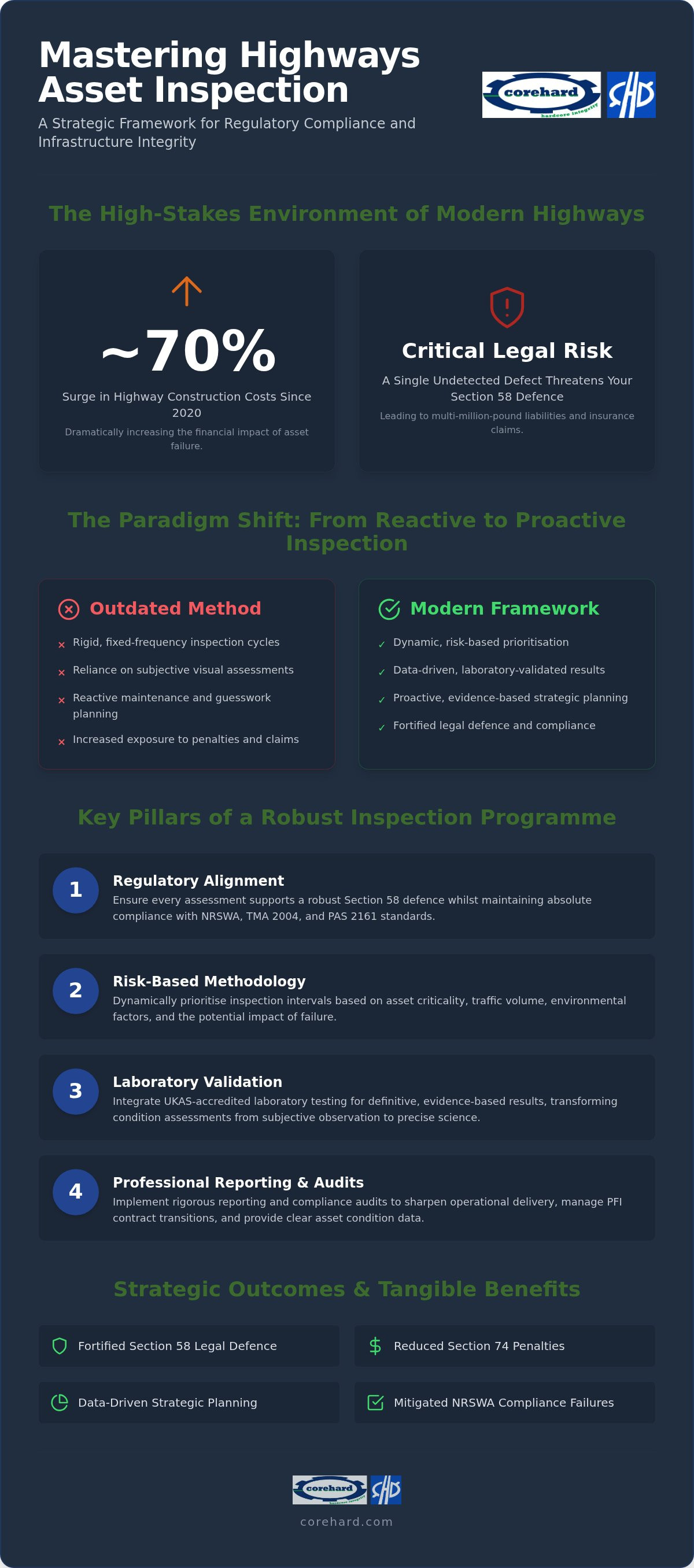
A single undetected defect within a high-speed carriageway is more than a simple maintenance oversight; it represents a multi-million-pound liability that threatens to dismantle a Section 58 defence. As highway construction costs have surged by approximately 70% since 2020, the margin for error in your highways asset inspection programme has effectively vanished. You likely recognise the frustration of managing inconsistent data from subjective visual assessments, alongside the looming pressure of PFI contract expiries and PAS 2161 reporting requirements that demand absolute clarity.
This guide provides the strategic framework required to master rigorous inspection protocols, ensuring your authority achieves full regulatory compliance and long-term infrastructure integrity. By implementing a robust, risk-based framework, you'll secure high-quality condition data that transforms strategic planning from guesswork into a precise science. We will explore the transition from reactive reporting to a laboratory-validated approach that reduces Section 74 penalties, mitigates the risk of NRSWA compliance failures, and fortifies your position against insurance claims.
Key Takeaways
- Aligning your inspection protocols with the UK regulatory landscape ensures that every assessment supports a robust Section 58 defence while maintaining absolute legal compliance.
- Adopting a sophisticated, risk-based methodology allows for the dynamic prioritisation of inspection intervals based on asset criticality and the potential impact of failure.
- Identifying the specific operational triggers for technical assessments enables the integration of UKAS-accredited laboratory testing into your highways asset inspection for definitive, evidence-based results.
- Implementing professional reporting and compliance audits serves to sharpen operational delivery, reduce Section 74 penalties, and manage the complex transition of PFI street lighting contracts.
- Recognising the strategic value of independent specialist advisory services provides the objective evidence and technical mastery required to manage difficult regulatory environments with confidence.
Understanding the Framework for Highways Asset Inspection
Establishing a professional highways asset inspection regime requires a deep understanding of the UK's intricate legislative environment. It isn't merely an operational necessity; it's a statutory imperative that safeguards public funds and infrastructure longevity. Central to this is the framework for infrastructure asset management, which provides the principles for balancing risk, cost, and performance across the network. Within this context, the New Roads and Street Works Act (NRSWA) acts as a primary shield, regulating utility interventions to prevent premature asset degradation and ensuring that reinstatements meet rigorous national standards.
Alignment with the Traffic Management Act (TMA) 2004 is equally vital. It ensures that inspection activities don't unnecessarily impede network fluidity whilst maintaining safety standards. As we move through 2026, the transition to the "Well-Managed Highway Infrastructure" code has become critical for every authority. This shift moves the industry away from prescriptive, one-size-fits-all intervals toward a risk-based approach that demands more sophisticated data collection. Local authorities in England must now also adhere to PAS 2161 standards when submitting road condition data, ensuring a level of technological consistency that was previously absent from the reporting cycle.
Regulatory Obligations and Legal Compliance
Highway Authorities hold a non-delegable duty under the Highways Act 1980 to maintain the public right of way in a safe condition. The legal weight of Section 58 of this Act cannot be overstated. It provides a statutory defence against "non-feasance" claims, provided the authority can prove it had taken such care as was reasonably required to secure that the highway was not dangerous to traffic. Professional highways asset inspection protocols are the bedrock of this defence. Without rigorous, documented inspection records, authorities face significant exposure to third-party liability and escalating insurance claims that could otherwise be mitigated through disciplined data capture.
Asset Categorisation: Carriageways, Footways, and Structures
Effective management begins with precise asset categorisation. Assets are classified based on a hierarchy that reflects usage volume, strategic importance, and local resilience factors. A primary distributor road carries different risk profiles compared to a residential footway, necessitating distinct inspection frequencies and methodologies. Routine safety inspections focus on identifying immediate hazards, whereas detailed condition assessments provide the longitudinal data required for long-term investment planning. Maintaining a consistent asset inventory is fundamental to this process. It ensures that every element, from structural embankments to pavement markings, is accounted for within the strategic maintenance cycle, allowing for a proactive rather than reactive approach to infrastructure care.
Establishing a Risk-Based Inspection Methodology
Transitioning from rigid, fixed-frequency cycles to a dynamic, risk-based highways asset inspection methodology is a core requirement for modern infrastructure resilience. Unlike traditional models that apply uniform schedules across all road types, a risk-based framework assesses the probability and consequence of failure for each specific asset. This process involves setting precise investigatory levels where the condition of a carriageway or structure triggers a formal review before it reaches a point of failure. Integrating traffic loading data and environmental factors, such as local flooding history or extreme temperature fluctuations, allows for a more sophisticated risk profile. This alignment with the Federal Highway Administration's asset management practices ensures that your authority's approach remains consistent with international standards for infrastructure oversight.
Step 1: Asset Identification and Hierarchy Mapping
Success begins with assigning a meticulous hierarchy to every footway and carriageway segment within the network. This isn't a static list; it's a living map that incorporates public usage data, emergency service routes, and strategic importance to the local economy. Establishing this baseline for condition reporting ensures that resources are directed where they're most needed. By mapping these dependencies, authorities can justify inspection intervals that deviate from the norm, provided they're backed by objective evidence and a clear understanding of asset criticality.
Step 2: Defining Defect Categories and Response Times
Defects must be categorised with absolute precision to ensure legal defensibility. Category 1 defects, which pose an immediate hazard to users, require rapid intervention, whilst Category 2 defects are monitored or scheduled for planned maintenance based on their severity. Setting defensible response times is essential for maintaining a Section 58 defence. Utilising Dynamic Assurance and Compliance protocols allows for the real-time monitoring of streetworks, ensuring that utility interventions don't compromise the integrity of the existing asset or lead to premature failure.
Step 3: Data Capture and Digital Record Keeping
Modern highways asset inspection demands more than a clipboard and a pen. Every inspection must generate GPS-tagged and time-stamped digital evidence to ensure data integrity during potential legal challenges or insurance claims. This granular level of detail is vital for long-term trend analysis. Asset management software can then process this data to predict future deterioration patterns, allowing for strategic budget allocation. Reliable data capture is the only way to move from reactive patching to a proactive, evidence-led maintenance programme that protects both the public and the authority's reputation.
Conducting Technical Condition Assessments and Laboratory Validation
Visual surveys form the initial layer of any highways asset inspection, but they frequently fail to capture the structural reality hidden beneath the surface. Relying solely on the human eye introduces subjectivity and leaves authorities vulnerable to undetected systemic failures that visual checklists simply cannot identify. Technical testing becomes a mandatory trigger when visual markers suggest subsurface instability or when high-risk assets, such as primary distributors, require definitive life-cycle analysis. Utilising a UKAS Accredited Testing Laboratory provides the objective evidence required to defend against litigation and verify contractor performance. This independent validation is essential for infrastructure assurance, moving beyond descriptive observations to empirical data that stands up in a court of law or during a PFI contract expiry negotiation.
Slip Resistance and Surface Friction Testing
Maintaining public safety requires more than just a level surface; it demands adequate friction to prevent incidents. Our Slip Resistance Testing services utilise the pendulum method to provide accurate Pendulum Test Values (PTV), which are critical for assessing the risk of pedestrian slips or vehicular skids. Identifying surface wear early allows for targeted interventions in high-traffic urban centres, directly reducing the authority's liability risk. It's a proactive step that ensures alignment with the "Well-Managed Highway Infrastructure" code whilst providing a clear audit trail for public safety compliance.
Sub-Surface Investigation using PANDA Penetrometers
Traditional coring is often too destructive or slow for rapid network-wide assessments of foundation strength. PANDA Penetrometer Hire offers a sophisticated alternative for evaluating soil compaction and layer thickness without compromising the pavement's structural integrity. This dynamic probing technology identifies hidden structural failures and voids before they manifest as costly surface expressions. It's an indispensable tool for verifying the compaction quality of utility reinstatements, ensuring they meet the required Specification for the Reinstatement of Openings in Highways (SROH) with absolute certainty.
Material Analysis and Asphalt Testing
Verifying that asphalt and binder quality meets national standards is a cornerstone of professional asset management. UKAS-accredited highways testing ensures that the materials used in both planned maintenance and utility streetworks are fit for purpose and durable. By conducting rigorous material analysis, authorities can validate that reinstatements aren't just aesthetically acceptable but are structurally sound. This level of technical oversight is a powerful tool for Section 74 mitigation, providing the empirical proof needed to challenge substandard workmanship. Integrating these technical assessments into your highways asset inspection regime ensures that every pound spent on the network is backed by verified material performance.
Implementing Professional Reporting and Compliance Audits
The culmination of a rigorous highways asset inspection is the delivery of a professional condition report that serves as a definitive record of network health. A structured report must move beyond simple observations, providing a detailed analysis of asset residual life, structural integrity, and regulatory alignment. For authorities managing utility interventions, performance reporting is the primary tool for ensuring NRSWA compliance. By conducting systematic streetworks compliance audits, authorities can identify patterns of substandard workmanship before they escalate into long-term maintenance liabilities. This level of oversight is particularly effective in mitigating Section 74 charges, as it provides the empirical evidence required to challenge overrun claims with absolute certainty.
Reporting for PFI Street Lighting Expiry
Managing the transition of PFI street lighting contracts requires a meticulous approach to asset surveys and condition reporting. As these long-term agreements approach their expiry, authorities must prepare for the handback of thousands of individual assets, many of which may harbour latent defects. Utilising independent data during this phase is essential for negotiating favourable expiry terms and ensuring that succession contracts aren't burdened by historical neglect. Our Street Lighting PFI Transition Advisory services provide the technical oversight needed to verify that every lighting column and electrical component meets the agreed handback standards.
Audit Trails for Legal and Regulatory Defence
Establishing a "Golden Thread" of inspection data is the only way to ensure a robust legal and regulatory defence in the event of third-party disputes. This involves creating a continuous, verifiable record that links initial safety inspections to technical assessments and final remedial actions. Professional reports must meet the exacting requirements of civil engineering technical advisory standards to be considered legally defensible. Independent verification acts as a safeguard, providing an objective layer of assurance that in-house monitoring often lacks. This disciplined approach to record-keeping protects the authority from the financial and reputational risks associated with undetected defects or failed compliance regimes.
Partnering for Strategic Infrastructure Assurance
Securing long-term network resilience requires a move away from fragmented, in-house monitoring toward a model of independent specialist advisory. Whilst internal teams possess valuable local knowledge, they often lack the technical depth or laboratory resources required to challenge utility performance or manage complex contract expiries with absolute objectivity. Partnering with a specialist entity ensures that your highways asset inspection data is not only accurate but strategically aligned with broader corporate governance goals. This independence provides the verified evidence needed to manage difficult regulatory environments, such as the transition from PFI street lighting contracts or the implementation of a Lane Rental Scheme.
Integrating Lane Rental Operational Services with periodic asset inspections creates a powerful synergy for high-traffic corridors. This approach ensures that the revenue generated from lane rentals is reinvested into the network with surgical precision, targeting assets that show early signs of fatigue. Given that highway construction costs have surged by approximately 70% since 2020, the financial argument for proactive condition assessments has never been more compelling. Identifying a sub-surface void or a failing binder course today prevents a catastrophic failure tomorrow, shielding the authority from the escalating costs of emergency repairs and third-party claims.
Choosing an Independent Laboratory for Roadworks
Selecting a partner with a UKAS Accredited Testing Laboratory is the non-negotiable benchmark for infrastructure assurance. UKAS accreditation guarantees that the testing methodologies used for slip resistance, material analysis, and soil compaction are rigorous, repeatable, and legally defensible. Corehard’s approach to independent testing bridges the gap between raw technical data and strategic decision-making. We provide the steady hand needed to navigate complexity, ensuring that your asset condition reporting is grounded in empirical truth rather than subjective visual estimates. This national strategy for reporting creates a consistent standard of excellence across your entire infrastructure portfolio.
Next Steps: Developing Your Inspection Strategy
Initiating a comprehensive asset survey and condition report is the first step toward reclaiming control over your network’s future. By leveraging our NRSWA & TMA Advisory services, you can sharpen your operational delivery and ensure that every utility intervention is monitored with meticulous care. Whether you require PANDA penetrometer hire for rapid site investigations or a full street lighting PFI transition audit, our team provides the technical mastery required for success. Contact Corehard today to discuss how our specialist advisory and UKAS-accredited testing can fortify your highways asset inspection framework and deliver verified, long-term results for your authority.
Securing the Future of Your Infrastructure Network
The transition from subjective visual checklists to a data-driven, risk-based highways asset inspection regime is no longer optional for authorities seeking long-term resilience. By integrating UKAS-accredited laboratory testing with rigorous reporting standards, you transform raw infrastructure data into a powerful tool for strategic governance and legal defence. This methodology ensures that every intervention on the network, from utility reinstatements to PFI handbacks, is validated against objective evidence. It's the only way to effectively mitigate Section 74 penalties whilst protecting the structural integrity of your most valuable assets.
Aligning your operational delivery with a specialist partner provides the steady hand needed to navigate an increasingly complex regulatory landscape. As NRSWA and TMA compliance specialists, we offer a national specialist advisory service that bridges the gap between field data and corporate oversight. Independent verification remains your strongest asset when you're managing the delicate expiry of street lighting contracts or developing a robust compliance strategy. Take the first step toward definitive infrastructure assurance today. Contact Corehard for Specialist Highways Asset Inspection and UKAS Accredited Testing to secure the reliability and safety of your network for years to come.
Frequently Asked Questions
What are the three main types of highway inspections?
Safety inspections identify immediate hazards that pose a risk to users. Service inspections assess the network's operational performance and long-term viability. Structural condition surveys provide the deep-dive data needed for strategic maintenance planning. Together, they form a comprehensive highways asset inspection framework that ensures regulatory compliance and public safety. These categories allow authorities to move from a reactive posture to a proactive strategy that prioritises resources based on actual network need.
How often should highways asset inspections be carried out?
Inspection frequencies aren't fixed; they're determined by an authority's risk-based assessment under the Well-Managed Highway Infrastructure code. Factors include road hierarchy, traffic volume, and local incident history. High-traffic distributor roads may require monthly safety checks, whilst quiet residential cul-de-sacs might only be inspected annually. This dynamic approach ensures resources are allocated to the areas of highest risk, maintaining network safety whilst optimising limited maintenance budgets.
What is the difference between a safety inspection and a condition survey?
Safety inspections are reactive and focused on identifying defects that pose an immediate danger to users, such as deep potholes or loose kerbs. In contrast, a condition survey is a strategic, data-driven assessment of an asset's structural health. It evaluates the residual life of the pavement or structure, providing the evidence-based insights required for multi-year investment planning and lifecycle management. Condition surveys offer the clarity needed for long-term governance.
Why is UKAS accreditation important for highways testing?
UKAS accreditation provides independent verification that a laboratory operates to the highest international standards of technical competence. For a highways asset inspection, this ensures that data regarding slip resistance or material quality is accurate and legally defensible. Results from an accredited facility carry significant weight during third-party disputes or insurance claims. It's the benchmark that guarantees the technical mastery required for high-stakes infrastructure assurance and regulatory compliance.
How can asset inspections help with Section 74 mitigation?
Rigorous inspection protocols allow authorities to monitor utility streetworks with precision. By documenting the exact condition of a site before and after works, authorities can identify overruns or substandard reinstatements immediately. This empirical evidence is essential for issuing and defending Section 74 charges. It ensures that utilities are held financially accountable for network occupations that exceed agreed durations, protecting both the budget and the asset's structural integrity.
What role does the PANDA penetrometer play in asset inspection?
The PANDA penetrometer is a lightweight, dynamic probing tool used to assess the compaction and thickness of pavement layers. It allows for rapid, non-destructive site investigations that identify hidden structural voids or weak subgrades. By utilising this technology, inspectors can verify the quality of utility reinstatements or investigate the causes of surface subsidence without the need for traditional, time-consuming core sampling. It's an indispensable tool for modern infrastructure validation.
How should local authorities manage PFI street lighting expiry?
Authorities should initiate independent condition reporting well in advance of the contract end date. This process identifies latent defects and ensures that assets are returned in the contractually agreed condition. Professional advisory services help bridge the gap between technical data and legal negotiations. It's the only way to protect the authority from inheriting significant maintenance backlogs or safety liabilities as the PFI transition concludes, ensuring a smooth handback process.
What is the "investigatory level" in a highway pavement investigation?
An investigatory level is a specific performance threshold, such as a minimum skid resistance value or a maximum rut depth, that triggers a formal assessment. It doesn't necessarily indicate an immediate failure but serves as an early warning system. Once an asset reaches this level, a specialist must determine if remedial work is required to prevent it from becoming a safety hazard. This ensures that maintenance is targeted, evidence-based, and prioritised effectively.


