

How many infrastructure managers can confidently assert that their highway assets are fully shielded from the escalating financial impact of Section 74 penalties and the structural risks of substandard workmanship? The persistent complexity of navigating the New Roads and Street Works Act (NRSWA) often results in a fragmented approach to quality control, where road reinstatement compliance testing is viewed as a mere administrative hurdle rather than a critical safeguard for asset longevity. You're likely all too familiar with the operational strain caused by inconsistent reinstatement standards and the subsequent premature failure of highway surfaces that should've remained durable for decades.
This technical guide promises to transform that regulatory burden into a structured framework for excellence, offering the precise insights required to achieve full alignment with Specification for the Reinstatement of Openings in Highways (SROH) standards. We'll explore the sophisticated methodologies behind statutory inspections and condition reporting, providing a clear roadmap for successful asset handback and long-term succession planning. By the end of this analysis, you'll possess the technical mastery to reduce defect risks and ensure every intervention on your network contributes to a robust, compliant, and sustainable infrastructure legacy.
Key Takeaways
- Aligning with NRSWA 1991 ensures that all highway interventions prioritise long-term pavement integrity and regulatory compliance.
- Mastering technical benchmarks defined within the SROH framework allows for the accurate evaluation of surface profile, regularity, and settlement performance.
- Implementing UKAS accredited road reinstatement compliance testing secures the independent, objective evidence necessary for high-stakes infrastructure handbacks.
- Mitigating financial risks associated with Section 74 penalties requires systematic compliance audits that identify and resolve systemic streetworks failures.
- Transitioning from reactive maintenance to a strategic asset inspection model utilises professional advisory services to enhance network durability and asset life cycles.
The Strategic Role of Condition Assessment for Highways
Condition assessment for highways functions as a rigorous, evidence-based protocol designed to evaluate the structural integrity and regulatory alignment of pavement assets. Rather than treating inspections as isolated events, sophisticated asset managers utilise these assessments to ensure absolute compliance with the New Roads and Street Works Act (NRSWA) 1991. This legislation mandates that all undertakers perform reinstatements to a specific standard, making road reinstatement compliance testing an indispensable component of any quality assurance framework. By adopting a proactive stance on asset condition reporting, authorities can identify latent defects before they escalate into premature failures, effectively extending the lifecycle of the highway network whilst maintaining public safety. This strategic shift from reactive patching to lifecycle-oriented management is what separates high-performing networks from those plagued by recurring defects.
The Interplay Between NRSWA and TMA Regulations
Statutory duties defined under NRSWA and the Traffic Management Act (TMA) 2004 dictate the frequency, methodology, and rigour of highway inspections. Whilst NRSWA focuses primarily on the technical quality of the works, the TMA 2004 introduces a layer of operational oversight intended to reduce network disruption and manage congestion. It's vital to recognise the legal distinction between a standard visual inspection and a technical condition assessment; the latter involves objective data collection and laboratory-backed evidence that stands up to legal scrutiny. The Street Works (Registers, Notices, Directions and Designations) Regulations further formalise this process, requiring precise coordination and notification to ensure that every intervention is documented and verified against national benchmarks. Failure to align these two regulatory pillars often results in administrative friction and missed opportunities for quality intervention.
Economic Drivers for Rigorous Highway Assessment
Precise reporting provides a formidable defence against the escalating costs of Section 74 overstay charges, which can severely impact project budgets if left unmanaged. Implementing a regime of road reinstatement compliance testing during the initial guarantee period allows authorities and contractors to identify substandard workmanship before the liability shifts back to the public purse. This technical foresight ensures that defects are rectified at the undertaker's expense, preserving the capital value of the asset and preventing the "reinstatement tax" of early-onset fatigue. Independent assurance remains the cornerstone of successful local authority handback procedures. It provides the verified certainty needed to transition responsibility without inheriting unforeseen financial liabilities or structural weaknesses that were masked by superficial finishes. Ultimately, the cost of a comprehensive assessment is a fraction of the expense incurred by a single premature pavement failure.
Technical Standards and the SROH Compliance Framework
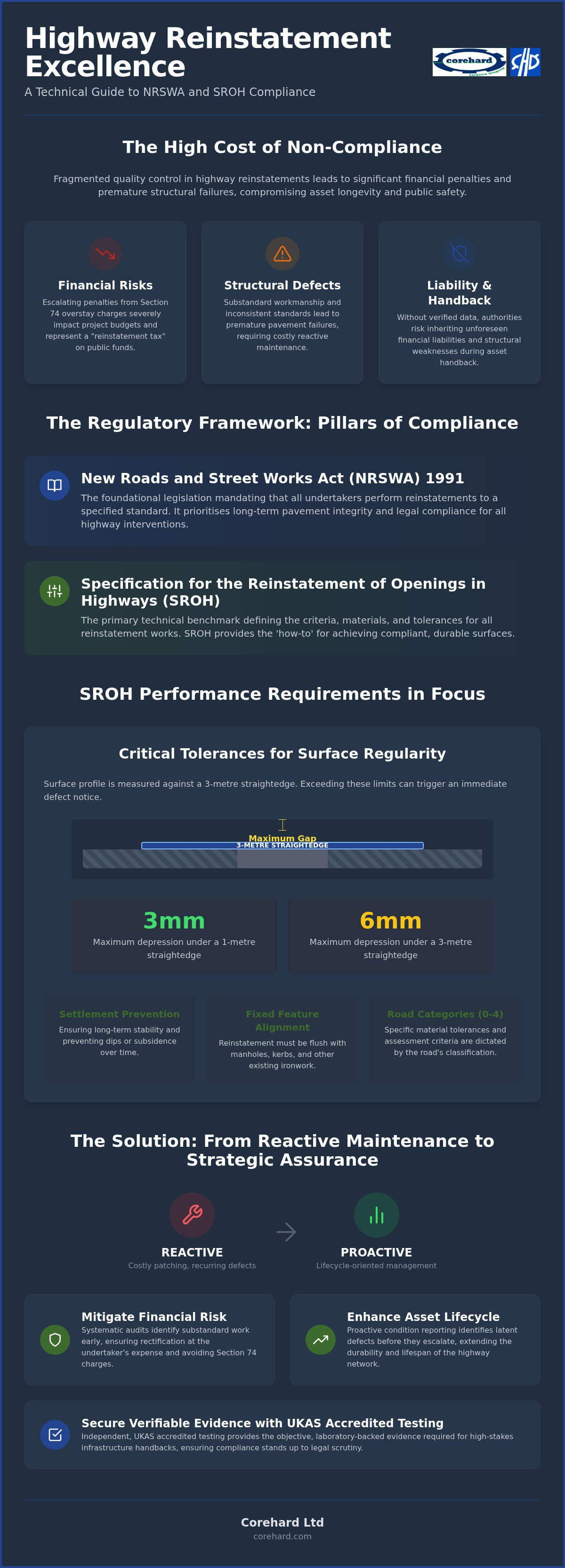
Performance standards under SROH focus heavily on surface regularity, fixed feature alignment, and the prevention of settlement. Tolerances for surface profile are exacting; for instance, the 3mm and 6mm regularity limits are critical benchmarks that, if exceeded, can trigger an immediate defect notice. The relationship between the reinstatement and the surrounding surface must be seamless to prevent trip hazards and structural water ingress. Skid resistance testing also plays a vital role in safety compliance, particularly on high-speed or high-risk sections of the network. These requirements are underpinned by mandatory guarantee periods, typically lasting two years for shallow excavations and up to three years for deep openings, during which the undertaker remains responsible for any failures.
Material Compliance and Specification Alignment
Achieving full compliance requires meticulous attention to the constituent layers of a reinstatement, from the backfill and sub-base to the final road base materials. Every layer must meet specific compaction and material quality standards to ensure the structural stability of the pavement. For those seeking to innovate, the process for verifying Alternative Reinstatement Materials (ARMs) offers a pathway to use sustainable or faster-setting products, provided they meet the rigorous equivalence tests set out in the code. Navigating these complexities often requires specialist NRSWA and TMA development advisory to ensure that civil engineering projects remain fully compliant from inception to handback. Rigorous road reinstatement compliance testing acts as the final verification step, confirming that the physical output matches the theoretical specification and protecting the asset from the risks of sub-standard material application.
UKAS Accredited Methodologies for Road Reinstatement Compliance Testing
Utilising a UKAS Accredited Testing Laboratory is non-negotiable for stakeholders who require absolute certainty in their data. Independent verification provides the objective evidence needed to settle disputes and confirm that contractors have met their statutory obligations. This level of technical support is essential across diverse environments, from standard streetworks to the high-stress requirements of airfield infrastructure. By integrating road reinstatement compliance testing into the project lifecycle, managers can ensure that every material layer performs as specified. It's the only way to guarantee that technical actions align with high-level strategic outcomes for the network.
Public safety hinges on the frictional characteristics of the finished surface. Slip resistance testing measures the micro-texture and macro-texture of the pavement, ensuring it provides adequate grip for all road users. This is particularly vital in high-risk areas such as pedestrian crossings or high-speed junctions where the consequences of surface failure are severe. Rigorous testing protocols ensure that these surfaces remain compliant throughout their intended lifespan, protecting both the public and the authority's reputation.
In-Situ Testing and Site Investigation Techniques
High-resolution site investigations often employ the PANDA penetrometer to assess soil strength and compaction levels in real-time. Choosing a PANDA penetrometer hire service allows site teams to perform rapid, non-destructive verification without the delays of traditional trial holes. Dynamic assurance for streetworks enables a move away from retrospective corrections toward a model of continuous quality monitoring. It's a disciplined approach that identifies compaction issues before the final surfacing is applied. This immediate feedback loop is essential for maintaining the momentum of major infrastructure projects whilst ensuring that quality standards aren't sacrificed for speed.
Laboratory Analysis of Pavement Materials
Asphalt testing and pavement material investigations provide a deeper look at the constituent properties of the road. Geotechnical testing for soil compaction and sub-base integrity ensures that the foundation of the reinstatement is capable of supporting traffic loads over the long term. Every assessment culminates in a detailed condition assessment report. This document must include UKAS-stamped results, site photographs, and clear technical summaries to satisfy local authority handback requirements. Comprehensive Asset Surveys & Condition Reporting provide the final layer of clarity needed for strategic network management, turning raw data into actionable intelligence.
Managing Compliance Risks and Section 74 Mitigation
Managing compliance risks requires a disciplined approach to oversight that extends beyond simple visual checks. Non-compliant road reinstatements introduce significant structural vulnerabilities, leading to water ingress and accelerated pavement fatigue. These technical failures often stem from systemic issues in the streetworks programme that only a rigorous compliance audit can uncover. Whilst in-house monitoring may seem cost-effective, it often lacks the necessary objectivity to challenge utility undertakers effectively. Independent asset surveys provide the unbiased, evidence-based reporting required to inform strategic decision-making and protect the highway authority’s long-term interests. By integrating road reinstatement compliance testing into a broader risk management framework, authorities can ensure that every intervention on their network adheres to the highest quality standards.
Strategies for Section 74 Penalty Mitigation
Section 74 of the NRSWA 1991 allows highway authorities to charge undertakers for occupation of the highway that extends beyond the agreed duration. These charges are often triggered by a failure to submit accurate registration notices or by leaving equipment on-site after works have concluded. The financial impact can be severe, particularly on high-traffic routes where daily rates are at their peak. Specialist compliance auditing identifies these overstays in real-time, providing the documentation needed to justify charges or, conversely, to help undertakers identify grounds for mitigation when delays are beyond their control. Accurate notice management, supported by photographic evidence and timestamped data, remains the most effective defence against disputed penalties. Beyond the immediate scope of streetworks, administrative bottlenecks often affect broader transport services; for example, you can learn more about why scheduling certain road-related tests can be particularly challenging in high-demand regions.
Identifying and categorising reinstatement defects is a precise technical exercise governed by statutory timeframes. Whether a defect is classified as a safety issue (Category 1) or a structural failure (Category 2), the process for managing remedial works must be handled with meticulous care. Specialist advisory services play a vital role here, acting as a technical mediator to resolve disputes between authorities and utilities regarding the root cause of a failure. This objective oversight ensures that remedial actions are proportionate and technically sound, preventing a cycle of repeated failures. To secure your network against these operational risks, professional NRSWA & TMA Advisory provides the steady hand needed to navigate regulatory complexity with confidence.
Implementing a National Highway Asset Inspection Strategy
Transitioning from reactive maintenance to a national highway asset inspection strategy marks a fundamental shift in how infrastructure is preserved and managed. Instead of responding to surface failures after they manifest, strategic asset condition reporting allows for the anticipation of structural decline through methodical data collection. This proactive methodology relies on consistent evidence, where road reinstatement compliance testing provides the granular detail needed to validate the performance of third-party works. For local authorities, this framework offers a standardised approach to highways advisory, ensuring that national benchmarks for safety and durability are met with uniform rigour across the entire network. Corehard Ltd positions itself as the strategic partner in this process, providing the technical mastery required to transform regulatory complexity into operational clarity.
Developing a Robust Handback and Succession Plan
The complexities surrounding PFI street lighting expiry and asset handback represent a significant operational challenge for authorities nearing the end of long-term contracts. Verifying the actual state of the asset at the point of transfer is essential to prevent the inheritance of unquantified financial or structural liabilities. Comprehensive condition assessments serve as the definitive record of asset health, ensuring that the infrastructure returned to the public sector meets the specific standards defined at the contract’s inception. Detailed reporting protects the public interest by identifying necessary remedial works before the provider's obligation ceases, providing a clear roadmap for future succession planning and capital investment.
The Future of Highway Compliance and Digital Assurance
Digital reporting and real-time data are sharpening operational delivery, allowing for more agile responses to network challenges and regulatory shifts. Whilst adopting new technologies is vital for efficiency, maintaining professional standards through rigorous, evidence-based methodology remains the absolute priority. The integration of road reinstatement compliance testing into digital asset management systems ensures that technical quality is verified at every stage of the project lifecycle. This disciplined approach to digital assurance creates a transparent narrative of compliance that satisfies both auditors and stakeholders. By combining independent UKAS accredited testing with specialist advisory, we ensure your infrastructure remains compliant, safe, and resilient against future demands.
Contact Corehard Ltd for Specialist Advisory and UKAS Accredited Testing to secure the long-term integrity of your highway network.
Securing the Future of Highway Infrastructure Integrity
Maintaining a resilient highway network requires a decisive shift from superficial monitoring to a framework of rigorous technical oversight. Establishing a robust evidence base through independent asset condition reporting ensures that every intervention aligns with statutory SROH benchmarks; this effectively insulates authorities from the structural risks and financial liabilities of latent defects. By prioritising road reinstatement compliance testing, infrastructure managers move beyond the administrative friction of Section 74 penalties and achieve a state of permanent regulatory alignment. This methodical approach to quality assurance doesn't just satisfy immediate legal duties; it safeguards the long-term durability of the entire pavement asset.
Managing the evolving complexities of NRSWA and TMA obligations demands a partner who provides both technical precision and strategic clarity. Corehard Ltd acts as a guardian of quality, utilising our UKAS accredited laboratory and specialist NRSWA & TMA advisory to deliver certain, objective results that stand up to the most demanding scrutiny. Consult Corehard Ltd for Specialist NRSWA Compliance and UKAS Accredited Testing to begin the transition toward a more secure and professionally managed infrastructure legacy. Your commitment to excellence today ensures a safer network for decades to come.
Frequently Asked Questions
What is the difference between a highway inspection and a condition assessment?
A highway inspection typically refers to the statutory, visual monitoring of a network to identify immediate safety hazards or surface defects. In contrast, a condition assessment is a technical, data-driven evaluation of the pavement’s structural integrity and remaining life. Assessments involve objective measurements and laboratory analysis to determine if the asset meets specific performance benchmarks, providing a deeper level of insight than the routine observations found in standard inspection regimes.
Why is UKAS accreditation essential for road reinstatement compliance testing?
UKAS accreditation provides the necessary assurance that road reinstatement compliance testing is conducted within a framework of absolute technical competence and impartiality. Using an accredited laboratory ensures that the data produced is robust, repeatable, and capable of withstanding legal scrutiny during disputes between authorities and undertakers. This independent verification is the only way to guarantee that testing methodologies align with national standards, protecting the long-term integrity of the highway asset.
How does the PANDA penetrometer assist in highway site investigations?
The PANDA penetrometer allows for high-resolution, real-time assessment of soil compaction and sub-base strength without the need for destructive trial holes. By measuring the resistance of the ground to dynamic penetration, site teams can verify the quality of backfill and compaction layers immediately. This technology identifies structural weaknesses before the final surfacing is applied, ensuring that the reinstatement meets the required density specifications to prevent future settlement or pavement fatigue.
What are the main performance requirements for a road reinstatement under SROH?
Performance requirements under the SROH focus on surface regularity, fixed feature alignment, and the absence of significant settlement or edge cracking. For example, reinstatements must adhere to specific tolerances for surface profile, typically measured against a 3-metre straightedge to ensure a seamless transition with the existing pavement. These standards are designed to prevent water ingress and trip hazards, ensuring the finished work provides the same level of serviceability as the surrounding highway.
Can independent condition assessments help mitigate Section 74 charges?
Independent condition assessments provide the objective evidence required to challenge or justify the financial impact of Section 74 overstay charges. By documenting the exact state of the site and the timeline of works through timestamped, technical reporting, authorities and contractors can resolve disputes based on verified facts rather than subjective observations. This level of transparency identifies systemic failures in notice management, allowing for the strategic mitigation of penalties through precise, evidence-backed data.
How long is the guarantee period for a standard road reinstatement?
The standard guarantee period for most road reinstatements is two years from the date of completion for shallow excavations. However, for deep openings exceeding 1.5 metres, this period extends to three years to account for the increased risk of sub-surface settlement. During this interval, the undertaker remains legally responsible for any defects that arise, making road reinstatement compliance testing a vital tool for authorities to verify quality before the liability period expires.
What role does slip resistance testing play in highway compliance?
Slip resistance testing evaluates the frictional properties of the road surface to ensure it provides sufficient grip for vehicles and pedestrians. By measuring micro-texture and macro-texture, these tests confirm that a reinstatement hasn't compromised the safety profile of the highway. Maintaining these standards is essential for public safety, particularly in high-risk areas like crossings or junctions where substandard surfacing could lead to an increased risk of skidding or accidents.
How should a local authority prepare for PFI street lighting expiry?
Local authorities should prepare for PFI street lighting expiry by commissioning comprehensive asset condition surveys at least two years before the contract ends. This process involves verifying the structural and electrical state of the equipment to ensure it meets the agreed handback standards. Rigorous reporting identifies any required remedial works that the provider must complete before the asset returns to the authority's control, preventing the inheritance of unquantified maintenance liabilities.


