

Did you know that as of January 2026, the financial exposure for a single higher-level street works offence has doubled to £600, whilst the maximum Fixed Penalty Notice now stands at a formidable £1,000? Managing the United Kingdom's highway network has always demanded meticulous attention, yet the implementation of the March 2026 Code of Practice elevates street works oversight from a routine administrative task to a critical discipline of corporate governance. You likely feel the mounting pressure of escalating operational costs and the persistent frustration of permit refusals that stall critical infrastructure delivery.
By engaging with a specialist NRSWA compliance consultancy, you can transition from reactive risk management to a position of absolute technical and regulatory mastery. This comprehensive guide details the methodologies required to secure 95% permit approval rates, manage the intricate expiry of PFI street lighting contracts, and utilise UKAS-accredited testing to guarantee zero-defect reinstatements. We provide the clarity and strategic oversight needed to mitigate financial risk and ensure your works remain fully aligned with the latest statutory obligations, protecting both your budget and your professional reputation.
Key Takeaways
- Navigating the stringent 2026 regulatory landscape requires a sophisticated understanding of the Traffic Management Act to mitigate the financial impact of doubled Fixed Penalty Notice charges.
- Achieving zero-defect reinstatements depends upon the strict application of the Specification for the Reinstatement of Openings in Highways whilst maintaining verified workforce credentials.
- Engaging a specialist NRSWA compliance consultancy offers the objective technical auditing required to sharpen operational delivery and secure permit approval rates exceeding 95%.
- Implementing structured governance models ensures a seamless transition during complex infrastructure milestones, specifically the handback of assets following PFI Street Lighting contract expiries.
- Integrating independent, UKAS-accredited laboratory testing into your compliance framework provides the empirical evidence necessary to defend against permit refusals and escalating overrun charges.
Understanding NRSWA Compliance in the Modern Regulatory Landscape
Establishing a robust framework for street works requires a shift in perspective, moving beyond simple permit acquisition toward a sophisticated governance model that integrates legal, technical, and operational obligations. Within this environment, compliance functions as a multi-layered discipline where technical precision in the field must align perfectly with administrative accuracy in the back office. The implementation of the March 2026 Code of Practice marks a definitive end to the era of "near enough" compliance, as highway authorities now possess enhanced digital oversight and a mandate for stricter enforcement. Engaging a specialist NRSWA compliance consultancy has become essential for organisations seeking to navigate these heightened expectations whilst maintaining the momentum of critical infrastructure delivery.
The Legal Framework: NRSWA 1991 and TMA 2004
Statutory duties for both authorities and statutory undertakers are anchored in the New Roads and Street Works Act 1991 and the Traffic Management Act 2004, which together dictate the coordination, safety, and quality standards of every opening in the highway. Whilst NRSWA provides the technical and safety foundations, the TMA 2004 empowers authorities to manage their networks proactively through permit schemes and the "network management duty." NRSWA compliance is defined as the absolute adherence to the safety, quality, and coordination standards established by UK law to protect the structural integrity of the highway and the safety of the public. Achieving this alignment requires a disciplined approach to workforce certification and a rigorous understanding of evolving secondary legislation that governs street works activity.
The Financial Risks of Non-Compliance
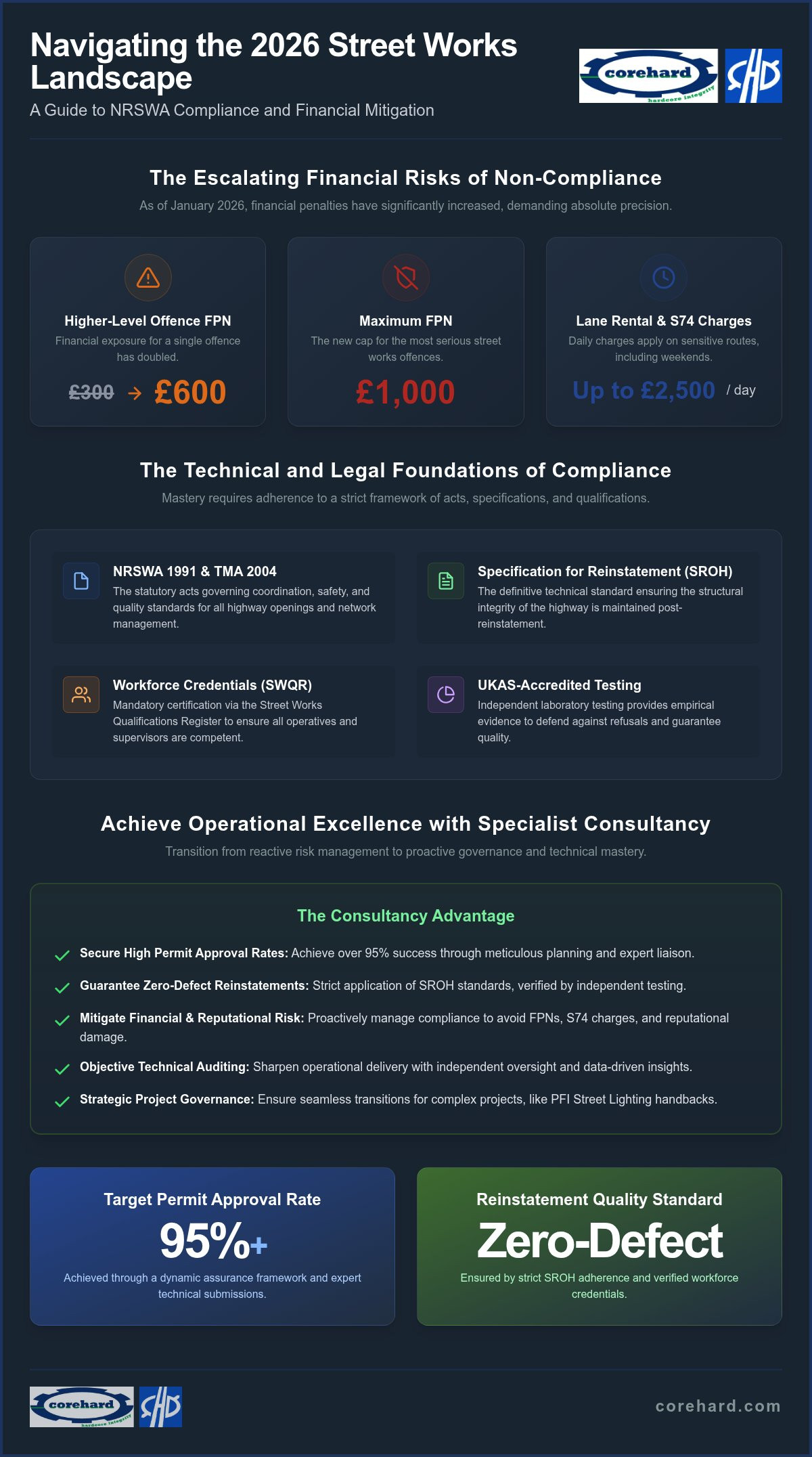
Financial exposure in the street works sector has reached unprecedented levels following the regulatory updates of January 2026, where the cost of Fixed Penalty Notices (FPNs) effectively doubled across all categories. Higher-level penalties for significant breaches have risen from £300 to £600, whilst the maximum FPN for the most serious offences now stands at £1,000. These direct costs are frequently compounded by Section 74 overrun charges, which now apply to every day of a delay, including weekends and bank holidays, removing the previous distinction between working and non-working days. For works on the most sensitive routes, Lane Rental charges of up to £2,500 per day necessitate absolute precision in project scheduling and execution. Beyond these immediate fiscal impacts, persistent non-compliance creates hidden costs through reputational damage and increased inspection frequencies, making an expert NRSWA compliance consultancy a vital partner in mitigating operational risk and protecting commercial margins.
Aligning utility works with local authority network objectives is no longer a peripheral concern but a strategic necessity for high-performing infrastructure teams. Successful delivery depends on demonstrating that every project contributes to the authority’s duty to minimise disruption and preserve the long-term life of the asset. By adopting a dynamic assurance framework, organisations can ensure that their technical outputs meet the rigorous demands of the modern regulatory landscape whilst securing the high permit approval rates required for efficient project delivery.
The Technical Foundations of Street Works Compliance
Technical integrity within the street works sector is governed by the Specification for the Reinstatement of Openings in Highways (SROH), which serves as the definitive technical standard for all works on the UK road network. Adherence to these standards is not a matter of operational discretion but a statutory obligation under the New Roads and Street Works Act 1991, ensuring that the structural integrity of the highway is maintained throughout the asset's lifecycle. To uphold this regulatory alignment, workforce assurance via the Street Works Qualifications Register (SWQR) remains a non-negotiable requirement, as uncertified supervisors or operatives represent a critical breach of compliance protocols and a significant risk to project safety. A sophisticated NRSWA compliance consultancy moves beyond administrative oversight to embed these technical requirements into the very fabric of operational delivery.
SROH Specification and Material Standards
Material selection and application are the primary drivers of reinstatement longevity, with the SROH detailing precise requirements for both interim and permanent layers to prevent premature settlement. Compliance audits must move beyond superficial checks to scrutinise soil compaction and asphalt quality, utilising advanced tools such as the PANDA penetrometer for objective site investigation. This penetrometer technology allows for non-destructive, high-precision compaction analysis, providing empirical data that validates whether the sub-base meets the required density parameters. By adopting such rigorous methodology, organisations can ensure that their technical outputs withstand the scrutiny of highway authority inspectors and reduce the likelihood of costly remedial works.
The Value of Independent Laboratory Testing
Utilising UKAS-accredited laboratory testing provides the objective evidence necessary to resolve complex disputes between highway authorities and contractors regarding material performance or reinstatement quality. Independent verification is essential for providing technical support across highways, streetworks, and airfield infrastructure, ensuring that every material used conforms to specified British Standards. This level of certainty is particularly vital when assessing slip resistance on footways, where failing to meet established safety thresholds can expose organisations to substantial public liability claims. Integrating such evidence-based data into a broader assurance framework allows for a seamless transition from technical complexity to operational clarity. Organisations seeking to sharpen their technical delivery often benefit from specialist NRSWA & TMA advisory services that link laboratory results with strategic compliance objectives.
Transitioning from visual inspections to technical condition assessments represents a fundamental shift towards a zero-defect culture in street works management. By leveraging a NRSWA compliance consultancy that prioritises objective technical reporting, contractors and authorities can move away from subjective debates and towards a verified model of infrastructure quality. This disciplined approach ensures that every reinstatement is not only compliant with current legislation but is also built to a standard that preserves the long-term integrity of the UK's vital road assets.
Evaluating Internal Management vs. Independent Consultancy
Maintaining high-level regulatory expertise within an in-house team presents a significant challenge, particularly as the technical and legal requirements of the New Roads and Street Works Act 1991 continue to evolve. Internal departments often find themselves consumed by the daily pressures of permit management, which can lead to a gradual erosion of the strategic oversight necessary to identify systemic risks before they manifest as financial penalties. By contrast, an independent NRSWA compliance consultancy provides an objective lens, identifying operational vulnerabilities that internal teams might overlook due to familiarity or established institutional habits. This external perspective is informed by cross-sector insights gained from working across diverse local authorities and utility providers, allowing for the implementation of best-practice governance models that sharpen operational delivery.
Scalability remains a critical factor for organisations managing fluctuating workloads or high-stakes infrastructure projects, such as large-scale utility upgrades or the complex handback of assets. Relying solely on internal headcount often results in either a lack of capacity during peak periods or excessive overheads during quieter phases. Partnering with a specialist advisor enables organisations to scale their compliance oversight dynamically, ensuring that complex schemes receive the required level of technical scrutiny without the burden of increasing permanent staff. This flexibility ensures that technical standards are maintained even under the pressure of accelerated project timelines.
Risk Mitigation and Liability Protection
Engagement with a NRSWA compliance consultancy grants immediate access to advanced diagnostic tools, such as PANDA penetrometers, without the need for significant capital expenditure or internal training programmes. This technical mastery is further supported by laboratory-backed data, which proves indispensable for resolving Section 74 overstay disputes and mitigating the financial impact of permit refusals. By acting as a bridge between technical site activities and high-level corporate governance, strategic advisory ensures that operational data is translated into actionable insights for decision-makers. This integration of technical evidence with strategic advice provides a level of certainty that internal management alone often cannot replicate.
Strategic Compliance for Complex Infrastructure Projects
Managing the inherent risks of large-scale infrastructure projects requires a transition from transactional permit filing to a sophisticated model of strategic network oversight. Complex schemes, particularly those operating within sensitive urban environments or under Lane Rental constraints, demand a level of precision that exceeds standard operational requirements. Engaging an expert NRSWA compliance consultancy ensures that every phase of the project, from initial application to final reinstatement, remains perfectly aligned with the authority’s network management duty. This high-level governance is essential for maintaining project velocity whilst mitigating the financial and reputational risks associated with permit refusals and site-level non-compliance.
Lane Rental Operational Governance
Applying for Lane Rental Schemes necessitates a thorough analysis of road network impact and the implementation of mitigation strategies that satisfy stringent authority requirements. Operational governance frameworks must be established to balance the necessity of project speed with the statutory obligation to minimise disruption on the most sensitive routes. This disciplined approach ensures that works don't just proceed; they do so with the verified approval of the highway authority and a clear plan for reducing occupation times. Strategic advisory provides the bridge between field-level technical actions and the high-level governance required to maintain 95% permit approval rates, ensuring that operational delivery remains consistent with strategic network objectives.
PFI Street Lighting Handback and Succession
Navigating the conclusion of street lighting PFI contracts presents a unique set of challenges for local authorities, specifically regarding the handback and transition of assets. Strategic advisory becomes a critical component in managing the risk of asset condition disputes that often arise during the final stages of these long-term agreements. Implementing professional asset surveys and condition reporting allows for the objective verification of compliance before contract expiry, ensuring that the authority isn't burdened with substandard infrastructure or hidden maintenance liabilities. Transitioning to new governance models requires the development of robust succession contracts that prioritise long-term safety and regulatory alignment. These contracts must be meticulously structured to ensure that the handback from the PFI provider to the new service model is seamless and verified. For authorities seeking a steady hand during these transitions, our Street Lighting PFI Transition Advisory services provide the clarity and technical mastery needed to protect the integrity of the highway asset.
Developing condition assessments for large-scale infrastructure ensures that every asset is evaluated against verified industry standards, providing a clear roadmap for future maintenance and compliance. By integrating professional highways asset inspection with long-term contract development, organisations can secure the durability of their networks and the safety of the public. This structured approach to complex infrastructure management ensures that technical actions are always grounded in a broader framework of professional excellence and regulatory certainty.
Implementing a Dynamic Assurance Framework with Corehard
Corehard Ltd's approach is grounded in the transition from regulatory complexity to operational clarity, providing a structured environment where technical site actions are inextricably linked to high-level strategic outcomes. By providing a steady hand through the intricacies of street works legislation, our specialist advisory services sharpen operational delivery and protect the long-term integrity of the highway asset. This is achieved through a disciplined framework that integrates technical evidence with strategic oversight, ensuring that performance consistently meets or exceeds the highest industry standards. Engaging our NRSWA compliance consultancy allows organisations to gain a partner capable of navigating the high stakes of modern street works whilst maintaining a calm control over difficult operational environments.
The Corehard Ltd Methodology for NRSWA Assurance
Our methodology follows a progressive path from risk identification to verified governance, ensuring that every layer of compliance is meticulously addressed. This structured approach provides the objective evidence needed to satisfy both internal stakeholders and external highway authorities.
- Step 1: Comprehensive compliance audit and risk identification. We begin by scrutinising existing processes and site operations to identify latent risks that could lead to permit refusals or financial penalties.
- Step 2: Technical asset inspection and UKAS-accredited testing. Utilising advanced diagnostic tools and independent laboratory analysis, we provide empirical data that validates the quality of reinstatements and material performance.
- Step 3: Strategic advisory and reporting for long-term governance. Our specialists translate technical data into actionable insights, providing the strategic reporting necessary for robust corporate governance and liability protection.
A Strategic Partnership for National Infrastructure
Positioning Corehard Ltd as a seasoned guardian of quality allows both highway authorities and contractors to operate with absolute confidence. Our national perspective provides a unique advantage, bringing cross-sector insights to deliver local compliance excellence across the United Kingdom without the limitations of a regional focus. By integrating UKAS-accredited laboratory data directly into the compliance auditing process, we provide an empirical foundation that defends against permit refusals and mitigates the financial impact of Section 74 overstay charges. This continuous monitoring ensures that operational performance remains amongst the highest industry standards, providing a verified narrative of professional excellence. Organisations seeking to secure their infrastructure delivery can enquire about Corehard Ltd’s specialist NRSWA compliance consultancy to begin the transition toward technical and regulatory mastery.
This strategic partnership ensures that every project is underpinned by rigorous methodology and technical mastery. By choosing an advisor that values objectivity and evidence above all else, you protect your organisation from the escalating costs of non-compliance whilst ensuring the safety and durability of the national road network. The result is a seamless transition from complexity to clarity, where every technical action is grounded in a broader framework of industry standards and verified performance.
Securing Operational Excellence in an Evolving Regulatory Landscape
The implementation of the 2026 Code of Practice and the doubling of Fixed Penalty Notice levels have fundamentally altered the risk profile of UK street works. Navigating this environment requires more than clerical oversight; it demands a disciplined integration of technical mastery and strategic governance. By leveraging independent UKAS Accredited Laboratory Testing and specialist condition reporting, organisations can move beyond the uncertainty of visual inspections toward a verified model of infrastructure quality. This transition from complexity to clarity is particularly vital for local authorities managing the high-stakes challenges of PFI Street Lighting Expiry, where objective evidence isn't just an advantage, it's a safeguard against hidden liabilities.
Partnering with a seasoned NRSWA compliance consultancy provides the steady hand needed to sharpen operational delivery whilst protecting the long-term integrity of the highway asset. Corehard remains a dedicated guardian of compliance, offering the NRSWA & TMA Strategic Advisory required to maintain 95% permit approval rates and secure zero-defect reinstatements. You can proactively mitigate financial risk and ensure your projects remain fully aligned with the latest statutory obligations. Consult the specialists at Corehard for expert NRSWA compliance advisory and secure the future of your infrastructure network.
Frequently Asked Questions
What is the primary role of an NRSWA compliance consultancy?
An NRSWA compliance consultancy serves as a strategic advisor that transitions organisations from regulatory complexity to operational clarity. Their primary role involves conducting comprehensive compliance audits, providing technical asset inspections, and ensuring that all street works activity aligns with the New Roads and Street Works Act 1991. By acting as a guardian of quality, they identify latent risks that internal teams might overlook, ultimately protecting the organisation from escalating financial penalties and reputational damage.
How have the 2026 regulatory changes affected street works compliance?
The 2026 regulatory shifts, specifically the new Code of Practice effective from April 10, have significantly increased the financial stakes for non-compliance. Fixed Penalty Notices have doubled, with higher-level offences now reaching £600 and maximum penalties standing at £1,000. Stricter enforcement also means that Section 74 overrun charges now apply to weekends and bank holidays. This environment necessitates a disciplined approach to permit management and site-level technical execution to avoid substantial operational losses.
What is the importance of UKAS-accredited testing in highways maintenance?
UKAS-accredited testing is essential because it provides independent, empirical evidence of reinstatement quality that visual inspections cannot replicate. This objective data is vital for verifying that materials and compaction levels meet the Specification for the Reinstatement of Openings in Highways (SROH) standards. In the event of a dispute between a highway authority and a contractor, laboratory-backed evidence serves as a definitive technical record, ensuring that liability is assigned based on objective facts rather than subjective observation.
Can an NRSWA consultant help mitigate Section 74 overstay charges?
Yes, a consultant mitigates Section 74 charges by integrating technical diagnostic tools like the PANDA penetrometer into the project lifecycle. By providing objective evidence of site readiness and compaction quality, they can defend against unfair overstay claims. Specialist advisory also sharpens permit management accuracy, ensuring that occupation times are minimised and that all statutory notifications are submitted within the required legal windows to prevent the triggering of daily overstay fees that damage commercial margins.
What are the specific requirements for SROH compliance in 2026?
SROH compliance in 2026 requires absolute adherence to the updated technical standards for material selection and compaction density as outlined in the March 2026 Code of Practice. Contractors must ensure that reinstatements, whether interim or permanent, meet precise performance criteria to prevent settlement and preserve asset integrity. Verification through UKAS-accredited laboratory testing and professional asset surveys has become a standard requirement for organisations seeking to demonstrate technical mastery and avoid the financial burden of costly remedial works.
How does Lane Rental operational governance differ from standard permit schemes?
Lane Rental operational governance is characterised by significantly higher financial risks and a focus on minimising network disruption on the most sensitive routes. Daily charges can reach up to £2,500, requiring a level of project precision that standard permit schemes don't typically demand. Governance frameworks must prioritise reduced occupation times and rigorous impact management, ensuring that every hour of work is justified and that operational delivery remains perfectly aligned with the authority's statutory network management duty.
What support is available for local authorities facing PFI street lighting expiry?
Local authorities can access specialist Street Lighting PFI Transition Advisory to manage the complex handback of assets as long-term contracts conclude. This support includes professional asset surveys and condition reporting to verify that infrastructure meets the required standards before expiry. By implementing robust succession contracts and strategic governance models, authorities can ensure a seamless transition that protects them from inheriting substandard assets or significant maintenance liabilities that weren't identified during the PFI term.
Why is independent asset condition reporting superior to in-house monitoring?
Independent asset condition reporting offers a level of objectivity and technical mastery that in-house teams often struggle to maintain alongside daily operational pressures. Engaging an external NRSWA compliance consultancy ensures that reporting remains unbiased and evidence-based, utilising advanced diagnostic equipment and UKAS-accredited laboratory data to identify systemic vulnerabilities. This professional distance provides a reliable foundation for corporate governance and long-term asset management that is defensible in the event of legal or financial disputes.


