

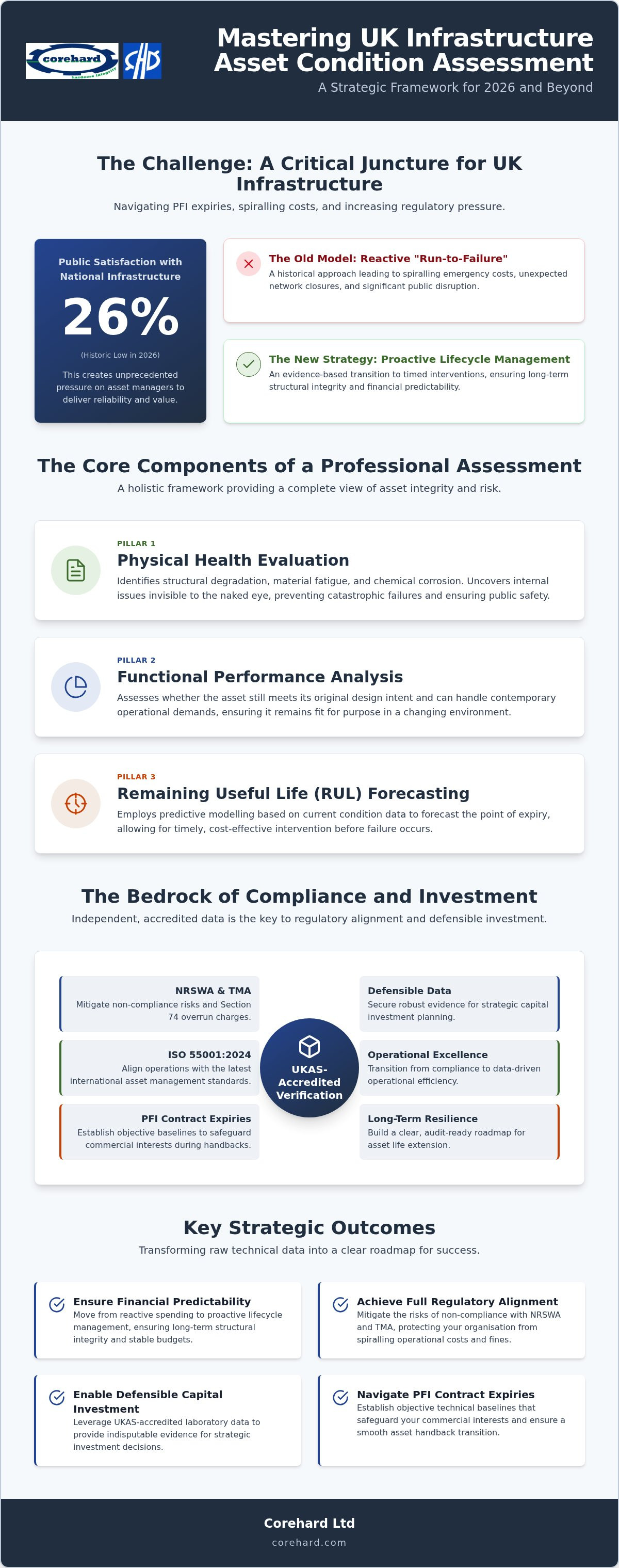
With public satisfaction in national infrastructure dropping to just 26% in 2026, the pressure on asset managers to deliver reliability whilst controlling costs has never been higher. You're likely facing the daunting reality of PFI contract expiries and the persistent worry that reactive maintenance costs will spiral beyond your control without a rigorous, evidence-based strategy. It's a high-stakes environment where failing to conduct a precise infrastructure asset condition assessment risks non-compliance with the New Roads and Street Works Act (NRSWA) and the Traffic Management Act (TMA). Establishing a defensible baseline for your portfolio isn't just a technical requirement; it's a prerequisite for navigating the transition from PFI handbacks to long-term stewardship.
This guide provides a strategic framework for 2026 to help you master technical requirements and ensure long-term resilience through UKAS-accredited verification. We'll examine how to secure defensible data for capital investment whilst aligning your operations with the latest ISO 55001:2024 standards and the Planning and Infrastructure Act 2025. We'll also explore the transition from complexity to clarity, providing the steady hand needed to navigate the evolving regulatory landscape of the United Kingdom and achieve full alignment with national standards.
Key Takeaways
- Transition from reactive "run-to-failure" models to proactive lifecycle management by utilising evidence-based evaluations that ensure long-term structural integrity and financial predictability.
- Secure full regulatory alignment with NRSWA and TMA standards to mitigate the risks of non-compliance whilst protecting your organisation from spiralling operational costs.
- Master the implementation of a robust infrastructure asset condition assessment framework that leverages UKAS-accredited laboratory data to provide defensible evidence for strategic capital investment.
- Navigate the complexities of PFI contract expiries and asset handbacks by establishing objective technical baselines that safeguard your commercial interests during the transition period.
- Identify the critical role of independent assurance and specialised testing in transforming raw technical data into a clear, audit-ready roadmap for asset life extension.
Understanding Infrastructure Asset Condition Assessment in the UK
Infrastructure asset condition assessment represents the systematic, evidence-based evaluation of an asset's physical health and operational performance. It serves as the fundamental pillar for modern What is infrastructure asset management? strategies, moving beyond simple checklists to provide a comprehensive view of structural integrity. Historically, many UK networks operated under a reactive "run-to-failure" model, which frequently resulted in spiralling costs and emergency closures. Today, the industry is transitioning towards proactive, data-driven lifecycle management, where intervention is timed to maximise the value of every pound spent on maintenance.
This shift is not merely a matter of operational preference; it's a necessity for maintaining public safety and economic stability across the United Kingdom. With public satisfaction in national infrastructure reaching historic lows, the ability to provide defensible data for investment is paramount. A critical distinction must be made between cursory visual inspections and technical condition reporting. Whilst a visual survey might identify surface-level defects, a professional infrastructure asset condition assessment utilises objective testing to uncover internal structural degradation and material fatigue that remain invisible to the naked eye.
The Core Components of a Professional Assessment
A rigorous assessment framework focuses on three primary pillars to provide a holistic view of asset integrity and risk:
- Physical health evaluation: This process identifies structural degradation, material fatigue, and chemical corrosion that could compromise the asset's safety or load-bearing capacity.
- Functional performance: Specialists assess whether the asset still meets its original design intent or if contemporary operational demands have exceeded its current capabilities.
- Remaining useful life (RUL): By employing predictive modelling based on current condition data, engineers can forecast the point of expiry, allowing for timely intervention before failure occurs.
Why 2026 is a Turning Point for UK Infrastructure
The year 2026 marks a significant juncture for the UK's built environment. Accelerated deterioration rates, driven by the increased frequency of extreme weather events and shifting climate patterns, have rendered historical maintenance schedules obsolete. Local authority budgets are under unprecedented pressure, requiring a level of precision in funding allocation that only granular, technical data can provide. The integration of digital twins and IoT sensors has transformed modern condition monitoring into a dynamic process, yet these digital tools still require the grounding of physical, UKAS-accredited testing to ensure that the virtual models accurately reflect the physical reality of the asset's health.
This emphasis on structural safety and long-term durability is equally relevant for community-facing assets. For those responsible for recreational facilities, SoftplayToys4kids offers a range of high-quality equipment designed to maintain safety standards within the broader built environment.
Technical Methodologies and Regulatory Alignment
Effective infrastructure asset condition assessment requires more than technical proficiency; it demands strict adherence to the United Kingdom's legislative framework. Aligning field activities with the New Roads and Street Works Act (NRSWA) and the Traffic Management Act (TMA) ensures that data collection doesn't result in punitive fines or network disruption. Central to this alignment is the Specification for the Reinstatement of Openings in Highways (SROH), which dictates the performance requirements for materials used in pavement investigations. For authorities operating Lane Rental Schemes, assessments must be strategically scheduled to avoid unnecessary charges whilst capturing the high-fidelity data needed for long-term planning. This technical rigour aligns with the strategic objectives outlined in the UK Government's Asset Condition Playbook, which emphasises the need for objective evidence during asset handbacks and contract expiries.
Compliance Audits and NRSWA Requirements
Robust condition assessments provide the primary defence against Section 74 overrun charges by documenting the precise timeline and quality of reinstatement works. By integrating independent asset inspections into the compliance loop, managers can meet their TMA legal obligations through verified performance reporting. Identifying and documenting defects through structured quality assurance protocols allows for the early detection of non-compliance, reducing the risk of premature failure and the associated costs of corrective maintenance. Organisations seeking to strengthen their regulatory standing often benefit from specialist NRSWA and TMA advisory services to bridge the gap between technical data and legal duty.
Specialist Testing: From Slip Resistance to PANDA Penetrometers
The choice between non-destructive testing (NDT) and intrusive sampling is dictated by the specific risk profile of the asset. For high-precision soil and sub-base investigation, the use of PANDA penetrometers allows for the determination of dynamic cone resistance without the extensive disruption of traditional trial pits. This level of detail is particularly critical for airfield and highway pavements where structural capacity is non-negotiable. Similarly, slip resistance testing remains a mandatory component of footway safety audits, providing the objective evidence required to mitigate public liability claims. Whether assessing the load-bearing capacity of a sub-grade or the frictional properties of a surface course, the methodology must be chosen to deliver certainty whilst minimising the impact on the wider transport network.
The Critical Role of Independent UKAS Accredited Testing
Establishing a defensible baseline for any infrastructure asset condition assessment requires a level of objectivity that internal departments or primary contractors often struggle to provide. Whilst contractor self-certification remains a common practice, it introduces an inherent conflict of interest that can lead to the systematic under-reporting of defects or the overestimation of an asset's remaining life. Relying on an independent UKAS-accredited testing laboratory eliminates these biases, providing stakeholders with the "gold standard" of objective evidence. This impartiality is vital when navigating the high-stakes environment of asset handbacks, where the financial implications of overlooked structural issues can reach millions of pounds.
UKAS accreditation serves as the ultimate benchmark for technical competence, ensuring that every test, from asphalt binder content to soil compaction ratios, is conducted according to rigorous national standards. It isn't merely a certification of quality but a continuous audit of a laboratory's methodology, equipment calibration, and staff expertise. By transforming raw laboratory data into structured, authoritative condition reports, asset managers can present a narrative of professional excellence that withstands scrutiny from auditors and regulators alike. This transition from complex technical output to clear strategic insight allows for the sharpening of operational delivery and the protection of long-term capital investments.
Benefits of an Independent Assurance Model
Adopting an independent assurance model provides the steady hand needed to navigate difficult regulatory or operational transitions, particularly during the critical phases of PFI contract expiry. By removing the primary contractor from the verification loop, local authorities can ensure that the assets they are inheriting meet the agreed-upon handback standards without the risk of hidden liabilities. This approach fosters a culture of transparency and accountability, where data-driven decisions are grounded in verified reality rather than optimistic projections. It provides the certainty required to defend investment plans to treasury departments and elected officials.
Laboratory Excellence in Highways and Streetworks
Achieving long-term structural integrity in highway networks depends on the precise geotechnical analysis of sub-base materials and the performance testing of pavement courses. Laboratory excellence involves a range of specialised activities, including:
- Testing asphalt and bituminous mixtures to verify compliance with SROH requirements and design specifications.
- Geotechnical soil testing to determine moisture-density relationships and ensure optimal compaction during reinstatement.
- Evaluating the durability and fatigue resistance of materials to forecast lifecycle outcomes accurately.
The link between laboratory precision and strategic lifecycle outcomes is direct; accurate data at the assessment stage prevents the premature failure of assets and ensures that maintenance funding is targeted where it will deliver the greatest impact. This methodical approach to material verification ensures that the physical reality of the network aligns perfectly with its digital records, creating a robust foundation for future asset management activities. For those managing broader property portfolios, this level of strategic oversight is comparable to utilising DST 1031 exchange replacement properties to preserve capital during asset transitions.
Executing an Effective Assessment: A Step-by-Step Approach
Establishing a rigorous methodology for infrastructure asset condition assessment ensures that every technical action is grounded in regulatory compliance and strategic value. The process begins with Phase 1: Strategic planning and regulatory scoping, where alignment with NRSWA and TMA requirements is established to mitigate the risk of legal non-compliance or network disruption. This preparatory stage defines the scope of the investigation, ensuring that subsequent data collection is both targeted and defensible. Phase 2 involves the execution of on-site inspections and technical testing, capturing the physical reality of the asset's health through precise field measurements.
Transitioning from the field to the laboratory, Phase 3 focuses on laboratory analysis and material verification to provide an objective evidence base for the assessment. This is followed by Phase 4: Condition grading and remaining life forecasting, where specialists apply predictive modelling to the verified data to determine the asset's future performance. The final stage, Phase 5: Strategic reporting and investment prioritisation, converts these technical findings into a clear roadmap for capital allocation. For organisations requiring technical rigour at every stage, Corehard Ltd's asset survey and condition reporting services provide the necessary expertise to navigate this five-phase framework with absolute confidence.
Managing PFI Street Lighting Expiry and Succession
Local authorities approaching the conclusion of long-term PFI agreements face unique challenges during the handback phase, requiring specialised steps to protect their commercial interests. Conducting comprehensive handback surveys is essential to ensure that street lighting assets meet the required performance standards before the contract expires, preventing the inheritance of significant maintenance backlogs. Risk management during the transition from PFI to new succession contracts depends on the ability to identify latent defects through rigorous inspection. Establishing a clear technical baseline allows for the seamless transfer of responsibility whilst ensuring that the successor provider has a verified starting point for their operational delivery.
Data Management and Reporting Standards
Organising complex technical data into actionable executive summaries is the final step in translating engineering findings into commercial reality. Using high-fidelity data to defend capital expenditure (CapEx) requests provides the objective evidence needed to secure precision funding in a competitive budgetary environment where every pound must be justified. Ensuring that all reports are "audit-ready" for regulatory bodies protects the integrity of the organisation's asset management strategy and demonstrates a commitment to transparency. This structured approach to data management transforms an infrastructure asset condition assessment from a technical exercise into a powerful tool for long-term corporate governance.
Strategic Outcomes: From Compliance to Operational Excellence
Achieving operational excellence through a professional infrastructure asset condition assessment involves more than meeting basic regulatory requirements. It requires the integration of technical data into a broader framework of corporate governance, where every decision is linked to long-term financial stability and public safety. By moving away from reactive, "run-to-failure" models, organisations can significantly reduce their long-term maintenance costs, as proactive interventions are typically far more cost-effective than emergency repairs. This strategic asset guardianship ensures that the physical health of the network is maintained at an optimal level, protecting the integrity of the United Kingdom's £506.7 billion net stock of infrastructure through disciplined lifecycle management.
Establishing this level of control requires a transition from simple oversight to a model of dynamic assurance. Protecting asset integrity depends on continuous compliance monitoring and the ability to bridge the gap between raw technical data and high-level strategic planning. Corehard Ltd acts as a specialist partner in this process, providing a comprehensive advisory and testing loop that ensures all data is technically robust and legally defensible. This methodical approach provides the steady hand needed to navigate difficult regulatory transitions, transforming the assessment process from a periodic obligation into a continuous driver of operational efficiency and safety.
Optimising Road Network Impact
Utilising specialised Lane Rental expertise allows authorities to facilitate essential assessments with minimal disruption to the travelling public. Through the strategic application of Lane Rental Operational Services, managers can coordinate inspection windows that align with existing works or off-peak periods, thereby reducing the commercial impact of road user delays. This smarter assessment approach delivers a tangible benefit by minimising the social and economic costs of network disruption whilst ensuring that technical rigour is never sacrificed for operational convenience. Effectively balancing these competing demands is essential for maintaining network fluidity and securing the granular data required for future capital investment planning without incurring unnecessary rental charges.
Securing the Future of UK Infrastructure
Securing the future of UK infrastructure depends on the continuous application of independent, accredited condition data to inform high-level decision-making. The long-term value of utilising UKAS-accredited laboratory testing lies in its ability to provide objective evidence that withstands the highest levels of scrutiny from auditors and stakeholders. By adopting a model of dynamic assurance, organisations can position themselves as leaders in infrastructure resilience, capable of meeting the challenges of climate change and evolving legislative standards with absolute confidence. This commitment to objective evidence provides the verified foundation needed for long-term stewardship and successful contract successions.
Partner with Corehard for UKAS-accredited asset assurance.
Securing Network Resilience through Technical Mastery
The evolution of the United Kingdom's built environment demands a shift from mere maintenance to strategic asset guardianship. Establishing a robust technical framework ensures that your organisation remains in full alignment with NRSWA and TMA regulations whilst protecting capital investments from the volatility of reactive repairs. By leveraging independent, UKAS-accredited data, you gain the objective evidence required to navigate complex transitions like PFI street lighting expiries with absolute certainty. This methodical approach doesn't just satisfy auditors; it secures the structural integrity of your network for the decades ahead.
It's time to move beyond the uncertainty of contractor self-certification and embrace a model of dynamic assurance. As PFI contracts reach their conclusion and climate-driven deterioration accelerates, the need for technical discipline has never been more critical. Partnering with specialists who provide a UKAS Accredited Laboratory, specialist NRSWA and TMA advisory, and expertise as PFI street lighting transition experts provides the steady hand needed to maintain oversight. You're invited to consult Corehard for independent infrastructure asset condition assessment to safeguard your portfolio. Take control of your asset lifecycle today to ensure a resilient, compliant future for your network.
Frequently Asked Questions
What is the difference between a visual inspection and a condition assessment?
A visual inspection identifies obvious surface defects like potholes or cracked glazing, whilst an infrastructure asset condition assessment involves a deeper, technical evaluation of structural health. It incorporates objective data from UKAS-accredited laboratory testing and non-destructive investigations to uncover internal fatigue. This evidence-based approach provides a far more reliable baseline for lifecycle planning than simple checklists, ensuring that maintenance strategies are grounded in the physical reality of the asset's integrity rather than just its appearance.
How often should infrastructure asset condition assessments be performed?
The frequency of a comprehensive infrastructure asset condition assessment typically ranges between two and five years, though this is heavily influenced by the asset's risk profile and traffic loading. High-speed strategic networks or critical bridges require more frequent monitoring to ensure safety and compliance with national standards. For local authorities, the schedule is often dictated by PFI contract milestones or the specific requirements of the Traffic Management Act to maintain network reliability and prevent spiralling reactive costs.
Is UKAS accreditation mandatory for highway testing in the UK?
Whilst UKAS accreditation isn't always a statutory requirement for every minor test, it's considered the industry standard for producing defensible, objective evidence. In the context of the Specification for the Reinstatement of Openings in Highways (SROH), using a UKAS-accredited laboratory ensures that material verification is technically robust. For local authorities and contractors, this accreditation provides the legal protection needed during disputes, as it verifies that testing was performed by a competent, independent entity.
How does asset condition assessment help with PFI contract expiry?
Condition assessments are vital during the PFI handback phase to verify that assets meet the specified residual life or condition standards defined in the original agreement. By conducting independent surveys, local authorities avoid inheriting significant maintenance liabilities and hidden structural defects from the outgoing provider. This process provides the objective evidence required to negotiate financial settlements or demand corrective works before the contract expires, ensuring a smooth and commercially safe transition to succession providers.
Can condition assessments reduce the frequency of roadworks?
Yes, proactive assessments significantly reduce roadwork frequency by allowing for right-time interventions that prevent minor defects from escalating into major structural failures. By identifying sub-surface issues early, managers can bundle maintenance activities and avoid the disruptive cycle of emergency reactive repairs. This data-driven approach supports the objectives of Lane Rental Schemes and the TMA by minimising network occupancy, ultimately improving traffic flow and reducing the total cost of ownership for the asset.
What are the legal implications of poor asset condition reporting under the TMA?
Failing to maintain accurate condition records can lead to substantial financial penalties under the Traffic Management Act, including Section 74 overrun charges and fixed penalty notices. Poor reporting undermines an authority's ability to coordinate works effectively, potentially resulting in legal challenges from utility companies or regulators. Beyond immediate fines, inaccurate data creates a risk of public liability claims if asset failure leads to accidents, making rigorous, audit-ready reporting a critical safeguard for corporate governance.
How is the remaining useful life of a highway asset calculated?
Calculating remaining useful life (RUL) involves comparing the asset's current physical state, determined through technical testing, against its original design specifications and historical performance data. Engineers use predictive modelling to forecast the point at which the asset will no longer meet safety or functional requirements. This calculation accounts for environmental factors, such as increased rainfall patterns in 2026, and actual traffic volumes, allowing for a precise determination of when full replacement or major intervention is required.
What role does the PANDA penetrometer play in asset surveys?
The PANDA penetrometer is a specialised tool used for the high-precision evaluation of soil and sub-base compaction without the need for extensive trial pits. It provides an instantaneous measure of dynamic cone resistance, allowing engineers to assess the structural capacity of the ground supporting a highway or airfield pavement. This method is particularly valuable for verifying the quality of reinstatements under NRSWA, as it delivers objective data on material density whilst minimising the physical disruption to the network.


