

A live street works excavation is either an organisation's clearest demonstration of public safety or its fastest route to severe regulatory penalties. With Section 74 overrun charges applying across all calendar days and statutory enforcement sharpening, conducting thorough NRSWA Cat A Inspections has become an indispensable operational safeguard rather than a routine administrative task.
Balancing rapid utility excavation with exacting signing, lighting, and guarding standards is an unrelenting challenge, particularly when teams face pressure to capture defensible records under tight deadlines. You know how quickly an unmanaged site issue can trigger permit disputes, unexpected fees, or friction with highway authorities.
This guide outlines how to master the statutory requirements, on-site inspection protocols, and defect procedures governing live works under the New Roads and Street Works Act 1991 (NRSWA) and the Traffic Management Act 2004 (TMA). We examine how to capture auditable evidence for Street Manager, manage dangerous and non-dangerous defect classifications, and establish an inspection regime that protects vulnerable road users whilst insulating your operations from compliance disputes.
Key Takeaways
- Master the statutory scope of NRSWA Cat A Inspections under the New Roads and Street Works Act 1991 and the Traffic Management Act 2004 to maintain legal compliance throughout live site operations.
- Follow a structured four-stage on-site inspection protocol covering permit conditions, physical excavation controls, and safe passage for vulnerable road users.
- Differentiate accurately between Immediate Danger and Non-Immediate Danger defects to trigger rapid site interventions and record approved statutory outcome codes.
- Build defensible digital records featuring time-stamped imagery and GPS coordinates to satisfy mandatory Street Manager logging and resolve dispute friction.
- Understand how independent compliance assurance supports highway authority resources, sharpens contractor delivery, and protects network availability.
Understanding NRSWA Cat A Inspections: Statutory Scope and Purpose
Street works environments present dynamic operational risks that change hour by hour. An active trench cannot be managed with passive assumptions. Under UK highway legislation, NRSWA Cat A Inspections serve as the primary compliance mechanism during the live phase of utility execution. Unlike post-construction assessments that evaluate the structural integrity of a finished tarmac surface, a Category A inspection scrutinises the operational footprint while apparatus is actively being exposed, repaired, or installed.
Understanding this distinction is vital for works promoters and monitoring authorities alike:
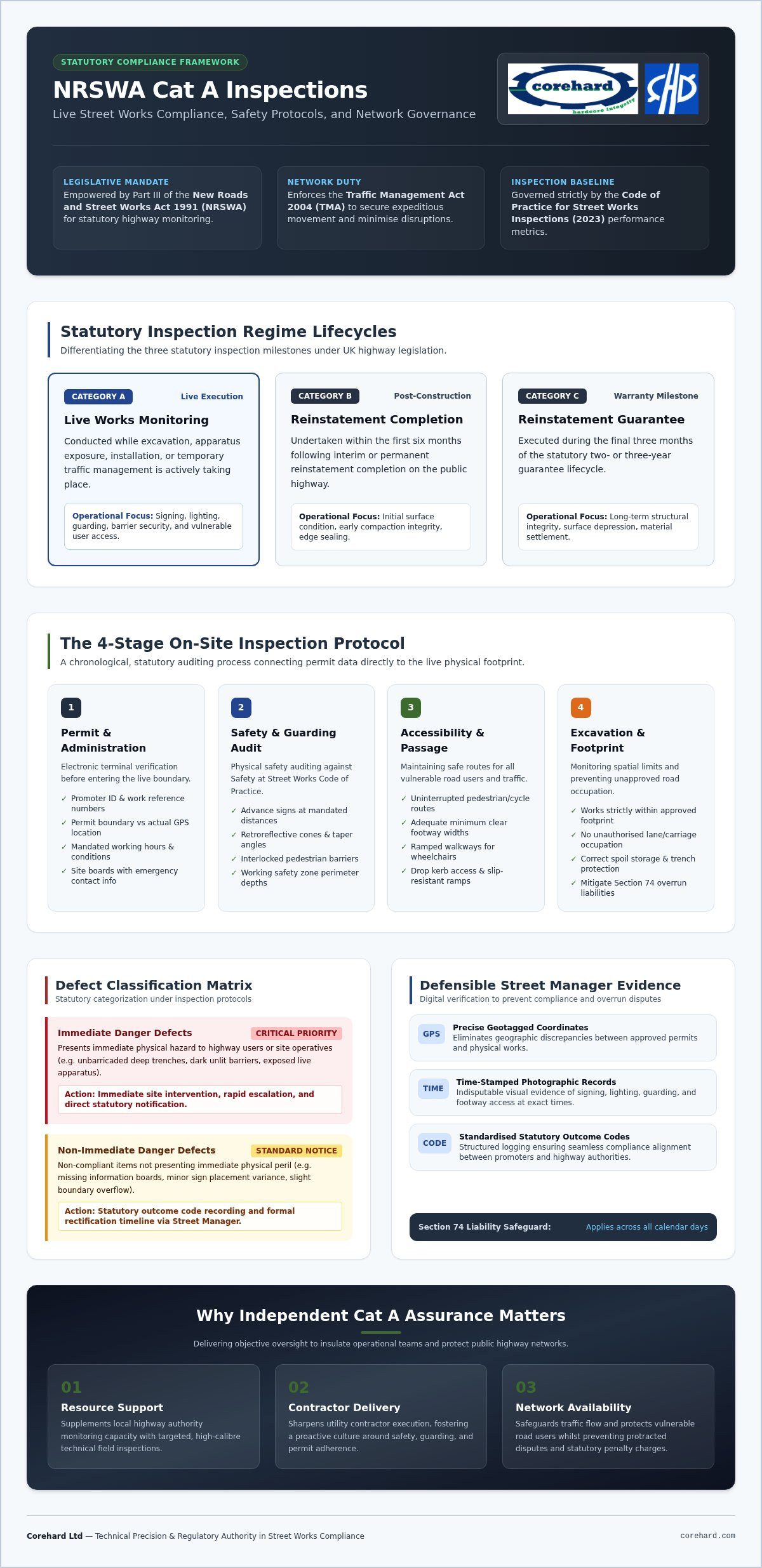
- Category A (Live Works): Conducted while excavation, physical work, or temporary traffic control is actively taking place on the network.
- Category B (Reinstatement Completion): Carried out within the first six months following permanent or interim site reinstatement.
- Category C (Reinstatement Guarantee): Undertaken towards the end of the statutory guarantee period, typically within the final three months of the two- or three-year lifecycle.
Category A inspections are never optional. They represent an active, statutory duty to verify that live highway disruptions comply strictly with national safety baselines.
The Legislative Mandate: NRSWA 1991 and TMA 2004
The statutory basis for on-site monitoring derives from Part III of the New Roads and Street Works Act 1991 (NRSWA), which empowers highway authorities to inspect works executed by statutory undertakers within their public networks. This power links directly with the Traffic Management Act 2004 (TMA), which places a binding Network Management Duty on local authorities to ensure the expeditious movement of all traffic.
Inspectors assess site compliance against the Code of Practice for Street Works Inspections (2023). This unified framework establishes standard inspection regimes across England, holding utility contractors accountable to measurable performance metrics throughout the live deployment window.
Core Objectives: Safety, Accessibility, and Disruption Minimisation
Every Category A assessment exists to protect network users. Operational teams must maintain uninterrupted passage for pedestrians, cyclists, and motorists while guaranteeing the physical protection of the workforce inside the site perimeter. Accessibility duties require absolute focus. Any diversion or temporary footway must cater fully for vulnerable road users, maintaining sufficient clear widths, drop kerbs, and continuous ramped walkways suitable for wheelchair users and pushchairs.
Active monitoring prevents avoidable congestion by ensuring works stay confined strictly to approved footprints. Unauthorised occupation of adjacent carriage lanes or idle sites occupying valuable road space breach TMA principles and expose promoters to direct enforcement.
The 4-Stage On-Site Protocol for Live Street Works Inspections
Arriving at an active excavation requires a methodical auditing process rather than an ad-hoc glance around the barriers. Statutory compliance cannot rely on guesswork. Performing professional NRSWA Cat A Inspections demands a disciplined, chronological approach that connects approved electronic permit records directly to the physical site footprint. Under the statutory authority established in the New Roads and Street Works Act 1991, inspectors must execute a four-stage assessment protocol to build an indisputable evidential record.
Stage 1 & Stage 2: Site Verification and Safety Auditing
Stage 1 focuses on administrative alignment before entering the live boundary. Inspectors review the electronic permit on their mobile terminal, cross-referencing:
- Promoter identity and designated works reference numbers
- Site boundary descriptions against actual geographic coordinates
- Mandatory permit conditions, such as restricted working hours or manual traffic control requirements
- Active site information boards displaying emergency contact details and promoter licensing data
Stage 2 shifts immediately to dynamic safety auditing. The assessor examines signing, lighting, and guarding against the Safety at Street Works and Road Works Code of Practice. Key checks verify that advance warning signs stand at mandated lead-in distances, retroreflective cones remain correctly spaced, and excavations feature continuous, locked pedestrian barriers with toe boards. Inspectors scrutinise temporary footways, checking that ramps have stable gradients and non-slip surfaces suitable for mobility scooters and prams.
Stage 3 & Stage 4: Permit Compliance and Network Impact
Stage 3 interrogates physical site management and highway space utilisation. Inspectors measure the operational footprint to verify that plant, spoil piles, and storage trailers remain strictly within the designated permit perimeter. For contractors working within restricted verges or footways, sourcing compact machinery from specialists like Ayr Tracked Plant & Equipment Hire can help keep equipment footprints well inside approved boundaries. Unauthorised encroachment into adjacent traffic lanes breaches the Traffic Management Act 2004 framework. This stage also confirms that work timings align with authorized dates, identifying early indicators of unauthorised occupation that could trigger Section 74 overrun charges across calendar days.
Stage 4 evaluates wider network impact and traffic disruption. Assessors check whether traffic control measures, such as portable signals or stop-go boards, operate effectively without creating unapproved queuing. For contractors seeking to benchmark operational standards or explore Traffic Control frameworks across complex road environments, thorough planning is essential. If you want to optimise operational consistency across your teams, integrating specialised NRSWA and TMA development services helps align site protocols with authority compliance expectations. The inspection concludes once the assessor records observations, logs time-stamped images, and submits the completed record directly into Street Manager.
Defect Classification: Immediate Danger vs Non-Immediate Danger
Classifying an on-site issue accurately can mean the difference between an orderly site correction and an emergency network escalation. Under the statutory framework governing NRSWA Cat A Inspections, inspectors cannot ignore deficiencies or rely on subjective descriptions. Every recorded issue must be logged formally as either an Immediate Danger or a Non-Immediate Danger defect, in line with the Code of Practice for Street Works Inspections. Misclassifying these findings distorts compliance data, increases public liability, and creates avoidable friction between authorities and undertakers.
Identifying and Responding to Immediate Danger Hazards
Immediate Danger defects present an acute, unacceptable hazard to the public or workforce, demanding instant intervention. Common triggers include:
- Unprotected deep trenches adjacent to active pedestrian desire lines
- Completely collapsed, missing, or breached safety barrier systems
- Unlit obstructions or missing retroreflective signing during darkness
- Traffic diverted into live opposing flows without compliant positive traffic control
When an inspector discovers an immediate hazard, formal procedures require urgent promoter notification to secure rapid attendance on site. The inspector has a professional duty to remain present or take proportionate temporary measures to safeguard the public until the contractor arrives to make the location safe.
Managing Non-Immediate Danger Breaches and Outcome Codes
Non-Immediate Danger issues involve technical breaches of codes that do not pose an imminent threat to life or limb. Typical examples involve twisted or dirty advance signs, minor gaps between barrier panels away from open excavations, or small deviations from agreed working space boundaries. While these breaches do not require emergency call-outs, undertakers must rectify them within prescribed statutory timescales.
To preserve complete legal clarity, inspectors evaluate sites against four approved statutory outcome codes:
- Pass: The live site fully complies with all safety codes, permit parameters, and network obligations.
- Pass with Observation: Minor technical issues exist that do not warrant a formal failure notice but require contractor attention.
- Fail (Dangerous): Severe breaches exist posing immediate risk, requiring urgent promoter intervention.
- Fail (Non-Dangerous): Non-immediate compliance failures that necessitate prompt remedial action within standard statutory response windows.
Applying this objective coding structure ensures defensible records when managing dispute discussions. Clear evidence trails gathered during live works assessments also directly support Section 74 mitigation services, giving undertakers and authorities verifiable data to settle overrun disputes fairly.
Defect Rectification, Street Manager Logging, and Escalation
Logging compliance failures isn't merely an administrative exercise; it establishes a legally binding audit trail. In England, every assessment conducted during live works must be uploaded directly to Street Manager or the highway authority's integrated inspection system. Without a swift, unambiguous digital log, defect notices lose enforceability, leaving network operators exposed to prolonged safety risks and unresolvable disputes. Under the New Roads and Street Works Act 1991 (NRSWA) and the Traffic Management Act 2004 (TMA), robust digital records protect both the highway authority and the undertaker by establishing an objective version of the truth.
Digital Record-Keeping via Street Manager and Authority Systems
Defensible live works enforcement relies on verifiable data captured at the roadside. When completing NRSWA Cat A Inspections, assessors must produce an evidential package that withstands formal contractor challenges. This standard requires three primary elements:
- Precise Geo-Coordinates: Automated GPS mapping confirming the assessor stood directly within the permitted works perimeter.
- Contextual Defect Descriptions: Clear, technical explanations linking observed physical hazards to specific statutory regulations.
- Time-Stamped Digital Photography: Comprehensive imagery showing both close-up technical breaches and the wider highway context to prove real-world network impact.
Submitting this documentation through Street Manager within prescribed statutory windows ensures works promoters receive immediate notification, giving their incident response teams the exact details needed to initiate remedial action.
Verification Re-Inspections and HAUC Escalation Triggers
Identifying an on-site breach is only the first step; statutory closure demands systematic verification. Statutory closure occurs only when no defects are identified during the initial assessment, or when all reported defects are formally rectified and verified through a physical re-inspection. A defect notice remains open and active on the national register until an assessor confirms that the contractor has restored compliant conditions.
When an undertaker demonstrates persistent non-compliance or fails to remediate dangerous conditions, highway authorities escalate the issue through regional Highway Authorities and Utilities Committee (HAUC) forums. Continued failure can trigger targeted inspection regimes, permit variations, or legal proceedings. Establishing structured operational oversight aligned with NRSWA compliance for utilities prevents these damaging escalations from disrupting major infrastructure programmes.
To safeguard your network with objective, auditable live site assessments, partner with our independent assurance team today.
Deploying Independent Cat A Assurance to Protect Highway Networks
Highway authorities oversee thousands of active utility excavations every month, yet many coordination teams struggle with severe internal capacity limits. Stretched engineering resources make sustained on-site monitoring difficult to achieve across expansive networks. Appointing an external partner to deliver NRSWA Cat A Inspections bridges this operational gap. Independent oversight delivers impartial compliance records, relieves overburdened internal staff, and establishes an objective standard that protects public safety without straining municipal budgets.
The Strategic Advantage of Independent Site Auditing
Third-party compliance auditing removes commercial and political tension from the inspection workflow. By maintaining clear independence from both network promoters and direct municipal operations, an external assurance partner delivers several key benefits:
- Eliminating Conflict of Interest: Neutral assessments provide an unbiased baseline that undertakers respect, reducing contested defect challenges.
- Expanding Network Coverage: Scalable field teams monitor active sites across traffic-sensitive corridors that internal local authority inspectors rarely reach.
- Defensible Evidence Trails: Rigorous photographic packs, geo-referenced timestamps, and meticulous logging hold up under formal legal arbitration.
This disciplined oversight ensures local authorities satisfy their mandatory Network Management Duty under the Traffic Management Act 2004 while enforcing safety obligations under the New Roads and Street Works Act 1991 (NRSWA).
Corehard’s Assured Cat A Inspection Methodology
Corehard operates an independent assurance model structured around four clear phases: Inspect, Report, Intervene, and Improve. All field personnel are qualified to the NRSWA supervisor standard and bring extensive hands-on highway engineering experience. Rather than treating compliance as a static tick-box exercise, assessors evaluate active works dynamically, intervening swiftly when dangerous hazards emerge on site.
Field data flows through an automated digital reporting platform that captures GPS coordinates and time-stamped visual evidence before uploading records directly into Street Manager or the client's asset system. With an established database containing over 125,000 completed inspections supporting more than 110 client accounts, Corehard provides the technical depth required to manage complex network operations. Organisations seeking strategic oversight across wider permitting and statutory obligations can leverage Corehard’s NRSWA compliance consultancy to build long-term operational resilience.
Securing Network Safety Through Defensible Live Site Assurance
Maintaining rigorous oversight across active street works isn't just about avoiding penalties; it's about establishing public safety and network efficiency as fundamental operational standards. Executing structured NRSWA Cat A Inspections ensures your live excavations comply strictly with statutory duties, preventing dangerous site conditions and eliminating dispute friction through accurate Street Manager reporting.
Achieving this level of consistency demands proven expertise. Backed by more than 125,000 completed inspections across over 110 client accounts, Corehard provides the independent assurance required to protect highway integrity. Every inspector is qualified to the NRSWA supervisors standard, delivering time-stamped digital evidence that withstands regulatory scrutiny.
Take control of your network compliance today. Partner with Corehard for independent NRSWA compliance and live works assurance and transform your live street works into a benchmark of operational excellence.
Frequently Asked Questions
What is the primary difference between an NRSWA Cat A, Cat B, and Cat C inspection?
The primary difference lies in the lifecycle phase of the site. NRSWA Cat A Inspections assess active works during physical excavation and live execution, focusing on signing, lighting, guarding, and site safety. Category B inspections evaluate structural compliance within the first six months following reinstatement completion. Category C inspections assess the site towards the end of the statutory guarantee period to verify long-term reinstatement integrity before final adoption.
Can a Category A inspection be closed if minor defects remain uncorrected on site?
No, a Category A inspection cannot be closed while defects remain active. Under statutory rules, site closure occurs only when an initial inspection reveals zero defects or after all identified defects have been formally rectified and verified through re-inspection. Even minor non-immediate issues remain open on the national register, requiring prompt remedial action within prescribed timescales before an inspector can confirm full compliance.
What immediate actions are required when an inspector identifies an Immediate Danger defect?
Identifying an Immediate Danger defect triggers an emergency response protocol. The inspector must notify the works promoter immediately, request urgent on-site attendance, and record the hazard as Fail (Dangerous). The inspector also has a professional responsibility to safeguard the public, implementing temporary safety adjustments where necessary or remaining on site until contractor response teams arrive to make the location secure.
Are local highway authorities legally mandated to carry out Category A inspections?
Yes, monitoring live works is an essential statutory responsibility. Category A inspections are never optional. Highway authorities hold formal monitoring powers under the New Roads and Street Works Act 1991 (NRSWA), which align directly with their Network Management Duty under the Traffic Management Act 2004 (TMA). Conducting these live assessments ensures highway authorities actively protect network users, minimise congestion, and hold statutory undertakers accountable to national safety codes.
How are inspection findings and photographic evidence submitted through Street Manager?
Assessors upload completed records directly into Street Manager or an integrated authority system using mobile inspection software. The digital submission must include precise GPS coordinates, exact works reference numbers, statutory outcome codes, and time-stamped digital photography showing the wider site context alongside specific defects. Issuing these records within prescribed timescales gives contractors prompt notification to execute required remedial actions.
What qualifications must an inspector hold to carry out statutory NRSWA inspections?
Qualified personnel conducting these assessments must hold certification to the NRSWA supervisors standard, supported by extensive street works and highway engineering experience. This qualification confirms comprehensive knowledge of the Safety at Street Works and Road Works Code of Practice and national inspection frameworks, ensuring inspectors assess signing, lighting, guarding, and permit conditions accurately without introducing dispute risk.


