

What if a visible dip or crack in a road reinstatement points to a symptom rather than the cause? Common road reinstatement failures can appear as settlement, cracking, fretting or water-related damage, but appearance alone does not establish why the defect occurred.
It is understandable to suspect poor workmanship or unsuitable materials when a patch is damaged. Yet similar surface signs can have different underlying causes, so acting on an assumption may lead to the wrong remedial decision. Start by recording what is visible and considering the site context before deciding whether further checks are needed.
This article explains which defects warrant closer assessment, how to investigate possible causes without treating symptoms as proof, and what evidence can support a defensible decision. Practical options include photographic and GPS-referenced records, measurement verification, core sampling and laboratory testing. Choose checks to match the question being assessed. Where the available evidence is unclear, an independent technical assessment may help bring the findings into focus.
Key Takeaways
- Recognise common road reinstatement failures by their visible signs, but treat these as prompts for assessment rather than proof of cause.
- Consider materials, installation, jointing, compaction and site conditions as possible factors to investigate, not automatic explanations.
- Compare observations with available records and inspection findings before deciding whether a defect is confirmed or what action may be appropriate.
- Use a structured process to record the concern, define the question and choose evidence-gathering steps proportionate to the issue.
- Where the condition remains uncertain or disputed, independent assessment, measurement verification or testing may help clarify the evidence.
Common road reinstatement failures: what the visible signs can tell you
A dip, crack or loose patch can draw attention to a reinstatement, but what you can see is evidence to assess, not proof of why the condition occurred. The common road reinstatement failures people notice first are surface symptoms. Deciding whether a reinstatement has failed, and what contributed to its condition, requires context and supporting evidence.
Which surface signs should prompt closer assessment?
Record observable changes such as cracking, local settlement, material loss or unevenness. Note where they occur in relation to the reinstatement and surrounding surface, how far they extend, and whether the condition appears to be changing. Clear descriptions help others understand the observation without presenting an unverified explanation as fact.
- Cracking: record its position, extent and visible pattern.
- Local settlement or unevenness: note any change in level or profile compared with the adjoining surface.
- Material loss or fretting: describe where the surface appears worn, loose or missing.
These signs prompt closer assessment; they are not automatic findings against a particular acceptance criterion. Use the terminology and criteria in the applicable specification and guidance, including the relevant Specification for the Reinstatement of Openings in Highways (SROH) where applicable. Check the definition and requirements before assigning a named defect category.
Why one symptom can have more than one possible cause
Surface appearance alone may not establish whether materials, installation, loading, site conditions or another factor contributed to the observed condition. The location, extent and timing of the change can help frame the enquiry, while site history and reinstatement records may provide useful context. This background overview of pavement engineering also explains why pavement materials and performance are considered together.
A recorded symptom describes what was observed; a confirmed cause requires evidence that supports an explanation.
For a useful record, capture:
- the precise location and limits of the concern, with photographs where appropriate;
- when it was first observed and whether it has changed;
- available reinstatement and site history, including relevant project records;
- nearby features or conditions that may help explain the observation.
Then assess the findings against the applicable specification and project requirements, rather than relying on assumptions about how the work was carried out. This distinction helps identify a proportionate next step. Some observations may be clarified through records and inspection; others may need further technical investigation.
How road reinstatement defects develop: materials, workmanship and site conditions
A surface defect can have several plausible explanations, so identifying a possible mechanism is not the same as proving what happened. Materials, installation methods, jointing, compaction and local site conditions are useful lines of enquiry. Each needs to be considered against the available evidence rather than treated as a universal explanation for common road reinstatement failures.
Material and pavement factors to consider
Check which materials were specified and recorded, and whether the project information indicates they were suitable for the reinstatement in question. A visible change alone cannot confirm a material issue. Depending on the question, pavement examination, core sampling or laboratory testing may provide evidence about the reinstated layers and materials. The Practical Guideline for Trench Reinstatements provides further background on materials, compaction and quality control.
Workmanship and site conditions as investigation questions
Review records of the work, including installation, jointing and compaction information, alongside relevant site conditions. These details can help focus an investigation, but do not establish that a particular practice caused a defect. Use the applicable reinstatement specification and project records as the assessment framework. Confirm the correct edition and requirements for the work before drawing conclusions.
Useful evidence may include:
- Photographs showing the defect’s position and extent, with dates where available.
- Location records that identify the reinstatement precisely.
- Project information, such as reinstatement details and records of materials or work methods.
- Inspection findings or test results, if further investigation is justified.
A plausible failure mechanism is a hypothesis until evidence supports attributing the observed condition to it. For example, if a surface irregularity appears close to a reinstatement joint, record that relationship and review the relevant work information. Do not infer a jointing problem from proximity alone. Apply the same discipline to suspected material or compaction concerns: define what evidence could answer the question, then select checks proportionate to it.
Where the cause or condition remains uncertain, independent technical support for reinstatement quality assessments, material and pavement investigations, measurement verification or testing may help build a clearer evidence base. Corehard provides reinstatement assessment and investigation support for technical review.
How to distinguish a surface symptom from a confirmed reinstatement failure
A visible defect can justify a closer look, but it does not by itself confirm that a reinstatement has failed or explain why. Match the observation to a clear question, then identify which records, inspection or testing could reasonably help answer it.
What records and observations help establish context?
Record the location, visible extent and date of the concern, together with relevant site context. Compare the observation with available reinstatement information and photographs, while recognising that records provide context rather than proof of causation. Any comparison with acceptance criteria or project requirements must use the applicable specification, checked for the work being assessed. For a wider view of how condition information supports asset decisions, see this infrastructure asset condition assessment framework.
| Observation | Information to check | Possible evidence | Next step |
|---|---|---|---|
| Cracking near a reinstatement | Position, extent, timing and available work records | Photographs, inspection notes and reinstatement information | Compare with applicable project requirements; investigate further if the evidence leaves a specific question unresolved. |
| Local settlement or unevenness | Location, measured profile and surrounding site context | Measurement verification and relevant location records | Verify the observed dimensions against the criteria that apply to the work. |
| Material loss or surface irregularity | Extent of the change and recorded reinstatement materials | Inspection findings; material or pavement investigation where justified | Define whether the concern relates to surface condition or needs evidence from within the pavement. |
| Uncertainty about the reinstated layers | Project details and the question the investigation needs to resolve | Core sample and laboratory test results, where appropriate | Arrange suitable technical interpretation before drawing conclusions. |
When does technical investigation add value?
Choose a method to answer a defined question, rather than testing simply because a defect is visible. Measurement verification may help establish dimensions or levels; pavement investigation may help examine the structure; and core sampling with laboratory testing may provide information about sampled materials. None is a standalone verdict. Interpret results alongside site observations, records and applicable requirements. This guide to highways testing provides further context on testing.
Keep the conclusion proportionate to the evidence. If findings remain uncertain or disputed, independent technical assessment can help clarify what is established, what remains a possibility and whether further investigation is justified.
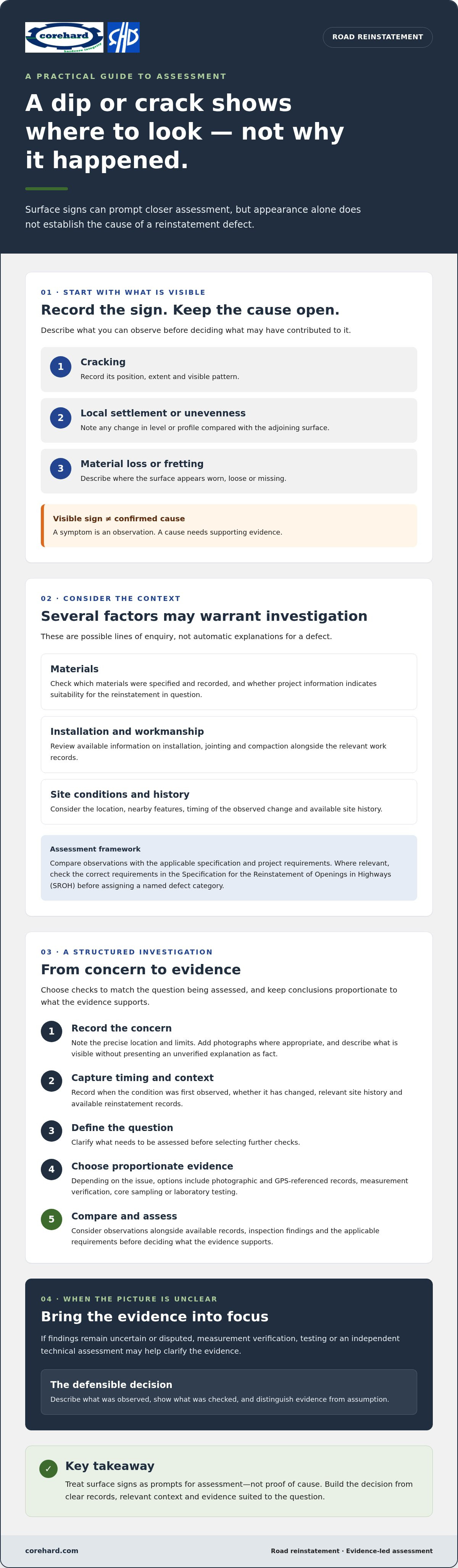
A practical process for recording and investigating road reinstatement failures
An unclear record can make a straightforward concern harder to assess. A consistent process helps teams move from an initial observation to an evidence-based decision without treating a visible symptom as a confirmed cause. The sequence below is an editorial framework, not a substitute for required procedures, project requirements or the applicable reinstatement specification.
Define the issue before choosing an investigation
Turn a broad concern into a focused question. Is the issue the location or extent of a surface change, a measured level, or uncertainty about reinstated materials? Check what information is already available and what remains unknown. Choosing a test before agreeing the question and relevant comparison criteria can produce results that do not resolve the concern.
A practical sequence is:
- Record the concern: describe what is visible, where it is and when it was noted.
- Review the context: gather relevant project information, reinstatement records and previous observations.
- Define the question: state what needs to be established and which applicable requirements or criteria should inform the assessment.
- Gather proportionate evidence: use existing records and inspection first, then consider further measurement or investigation if a clear question remains.
- Assess the findings: distinguish what the evidence establishes from what remains uncertain before deciding on next steps.
Record findings so decisions remain traceable
Make the record useful to someone who was not at the site. Include a clear description, date and location, with photographs that show both the detail and its setting. GPS-referenced records can help identify the observation’s position, while project information may connect it to the relevant works. Digital reporting can bring photographs and location details together in an accessible evidence trail.
Keep the record structured: separate direct observations and measurements from technical interpretation, then state any recommendation and the evidence supporting it. For example, note that a surface is uneven as an observation; do not record a cause unless the assessment supports that conclusion. Where details are missing, identify the gap instead of filling it with an assumption.
For wider context on street-works obligations and compliance, see this NRSWA compliance consultancy guide. Applying relevant requirements is essential when assessing common road reinstatement failures, while a traceable evidence trail helps explain how a decision was reached.
Corehard’s street-works inspection and assessment support includes independent inspection and technical support for reinstatement quality assessment.
How independent technical assessment can support reinstatement decisions
Where a reinstatement concern is uncertain or disputed, the next decision may depend on evidence beyond the initial observation. Independent technical assessment can provide an impartial view of the recorded condition and relevant investigation findings, helping decision-makers understand what is supported and what remains unresolved. It does not guarantee a particular conclusion or determine the appropriate outcome on its own.
What Corehard's independent technical support covers
Corehard operates independently of utility companies and contractors. Its stated support includes street-works inspections and reinstatement quality assessments, alongside material and pavement investigations. This can help examine a specific concern through appropriate evidence, rather than infer the cause of a visible defect from appearance alone.
Depending on the question being assessed, evidence-gathering may include:
- Inspection and reporting: digital reporting can include photographic evidence and GPS-referenced records to document observations and their location.
- Measurement verification: checking recorded measurements where dimensions or levels are part of the concern.
- Material and pavement investigation: examining relevant aspects of the pavement where the available evidence indicates this may help.
- Core sampling and laboratory testing: gathering and testing a sample when that method is appropriate to the issue under review.
Choosing a proportionate next step
Before arranging further assessment, clarify what remains uncertain and what evidence could address it. Confirm the applicable reinstatement specification, project requirements and any relevant test criteria before relying on a comparison. This keeps the investigation focused and helps avoid conclusions that extend beyond the findings.
For organisations reviewing common road reinstatement failures, independent input may be useful when parties interpret the condition differently or existing records leave important questions open. A technical assessment can document observations and present evidence for consideration, while the decision-maker remains responsible for applying the relevant requirements to the case. Where confirmed defects require re-excavation or surface repairs, having reliable plant machinery on site is crucial, and contractors can discover Rocket Rentals Ltd for specialist equipment hire.
Make your next reinstatement decision evidence-led
A surface defect deserves attention, but a reliable decision depends on more than appearance. Record what can be observed, check it against the relevant project information and specification, and keep possible causes provisional until evidence supports a conclusion. Select further investigation to answer a defined question rather than assuming every concern needs the same checks.
This approach brings greater clarity to common road reinstatement failures, particularly when the condition is uncertain or accounts differ. Independent technical input may help assess the evidence without presuming a particular finding. Corehard operates independently of utility companies and contractors, with stated support including reinstatement quality assessments, material and pavement investigations, and digital reporting that can include photographs and GPS-referenced records.
If you have an unresolved reinstatement concern, contact Corehard to discuss independent reinstatement assessment.
Frequently Asked Questions
What are common road reinstatement failures?
Common visible concerns include cracking, settlement, surface irregularity and material loss. These signs may warrant closer assessment, but they do not establish that a reinstatement has failed or identify the cause. Record what is visible and consider its location, extent and context alongside available site records. Check the relevant project requirements and applicable specification before assigning formal defect terminology or deciding whether the condition meets an acceptance criterion.
Why do road reinstatements fail?
Potential contributing factors may include materials, workmanship, the interface with the existing pavement or local site conditions. These are possibilities to investigate, not conclusions that can be drawn from appearance alone. Document the condition, review available reinstatement and project information, and identify what remains uncertain. Check any proposed technical explanation against the applicable reinstatement specification and evidence from the site.
How can you identify a failed road reinstatement?
Start by recording the location, date, visible condition and relevant site context, using clear photographs where useful. Then compare the observations with the project requirements and applicable specification, rather than relying on appearance alone. If the extent or significance of the condition remains unclear, define the question that needs answering. Measurement verification, pavement investigation or testing may be appropriate if they can provide relevant evidence.
Can a visual inspection confirm the cause of a reinstatement defect?
No. A visual inspection can document visible symptoms and help identify what needs further assessment, but it may not establish the underlying cause. Review relevant site records and context, and consider further investigation if important uncertainties remain. In reporting findings, distinguish observed facts from interpretation and recommendations. Any conclusion should be supported by appropriate evidence and considered against the requirements that apply to the specific work.
What evidence helps investigate road reinstatement failures?
Useful evidence may include dated photographs, precise location information, inspection observations and relevant reinstatement or project records. The appropriate additional evidence depends on the question: measurement verification may address dimensions or levels, while material or pavement investigations may examine other concerns. Core sampling and laboratory testing may also be relevant. Confirm applicable criteria before testing and interpret results in the context of the work and site evidence.
When should an independent technical assessment be considered?
Consider independent assessment when the condition, extent or possible cause remains uncertain, or impartial evidence would help inform a decision. Agree the question to be investigated and confirm the applicable requirements before selecting a proportionate scope. Corehard operates independently of utility companies and contractors; its stated technical support includes reinstatement quality assessments, material and pavement investigations, measurement verification, core sampling and laboratory testing. These methods support assessment, but do not guarantee a particular finding.


