

An asset count alone won’t tell you whether a survey will support the decisions your authority needs to make. The value of street lighting asset surveys lies in the quality and consistency of the evidence, how clearly findings relate to the assets, and whether the reporting helps people take the next step.
If the scope is unclear, proposals are difficult to compare and important information can be missed. Start by defining the decisions the survey must inform, then specify the evidence and reporting needed to support them.
This guide explains how to set a practical scope, assess the quality and usability of survey evidence, and compare proposals against the same requirements. It also covers preparation and how asset surveys and condition reporting can contribute to wider asset-management planning, including street lighting PFI transition decisions.
Key Takeaways
- Define the decisions the survey must inform before setting its scope.
- Assess whether evidence is clear, traceable and practical for your authority to use.
- Set out reporting requirements before comparing proposals, then assess each against the same brief.
- Gather existing asset information and identify known gaps to make the brief more precise.
- Corehard provides asset surveys and condition reporting, asset inspections and condition assessments to support authorities’ asset-management requirements.
What should a street lighting asset survey help your authority decide?
Survey work is easier to scope and evaluate when the authority knows what decisions the findings need to inform. Without that purpose, a survey may produce accurate information that is difficult to apply. An asset count is one possible output, but it should not be treated as the objective unless that is what the authority needs.
A street lighting asset survey is the structured collection and assessment of information about lighting assets, carried out to help an authority understand what it manages and inform defined decisions. The assets, information and assessment required depend on the project brief. There is no single scope that suits every authority.
Start with the decisions the survey needs to support
First, define the immediate need. Is the authority seeking a clearer understanding of its asset base, a condition assessment, better reporting, or evidence to inform transition planning? These purposes may overlap, but they can call for different information. An inventory requirement, for example, is not the same as a condition review or a survey supporting PFI transition planning.
Separate the immediate task from longer-term asset-management questions. A report prepared for a specific decision may need a focused evidence base, while longer-term planning may call for information that can be reviewed over time. State both requirements in the brief and identify which outputs are essential. This makes it easier to judge whether a proposal is relevant rather than simply comprehensive.
Background on street-lighting components, control systems and maintenance can be found in the Street light Wikipedia article. Use this as general context, not as a substitute for defining what your authority needs the survey to establish.
Set boundaries around the survey scope
List the assets and information that relate directly to the decisions in the brief. Then identify what the authority already knows, what is missing or uncertain, and whether any gaps could affect the work. This helps keep the scope focused on information that has a clear purpose rather than collecting every conceivable data point.
Describe the assessment and deliverables required for each project. If the survey is intended to support condition reporting, state what the authority needs to understand from the assessment and how findings should be presented. If it relates to transition planning, identify the specific questions the evidence is expected to inform.
Keep survey evidence distinct from the decisions that follow. Findings can inform maintenance planning, reporting or PFI transition work, but do not determine the authority’s priorities or choices. A well-defined scope gives decision-makers a clearer basis for reviewing the evidence, understanding its limits and deciding what further action is appropriate.
Which survey evidence and reporting features should you assess?
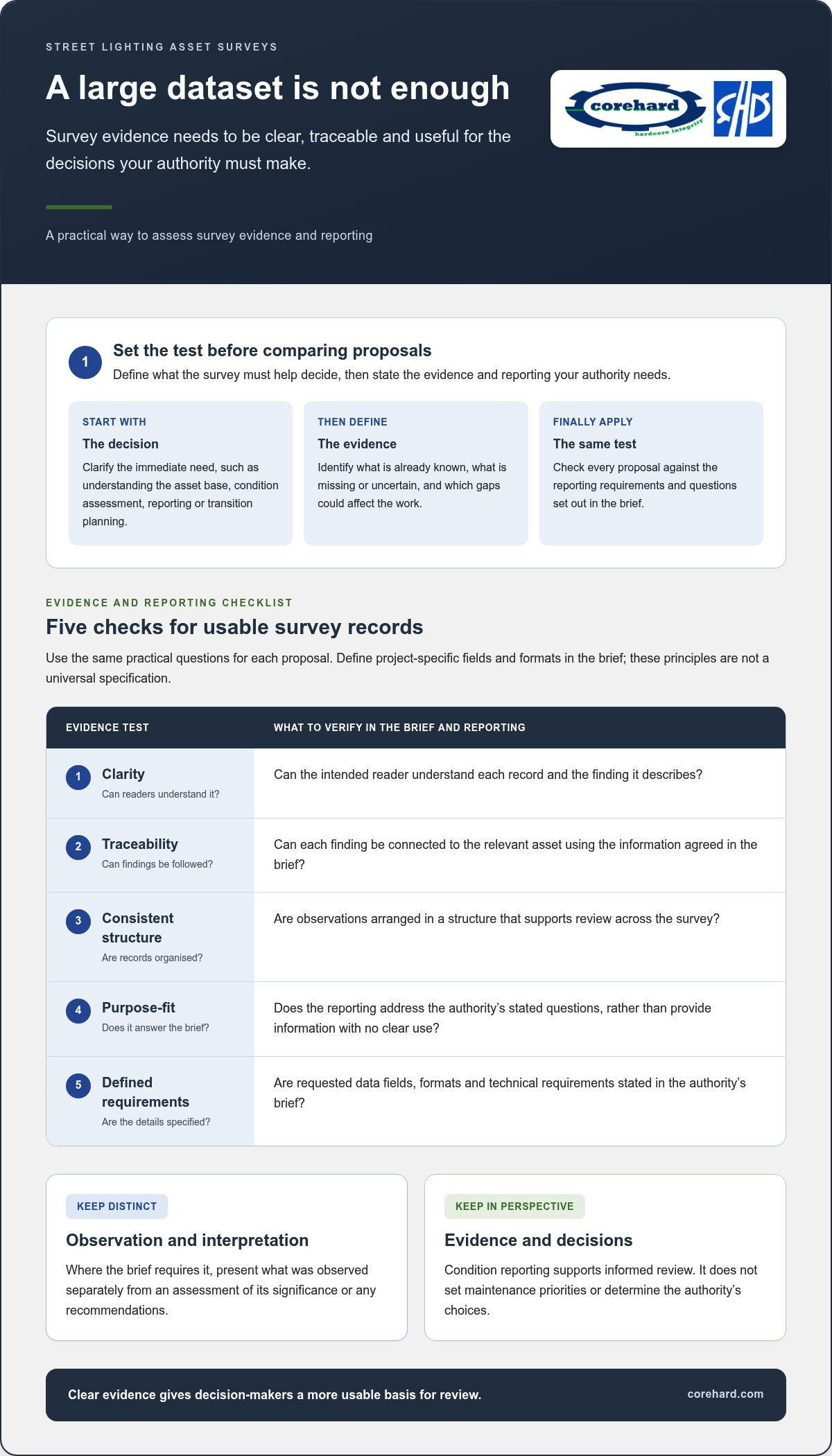
Survey information can be extensive and still fall short if readers cannot connect a finding to the relevant asset or understand what it means. Before comparing proposals for street lighting asset surveys, define the reporting outputs your authority needs. Then apply the same practical test to each: will the proposed evidence answer the questions in the brief?
Use this checklist to assess whether the records will be clear, traceable and useful:
- Clarity: Can the intended reader understand each record and the finding it describes?
- Traceability: Can a finding be connected to the relevant asset using the information agreed in the brief?
- Consistent structure: Are observations organised in a way that supports review across the survey?
- Purpose-fit: Does the reporting address the authority’s stated questions, rather than provide information with no clear use?
- Defined requirements: Are requested data fields, formats and technical requirements stated in the authority’s brief?
These are evaluation principles, not a universal specification. Define project-specific fields and formats according to the authority’s needs. Do not assume that the same technology, evidence format or data structure is necessary for every survey.
Check whether evidence is clear and traceable
A useful record should show which asset a finding relates to and how that finding appears in the report. Specify how observations should be documented and linked to the agreed reporting structure. This allows reviewers to follow the evidence without relying on unwritten assumptions.
Where the brief requires it, distinguish recorded observations from interpretation or recommendations. For example, a report can present what was observed separately from an assessment of its significance. Keeping these elements clear helps decision-makers see what the evidence says and where professional judgement has been applied.
Assess whether reporting will support real decisions
Consider who will use the report and what they need to do with it. An asset-management team, reporting lead and staff involved in transition planning may need to review the same evidence for different purposes. Make sure the reporting structure reflects the questions in the brief and makes relevant findings accessible to their intended users.
Clear condition reporting supports informed review by presenting findings in an organised, understandable way. It does not determine maintenance priorities or guarantee a particular operational or financial outcome. Its value is in giving the authority a more usable basis for considering next steps.
Corehard’s asset surveys and condition reporting support authorities in assessing survey and reporting requirements against their intended use of the findings.
How can you compare street lighting asset survey proposals fairly?
Proposals can look similar at first glance while covering different work. To compare street lighting asset surveys fairly, give each proposal the same brief and assess how clearly it responds to the same objectives, evidence needs and reporting expectations.
A comparison table helps show what is included, what is assumed and where proposals differ. Use consistent headings for each submission:
| What to compare | |
|---|---|
| Scope | Whether the assets, assessment tasks and intended outputs are described clearly against the brief. |
| Evidence | How the proposal explains the recording and presentation of findings, and how these relate to the relevant assets. |
| Reporting | Whether the proposed report structure addresses the authority’s questions and can be used by its intended readers. |
| Project fit | How directly the approach supports the stated purpose, such as asset understanding, condition assessment or transition planning. |
| Assumptions | Any exclusions, dependencies or project-specific requirements that could affect what the work covers. |
Compare scope and project fit
Start with the authority’s objectives, not differences in proposal wording. For each submission, note which assets it covers, what assessment work it describes and what outputs it proposes. If a proposal uses broad terms, record what remains unclear instead of assuming that it matches another offer.
Make assumptions visible. One proposal may depend on information supplied by the authority; another may exclude a requirement that matters to the brief. Record these points separately so decision-makers can see whether a difference reflects project fit or a different interpretation of the requested work.
Compare reporting and professional capability
Assess whether each proposal explains how its reporting will serve the people who need to review the findings. For example, assess a report intended to support condition review against the authority’s stated questions, not simply by its length or presentation.
Look for relevant evidence in the proposal about asset inspections, condition assessments and reporting. Specific explanations of how the work relates to the brief are more useful than generic assurances. Apply the same test to every submission, recording where evidence is provided, where information is assumed and where a requirement remains unanswered.
Fair comparison depends on consistency: use one brief, shared evaluation headings and a clear record of differences. This gives the authority a reasoned basis for identifying the proposal that best aligns with its requirements, without treating unstated assumptions as standard features.
How should an authority prepare for a street lighting asset survey?
A well-prepared brief can prevent avoidable uncertainty once survey work is under way. Before commissioning street lighting asset surveys, bring the purpose, existing information and intended use of the findings into one clear project discussion.
Build a clear survey brief
Use this sequence to turn broad requirements into a brief that can be understood and assessed:
- Define the decisions. State whether the survey will support asset understanding, condition review, reporting, transition planning or a combination of these.
- Set the scope. Identify the assets relevant to those decisions and describe the assessment work the authority wants considered.
- Specify information needs. Set out the information the authority needs to review, including any project-specific data fields or requirements.
- Identify constraints and dependencies. Note known gaps, relevant project dependencies and matters that need to be addressed during planning.
- Agree reporting expectations. Describe the outputs needed, who will use them and what questions they should help answer.
This sequence gives the authority a practical basis for setting scope without assuming that every project needs the same methods or deliverables. It also helps distinguish essential requirements from preferences, making the brief clearer for everyone involved.
Prepare existing information and stakeholders
Bring together relevant asset records already held by the authority, whatever system or format they use. Note information that appears incomplete, inconsistent or uncertain. Identifying these gaps early helps shape the project requirements without assuming that any one system contains a complete record.
Be specific about people as well as information. Identify who will review the findings, who needs to use the report and how it will inform internal discussions or decisions. If the intended use includes condition review and transition planning, make sure both sets of questions are represented in the brief. An infrastructure asset condition assessment guide can also help teams consider how evidence about condition fits into wider asset-management discussions.
These steps help an authority prepare a focused brief about survey requirements and reporting value. Corehard provides asset surveys and condition reporting, asset inspections and condition assessments. Explore Corehard’s asset survey and reporting services.
How Corehard supports street lighting asset surveys and reporting
A survey is most useful when its scope and reporting align with the decisions an authority needs to make. Corehard provides Asset Surveys & Condition Reporting to support authorities’ asset-management requirements, with the work focused on the project’s objectives and the intended use of the findings.
Align survey and condition reporting with authority requirements
Start by clarifying what the authority needs to understand and who will use the resulting information. The purpose may relate to asset understanding, condition review, reporting or a wider planning requirement. Setting that context helps establish a scope that fits the project rather than assuming every authority needs the same approach.
Corehard provides asset surveys and condition reporting, alongside asset inspections and condition assessments. Assess the services against the framework in this guide: how the scope relates to the brief, what evidence the authority needs to review, and how reporting should support its intended use. Define the specific methods, formats and deliverables around the project requirements.
This keeps the focus on practical fit. The authority can set out its objectives, relevant existing information and reporting needs, then assess how the survey and condition reporting align with them.
Consider survey evidence within a wider PFI transition
Where a street lighting project involves PFI transition planning, asset information may form part of the wider context. Identify the questions the survey evidence is expected to inform, while keeping the survey scope distinct from broader transition decisions. Corehard also provides Street Lighting PFI Transition Advisory for authorities whose projects include this area of planning.
For further context, the guide to street lighting PFI expiry and strategic handback explores wider transition considerations. Read alongside a clearly defined survey brief, it can help authorities consider how asset information relates to their planning needs.
Corehard’s asset survey and reporting work can be aligned with your authority’s objectives, information requirements and intended use of findings. Discuss your street lighting survey requirements with Corehard to frame the project around the decisions your evidence needs to support.
Make your next survey decision with confidence
The strongest street lighting asset surveys are shaped around the decisions an authority needs to make, not simply the number of assets recorded. A clear brief, consistent proposal comparison and reporting designed for its intended users help turn survey information into a practical basis for review and planning.
Before commissioning work, define the scope and evidence your authority needs, gather relevant existing information and agree how findings should be presented. These steps make it easier to assess whether a survey and report fit your project, including where asset information may inform wider planning or a PFI transition.
Corehard provides Asset Surveys & Condition Reporting, alongside asset inspections and condition assessments. Explore Corehard’s asset survey and reporting services.
A considered brief is a practical first step towards clearer evidence and more confident asset decisions.
Frequently Asked Questions
What is a street lighting asset survey?
A street lighting asset survey is the structured collection and assessment of information about an authority’s lighting assets. It helps the authority understand the assets within scope and inform decisions such as condition review, reporting or planning. The precise scope depends on the authority’s objectives, so the term does not imply one universal specification. A clear brief sets out what the survey should establish and how the findings will be used.
What should a street lighting asset survey include?
A street lighting asset survey should include the assets, information and assessment work needed to meet the authority’s stated objectives. The brief might focus on understanding the asset base, assessing condition or gathering information for reporting. Define these needs for each project rather than assuming a standard scope. Agree the data fields, evidence requirements and reporting outputs in advance, and specify project constraints or dependencies that could affect how findings are recorded or reviewed.
How do you compare street lighting asset survey providers?
Compare proposals against the same written brief, using consistent headings such as scope, evidence, reporting, project fit and assumptions. Check whether each clearly describes the assets and work included, how findings will be documented and whether reporting addresses the authority’s intended decisions. Record exclusions and dependencies separately, and assess claims against the evidence in the proposal. This makes differences easier to evaluate without treating unstated assumptions as standard features.
Why is condition reporting important in a street lighting survey?
Condition reporting organises assessment findings so the authority can review them against its intended purpose. Clear reporting helps readers understand which asset a finding relates to and, where required by the brief, distinguish recorded observations from interpretation or recommendations. This can support consideration of maintenance or asset-management questions, but the report does not make those decisions for the authority or guarantee a particular outcome. Define the reporting requirements before commissioning the work.
Can street lighting asset survey findings support a PFI transition?
Survey findings may provide relevant asset information for an authority’s street lighting PFI transition planning when the survey scope reflects the questions that work needs to address. The survey remains distinct from wider transition decisions: evidence can inform consideration, but it does not determine the authority’s approach. Corehard provides Street Lighting PFI Transition Advisory alongside asset surveys and condition reporting, linking these services where they are relevant to the project.


