

A street works defect notice is only as defensible as the dimensional measurements and photographic proof underpinning it. Operating an exacting street works defect inspection process under the New Roads and Street Works Act 1991 (NRSWA) has become essential as authorities face protracted dispute cycles with statutory undertakers. Without unassailable data, defect notifications are routinely contested and overturned, shifting the financial burden of sub-standard compaction and premature asset deterioration directly onto highway authorities.
Asset managers recognise how difficult it is to monitor reinstatement quality across extensive networks when internal inspection resources are stretched thin. This guide provides the strategic framework needed to master statutory inspections, enforce contractor compliance, and protect capital highway assets against long-term structural failure. From aligning non-conformance records with the SROH Fourth Edition to establishing an airtight digital audit trail, you will learn how to resolve liability disputes decisively while minimising the operational burden on your team.
Key Takeaways
- Mastering the statutory street works defect inspection process under NRSWA enables highway authorities to establish clear undertaker liability and secure enforceable remedial outcomes.
- Navigating the structured three-stage defect escalation procedure ensures rigorous adherence to notice timeframes, preventing legitimate non-conformance claims from lapsing.
- Applying precise SROH Fourth Edition performance benchmarks allows asset teams to distinguish safety-critical intervention thresholds from structural defects with total clarity.
- Capturing calibrated dimensional measurements alongside GPS-referenced photographic evidence eliminates the evidential omissions utilities exploit to overturn notices.
- Deploying independent technical assurance delivered by inspectors qualified to the NRSWA supervisors standard safeguards capital asset longevity whilst removing operational strain from internal teams.
Statutory Foundations of the Street Works Defect Inspection Process
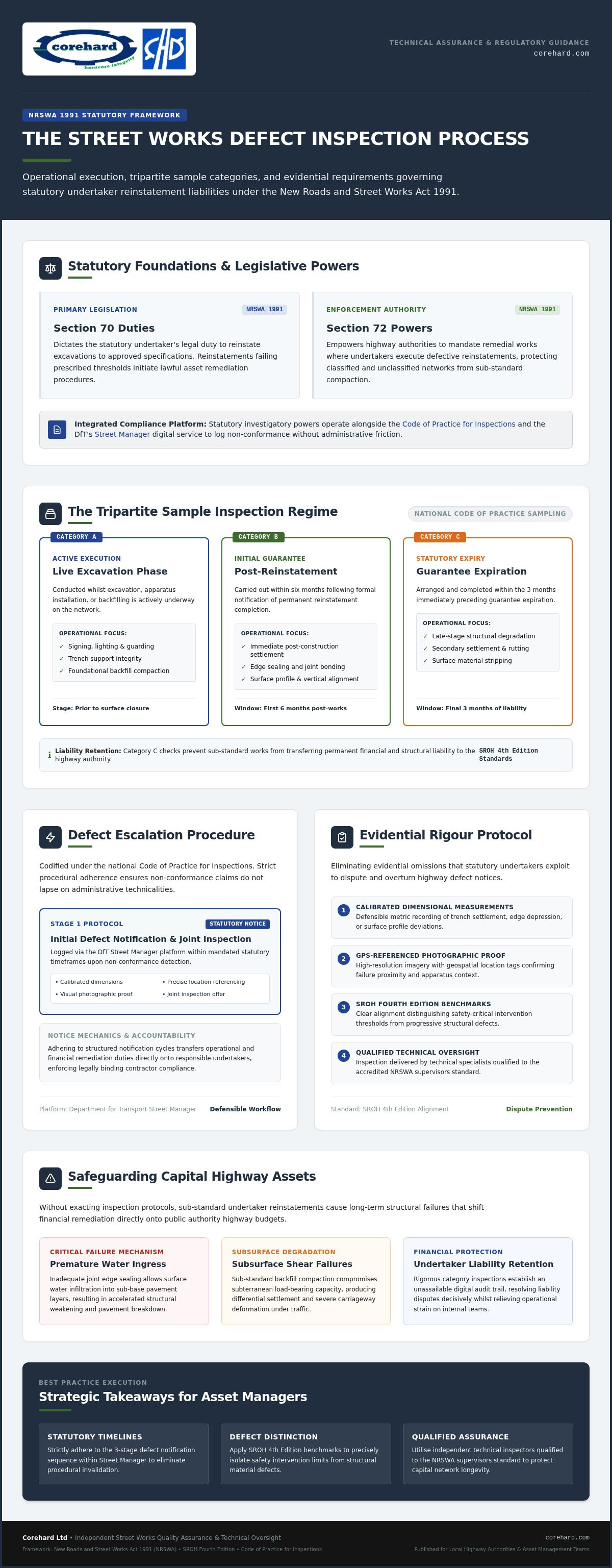
Executing an enforceable highway oversight regime requires an uncompromising grasp of primary legislation. Under the New Roads and Street Works Act 1991 (NRSWA), highway authorities hold explicit supervisory powers to inspect, evaluate, and challenge interventions executed by utility companies. Understanding the Statutory Foundations of the Street Works Defect Inspection Process allows network managers to establish clear lines of liability when apparatus installations compromise carriageway or footway stability. Section 70 dictates the undertaker's statutory duty to reinstate their excavations to approved specifications. When reinstatements fail to meet required thresholds, the street works defect inspection process provides the lawful mechanism to secure comprehensive asset remediation.
Legislative Framework: NRSWA 1991 and Associated Codes
Section 72 of NRSWA establishes the authority to mandate remedial works where undertakers execute defective reinstatements. Highway authorities exercise these statutory investigatory powers across all classified and unclassified networks. These statutory powers operate directly alongside the statutory Code of Practice for Inspections. By linking these provisions with modern digital permitting platforms such as the Department for Transport's Street Manager service, compliance teams can log non-conformance without administrative friction. Rigorous compliance monitoring directly protects structural pavement layers from premature water ingress and subsurface shear failures, safeguarding public capital assets from unchecked degradation.
The Tripartite Inspection Categories under National Standards
Quantifying utility performance relies on a structured, three-phase sample regime defined within national codes of practice. Rather than inspecting ad-hoc, authorities deploy a disciplined sampling methodology structured across three distinct operational phases:
- Category A Inspections: Executed while excavation or apparatus placement is actively underway. These inspections confirm appropriate signing, lighting, and guarding compliance, trench support, and foundational backfill compaction before surface material closure.
- Category B Inspections: Carried out within six months following the notification of a permanent reinstatement. They evaluate immediate post-construction settlement, edge sealing, joint integrity, and surface profile alignment.
- Category C Inspections: Arranged and completed within the three months immediately preceding the expiration of the statutory guarantee period. These checks identify late-stage structural degradation, material stripping, or secondary settlement before statutory liability transfers permanently to the public authority.
Disciplined category inspections create an uninterrupted paper trail across the life of the intervention. When non-conformance is identified during any of these stages, the statutory street works defect inspection process formally escalates, transferring financial and operational remediation duties directly to the responsible utility undertaker.
The Three-Stage Defect Procedure: Operational Execution and Notice Mechanics
Executing an enforceable defect management workflow demands precise alignment with statutory timelines. When non-conformance is identified, authorities cannot rely on informal correspondence. Instead, the statutory street works defect inspection process requires a structured, three-stage escalation sequence codified under the national Code of Practice for Inspections. Navigating these stages correctly ensures that undertakers remain legally accountable for sub-standard works, preventing legitimate notices from being dismissed on administrative technicalities.
Stage 1: Initial Defect Notification and Joint Inspection Protocol
The process initiates the moment an inspector records a non-conformance. Authorities must log the formal defect notice through the Department for Transport's Street Manager platform within the mandated statutory timeframe. The notice must contain exact dimensional measurements, precise location referencing, and clear imagery of the failure.
Upon notification, the undertaker has a defined window to respond. If liability is disputed, either party can request a joint site inspection. During this site review, technical representatives inspect the failure against specification limits, agree upon the remedial scope, and confirm immediate ownership of site safety measures to mitigate public risk.
Stage 2: Monitoring Remedial Works and Traffic Management Verification
Stage 2 commences once the undertaker undertakes physical remediation. Highway compliance officers monitor the intervention to ensure total adherence to statutory safety codes. Network managers must actively verify the following operational controls:
- Site safety standards: Complete adherence to signing, lighting, and guarding requirements specified in the Safety Code.
- Permit compliance: Verification that remedial interventions operate within sanctioned permit windows, avoiding unauthorized road occupancy and potential Section 74 overrun charges.
- Material standards: Visual confirmation that the undertaker is excavating back to sound materials and executing full saw-cut edges.
Managing this stage with structured protocols ensures that the remedial intervention does not induce secondary failures in the surrounding pavement structure. For contractors and asset managers seeking to uphold broader operational standards and workforce compliance, accredited vocational programmes from providers such as insightsecurity.ie offer valuable insight into professional risk and safety education.
Stage 3: Post-Rectification Warranty and Final Close-Out
Stage 3 concludes the enforcement cycle following the utility's completion of permanent remedial works. Inspecting officers conduct a comprehensive post-completion review to verify that the replacement surface meets specified profile, skid resistance, and compaction tolerances. Once signed off, the remedial work triggers a fresh statutory guarantee period, resetting the warranty clock for the intervention. The defect record is formally resolved within Street Manager, concluding the statutory cycle. When managing high volumes of complex utility notifications, local authorities often engage specialized NRSWA compliance consultancy to streamline notice administration and maintain an airtight evidential register.
Defect Categorisation and SROH Performance Criteria
Enforcing compliance during the street works defect inspection process requires an objective technical baseline. Subjective opinions from field inspectors carry little weight in formal disputes; instead, every recorded failure must align strictly with the performance parameters defined in the statutory SROH reinstatement specification. Operating within the SROH Fourth Edition framework, compliance officers must apply precise dimensional criteria to separate acceptable material settling from actionable structural defects. Integrating these standards with wider infrastructure asset condition assessment programmes ensures that sub-standard interventions are intercepted before they compromise the underlying road base.
Emergency, High-Risk, and Non-Dangerous Defect Classifications
Every logged defect requires immediate risk triage to govern response urgency. National inspection codes distinguish non-compliance through clear operational priorities:
- Emergency defects: Failures presenting immediate physical peril to public safety, such as collapsed trenching, unsupported voids, or broken ironwork. These trigger immediate authority make-safe actions if the promoter fails to attend instantly.
- High-risk defects: Significant hazards that do not constitute immediate structural collapse but exceed acceptable safety envelopes, such as sharp vertical trips exceeding 25mm in high-footfall pedestrian zones. Undertakers are mandated to mobilize and rectify the issue within expedited two-hour windows.
- Non-dangerous defects: Structural or profile departures from the specification, including moderate edge fretting or surface depressions outside intervention limits. These are managed via statutory working-day programmes, typically requiring permanent resolution within 28 days.
Classifying these failures accurately avoids administrative challenges while ensuring emergency resources target genuine highway hazards.
SROH Tolerances: Surface Profile, Settlement, and Edge Cracking
Evaluating reinstatement durability requires calibrated measurement rather than visual estimation. Inspecting officers assess edge cracking, fretting, and structural displacement using a graduated rolling straightedge or wedge gauge placed across the intervention.
Under the SROH Fourth Edition, intervention limits govern surface profiles. Depressions, crowning, and edge stepping are recorded against explicit thresholds across 1-metre and 2-metre spans. Excessive settlement often points to systemic failures beneath the asphalt, including insufficient granular sub-base compaction, inappropriate lift thicknesses, or compromised backfill materials. In addition to profile integrity, inspectors review surface sealing, joint durability, texture depth, and skid resistance. When surface sealants degrade or joints open wider than statutory limits, water permeates the structural layers. Establishing that a defect violates these quantifiable thresholds ensures your notice remains unassailable throughout the entire street works defect inspection process.
Evidential Rigour: Eliminating Invalidation and Defect Disputes
Vague defect notices create friction and generate costly dispute cycles. When an authority issues a notice, undertakers routinely examine the submission for administrative omissions or ambiguous measurements to justify formal challenges. Perfecting the street works defect inspection process requires an unshakeable evidence package that proves non-compliance before the undertaker can formulate a technical defence.
Standardised Digital Evidence: Photographic and Positional Rigour
To survive utility scrutiny, photographic submissions must follow a disciplined three-tier capture protocol:
- Contextual imagery: Wide-angle framing that establishes the reinstatement's position relative to permanent local landmarks and building lines.
- Intermediate framing: Mid-range photography capturing the full perimeter of the opening, showing joint interfaces and road markings.
- Close-up metric records: Macro imagery displaying calibrated metric wedge gauges or straightedges placed directly across the non-conforming profile to record millimetric deviations.
Every digital image must contain tamper-evident metadata, including automated timestamps and GPS coordinates accurate to within statutory tolerances. Integrating these records directly into Street Manager creates an unalterable audit trail. This level of technical oversight mirrors the evidential discipline applied across lane rental scheme operational governance, where transparent data prevents operational gridlock.
Mitigating Defect Notice Challenges and Dispute Escalation
Undertakers challenge notices most frequently on procedural grounds. Mismatched permit references, imprecise descriptions like "settled trench," or insufficient proof distinguishing pre-existing road wear from fresh excavation failures remain primary dispute drivers. Inspecting teams must log exact dimensions, quantify specific material breaches against the SROH, and corroborate findings against historical highway condition records.
When an undertaker contests liability, presenting a clear evidentiary dossier allows compliance teams to conduct decisive joint site meetings that resolve disputes swiftly. Highway authorities can partner with Corehard for independent compliance oversight to secure dispute-ready digital evidence that protects capital assets while removing administrative strain from internal teams.
Deploying Independent Assurance and Technical Street Works Oversight
Operating a defensible statutory oversight regime often strains local authority resources. With thousands of utility notices processed annually, internal teams struggle to maintain visual surveillance across expanding networks. Engaging an independent technical partner eliminates institutional resourcing bottlenecks while introducing commercial impartiality to the street works defect inspection process. Independent inspections remove perceived bias during disputes, ensuring that every non-conformance notice stands up to utility scrutiny. Independent monitoring models frequently recover their operational expenditure through statutory inspection fees and substantiated defect charges, creating a self-sustaining compliance framework for local authorities.
The Value of NRSWA Supervisor-Qualified Independent Inspectors
Technical credibility rests on the qualifications of the inspecting personnel. Corehard ensures that all inspectors are qualified to NRSWA supervisors standard, providing the deep technical acumen needed to assess complex utility excavations objectively. Drawing from a proprietary database holding more than 125,000 completed inspections, these specialists evaluate multi-utility trench configurations with total consistency. Independent deployment also delivers immediate operational relief. By providing secure access for over 110 client accounts, digital reporting platforms transmit GPS-referenced inspection records and calibrated photographic logs directly into Street Manager, eliminating the administrative burden on internal highway engineering staff.
Advanced Technical Backing: Core Sampling and Materials Testing
Visual surveys cannot always reveal what lies beneath the binder course. When undertakers dispute compaction standards or layer depths, non-destructive surface evaluations reach their limit. Definite proof requires moving from visual inspection to forensic material verification:
- Volumetric air void determination: Extracting core specimens to evaluate compaction levels against SROH bulk density requirements.
- Constituent layer measurement: Measuring exact binder and surface course thicknesses to identify unapproved structural reductions.
- Material verification: Testing asphalt mixtures to confirm compliance with approved constituent grading curves.
Integrating visual inspections with a dedicated UKAS accredited highways testing laboratory establishes an unbroken chain of custody. This forensic approach resolves complex, high-liability disputes decisively. By combining visual compliance audits with accredited laboratory testing, authorities secure unshakeable legal certainty across every phase of the street works defect inspection process.
Securing Long-Term Asset Integrity Through Evidential Precision
Protecting the road network demands far more than reactive monitoring. When highway authorities ground the street works defect inspection process in strict SROH Fourth Edition performance criteria and unassailable digital evidence, protracted liability disputes resolve quickly and long-term asset longevity is secured.
Corehard delivers that definitive technical assurance. With more than 125,000 completed inspections recorded within our secure database, our specialist team provides trusted compliance oversight for over 110 client accounts. Crucially, all inspectors are qualified to NRSWA supervisors standard, combining rigorous on-site defect logging with forensic backing from our independent UKAS-accredited testing laboratory to eliminate contractor pushback entirely. You don't have to carry the administrative or operational burden of network enforcement alone. Enhance your street works compliance with independent, dispute-ready inspection solutions and protect your capital highway assets with complete confidence.
Frequently Asked Questions
What is the statutory definition of a street works defect under NRSWA 1991?
Under NRSWA 1991, a street works defect is any failure by a statutory undertaker to execute reinstatement obligations in compliance with Section 70 and Section 72. This includes departures from the Specification for the Reinstatement of Openings in Highways (SROH), such as unapproved materials, insufficient layer depths, inadequate compaction, surface irregularities, or failed edge sealing. It designates any physical non-conformance that threatens asset longevity or public safety.
How quickly must an undertaker respond to a high-risk or dangerous defect notification?
Response times depend directly on the operational risk classification assigned during the street works defect inspection process. For emergency or high-risk defects presenting an imminent hazard to highway users, undertakers must attend site within two hours to execute make-safe measures or commence remedial repairs. If an undertaker fails to respond within this statutory window, the highway authority can deploy emergency teams and recover all reasonable costs.
What technical tolerances determine a surface profile failure under the current SROH?
Surface profile compliance is evaluated using calibrated straightedges and graduated wedge gauges measured across one-metre and two-metre spans. Under the SROH Fourth Edition, strict intervention limits govern maximum permissible crowning, depressions, and edge stepping. Depressions or crowning exceeding 10mm across a one-metre span typically breach tolerance limits. Stepping between adjacent surfaces or along edge joints exceeding 5mm also triggers an actionable defect notice requiring formal rectification.
Can an authority recover inspection and administrative costs for identified street works defects?
Yes, highway authorities hold explicit statutory powers under Section 72 of NRSWA and the Inspections Code of Practice to recover prescribed fees from responsible undertakers. When an inspection confirms a genuine defect, the authority can recover statutory fees for the initial failed inspection, the subsequent joint site review, and the final sign-off inspection following permanent remedial completion, alongside reasonable investigative expenses.
How does Street Manager handle the submission and tracking of statutory defect notices?
Street Manager operates as the central digital portal for issuing, tracking, and resolving notices throughout the street works defect inspection process. Inspecting officers upload precise geospatial locations, SROH defect categories, dimensional measurements, and photographic evidence directly against the original permit record. Undertakers receive instantaneous notification, enabling them to accept liability, coordinate joint site meetings, or schedule remedial works while maintaining an immutable digital audit log.
What happens if an undertaker fails to complete remedial works within agreed timeframes?
If an undertaker neglects statutory obligations or exceeds agreed rectification windows, the highway authority can exercise default powers under Section 72 of NRSWA. The authority is legally empowered to execute the necessary remedial works using its own contractors and recover all operational, administrative, and traffic management costs from the undertaker. Continued highway occupation beyond sanctioned permit dates also exposes the utility to daily Section 74 overrun charges.
Why is independent core sampling necessary when investigating subsurface reinstatement defects?
Visual surveys cannot evaluate whether subsurface layers satisfy mandatory compaction and material standards. Core extraction supported by a UKAS-accredited testing laboratory provides definitive physical evidence of constituent layer thickness, material grading, and air void percentages. When undertakers dispute structural settlement or alleged sub-base compaction failure, independent laboratory analysis delivers forensic proof that resolves contested defect liability decisively without subjective conjecture.


