
Following the legislative amendments in January 2026, the financial implications of street works overruns have reached a critical threshold, with Section 74 charges now accruing across every day of the week, including weekends and bank holidays. For infrastructure providers operating on category 0, 1, or 2 traffic-sensitive streets, the sudden escalation to £10,000 per day for prolonged occupation represents a profound risk to project viability and corporate reputation. You likely recognise that the complexity of managing NRSWA and TMA regulations simultaneously has made avoiding these penalties a significant operational challenge. This article demonstrates how professional Section 74 mitigation services provide the technical assurance and rigorous oversight necessary to protect your organisation from unreasonable charges. By shifting from reactive management to a strategy rooted in independent auditing and UKAS-accredited testing, you can secure reduced daily charges and foster more constructive relationships with highway authorities. We will examine the transition from regulatory complexity to operational clarity, focusing on the role of defensible technical evidence in disputing charges and maintaining compliance in an era of heightened enforcement.
Key Takeaways
- Gain a comprehensive understanding of the 2026 NRSWA legislative updates to manage the increased financial risks associated with daily overrun charges.
- Learn how professional Section 74 mitigation services utilise technical assurance to identify and neutralise common triggers for prolonged occupation penalties.
- Utilise UKAS-accredited laboratory testing as a strategic tool for generating the objective evidence required to successfully dispute unreasonable charges.
- Establish a rigorous five-step compliance framework that prioritises early defect detection and proactive notice management to protect your project budgets.
- Achieve a transition from regulatory complexity to operational clarity by integrating specialist advisory with dynamic assurance solutions.
The Statutory Basis of Section 74: Mitigating Risk in Street Works
Section 74 of the New Roads and Street Works Act 1991 (NRSWA) functions as the primary legislative mechanism for penalising works that exceed their agreed duration on the public highway. In the current 2026 regulatory environment, the concept of "unreasonable prolonged occupation" has become a central focus for highway authorities seeking to minimise traffic disruption. These authorities trigger charges as soon as the agreed permit duration expires or when a site remains occupied without a valid notice. For Statutory undertakers and their contractors, the strategic deployment of Section 74 mitigation services is now a fundamental requirement for protecting project budgets. Beyond the immediate financial penalties, consistent overruns can lead to the revocation of permit-to-work privileges, effectively halting an organisation's ability to deliver essential infrastructure projects.
The Legal Framework: NRSWA and TMA Explained
Distinguishing between the duties mandated by NRSWA and the Traffic Management Act 2004 (TMA) is essential for maintaining operational compliance. While NRSWA establishes the technical standards for reinstatements and the basic notice system, the TMA grants authorities the power to coordinate works through sophisticated permit schemes and lane rental governance. Compliance requires absolute precision in every notice sent. Any discrepancy between the permit data and the physical site presence can result in a failure to "close" a notice correctly, which remains a leading cause of avoidable charges. Professional Section 74 mitigation services bridge the gap between these two acts, ensuring that every permit application and works notice aligns with statutory requirements and actual onsite activity.
Commercial Impact of Overrun Charges
For organisations dealing with high-value overrun claims or complex statutory disputes, North East Barristers Chambers provides direct access to specialist legal counsel for businesses across the UK.
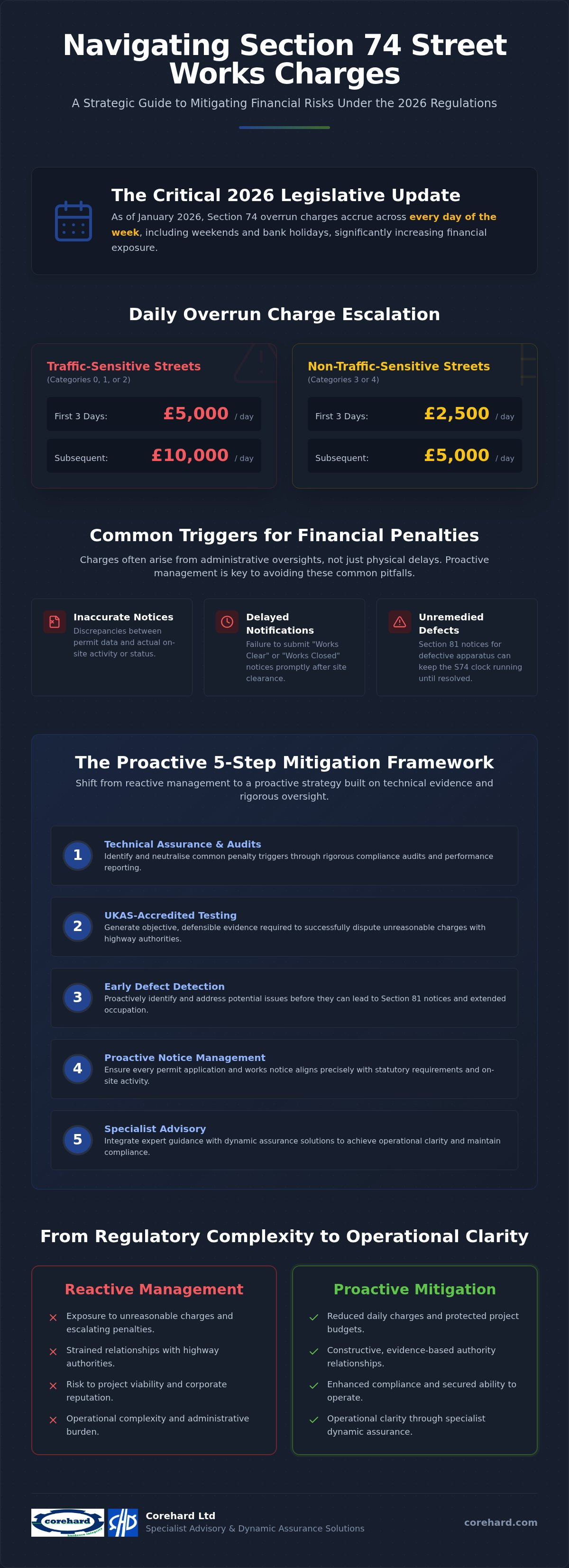
Financial penalties for street works overruns underwent a significant escalation on 5 January 2026, when charges were extended to cover all days, including weekends and bank holidays. For works occupying any part of the carriageway on category 0, 1, or 2 traffic-sensitive streets, the daily charge is £5,000 for the first three days, rising to £10,000 for every subsequent day. On non-traffic-sensitive streets in categories 3 or 4, the rates are £2,500 and £5,000 respectively. These direct costs are frequently exacerbated by the hidden administrative burden of managing disputes and the long-term degradation of authority relationships, which can lead to more restrictive permit conditions. According to HAUC(UK) guidance, the prescribed period is the duration defined by regulation for a specific works category, beyond which occupation is deemed unreasonable and subject to daily charges.
Analysing the Mechanics of Unreasonable Prolonged Occupation
Determining what constitutes a "reasonable duration" requires a precise understanding of the specific works category-whether Major, Standard, or Minor-and the traffic sensitivity of the street as defined by the local authority. Under Section 74 of the New Roads and Street Works Act 1991, the duration clock begins the moment the "Actual Start" notice is digitally submitted and continues until the "Works Clear" or "Works Closed" signal is verified by the authority's management system. Managing these stop and start signals with absolute accuracy is vital; any delay in notifying the authority of completion, even by a few hours, can trigger an automatic overrun charge under the strict 2026 charging regime. The situation becomes significantly more complex when Section 81 notices for defective apparatus are issued simultaneously. If an authority deems that the highway cannot be safely reopened due to defective apparatus, they may argue that the Section 74 clock should continue to run until the defect is remedied, leading to compounding financial penalties. Many infrastructure providers now utilise Section 74 mitigation services to audit these timelines in real-time, ensuring that technical disputes regarding site clearance don't escalate into multi-day overruns.
Common Triggers for Financial Penalties
Financial penalties often stem from administrative oversights rather than physical delays on the ground. Late submission of registration notices remains a primary trigger, as the authority cannot legally verify the completion of works without the corresponding digital record. Inaccurate site dimensions also pose a significant risk; if the physical works occupy more of the carriageway than specified in the original permit, the authority may invalidate the permit entirely and apply overrun charges for the total duration of the occupation. Additionally, the failure to remove traffic management equipment, such as temporary signals, cones, or advanced warning signage, after the works are physically complete is a frequent cause of prolonged occupation charges, as the site is not considered cleared until all equipment is removed.
Managing Unforeseen Delays and Extensions
Requesting an extension of the prescribed period requires a proactive approach and the provision of objective, technical evidence. When unforeseen circumstances, such as the discovery of unmapped utility assets or severe weather events, threaten the project schedule, you must submit a permit variation request before the existing permit expires. Authorities are increasingly rigorous in their assessment of these requests, frequently rejecting variations that lack detailed technical justification or photographic evidence. Establishing a direct line of real-time reporting from the site to the permit office ensures that every delay is documented as it occurs, creating a defensible record for any future disputes. For organisations seeking to sharpen their operational delivery and protect their budgets, engaging in NRSWA & TMA Advisory provides the strategic oversight needed to navigate these high-stakes regulatory transitions.
Technical Assurance as a Mitigation Tool: The Role of UKAS-Accredited Testing
The transition from administrative compliance to technical certainty represents the most effective strategy for managing the Statutory Basis of Section 74. While many organisations focus exclusively on notice accuracy, the physical quality of the reinstatement often dictates when an authority will allow the "Works Closed" status to be formalised. Utilising an independent UKAS Accredited Testing Laboratory ensures that every layer of the reinstatement meets the rigorous demands of the Specification for the Reinstatement of Openings in Highways (SROH). This objective data serves as an irrefutable record, protecting contractors from subjective authority claims that a site remains "unreasonably occupied" due to perceived defects. By integrating Section 74 mitigation services into the operational workflow, infrastructure providers can verify that their works are "first-time right," effectively closing the window for prolonged occupation charges before they escalate.
Independent Laboratory Support for Highways
Independent testing carries significantly more weight with highway authorities than internal quality checks, primarily because it removes the potential for bias in compliance reporting. When a third-party specialist conducts asphalt analysis or soil compaction testing, the resulting reports provide a level of technical mastery that authorities find difficult to dispute. Aligning site activities with SROH standards through verified laboratory data demonstrates a commitment to long-term asset integrity. This is particularly crucial for large-scale infrastructure projects where the cumulative cost of potential defects could jeopardise commercial margins. Objective evidence of material quality and compaction depth ensures that the transition from complexity to clarity is grounded in measurable industry standards.
Assurance vs. Reactive Management
Proactive technical assurance is a strategic investment that consistently outweighs the escalating daily fees of Section 74 overruns. For instance, utilising PANDA Penetrometer Hire allows for rapid, independent compaction verification without the delays associated with traditional testing methods. This real-time data prevents "re-excavation" orders, which are a common trigger for significant occupation extensions. Similarly, conducting Asset Surveys & Condition Reporting before and after works provides a clear baseline, ensuring that contractors aren't penalised for pre-existing highway degradation. For footway works, specialised slip resistance testing offers the absolute certainty required to sign off a site safely. Effective Section 74 mitigation services rely on this steady, methodical approach to compliance, moving away from frantic reactive management toward a verified, confident outcome.
Implementing Robust Compliance Audits and Performance Reporting
Establishing a comprehensive governance framework is the next logical progression after securing technical laboratory data. While individual site tests provide specific evidence, systemic Section 74 mitigation services rely on a structured auditing process to identify and neutralise risks across the entire project lifecycle. This methodical approach moves beyond simple notice management, creating a narrative of professional excellence that highway authorities recognise and respect. By integrating Dynamic Assurance & Compliance into your operational workflow, you can ensure that every statutory obligation is met with precision, reducing the likelihood of subjective penalties. A robust five-step framework for a streetworks compliance audit typically includes:
- Pre-works Baseline: Documenting the existing highway condition to prevent liability for pre-existing damage.
- Permit Synchronisation: Verifying that physical site dimensions and traffic management match the digital permit exactly.
- Technical Mid-point Audit: Conducting onsite inspections to ensure reinstatement materials and methods align with SROH standards.
- Interim-to-Permanent Reconciliation: Managing the transition between work phases to ensure the Section 74 clock is paused or stopped correctly.
- Final Notice Verification: Confirming that all equipment is removed and the "Works Closed" notice is submitted within the statutory timeframe.
Utilising independent NRSWA defect inspection services allows your organisation to identify potential non-compliance issues before they are flagged by an authority inspector. This proactive oversight is essential for maintaining a high inspection pass rate, which directly influences your standing within permit schemes and lane rental governance. When performance reporting identifies systemic failures in notice management or site clearance, it provides the "lessons learned" feedback loop required to sharpen operational delivery nationally.
Asset Inspections and Condition Reporting
High-quality Asset Surveys & Condition Reporting provide the objective evidence needed to defend against claims of "unreasonable occupation" following works completion. By utilising professional asset surveys to document the site status at handover, you create a defensible technical record that protects your organisation from disputes regarding highway degradation. Best practices for these reports include high-resolution photographic evidence with time and location metadata, alongside detailed site logs that track every variation in traffic management. This level of meticulous documentation ensures that any challenges from highway authorities are met with factual, verified data rather than anecdotal assertions.
Performance Benchmarking for Utilities
Analysing national Section 74 data allows utilities and contractors to identify high-risk teams or regions where overrun charges are disproportionately high. Setting clear KPIs for notice accuracy and duration management creates a culture of accountability, ensuring that every operative understands the financial stakes of prolonged occupation. These benchmarks should focus on the "first-time right" metrics discussed previously, linking technical reinstatement quality with administrative precision. Developing a structured feedback loop from compliance audits ensures that specific technical failings don't become systemic operational weaknesses, ultimately safeguarding your commercial margins and authority relationships.
Corehard: Specialist Advisory and Dynamic Assurance Solutions
Corehard Ltd serves as a strategic partner for organisations navigating the high stakes of national NRSWA and TMA compliance. By integrating a UKAS Accredited Testing Laboratory with specialist advisory services, we provide a unique model of dynamic assurance that secures long-term asset integrity and regulatory alignment. This combination allows utility undertakers and highway authorities to move beyond reactive penalty management toward a verified, confident outcome. Our Section 74 mitigation services are built on this foundation of technical mastery, ensuring that every project is supported by objective, defensible evidence that withstands the scrutiny of any regulatory audit. This independent oversight is essential for maintaining the "big picture" perspective required in modern infrastructure delivery, where precision and safety are non-negotiable.
Expert Consultancy for Complex Infrastructure
Managing the transition from complexity to clarity is particularly critical in high-pressure environments such as Lane Rental Schemes or complex permit governance frameworks. Corehard Ltd provides the steady hand required to navigate these operational challenges, offering Lane Rental Operational Services and specialist support for Lane Rental Scheme Applications. We also specialise in simplifying difficult regulatory transitions, such as the succession and handback processes for PFI street lighting contracts. Our Street Lighting PFI Transition Advisory ensures that asset condition reporting is meticulous and objective, protecting all parties from the financial risks associated with substandard handovers or unresolved maintenance liabilities. We act as a seasoned guardian of quality, ensuring that every technical action is linked to a high-level strategic outcome.
National Reach and Technical Mastery
Our national capability ensures that large-scale infrastructure projects across the UK benefit from the same level of disciplined, technical oversight. Leveraging our UKAS-accredited laboratory, we provide a range of services from Slip Resistance Testing to the hire of specialised equipment like the PANDA Penetrometer. This independent voice of assurance is vital for maintaining the integrity of the public highway whilst protecting your commercial margins from escalating overrun charges. The value of objective evidence cannot be overstated when navigating the 2026 charging regimes; it is the primary tool for ensuring alignment with industry standards and legal obligations. Whether you are a local authority seeking to sharpen your oversight or a utility provider requiring rigorous Section 74 mitigation services, our team delivers the technical assurance needed to succeed. Contact Corehard Ltd for a comprehensive compliance audit or technical advisory to secure your project's regulatory standing.
Securing Operational Excellence through Technical Assurance
Securing operational excellence in street works requires a fundamental transition from reactive penalty management to proactive technical assurance. By utilising objective laboratory data and rigorous auditing, your organisation can replace subjective authority disputes with a narrative of verified compliance. This methodical approach ensures that every reinstatement meets SROH standards whilst protecting project budgets from the significant financial risks introduced by the 2026 legislative updates. Since 2011, Corehard has provided the expert NRSWA and TMA consultancy required to navigate high-stakes regulatory environments with absolute precision. Our UKAS-accredited technical laboratory and national coverage offer the independent voice of assurance needed to defend against unreasonable prolonged occupation charges. Engaging professional Section 74 mitigation services is the most effective way to maintain vital authority relationships and ensure long-term asset integrity. Achieving compliance is a disciplined process that rewards meticulous attention to detail and rigorous governance. We're ready to provide the steady hand your infrastructure projects require to thrive under modern regulatory scrutiny. Please contact Corehard today for specialist Section 74 mitigation and NRSWA advisory services.
Frequently Asked Questions
What exactly constitutes "unreasonable prolonged occupation" under Section 74?
Unreasonable prolonged occupation occurs when works continue beyond the agreed permit expiry or when a site remains occupied without a valid notice. This includes instances where physical works are complete, but traffic management equipment or waste materials haven't been removed from the highway. Under the 2026 regulations, even a few hours of administrative delay in closing a notice can trigger these daily penalties. Maintaining precise site logs is the most effective way to define exactly when occupation ceased.
How much are the Section 74 daily charges in 2026?
As of January 2026, daily charges for carriageway overruns on traffic-sensitive streets (Categories 0, 1, or 2) are £5,000 for the first three days and £10,000 for subsequent days. On non-traffic-sensitive streets (Categories 3 or 4), the rates are £2,500 and £5,000 respectively. These charges now apply to all days, including weekends and bank holidays. Non-carriageway occupation attracts lower daily rates, such as £250 for Category 3 or 4 streets, provided the carriageway remains clear.
Can Section 74 charges be disputed if the delay was caused by a third party?
Disputes are possible but require objective, technical evidence of the third-party interference. If unmapped utility assets or damage caused by another contractor prevents the timely completion of works, you must submit a permit variation request immediately. Authorities rarely accept retrospective claims of third-party delays without real-time photographic evidence and detailed site reports. Professional Section 74 mitigation services specialise in documenting these complex scenarios to provide a defensible record for any future dispute.
What is the difference between a Section 74 charge and a Fixed Penalty Notice (FPN)?
Section 74 charges are daily fees for occupying the highway beyond the agreed timeframe, whereas Fixed Penalty Notices (FPNs) are one-off fines for specific regulatory breaches. FPNs typically relate to administrative errors, such as incorrect notice data, or safety failures like inadequate signing and lighting. While Section 74 costs can escalate into tens of thousands of pounds, FPNs are capped at £1,000 for the most serious offences following the January 2026 rate increases.
How does a UKAS-accredited laboratory help in mitigating street works fines?
A UKAS-accredited laboratory provides the independent, objective evidence required to prove that a reinstatement meets the Specification for the Reinstatement of Openings in Highways (SROH). This technical assurance prevents highway authorities from issuing re-excavation orders or arguing that a site remains occupied due to perceived material defects. By validating the quality of the work through Section 74 mitigation services, you can formalise the "Works Closed" status with absolute technical certainty and avoid prolonged daily fees.
Is an extension to a street works permit always guaranteed if requested?
Permit extensions are never guaranteed and remain at the discretion of the highway authority. Authorities assess extension requests based on the impact on traffic flow and the validity of the justification provided. Requests based on poor planning or avoidable contractor delays are frequently rejected. To increase the likelihood of approval, you must submit permit variations well before the current permit expires, supported by clear evidence of unforeseen technical challenges or external complications that were beyond your control.
How can local authorities use Section 74 mitigation services to improve network flow?
Local authorities use these services to establish a rigorous, data-driven framework for monitoring utility performance across their network. By utilising independent asset surveys and compliance audits, authorities can ensure that reinstatements meet long-term quality standards, reducing the need for future remedial works. This proactive approach minimises unnecessary congestion and improves the overall flow of the network by ensuring that undertakers adhere strictly to agreed durations and technical specifications, fostering a culture of operational discipline.
What role does the PANDA penetrometer play in NRSWA compliance?
The PANDA penetrometer allows for rapid, non-destructive compaction verification of soil and reinstatement materials. In the context of NRSWA compliance, it provides immediate data on whether the material density meets statutory requirements. This prevents the significant delays associated with traditional core sampling or laboratory wait times. By confirming compaction quality in real-time, contractors can avoid the re-work orders that often lead to prolonged occupation and the subsequent accumulation of expensive Section 74 charges.


