

As a street lighting PFI approaches expiry, the risk is not always a single asset defect. It can be the gap between what the contract requires, what the records show and what the authority needs to decide next. PFI street lighting risk management brings these issues together early enough to support clear, evidence-based decisions.
Authorities preparing for handback may need to work through complex contractual obligations, uncertain asset information and choices about future service delivery. Incomplete or inconsistent records can make it harder to assess condition, prioritise concerns and explain why a transition decision is justified.
This guide offers a practical way to identify and assess expiry risks, connect asset evidence with contract requirements, and coordinate decisions across internal teams. It also explains how handback findings can inform future service planning, whether the authority is considering in-house delivery, a successor contract or a hybrid approach. The aim is to help you build a prioritised view of risks, set clear next steps and understand where specialist PFI transition advice can support a well-evidenced process.
Key Takeaways
- Use PFI street lighting risk management to connect contract obligations, asset evidence and future service decisions in one prioritised view.
- Map contractual, asset-information, governance and service-continuity risks to identify where record gaps could complicate handback planning.
- Choose an authority-led review, specialist advice or a coordinated approach based on internal capacity, evidence quality and transition complexity.
- For each risk, record its evidence source, potential consequence, owner, mitigation and review status.
- Specialist guidance on PFI expiry and succession contracts can support evidence-led transition planning.
PFI street lighting risk management: why expiry demands a joined-up view
As a street lighting PFI approaches expiry, authorities need to prepare for the end of the contract while maintaining a reliable service and deciding how it will operate in future. These questions are connected. Uncertainty about asset condition or contractual responsibilities can affect handback planning, transition choices and the authority’s confidence in its decisions.
PFI street lighting risk management means identifying, assessing and controlling risks associated with expiry and transition. It brings together the contract, available information about the lighting network and plans for future service delivery. The risks depend on the terms of the agreement and the project’s circumstances. General guidance can help structure a review, but only a project-specific review can establish what a particular contract requires.
What makes street lighting PFI expiry a risk management issue?
A PFI is a form of long-term public-private arrangement. For background on its history and structure, see this overview of the Private Finance Initiative (PFI). At expiry, authorities need to understand the agreement’s handback requirements, the evidence available about the assets and how responsibilities may change. Unclear records can make it difficult to distinguish a confirmed condition issue from an information gap, or to decide what action is appropriate.
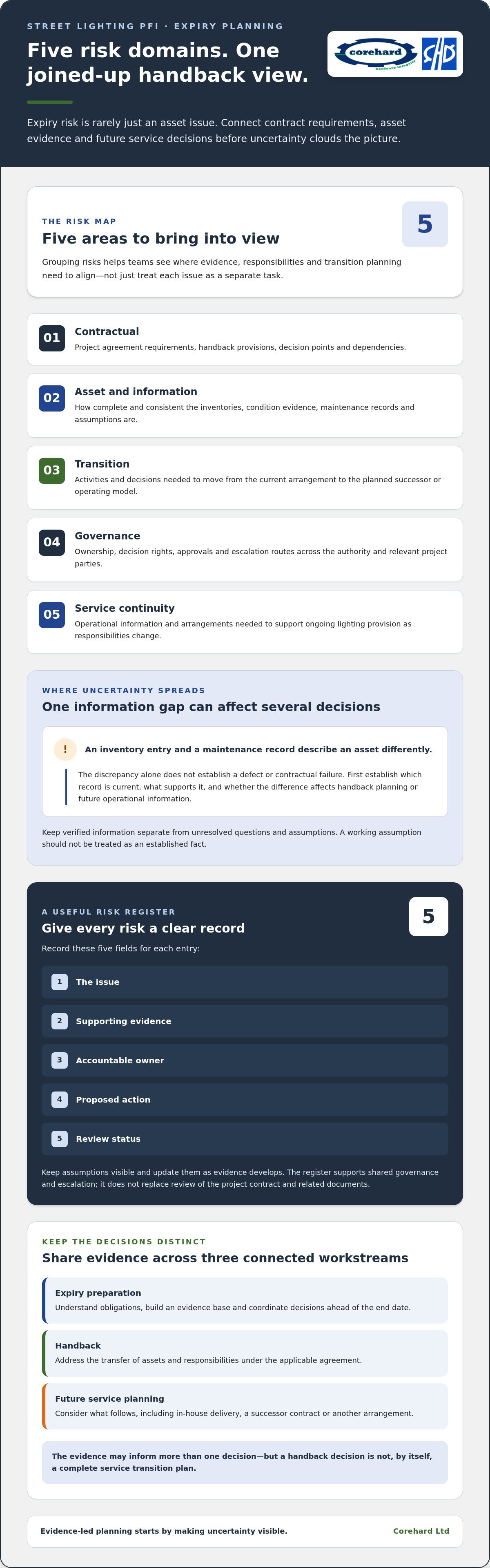
A risk register helps bring these matters into view. For each entry, record the issue, supporting evidence, accountable owner, proposed action and review status. This gives teams a shared basis for governance and escalation. A register is a management aid, not a substitute for reviewing the project contract and related documents. Keep its assumptions visible and update them as evidence develops.
Which decisions should authorities keep in view?
Start by identifying the contract’s handback requirements and decision points. Then distinguish questions about the assets from choices about future service arrangements. For example, establishing whether the available evidence gives a clear picture of asset condition is different from deciding whether future operations should be delivered in-house, through a successor contract or through another arrangement. The evidence may inform both decisions, but they are not the same decision.
Expiry preparation involves understanding obligations, building an evidence base and coordinating decisions ahead of the end date. Handback concerns the transfer of assets and responsibilities under the applicable agreement. Succession and future service planning concern what follows. Keep these workstreams distinct, while sharing relevant evidence between them, so a handback decision is not mistaken for a complete service transition plan.
For broader context on the handback process, see Street Lighting PFI Expiry: Strategic Handback Guide 2026. The contract and project circumstances should guide which risks matter, who needs to decide and when.
Map PFI street lighting risks across assets, contracts and service continuity
A useful risk map shows what could go wrong and how one uncertainty may affect another. Group risks so teams can see where evidence, responsibilities and transition planning need to align, rather than treating each issue as an isolated task.
- Contractual: requirements, handback provisions, decision points and dependencies documented in the project agreement.
- Asset and information: the completeness and consistency of inventories, condition evidence, maintenance records and stated assumptions.
- Transition: activities and decisions needed to move from the current arrangement to the planned successor or operating model.
- Governance: ownership, decision rights, approvals and escalation routes across the authority and relevant project parties.
- Service continuity: operational information and arrangements needed to support ongoing lighting provision as responsibilities change.
These categories overlap. An uncertain asset record, for example, may affect condition assessment, handback discussions and the information needed to plan future maintenance. Effective PFI street lighting risk management makes these connections visible and identifies the evidence or decision that could resolve each uncertainty.
How can asset and information gaps create uncertainty?
Organised asset records and condition evidence give teams a clearer basis for understanding what is included in the network and what is known about it. Separate verified information from unresolved questions and assumptions. This prevents a working assumption from being treated as an established fact.
For example, an inventory entry may describe an asset’s location differently from a related maintenance record. That discrepancy does not, by itself, establish a defect or contractual failure. It does create a question to investigate: which record is current, what evidence supports it, and could the difference affect handback planning or future operational information?
How do contract and continuity risks connect?
Review the obligations and handback requirements in the project documents alongside any dependencies that could affect transition decisions. Do not treat a general description of PFI practice as a conclusion about a particular authority’s rights or responsibilities. Assess those against the applicable agreement and project evidence.
Future service planning also relies on usable asset and operational information. If it is unclear who owns a decision, when approval is required or how an unresolved issue should be escalated, coordinated action may be delayed. Record the relevant owner, decision point and escalation route, then check them against the project’s governance arrangements.
Assess financial or technical implications using the available evidence, not assumptions based on a risk category alone. Authorities developing this joined-up view can also draw on specialist PFI street lighting transition advisory.
Compare approaches to managing PFI street lighting expiry risks
There is no single approach to expiry risk that suits every authority. The right balance depends on internal capacity, the quality of available evidence, governance arrangements and transition complexity. An authority-led review can establish a shared picture; specialist advice can add focused expertise; a coordinated approach can connect project knowledge with specialist input.
Use the comparison to assess what each approach can contribute and what it needs to work well. The project contract and the authority’s arrangements continue to govern responsibilities and decisions, whichever support model is used.
| Approach | Strengths | Constraints to consider | Evidence and conditions needed |
|---|---|---|---|
| Authority-led review | Builds on internal knowledge and brings contract, asset and service information into a shared view. | Staff capacity and access to relevant commercial or technical expertise may limit the review’s scope. | Accessible project documents, asset information, clear internal ownership and capacity to investigate gaps. |
| Specialist advisory input | Adds focused experience to consideration of PFI expiry and succession decisions. | Advice needs to reflect the project’s records and contract and fit with authority governance. | Relevant contract and asset evidence, agreed questions and clear links to authority decision-makers. |
| Coordinated combination | Connects the authority’s project knowledge with specialist input where evidence gaps or transition complexity warrant it. | Requires defined responsibilities, timely information-sharing and coordinated decision-making. | A shared evidence base, assigned owners, decision points and agreed escalation routes. |
When can an authority-led review be appropriate?
An internal review can be a practical starting point when teams can access the contract, asset records and operational knowledge. Bringing these sources together helps identify inconsistencies and questions for further assessment. The review’s depth will depend on workload and available expertise. Where issues require specialist or contract-specific advice, an internal review alone may not be sufficient.
What can specialist PFI transition advisory contribute?
Specialist advisory can help authorities examine expiry and succession decisions in light of project evidence and circumstances. Corehard provides guidance on PFI street lighting expiry and succession contracts to support this work alongside an authority’s internal review. For more on succession planning, see PFI Street Lighting Succession: A Guide for Authorities.
Whichever approach is used, retain clear authority over decisions. Record who provides advice, who owns each action and which governance route applies. This keeps PFI street lighting risk management aligned with the contract and the authority’s decision-making arrangements. For organisations that also oversee broader infrastructure works or wish to explore specialist consultancy in the construction sector, visit PK Services for further insight into project advisory.
Build a practical PFI street lighting risk management process
A risk register is useful when it helps people decide what to do next. A clear process connects evidence to accountable actions and keeps uncertainties visible, rather than presenting assumptions as established facts.
Authorities can structure the work as a sequence:
- Define the scope. Set out which expiry and transition matters are being reviewed, including the relevant contract, assets, operational dependencies and authority decisions.
- Gather the evidence. Bring together applicable project documents, asset information, condition evidence and service records. Note gaps or inconsistencies rather than filling them in without evidence.
- Assess each risk. Describe its cause and possible consequence, then assess its priority using transparent, project-specific criteria. Flag assumptions that need further evidence.
- Assign ownership. Identify who will progress each action and who has authority to make related decisions under the project’s governance arrangements.
- Review and update. Record progress, outstanding questions and changes in the evidence. Revisit priorities at relevant contract milestones and governance review points.
How should an authority structure its risk register?
Use consistent fields so risks can be compared and reviewed: description, cause, evidence source, potential consequence, owner, current controls, proposed mitigation and review status. Keep existing controls separate from planned actions, so it is clear what is already in place and what remains to be done. Link each entry to supporting documents and related decisions to make the rationale traceable through governance.
If two project records differ, document both sources and identify what needs to be checked. Keep the issue marked as unresolved until evidence supports a conclusion. This gives decision-makers a more accurate view than assigning an impact before the facts are established.
How can reviews turn evidence into decisions?
Set review points around the contract’s relevant milestones and the authority’s established governance arrangements, rather than applying an assumed timetable to every project. At each review, consider whether evidence has changed, whether actions have progressed and whether a decision is due. Escalate unresolved gaps through the appropriate authority process, stating the evidence and potential implications clearly.
Keep the register active. Close a risk only when the reason for doing so is recorded, and update linked actions when circumstances change. Street Lighting Handback Advisory: A Practical Checklist for 2026 is a related resource for handback planning.
For support with evidence-led expiry and transition planning, discuss Corehard’s PFI street lighting transition advisory.
How Corehard supports PFI street lighting risk management and transition
Expiry decisions are easier to coordinate when project evidence is considered alongside the contract, the authority’s governance arrangements and plans for the service that follows. Corehard provides specialist guidance on PFI street lighting expiry and succession contracts, supporting authorities as they assess issues relevant to their transition.
Corehard’s guidance can be used alongside the authority’s contract documents, asset information and risk records. These provide the project context; advisory input helps teams examine expiry and succession questions against that context. It supports informed consideration while leaving authority decisions and contract-specific rights and responsibilities to the relevant project documents and governance processes.
Where can specialist guidance fit into the authority’s work?
Authorities can use advisory input when reviewing expiry requirements, considering succession arrangements or connecting handback evidence with future service planning. Keep approvals and decision ownership within the authority’s established governance arrangements, and address project-specific contract interpretation through the appropriate channels.
For broader handback context, read Street Lighting PFI Expiry: Strategic Handback Guide 2026. It complements this risk-management guide by addressing the wider handback picture.
What should the authority do next?
Before a review or advisory discussion, assemble the material that will clarify the project’s position. A focused starting point is to:
- Bring together the relevant contract documents, asset information and existing risk records.
- List unresolved questions, distinguishing evidence-backed points from assumptions.
- Identify decision owners, relevant approval routes and upcoming project milestones.
- Consider how each open issue relates to handback, succession or future service planning.
This preparation helps teams frame the issues clearly and focus discussion on decisions that matter to the project. It also provides a practical basis for assessing whether existing evidence supports the next steps or whether further assessment or specialist input is needed.
Strong PFI street lighting risk management depends on evidence-based decisions taken through the right governance routes. To discuss your authority’s PFI street lighting transition requirements, speak with Corehard about its specialist expiry and succession guidance.
Turn expiry planning into confident next steps
Effective PFI street lighting risk management connects contract requirements, asset evidence and future service decisions. A clear risk map helps authorities distinguish verified information from assumptions, while a proportionate review process gives each issue an owner, a response and a suitable point for reconsideration.
The right support model depends on the authority’s capacity, the quality of its records and the complexity of the transition. Whatever approach is taken, keep decisions and approvals aligned with the project contract and the authority’s governance arrangements.
Corehard provides specialist guidance on PFI street lighting expiry and succession contracts, alongside advisory, consultancy and infrastructure compliance services. Authorities can bring relevant contract documents, asset information and existing risk records into discussions about transition requirements, helping focus attention on unresolved questions and upcoming decisions.
Discuss PFI street lighting transition advisory with Corehard to take a considered next step towards expiry planning. Clear evidence, accountable ownership and timely decisions can help authorities approach the transition with greater clarity and confidence.
Frequently Asked Questions
What is PFI street lighting risk management?
PFI street lighting risk management is the process of identifying, assessing and controlling risks linked to a street lighting PFI’s expiry and transition. It brings contract requirements, asset information, service continuity and future operating decisions into a structured view. Authorities can use this to identify evidence gaps, assign responsibility and review issues through their governance arrangements. The assessment should reflect the specific project and its contract, rather than assume the same risks or obligations apply everywhere.
Which risks should authorities assess before a street lighting PFI expires?
Authorities should consider contractual and handback requirements, asset condition and information quality, transition dependencies, governance and service continuity. For example, an inconsistency between an asset record and maintenance information may need investigation before teams rely on it for handback or future service planning. Assess financial and technical implications against project evidence rather than assuming them. Prioritise risks using criteria suited to the project, and record outstanding questions separately from verified facts.
How early should PFI street lighting expiry planning begin?
The Infrastructure and Projects Authority’s guidance, Preparing for PFI contract expiry, recommends that authorities begin expiry planning at least seven years before the contract end date. Starting early gives teams time to understand project requirements, organise evidence, identify decision points and plan governance. The review schedule should then reflect the contract’s milestones and the authority’s arrangements. Verify dates and requirements against the project documents.
Can an authority manage PFI street lighting risks using an internal team?
Yes. An authority-led review can bring contract documents, asset records and operational knowledge together, particularly where internal teams have the capacity and relevant expertise. Its practical scope depends on staff availability, evidence quality and the complexity of expiry and succession decisions. An internal review does not automatically replace specialist or contract-specific advice where the issues require it. Responsibilities and approvals should remain aligned with the authority’s established governance arrangements.
What happens if street lighting asset information is incomplete at PFI expiry?
Incomplete information can make it harder to establish what is known about the assets, assess condition and prepare for handback or future operations. It does not, on its own, establish that an asset is defective or that a contractual requirement has been breached. Record missing or conflicting information as an evidence gap, identify its source and owner, and determine what further review is needed before relying on it for a decision.
Does PFI expiry automatically determine who will provide the future street lighting service?
No. The expiry of the existing arrangement and the choice of future service model are separate matters. Authorities may consider in-house delivery, a successor contract or a hybrid approach, taking account of project evidence and their governance processes. The contract and project circumstances shape the relevant handback requirements, but expiry alone should not be treated as deciding the future operating arrangement. Plan and govern these decisions distinctly.
How can a PFI street lighting risk register support transition decisions?
A risk register gives teams a consistent record of each issue, its evidence source, potential consequence, owner, planned mitigation and review status. It can distinguish verified information from assumptions, link risks to supporting documents and show which questions need escalation or a decision. This helps authorities review priorities as project evidence or circumstances change. A register supports governance and coordination, but it does not replace project-specific contract review or the authority’s decision-making arrangements.


