
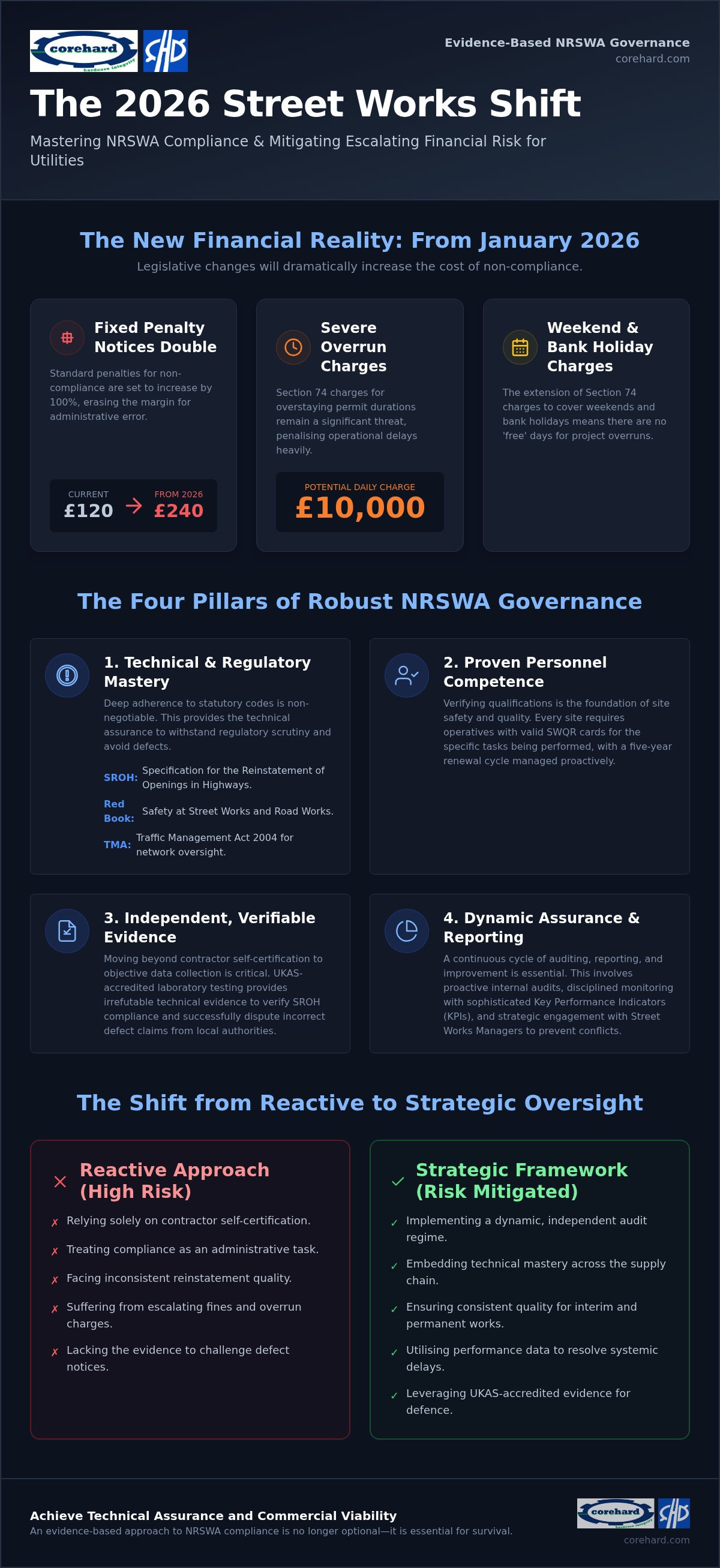
Can your current street works strategy withstand the 2026 doubling of Fixed Penalty Notices and the extension of Section 74 charges to weekends? With standard penalties rising to £240 and overrun costs reaching up to £10,000 per day, the financial margin for error has effectively vanished. Achieving consistent NRSWA compliance for utilities now requires more than just administrative diligence; it demands a rigorous, evidence-based approach to governance that links technical precision with high-level commercial outcomes.
You've likely experienced the frustration of inconsistent contractor reinstatements and the escalating burden of navigating diverse local authority permit schemes. It's a complex landscape where minor technical failures quickly translate into significant commercial liabilities. This guide provides an authoritative framework to master these complexities, offering a strategic roadmap for risk mitigation and technical assurance. We'll examine the 2026 legislative shifts, the necessity of UKAS-accredited evidence, and the implementation of dynamic audit regimes to ensure your operations remain both compliant and commercially viable.
Key Takeaways
- Navigating the 2026 legislative landscape requires a precise understanding of doubled Fixed Penalty Notices and the extension of Section 74 charges to weekends, necessitating a shift from reactive to strategic oversight.
- Establishing a comprehensive framework for NRSWA compliance for utilities ensures that technical mastery is embedded across the supply chain, moving beyond basic certification to a culture of dynamic assurance.
- Mitigating escalating overstay charges involves the rigorous application of Section 74 management protocols and the strategic use of performance reporting to identify and resolve systemic operational delays.
- Utilising UKAS-accredited laboratory testing provides the irrefutable technical evidence required to verify SROH compliance and successfully dispute local authority defect claims.
- Developing sophisticated Key Performance Indicators allows for the disciplined monitoring of reinstatement quality, ensuring that both interim and permanent works meet the highest industry standards for safety and longevity.
The Regulatory Landscape: NRSWA and TMA Obligations for Utilities
Establishing a robust framework for NRSWA compliance for utilities begins with a comprehensive understanding of the New Roads and Street Works Act 1991 (NRSWA). This legislation provides the primary legal structure for Statutory Undertakers when they occupy the public highway to maintain or install infrastructure assets. Whilst NRSWA focuses on the technical execution and reinstatement quality, the Traffic Management Act 2004 (TMA) introduces a strategic layer of network oversight. The TMA grants local authorities the power to manage network flow more aggressively, meaning that any failure in compliance now triggers immediate, high-impact intervention under modern permit schemes.
Non-compliance carries severe financial and operational weight that transcends simple administrative friction. From January 2026, the Street and Road Works (Charges and Penalties) (Amendments) (England) Regulations 2025 double the cost of Fixed Penalty Notices (FPNs), with standard offences rising from £120 to £240. Beyond these immediate fines, utility companies risk significant exposure to Section 74 overrun charges, which can reach £10,000 per day. Maintaining NRSWA compliance for utilities is therefore a matter of commercial survival; it's a landscape where persistent failure erodes the relationship with the Street Authority and may lead to the revocation of essential permit privileges.
Key Statutory Codes of Practice
Adhering to statutory codes provides the necessary technical assurance to survive regulatory scrutiny. The Specification for the Reinstatement of Openings in Highways (SROH) acts as the definitive benchmark for all backfill and surfacing activities, ensuring that the road structure's integrity is preserved. Complementing this is the "Red Book"-Safety at Street Works and Road Works-which dictates the mandatory requirements for signing, lighting, and guarding. Finally, the Code of Practice for the Co-ordination of Works ensures that the timing and duration of activities align with the authority's duty to minimise public disruption.
The Role of the Street Authority
Navigating the interface between the utility and the Highway Authority requires a disciplined communication strategy. Most authorities have transitioned from simple notification regimes to complex permit schemes, where permission to work is conditional, time-bound, and subject to strict performance criteria. Proactive engagement with Street Works Managers is essential for identifying potential conflicts before they escalate into defects. This collaborative approach facilitates smoother project delivery and ensures that the utility's duty of care to both the authority and the public is met through transparent, verified operational data.
The Core Pillars of NRSWA Compliance: A Governance Checklist
Strategic NRSWA compliance for utilities demands a transition from simple operational box-ticking to a sophisticated governance model. It involves the methodical verification of site credentials and the precise management of statutory notifications. Under the New Roads and Street Works Act 1991, utility companies remain legally accountable for the actions of their contractors. This responsibility necessitates a proactive internal audit programme that validates site performance against regulatory benchmarks in real-time, ensuring that every excavation and reinstatement meets the required standard before the authority intervenes. Relying on contractor self-certification is often insufficient; true technical assurance comes from independent oversight and objective data collection.
Personnel Competence and Qualifications
Personnel competence forms the absolute foundation of site safety and technical quality. Every active site must have at least one operative whose Street Works Qualifications Register (SWQR) card is current and covers the specific units of work being performed. Whilst a qualified supervisor must be appointed to the project, they aren't required to be present at all times; however, they must be able to attend the site if requested by the authority. Managing the five-year renewal cycle for these qualifications is a significant administrative burden for large-scale utility providers. Success requires a centralised tracking system that triggers re-assessment alerts well in advance of expiry. Effective governance goes beyond the card itself; it ensures that site teams possess a deep, practical understanding of SROH requirements. To support this, many organisations explore IOSH Managing Safely to provide their supervisors with a broader foundation in health and safety management, helping to prevent common defects that lead to long-term liabilities.
Permit and Notice Management
Permit and notice management requires absolute administrative precision to avoid the doubling of Fixed Penalty Notices. You must accurately categorise works as Minor, Standard, Major, or Emergency, as each carries distinct notification windows and evidentiary requirements. Aiming for a "First Time Permanent" reinstatement is the most effective way to reduce the administrative load and the risk of overstay charges. This strategy eliminates the need for interim-to-permanent follow-up notices and significantly limits the period of liability for the utility. In traffic-sensitive locations, work must be strictly confined to permitted hours to avoid the escalating Section 74 costs mentioned earlier. Meticulous record-keeping, including date-stamped photographic evidence of every reinstatement stage, provides the technical assurance needed to defend against authority challenges. Implementing a specialist advisory and audit regime can help your organisation identify systemic noticing failures before they result in substantial financial exposure.
NRSWA Performance Reporting and Dynamic Assurance
Sustaining NRSWA compliance for utilities in an increasingly complex regulatory environment requires a sophisticated transition from periodic, reactive auditing to a model of dynamic assurance. This framework relies on the continuous ingestion of site data through digital reporting platforms, allowing for the real-time monitoring of every excavation and reinstatement. By developing granular Key Performance Indicators (KPIs), such as notice-to-permit accuracy and first-time reinstatement pass rates, utility providers can identify systemic failures within their supply chain with surgical precision. This proactive oversight ensures that operational delivery remains aligned with statutory obligations, providing a verified narrative of compliance for annual performance reviews with local highway authorities and ensuring that NRSWA compliance for utilities is treated as a strategic asset rather than an administrative burden.
The implementation of dynamic assurance protocols allows for the immediate identification of safety breaches, ensuring that all worksites strictly adhere to the Safety at Street Works and Road Works Code of Practice. Rather than waiting for a local authority inspector to issue an FPN, internal governance teams can utilise real-time imagery and site data to rectify issues in situ. This level of technical mastery not only protects the utility's reputation but also safeguards the public, creating a culture of excellence that transcends basic regulatory requirements. It's a shift from hoping for compliance to verifying integrity through objective, evidence-based reporting that stands up to the highest levels of scrutiny.
Strategic Asset Inspections
Independent third-party inspections serve as a critical guardian of quality, providing an objective lens that internal contractor reports often lack. By transitioning from reactive defect management to proactive condition assessments, utility companies can gain a deeper understanding of their asset's long-term viability. These inspections utilise advanced methodologies to verify that every layer of a reinstatement meets the required compaction and material standards. Leveraging this data allows managers to drive contractor accountability, ensuring that the supply chain delivers technical excellence that stands up to the rigours of independent UKAS-accredited laboratory testing.
Lane Rental and Permit Governance
Operating within high-congestion urban environments introduces significant financial risks, particularly where Lane Rental schemes are in force. Successful governance in these areas requires absolute precision in permit applications and a disciplined approach to operational windows. Any deviation from the agreed schedule can result in substantial daily charges that erode project margins. To mitigate these risks, utility providers must integrate specialised advisory services into their planning phases. You can learn more about our Lane Rental operational services to understand how strategic governance can reduce your exposure to these escalating costs and ensure your projects remain commercially viable.
Mitigating Financial Risk: Section 74 and Defect Management
Section 74 of the NRSWA represents one of the most potent financial risks to utility providers, particularly as the 2026 regulatory amendments expand the scope of these charges to include weekends and bank holidays. This shift means that a project overrunning by just two days across a Saturday and Sunday could now result in an additional £20,000 in charges for high-category roads. Achieving NRSWA compliance for utilities requires a meticulous approach to duration management, where every hour of occupation is accounted for and justified through verifiable site data. Failure to manage these timelines doesn't just result in direct costs; it signals a lack of operational control to the highway authority—a principle of compliance that extends to property safety, where professional UK Fire Risk Assessments are essential for landlords and businesses to meet their legal obligations.
Effective duration management hinges on the precise timing of "Works Clear" and "Works Closed" notifications. A "Works Clear" notice must be submitted when the site is vacated and all signing, lighting, and guarding are removed, whilst the "Works Closed" notice confirms the permanent reinstatement is complete. Any delay in these submissions can trigger an automatic overrun charge, even if the physical work is finished. When unforeseen technical challenges arise, proactive negotiation for a duration extension is essential. These applications must be supported by objective evidence and submitted before the current permit expires to remain valid. Section 74 mitigation is a critical financial control that protects the commercial integrity of utility infrastructure projects.
Defect Management and Remediation
Defect management requires a clear distinction between immediate safety issues and long-term technical failures. Safety defects, such as unstable barriers or missing lamps, demand instant rectification to avoid FPNs, which are set to double to £240 in January 2026. Conversely, technical defects related to material compaction or air voids may not surface until well into the two-year guarantee period, or three years for excavations deeper than 1.5 metres. Establishing a "Right First Time" culture is the only sustainable way to eliminate the hidden costs of remedial works and the administrative burden of managing long-term liabilities. By building a technical evidence base through independent UKAS-accredited testing, you can effectively challenge unreasonable defect notices and ensure your reinstatement quality is irrefutable. This level of assurance is vital for maintaining high-level NRSWA compliance for utilities across diverse contractor networks.
Technical Excellence: Integrating Independent UKAS Testing
Visual inspections, whilst essential for immediate safety verification, are fundamentally insufficient for proving long-term adherence to the Specification for the Reinstatement of Openings in Highways (SROH). Surface-level assessments cannot detect subsurface compaction failures or excessive air voids that lead to premature pavement degradation. Achieving NRSWA compliance for utilities at a strategic level requires a transition toward empirical, laboratory-backed evidence. By integrating technical testing into the governance cycle, utility providers move from a position of subjective hope to one of objective certainty. This rigorous approach ensures that every reinstatement is not only visually acceptable but structurally sound, effectively shielding the organisation from future maintenance liabilities and the escalating financial penalties associated with defective works.
Utilising advanced diagnostic tools like the PANDA Penetrometer allows for rapid, non-destructive compaction testing directly on-site. This technology provides immediate data on the mechanical properties of the soil and backfill layers, enabling site supervisors to verify integrity before the final bituminous layers are applied. Such proactive technical mastery prevents the "interim-to-permanent" failure cycle that often plagues large-scale infrastructure projects. When technical assurance is embedded into the operational workflow, it acts as a definitive safeguard against litigation. It provides the "guardian of quality" oversight necessary to manage diverse contractor networks with absolute precision, ensuring that NRSWA compliance for utilities remains a verifiable reality rather than a mere administrative ambition.
UKAS Accredited Highways Testing
Independent verification through a UKAS-accredited facility is the only way to secure the legal and regulatory standing required to challenge local authority defect notices. These laboratories provide precise analysis of air voids and compaction levels in bituminous materials, offering irrefutable evidence of material quality that stands up to the highest levels of scrutiny. Using an accredited partner ensures that the testing methodology is standardised, repeatable, and globally recognised for its accuracy. To strengthen your technical evidence base, you can explore our UKAS accredited testing laboratory services and discover how objective data can transform your compliance strategy.
Condition Assessment and Reporting
Translating complex laboratory data into actionable strategic reports is essential for senior stakeholders who must manage high-level corporate risk. These reports bridge the gap between site-level technicalities and boardroom-level financial oversight, providing a clear narrative of asset health and contractor performance. Technical evidence is particularly vital when securing "handback" acceptance for major infrastructure projects, where the authority requires proof of longevity before releasing the utility from its guarantee period. Specialist advisory services ensure that this data is presented within the correct regulatory context, providing the certainty needed to navigate the 2026 legislative landscape with confidence and disciplined control.
Securing Operational Integrity in a High-Stakes Regulatory Environment
Transitioning toward a model of technical mastery and strategic oversight is essential in a landscape defined by escalating penalties and heightened authority scrutiny. Success in this environment relies on the synthesis of dynamic assurance, rigorous duration management, and the irrefutable evidence provided by independent technical testing. By moving beyond simple administrative adherence to a framework of verified operational integrity, you protect both your reputation and your commercial margins. It's about establishing a steady hand over regulatory complexity to ensure long-term asset safety and structural excellence.
As NRSWA & TMA development specialists, we provide the authoritative guidance needed to navigate these complex transitions with absolute confidence. Our comprehensive assurance and compliance solutions, supported by an independent UKAS accredited testing laboratory, ensure that your infrastructure assets meet the highest industry standards whilst minimising financial exposure. You can consult Corehard Ltd for specialist NRSWA compliance advisory to secure your network's future and achieve absolute NRSWA compliance for utilities. We're ready to help you transform these regulatory challenges into a verified narrative of professional excellence and disciplined control.
Frequently Asked Questions
What are the main requirements for NRSWA compliance for utilities?
Achieving NRSWA compliance for utilities requires strict adherence to statutory duties regarding noticing, site safety, and reinstatement quality. Statutory undertakers must ensure all works are correctly notified through the Street Manager system, and site personnel must hold valid SWQR qualifications. Beyond administrative tasks, the core requirement is the permanent reinstatement of the highway to the standards defined in the SROH, ensuring that the road's structural integrity and safety are maintained throughout the guaranteed liability period.
How much are Section 74 overstay charges in 2026?
Section 74 overstay charges vary based on the road category and the duration of the overrun, with daily rates reaching up to £10,000 for the most traffic-sensitive routes. From January 2026, these charges are applicable for every day of the overrun, including weekends and bank holidays. This legislative change significantly increases the financial risk for projects that fail to clear the highway by the agreed permit expiry date, necessitating more precise duration management and proactive authority engagement.
What is the difference between an operative and a supervisor under NRSWA?
The primary distinction lies in their specific units of competence and their required presence on-site. An operative is qualified to physically execute the works, such as excavation and reinstatement, and at least one must be present at all times during active construction. A supervisor is responsible for the technical oversight and quality assurance of the worksite. Whilst a supervisor doesn't need to be permanently on-site, they must be readily available to attend and justify the technical methods employed if requested.
Can a utility company dispute a reinstatement defect notice?
Utility companies can and should dispute defect notices when objective evidence suggests the reinstatement meets SROH standards. Successful challenges typically rely on technical data from independent UKAS-accredited laboratory testing, which provides irrefutable proof of material compaction and air void levels. By presenting empirical evidence that contradicts a visual assessment, a utility can avoid the costs of unnecessary remedial works and protect its performance rating with the local highway authority, ensuring long-term commercial protection.
How often should streetworks compliance audits be conducted?
Compliance audits should be conducted on a risk-based frequency that aligns with your operational volume and contractor performance history. For high-volume utility providers, a regime of dynamic assurance involving real-time digital reporting and weekly site inspections is recommended. Regular auditing identifies systemic failures early, allowing for corrective action before defects result in Fixed Penalty Notices or Section 74 charges. A disciplined audit schedule ensures that technical standards remain consistent across the entire supply chain and diverse project types.
What role does the SROH play in utility compliance?
The Specification for the Reinstatement of Openings in Highways (SROH) acts as the mandatory technical benchmark for all street works in the UK. It defines the required materials, layer thicknesses, and compaction methods necessary to restore the highway to its original condition. For NRSWA compliance for utilities, the SROH is the legal standard against which all reinstatements are measured, making it the primary reference for both site operatives and quality assurance auditors to ensure structural integrity.
Why is UKAS-accredited testing necessary for streetworks?
UKAS-accredited testing is necessary because it provides the only form of technical evidence that carries full legal and regulatory weight during a dispute. Laboratory analysis from an accredited facility ensures that material testing is performed to rigorous, standardised protocols. This objective proof of quality is essential for verifying that a reinstatement complies with SROH requirements, particularly when challenging authority claims regarding subsurface failures that cannot be accurately diagnosed through visual inspection or subjective site reports.
What is the impact of the Traffic Management Act on utility works?
The Traffic Management Act 2004 (TMA) shifts the focus from individual site quality to the broader impact of works on the road network. It grants local authorities the power to implement permit schemes, which allow them to coordinate works more tightly and impose conditions on timing and duration. Under the TMA, authorities have a network management duty to minimise disruption, meaning that utility companies face stricter oversight and higher financial penalties for any activities that impede traffic flow.


