

Contractual interpretation alone won't protect a highway authority from inheriting severe deferred maintenance liabilities; successful handback is decided on the ground through independent, verifiable technical evidence. With more than 30 English local authorities approaching the conclusion of 25-year concessions, securing authoritative street lighting PFI expiry advice has become an urgent operational priority rather than a distant administrative exercise. Years of cumulative inventory drift, incomplete Special Purpose Vehicle records, and constrained internal auditing capacity leave public bodies critically exposed to unbudgeted capital expenditures as handback deadlines converge.
It's entirely understandable that local authority directors feel apprehensive about assuming responsibility for tens of thousands of lighting columns without definitive, objective verification of their structural and electrical health. This strategic guide enables you to navigate local authority street lighting PFI expiry with confidence through proven handback strategies, technical condition assurance, and succession planning. We outline the end-to-end handback roadmap, testing frameworks, and procurement models essential for safeguarding public funds, securing commercial parity, and establishing uninterrupted public service delivery.
Key Takeaways
- Structured handback planning must commence five to seven years prior to contract conclusion to address inventory drift and safeguard municipal capital allocations.
- Empirical structural assessments and certified electrical testing form the only defensible basis for establishing true residual asset life and identifying deferred maintenance liabilities.
- Evaluating successor delivery options early ensures operational continuity and smooth procurement under current public sector contracting regulations.
- Securing specialist street lighting PFI expiry advice provides the independent, technical evidence base required to negotiate commercial parity and enforce contractual retention mechanisms.
- Implementing a disciplined five-year milestone roadmap eliminates late-stage operational shocks, ensuring full statutory compliance and uninterrupted public service delivery.
Understanding Street Lighting PFI Expiry: The Strategic Handback Challenge
Managing the conclusion of long-term infrastructure concessions requires moving beyond routine contract management into rigorous technical governance. Across the country, extensive portfolios delivered under the Private Finance Initiative (PFI) framework are entering their terminal stages. Concessions established in the early 2000s under 25-year terms now demand immediate strategic attention, as the operational runway contracts rapidly. The contractual relationship between the local authority and the Special Purpose Vehicle (SPV) fundamentally shifts at handback. Without independent street lighting PFI expiry advice, public authorities risk accepting networks plagued by inventory drift, unmapped third-party attachments, and incomplete maintenance histories.
The Mechanics of Handback Provisions
Concession agreements establish strict parameters governing asset condition upon transfer, requiring guaranteed residual structural life and statutory electrical safety certification. Enforcing these requirements depends on robust handback mechanics. Contracts typically mandate joint condition inspections overseen by an Independent Tester to determine compliance against agreed handback criteria. Crucially, standard frameworks empower the authority to establish a retention fund, withholding portions of the unitary charge during the final 18 to 24 months. This financial mechanism ensures capital is available to execute rectifications if the concessionaire fails to deliver assets in the stipulated condition.
The Financial and Operational Risks of Late Action
Deferring handback preparation compromises municipal leverage and exposes highway authorities to latent structural defects, corroded columns, and obsolete sub-components. Once the SPV dissolves upon contract expiry, the opportunity to enforce remediation evaporates, transferring heavy deferred maintenance liabilities directly onto local taxpayers. Operational transitions also present serious continuity challenges, particularly when migrating maintenance histories, inventory databases, and statutory electrical records. Seeking early street lighting PFI expiry advice enables authorities to systematically audit assets, challenge disputed condition data, and secure commercial parity before final handover windows close.
Technical Handback Criteria: Auditing Structural and Electrical Residual Life
Defensible handback negotiations rest entirely upon empirical engineering evidence. While concessionaires may present satisfactory scheduled maintenance logs, physical asset verification consistently uncovers hidden structural fatigue and electrical non-compliance. Following established Infrastructure and Projects Authority guidance on PFI expiry, councils must deploy comprehensive survey programmes well in advance of contract termination. Deploying an early infrastructure asset condition assessment enables public authorities to establish true baseline conditions. Specialist street lighting PFI expiry advice ensures that abstract contract terms translate into enforceable, objective technical standards.
Structural Integrity and Ultrasonic Testing
Structural evaluations across steel, aluminium, and concrete columns demand rigorous non-destructive evaluation. Governed by ILP GN22 (ATOMS) standards, testing regimes utilise Relative Loss of Section (RLS) ultrasonic measurement and Swage Joint Analysis to detect sub-surface root and internal base corrosion. These assessments establish the Column Condition Index (CCI) across categories 1 to 5, determining the Assumed Residual Life (ARL). If structural wall thickness falls below critical threshold limits, the concessionaire must execute asset replacement before achieving contract discharge.
Electrical Infrastructure and Network Health
Electrical assets must satisfy BS 7671 IET Wiring Regulations alongside Highway Electrical Registration Scheme (HERS) requirements. Authorities must audit private cabling networks, earthing loop impedances, and feeder pillars against statutory six-year testing intervals. Furthermore, first-generation LED luminaires installed over a decade ago must be examined for lumen degradation and Central Management System (CMS) interoperability to avoid inheriting premature renewal costs. Consulting seasoned providers of technical assurance services ensures local authorities confirm compliance without straining internal resources.
Data Reconciliation and Asset Register Validation
Discrepancies between contractual GIS records and roadside assets represent a substantial commercial exposure. Independent field audits regularly identify undocumented bracket modifications, unauthorized third-party attachments such as 5G small cells, and unrecorded structural replacements. Validating physical installations against the central asset inventory establishes a single source of truth. By seeking independent street lighting PFI expiry advice early, authorities secure the auditable evidence needed to substantiate retention escrow withholdings and protect council budgets.
Evaluating Succession Operating Models: Selecting the Post-PFI Route
Selecting a successor operating framework requires balancing statutory accountability, financial risk, and day-to-day delivery capabilities. A landmark National Audit Office review of expiring PFI assets emphasised that public authorities frequently underestimate the time required to establish viable post-expiry arrangements. Operating models cannot be devised in isolation from wider highway network operations. Any prospective transition must integrate street works permitting, traffic management coordination, and statutory compliance, issues frequently addressed through specialist NRSWA compliance consultancy. Councils evaluating future delivery vehicles generally weigh direct insourcing against externalised procurement models.
Insourcing via a Direct Labour Organisation (DLO)
Returning illuminated highway networks to direct council administration provides total operational oversight and prioritisation control. That autonomy carries substantial capital burdens. Establishing a municipal DLO requires procurement of dedicated insulated mobile elevating work platforms (MEWPs), adequate depot infrastructure, and complex inventory management systems. Inward TUPE transfers of operating personnel from the outgoing concessionaire frequently introduce contentious pension liabilities and harmonisation disputes. Authorities must evaluate whether their internal corporate machinery can absorb these long-term commitments without undermining service agility.
Outsourcing via a Term Maintenance Contract (TMC)
Re-engaging the competitive market via a standalone contract or an integrated highways term maintenance contract transfers front-line operational risks back to specialist contractors. Procuring through standard highway frameworks allows authorities to benchmark service unit costs and establish rigorous key performance indicators. Market volatility presents hurdles. Current procurement frameworks demand robust indexation formulas to handle fluctuating material and energy costs. Structuring these complex specifications benefits from early street lighting PFI expiry advice, ensuring procurement scopes accurately reflect true asset liabilities rather than historical contractual assumptions.
Highway authorities often find the greatest operational synergy by amalgamating street lighting into broader highways maintenance tenders. Consolidating lighting repairs with existing civils, carriageway maintenance, and emergency response arrangements lowers administrative overheads while ensuring consistent street works permitting and compliance across the entire road network. Independent street lighting PFI expiry advice provides the structural baseline required to package these multi-discipline tender documents effectively, giving commercial bidders confidence while safeguarding the authority's budgetary boundaries.
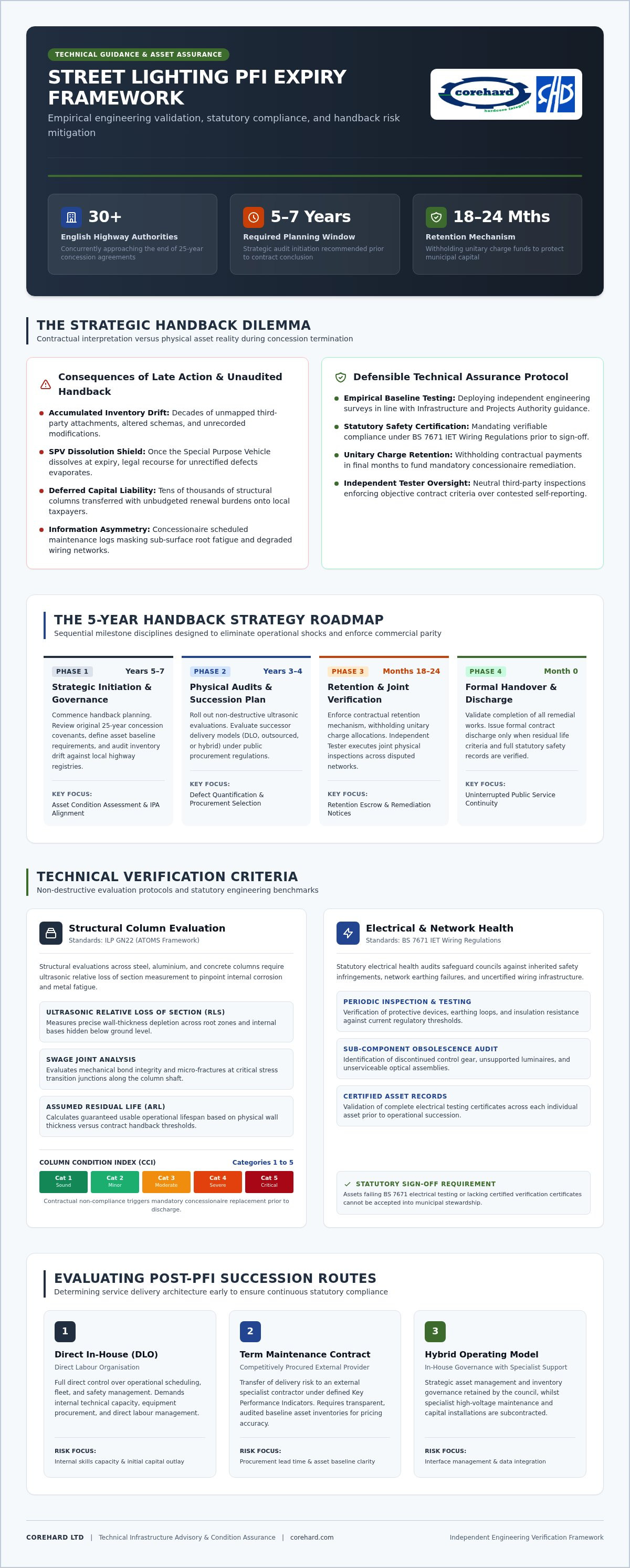
The 5-Year Handback Strategy: A Practical Implementation Roadmap
Executing a seamless contract transition across tens of thousands of illuminated assets demands an uncompromising project management discipline. Authorities attempting to manage handback within compressed twelve-month timeframes routinely forfeit their commercial leverage, leaving officers insufficient time to enforce extensive defect remediation. Implementing a structured five-year timeline establishes clear accountability gates, protecting municipal capital allocations through legally admissible verification data. Sourcing early street lighting PFI expiry advice ensures every testing milestone, retention calculation, and procurement phase aligns with wider corporate governance cycles.
Years 5 to 3: Strategy, Inventory, and Initial Sampling
Programme initiation begins by constituting a cross-functional project board comprising legal, commercial, and technical highway leads. Teams must complete baseline inventory reconciliations, comparing historical contractual asset registers against live geographic asset datasets. Strategic sample testing across distinct structural cohorts begins during this window. Identifying macroscopic failure trends early allows the authority to formally notify the concessionaire of systemic defects while multi-year lifecycle budgets remain available within the project company.
Years 2 to 1: Comprehensive Auditing and Financial Retention
Joint condition surveys accelerate across designated representative asset cohorts, utilising accredited non-destructive structural and electrical testing regimes. The practical milestones during this intensive period include:
- Defect Cost Quantification: Translating identified structural degradation and cabling non-compliance into robust, priced schedules of required rectification works.
- Retention Fund Enforcement: Formally establishing the retention escrow account by withholding unitary charge percentages in accordance with contractual terms.
- Successor Mobilisation: Initiating public procurement workstreams for incoming term maintenance or mobilising internal workforce structures to eliminate service hiatuses.
Final 12 Months: Remediation, Settling, and Transition
Activity shifts toward rigorous snagging audits to verify that the concessionaire executes agreed structural replacements and component repairs to required specifications. Unresolved defects must be offset directly against retained unitary charge funds before final account discharge. In parallel, operational teams execute data migration, key transfer, and employee TUPE consultations. To protect your capital programmes against deferred liabilities, commission our Street Lighting PFI Transition Advisory team to structure a defensible handback roadmap backed by independent street lighting PFI expiry advice.
Ensuring Commercial and Technical Integrity: The Independent Advisory Advantage
Confronting an outgoing Special Purpose Vehicle without dedicated technical advocacy places local authorities at an immediate commercial disadvantage. Private concessionaires operate under structural incentives to protect end-of-contract equity by constraining lifecycle capital expenditure and presenting optimistic maintenance histories. Relying on contractor self-certification risks overlooking deep-seated asset deficiencies that subsequently drain council revenue reserves. Seeking independent street lighting PFI expiry advice levels the commercial playing field, transforming subjective opinions into empirical, verifiable data sets that withstand rigorous legal scrutiny.
Impartial Technical Evidence vs Contractor Self-Reporting
Objective condition data provides the definitive lever for resolving commercial friction without triggering protracted formal arbitration. Concessionaire maintenance records often record cosmetic repairs rather than true asset health, masking systemic degradation across underground private cabling or column root sections. Independent engineering audits, conducted strictly in accordance with national highway standards, provide legally admissible documentation that directly substantiates contractual non-compliance. When local authorities hold clear, auditable physical evidence, SPVs cannot easily contest rectification notices or evade agreed retention fund deductions.
Comprehensive Succession Assurance with Corehard Ltd
Safeguarding public sector asset integrity requires a technical partner that bridges physical testing capabilities with strategic contract management. Operating nationally across municipal and highway infrastructure, Corehard Ltd delivers the robust engineering oversight and independent condition assessment required to secure commercial parity. Our specialist advisory team helps highway authorities establish transparent, auditable baselines across their entire illuminated network, ensuring that deferred maintenance liabilities remain with the contractor rather than public accounts.
Navigating the complex interface between contractual obligations and operational reality demands rigorous governance at every stage. We provide end-to-end Street Lighting PFI Transition Advisory, comprehensive asset condition reporting, and dynamic compliance auditing designed to protect municipal balance sheets and maintain uninterrupted public service delivery. To establish absolute confidence throughout your handback programme, Partner with Corehard Ltd for street lighting PFI transition advisory and secure authoritative street lighting PFI expiry advice tailored to your authority's strategic objectives.
Taking Strategic Command of Your Infrastructure Transition
Navigating the end of a 25-year concession doesn't have to jeopardise municipal balance sheets or disrupt critical public services. Establishing a methodical five-year roadmap, conducting empirical structural and electrical testing, and implementing a resilient succession operating model ensures highway authorities avoid inheriting unbudgeted deferred maintenance liabilities. True commercial leverage always rests upon verifiable engineering evidence rather than optimistic contractor assurances.
Securing authoritative street lighting PFI expiry advice provides the objective foundation required to negotiate commercial parity and enforce contractual retention mechanisms. Backed by a UKAS-accredited testing laboratory and comprehensive asset condition reporting capabilities, our specialist national advisory team delivers independent compliance consultancy that safeguards public sector integrity at every milestone. Take command of your network's future today: Secure independent PFI street lighting expiry guidance with Corehard to achieve total contractual compliance, protect local budgets, and execute a seamless operational handover.
Frequently Asked Questions
When should a local authority begin preparing for street lighting PFI expiry?
Authorities should initiate preparations at least five to seven years prior to contract expiry. National guidance frameworks recommend early data collation, asset register reconciliation, and preliminary sampling well ahead of the final concession years. Starting early provides sufficient runway to identify macroscopic degradation trends, establish governance boards, and ensure outgoing contractors allocate lifecycle capital for necessary rectifications before the final operational period.
What are the common technical pitfalls during PFI asset handback?
The primary technical pitfalls involve inventory drift, unrecorded equipment modifications, and unverified structural corrosion. Local authorities frequently discover unmapped third-party attachments, undocumented column alterations, and obsolete luminaire batches. Inadequate historical testing often conceals severe underground cabling deterioration and internal base corrosion. Without specialist street lighting PFI expiry advice, councils risk accepting degraded infrastructure without the contractual evidence required to mandate remediation.
How do handback retention funds protect local authorities from defective assets?
Retention funds protect authorities by withholding a pre-agreed percentage of the unitary charge during the final 18 to 24 months of the concession. If independent technical audits identify outstanding defects or failure to satisfy residual life criteria, these funds remain ring-fenced in an escrow account. The council can utilise this capital directly to remediate non-compliant assets if the concessionaire refuses or fails to complete required rectification works before contract dissolution.
Can an authority dispute the SPV's condition survey results?
Yes, local authorities possess explicit contractual rights to challenge contractor self-assessments using objective, verified field data. Most PFI agreements outline formal dispute escalation mechanisms governed by an Independent Tester or joint technical audits. When authorities commission empirical non-destructive structural testing and certified electrical safety inspections, they establish an auditable evidence base that disproves overly optimistic contractor reports without needing formal litigation.
What happens if street lighting assets fail residual life criteria at handback?
Assets failing contractual residual life criteria must be replaced or refurbished at the concessionaire's sole expense prior to final discharge. If the contractor fails to deliver columns with the guaranteed remaining lifespan, the authority serves formal defect notices. Should the Special Purpose Vehicle refuse remediation, the council retains equivalent sums from the retention escrow fund or draws upon terminal performance bonds to finance direct capital replacements.
What succession options exist for managing street lighting post-PFI?
Local authorities typically evaluate three primary successor operating models following contract conclusion. These include insourcing operations via a Direct Labour Organisation, procuring a specialist standalone term maintenance contract, or amalgamating street lighting into broader highways maintenance agreements. Choosing the correct route depends upon internal plant capacity, corporate risk appetite, and local procurement timelines under current public sector contracting legislation.
Why is independent technical testing required alongside legal advice?
Legal counsel interprets contractual provisions, but only independent technical testing provides the admissible engineering evidence needed to enforce them. Proving non-compliance requires empirical ultrasonic thickness measurements, Column Condition Index calculations, and statutory electrical test certificates. Securing independent street lighting PFI expiry advice backed by UKAS-accredited laboratory standards ensures that legal notices rest on defensible physical data, compelling the private entity to settle liabilities before dissolving.


