

The structural integrity of an airfield is not merely a matter of engineering; it is a legal and operational safeguard that determines the long-term viability of the entire facility. Whilst many operators view airfield infrastructure testing as a disruptive necessity, the reality is that objective data remains the only credible defence against the catastrophic risk of pavement failure under the weight of modern, heavier aircraft. You're likely caught between the immediate pressure to minimise operational downtime and the rigorous demands of competing regulatory frameworks, particularly when reconciling the nuances of DIO specifications with BS EN standards.
This article provides a comprehensive technical reference designed to transform these complex regulatory hurdles into a clear, manageable testing programme that satisfies the most stringent oversight bodies. We'll examine the latest 2026 compliance updates, including the evolution of SPEC 13 and SPEC 33, whilst outlining how UKAS-accredited methodologies provide the evidentiary weight required to justify essential maintenance budgets. By aligning technical precision with strategic asset management, you'll ensure your infrastructure remains resilient against both increasing traffic loads and evolving legal obligations.
Key Takeaways
- Identifying sub-surface structural fatigue through rigorous technical analysis is essential, as standard visual inspections often fail to detect the early markers of pavement failure.
- Selecting the optimal balance between Non-Destructive Testing and intrusive verification ensures precise airfield infrastructure testing whilst minimising the impact on operational availability.
- Utilising UKAS-accredited laboratory data provides the objective evidence required to satisfy regulatory bodies and secure the necessary budgets for long-term asset maintenance.
- Designing an objective-led testing programme allows operators to navigate the complexities of DIO and BS EN standards with absolute clarity and professional confidence.
- Partnering with an independent specialist converts complex pavement data into a strategic roadmap for enhancing infrastructure resilience and ensuring sustained compliance.
The Strategic Importance of Airfield Infrastructure Testing
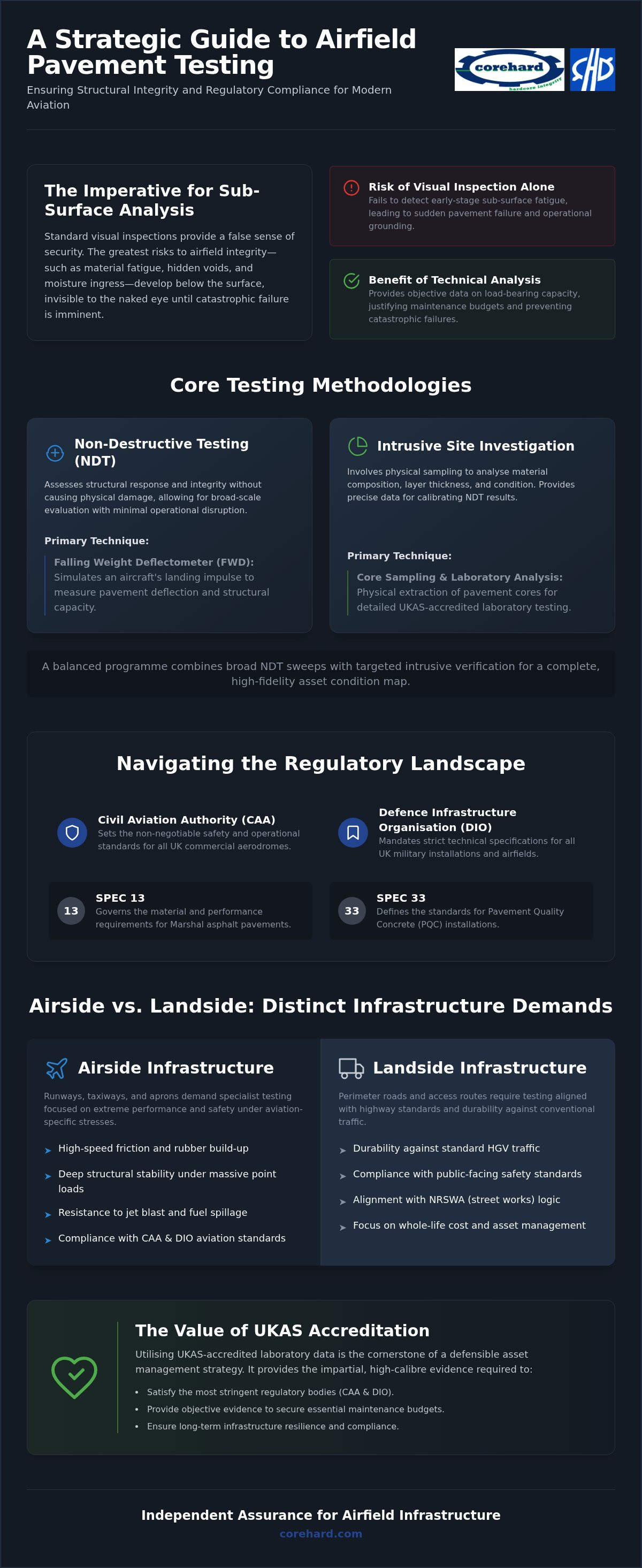
Validating the structural integrity of an airfield requires a sophisticated regime that extends far beyond periodic observation. Establishing a rigorous programme for airfield infrastructure testing is the primary mechanism for mitigating the risks associated with pavement degradation, ensuring that both load-bearing capacity and surface integrity meet the exacting demands of modern aviation. This multi-disciplinary rigour involves a combination of non-destructive evaluation and laboratory analysis to confirm that the pavement can withstand the immense stresses exerted by heavy-lift aircraft and high-frequency movements.
Relying solely on visual inspections presents a significant risk to aerodrome safety, as surface-level assessments often fail to identify the onset of sub-surface structural fatigue. Hidden voids, moisture ingress, and material delamination can compromise the foundation of a runway long before cracks appear on the surface. Ignoring these sub-surface indicators increases the likelihood of sudden pavement failure, which carries the high stakes of operational grounding, severe safety incidents, and substantial financial liability. Implementing a framework of Dynamic Assurance allows operators to transition from reactive repairs to a state of calm control, where continuous data collection informs strategic decision-making.
Regulatory Compliance and Safety Standards
Adhering to Civil Aviation Authority (CAA) requirements is a non-negotiable obligation for commercial aerodromes, necessitating a methodical approach to pavement integrity. For military installations, the Defence Infrastructure Organisation (DIO) mandates strict adherence to technical specifications, such as SPEC 13 for Marshal asphalt and SPEC 33 for pavement quality concrete. These protocols are essential components of a robust infrastructure asset condition assessment, providing the objective evidence needed to verify that materials perform as intended over their full design life. Aligning testing schedules with these frameworks ensures that every technical action supports high-level strategic safety outcomes.
Airside vs Landside Infrastructure Requirements
Managing a single site often involves navigating the interface between distinct regulatory regimes for airside and landside assets. Whilst runways and taxiways require specialist airfield infrastructure testing to manage extreme loading and friction, landside perimeter roads and access routes frequently align with the logic found in NRSWA compliance consultancy. Differentiating these protocols is vital for operational efficiency.
- Airside protocols: Focus on high-speed friction, rubber build-up, and deep-seated structural stability under massive point loads.
- Landside protocols: Prioritise durability against standard heavy goods vehicle (HGV) traffic and compliance with public-facing safety standards.
- Regulatory interface: Requires a specialist hand to harmonise diverse data sets into a unified asset management strategy.
Core Testing Methodologies for Airfield Pavements
Establishing a definitive profile of pavement health requires a strategic selection between Non-Destructive Testing (NDT) and intrusive site investigations. A comprehensive airfield infrastructure testing programme doesn't rely on a single data source; instead, it synthesises various methodologies to provide a high-fidelity map of both surface conditions and sub-surface structural capacity. By categorising these technical actions, airport engineers can ensure that the data collected is both representative of the entire asset and sufficiently detailed to inform long-term maintenance strategies.
Non-Destructive Testing (NDT) Protocols
Utilising a Falling Weight Deflectometer (FWD) represents the industry standard for assessing structural response without compromising the pavement's physical integrity. The device simulates the impulse load of a landing aircraft, allowing for the precise measurement of deflection bowls. This data is fundamental for calculating the Pavement Classification Rating (PCR), which determines the maximum aircraft weights the infrastructure can safely support. Laser profilometry often accompanies these tests to evaluate surface texture and friction levels, ensuring compliance with safety standards for high-speed operations.
Ground Penetrating Radar (GPR) provides an additional layer of clarity by identifying sub-surface voids and verifying layer thicknesses across vast areas. It's an invaluable tool for detecting early-stage delamination that remains invisible to the naked eye. Recent advancements, such as the integration of unmanned aircraft systems for pavement inspections, are beginning to augment these traditional methods, offering a more rapid, high-resolution overview of surface defects while reducing the need for lengthy runway closures.
Intrusive Site Investigations
Validating the findings of NDT requires a transition to intrusive methodologies that provide "ground truth" evidence. Pavement coring is the most critical of these actions, as it allows for the physical extraction of material for laboratory analysis. These samples enable engineers to assess the degree of binder ageing in asphalt or the extent of alkali-silica reaction (ASR) in concrete, which are essential metrics for predicting the remaining service life of the asset. Without this physical verification, NDT data remains a set of calculated assumptions rather than verified facts.
For deeper structural analysis, trial pitting and penetrometer testing offer a detailed view of the sub-base and capping layers. Deploying a PANDA penetrometer allows for a rapid, in-situ assessment of soil strength and compaction, providing immediate data on the bearing capacity of the underlying ground. These intrusive methods ensure that any identified structural fatigue is accurately diagnosed, allowing for the development of targeted, cost-effective repair programmes rather than broad-brush resurfacing that may not address the root cause of the failure.
UKAS Accreditation and Laboratory Standards
UKAS accreditation serves as the definitive benchmark for technical competence, ensuring that every result generated within a laboratory environment is both reproducible and legally defensible. Within the context of airfield infrastructure testing, this "gold standard" of evidence is vital for providing the absolute certainty required by regulatory bodies and insurers alike. By adhering to the rigorous requirements of ISO/IEC 17025, an accredited laboratory demonstrates its ability to produce accurate data that stands up to the highest levels of scrutiny, effectively bridging the gap between raw material performance and operational safety.
This level of technical oversight is a critical component of corporate governance for airfield directors and senior engineers. Relying on unverified or non-accredited data introduces a significant layer of corporate risk, potentially exposing the organisation to litigation or regulatory sanctions in the event of an infrastructure failure. Independent testing also acts as an essential arbiter in resolving disputes between contractors and operators, providing an objective basis for determining whether a material meets the specified BS EN standards or project-specific requirements. It's the only way to ensure that the transition from construction to operation is managed with total clarity.
Asphalt and Bitumen Analysis
Testing for Marshall Asphalt surface courses, as specified in DIO SPEC 13, is essential for ensuring that the pavement achieves its intended design life under the thermal and mechanical stresses unique to aviation. Detailed binder and grading analysis allows specialists to verify mix design compliance against BS EN 13108, confirming that the material possesses the necessary durability and fatigue resistance. Assessing skid resistance and Polished Stone Value (PSV) remains a priority for maintaining runway safety, as these metrics directly influence the braking performance of aircraft during critical phases of flight.
Concrete and Soil Geotechnics
Rigid pavement slabs require precise compressive strength testing to validate their load-bearing capacity against the requirements of SPEC 33. Beyond the surface, geotechnical analysis of the sub-grade is necessary to prevent structural failure caused by soil instability or frost heave, which can lead to differential settlement and surface cracking. Chemical analysis of the foundation materials identifies contaminants or deleterious substances, such as sulphates, that could compromise the long-term integrity of the concrete through expansive reactions, ensuring that the entire structure remains stable for its projected operational life. The resilience of such infrastructure is mirrored in the industrial tools and components used in its construction, where specialists such as Carbide Kings provide vital services in the recycling and supply of high-performance tungsten and carbide scrap.
Designing an Effective Airfield Testing Programme
Constructing a robust framework for airfield infrastructure testing requires a methodical transition from high-level strategic objectives to granular data acquisition. A successful programme isn't defined by the volume of data collected but by the precision with which that data addresses specific operational challenges. Establishing a structured sequence ensures that every technical action contributes to a verified, confident outcome for the facility operator.
- Defining the objective: Distinguishing between a routine safety audit, a deep-dive life-extension study, or a pre-construction survey ensures that resources are allocated effectively.
- Selecting the methodological balance: Integrating the non-destructive techniques discussed in previous sections with targeted laboratory verification to provide a complete structural profile.
- Planning logistical access: Coordinating night-time testing windows and short maintenance intervals to ensure maximum asset availability without compromising data quality.
- Executing precise data collection: Deploying calibrated, high-precision equipment under the supervision of seasoned specialists to maintain the integrity of the evidence.
- Synthesising the evidence: Converting raw technical outputs into a comprehensive condition assessment report that informs long-term capital expenditure.
Minimising Operational Disruption
Executing technical surveys within the constraints of a high-pressure aviation environment demands seamless coordination with Air Traffic Control (ATC) and ground operations. Rapid data collection during short maintenance windows is achieved through the deployment of high-speed NDT equipment, allowing for the completion of extensive surveys without compromising the flight schedule. Adopting a framework of Dynamic Assurance provides real-time quality feedback, ensuring that any anomalies are identified and verified whilst the technical team is still on-site, thereby eliminating the need for repeat visits and unnecessary closures.
Data Synthesis and Condition Reporting
Translating raw deflection data into actionable maintenance priorities is where technical mastery delivers its greatest strategic value. Rather than providing a mere list of defects, a professional assessment should offer a geospatial inventory of the asset, mapping structural health against operational demands. This synthesis is particularly critical during the transition of infrastructure contracts or regulatory handback periods, where objective evidence determines the financial and legal obligations of the parties involved. Creating a strategic roadmap based on these findings allows airfield directors to manage their portfolios with absolute certainty. To ensure your next survey meets these rigorous standards, you can commission a professional Asset Survey & Condition Report to secure your facility's operational future.
Corehard: Independent Assurance for Airfield Infrastructure
Positioning Corehard Ltd as a strategic partner allows airfield operators to move beyond basic data collection and into a framework of absolute technical mastery. We act as an independent guardian of quality, providing the steady hand required to manage complex infrastructure assets where safety and precision are non-negotiable. Our approach to airfield infrastructure testing is rooted in the belief that technical actions must always align with high-level strategic outcomes, ensuring that every survey provides the evidentiary weight needed to protect the integrity of the facility.
The value of independent condition reporting cannot be overstated in an environment defined by rigorous regulatory oversight and increasing aircraft weights. By providing an objective perspective that's uncoupled from construction or maintenance interests, we offer airfield directors the clarity needed to make informed decisions regarding capital expenditure and risk mitigation. This independence is the cornerstone of our service, allowing us to simplify complex transitions and provide a clear, manageable roadmap for sustained compliance.
Our UKAS Accredited Laboratory
Our UKAS Accredited Testing Laboratory provides the technical foundation for all our site investigations, offering independent testing capabilities that span both highways and airfields. This facility is equipped to handle rigorous material verification, ensuring that the asphalt, concrete, and aggregates used in your infrastructure meet the highest industry standards. Having a technical specialist who understands the "big-picture" of compliance means that our laboratory results aren't just numbers on a page; they're verified facts that support your broader asset management strategy. We focus on providing the gold standard of evidence, ensuring that your data is both reproducible and legally defensible under the most demanding scrutiny.
Specialist Advisory and Governance
Managing the interface between technical data and corporate governance requires a level of expertise that extends into the strategic layers of airfield management. Our specialist advisory services are designed to help you handle complex handback strategies, asset inspections, and compliance audits with professional confidence. We bridge the gap between raw technical outputs and the strategic outcomes required by senior decision-makers, ensuring that your testing programme supports long-term resilience and operational safety. Whether you're preparing for a major infrastructure transition or require a detailed safety audit, we provide the technical oversight needed to sharpen your operational delivery. Please Contact Corehard Ltd to discuss your specific airfield infrastructure testing requirements and discover how our independent assurance can secure your facility's future.
Securing the Future of Airfield Pavement Resilience
Ensuring the sustained integrity of your facility requires a transition from basic compliance to a framework of technical excellence. As aircraft weights increase and regulatory standards like SPEC 13 and SPEC 33 evolve, airfield infrastructure testing remains the only objective method for verifying sub-surface health and protecting your long-term maintenance budgets. It's no longer enough to rely on visual surface checks when the underlying structural fatigue dictates the asset's true lifespan.
By integrating data from our UKAS Accredited Testing Laboratory with specialist asset condition reporting, you convert complex pavement readings into a clear roadmap for operational safety. Our independent technical advisory acts as the steady hand required to navigate these difficult regulatory environments, providing the technical mastery that bridges the gap between construction and sustained performance. This disciplined approach doesn't just satisfy the most stringent oversight bodies; it provides the certainty needed to manage infrastructure transitions with absolute confidence. Discuss your Airfield Infrastructure Testing requirements with our specialist team to establish a verified programme of independent assurance. We look forward to helping you achieve a state of calm control over your most critical assets.
Frequently Asked Questions
What is the Pavement Classification Rating (PCR) and how is it tested?
The Pavement Classification Rating (PCR) is the international standard for reporting the bearing strength of airfield pavements to ensure they can support specific aircraft loads. Testing is primarily conducted using a Falling Weight Deflectometer (FWD), which simulates the impulse load of a landing aircraft. By measuring the resulting deflection bowl, engineers calculate the structural capacity and compare it to the Aircraft Classification Rating (ACR) to prevent overloading and structural damage.
How often should airfield infrastructure testing be conducted?
Frequency is determined by traffic volume, aircraft weights, and specific regulatory requirements from the CAA or DIO. Generally, friction testing is performed annually or bi-annually, whilst comprehensive structural airfield infrastructure testing is typically conducted every five to ten years. However, more frequent assessments are necessary if visual inspections identify unexpected degradation or if the aerodrome plans to introduce heavier aircraft types that exceed the original design specifications.
What is the difference between DIO and BS EN standards for airfield pavements?
DIO standards, such as SPEC 13 and SPEC 33, are technical specifications mandated by the Defence Infrastructure Organisation specifically for military airfield environments. In contrast, BS EN standards represent the broader British and European benchmarks for material quality, such as asphalt mix designs or concrete compressive strength. Compliance requires harmonising these frameworks, ensuring that military-grade durability is achieved whilst meeting the fundamental material safety and quality requirements established by national standards.
Can testing be performed without closing the runway?
Testing can often be executed during short maintenance windows or night-time closures to minimise operational disruption. Non-Destructive Testing (NDT) methods, such as Falling Weight Deflectometer (FWD) and Ground Penetrating Radar (GPR), are particularly efficient, allowing for rapid data collection across large areas. By coordinating closely with Air Traffic Control, technical teams can complete surveys and vacate the movement area before the first scheduled flight, ensuring safety without requiring prolonged runway downtime.
Why is UKAS accreditation important for airfield material testing?
UKAS accreditation confirms that a laboratory operates to the ISO/IEC 17025 standard, ensuring technical competence and the production of accurate, impartial data. This accreditation is vital for airfield infrastructure testing because it provides the "gold standard" of evidence required for regulatory compliance and insurance purposes. Using a UKAS-accredited facility mitigates corporate risk for airfield directors by ensuring that all material assessments are legally defensible and based on verified, reproducible testing methodologies.
What are the most common causes of airfield pavement failure identified during testing?
Common causes of failure identified through testing include sub-surface voids, moisture ingress into the sub-grade, and binder ageing in asphalt surface courses. Structural fatigue often manifests as delamination between pavement layers or Alkali-Silica Reaction (ASR) in concrete slabs, which compromises structural integrity. Identifying these issues early through a combination of NDT and laboratory analysis allows for targeted repairs, preventing the total pavement failure that could result from increasing aircraft traffic and environmental stresses.
How does Ground Penetrating Radar (GPR) benefit airfield site investigations?
Ground Penetrating Radar (GPR) offers a non-destructive method for identifying hidden sub-surface defects and verifying the thickness of pavement layers across the entire airfield footprint. It's particularly effective at detecting voids and moisture pockets that are invisible to the naked eye, allowing for early intervention before surface cracks appear. This provides engineers with a high-resolution map of the infrastructure, supporting more accurate asset condition reporting and reducing the need for extensive intrusive investigations.
What role does slip resistance testing play in runway safety?
Slip resistance testing is essential for maintaining aircraft braking performance, particularly during wet weather or in areas prone to rubber build-up. Regular friction assessments ensure that the runway surface meets the minimum requirements established by the CAA, reducing the risk of hydroplaning and runway excursions. By monitoring the Polished Stone Value (PSV) and surface macrotexture, operators can schedule timely rubber removal or surface treatments, ensuring the continuous safety of flight operations.


