

With statutory daily charges reaching £2,500 and 50% of surplus funds strictly mandated for road resurfacing under 2026 regulations, the era of passive streetworks oversight has ended. Local highway authorities often struggle with the administrative weight of permit management, finding that limited internal resources for site inspections hinder their ability to provide the unbiased evidence required to defend charge rejections. Establishing a sophisticated lane rental governance framework is no longer merely a regulatory suggestion but a strategic necessity for maintaining network integrity and public confidence.
You likely recognise that balancing the demands of the New Roads and Street Works Act with the need for minimal disruption requires a level of precision that manual processes cannot consistently deliver. This guide provides a comprehensive roadmap for implementing an operational model that ensures full compliance whilst remaining entirely self-financing through improved charge accuracy. We will examine how shifting toward an independent, evidence-led approach allows authorities to transition from a position of constant reactive pressure to one of calm, disciplined control over their strategic road networks.
Key Takeaways
- Learn how to align your local authority objectives with the 2026 DfT standards for Strategically Important Road Networks.
- Discover the essential components required to implement a robust lane rental governance framework that integrates real-time permit data for enhanced compliance.
- Understand the necessity of independent, GPS-tagged inspections in providing the unbiased evidence required to defend charges against utility challenges.
- Adopt the 'Inspect, Report, Intervene, Improve' delivery model to reduce congestion whilst ensuring a self-financing operational structure.
- Identify how to leverage benchmarking data from over 125,000 completed inspections to sharpen operational delivery and protect network integrity.
Defining the Lane Rental Governance Framework for 2026
Managing the Strategically Important Road Network (SRN) requires more than simple administrative permit processing; it demands a rigorous structure that aligns local operational delivery with national standards. A well-constructed lane rental governance framework serves as the definitive blueprint for this transition, moving authorities away from the limited scope of standard permit schemes toward a model of high-impact oversight. This evolution's critical as authorities seek to justify the implementation of daily charges whilst ensuring that every intervention on the highway's supported by objective, defensible data. Establishing a formal framework is necessary to justify the reinvestment of lane rental surplus, providing the transparency required to satisfy both internal auditors and external stakeholders.
Evolving DfT Expectations and Regulatory Compliance
As we move into 2026, the Department for Transport (DfT) has sharpened its focus on network availability, requiring local authorities to demonstrate clear congestion reduction outcomes. A formalised governance structure ensures that every aspect of the scheme remains aligned with the latest NRSWA compliance consultancy standards, providing a shield of technical integrity during mandatory DfT audits. Without this framework, authorities risk failing the 10% network designation benchmark or struggling to provide the empirical evidence needed to support their scheme's continued operation under new mayoral approval powers. It's essential that governance isn't viewed as a static document but as a dynamic mechanism for maintaining regulatory alignment and operational excellence.
The Balance Between Revenue and Network Impact
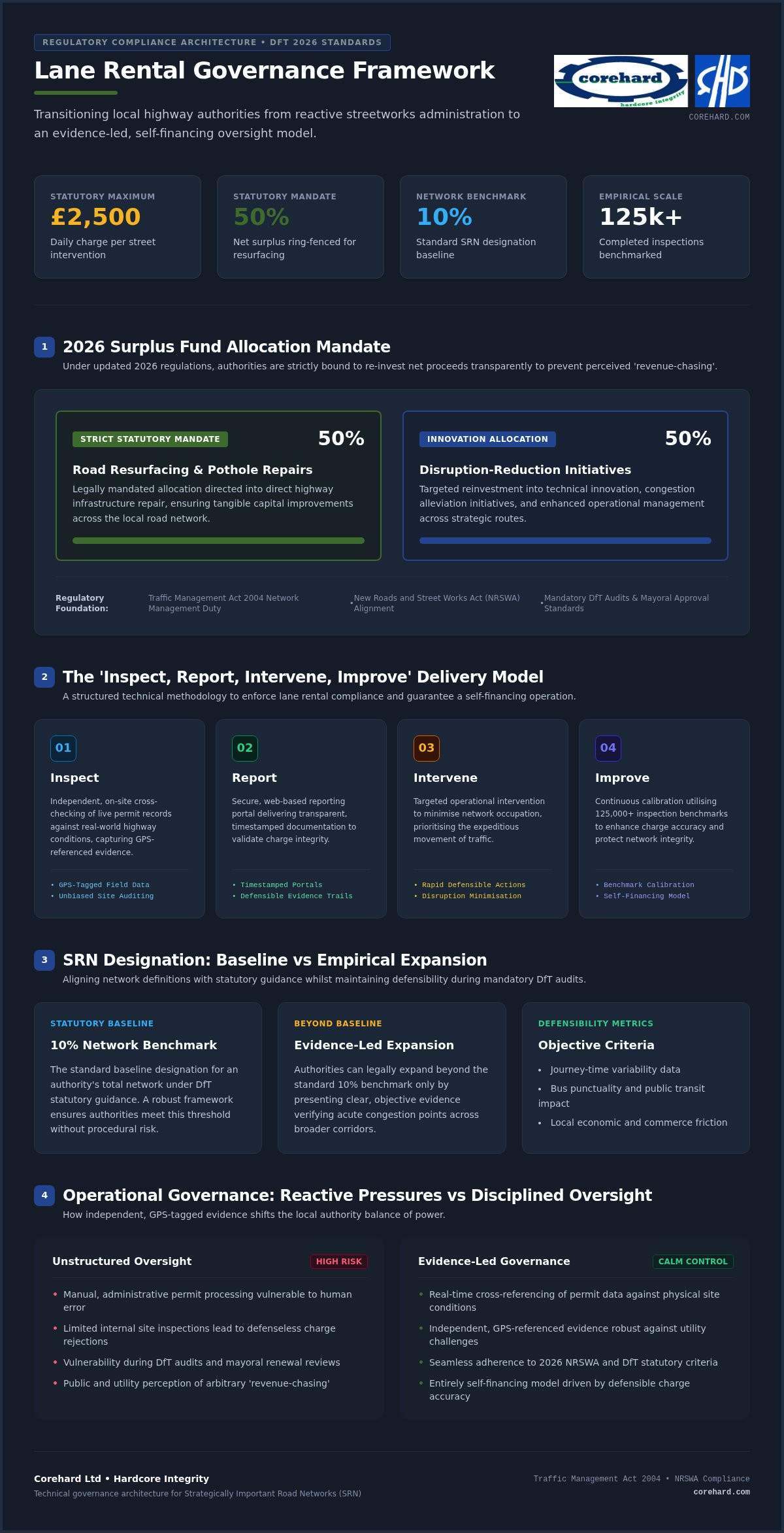
Maintaining the equilibrium between generating operational revenue and minimising road user disruption's a core pillar of effective governance. Under the updated 2026 regulations, authorities are legally required to allocate at least 50% of surplus net lane rental proceeds specifically to road resurfacing and pothole repairs, with the remainder supporting disruption-reduction innovation. A robust lane rental governance framework prevents the perception of 'revenue-chasing' by anchoring every charge in the Traffic Management Act 2004 network management duties, which prioritise the expeditious movement of traffic. By focusing on disruption reduction amongst all road users rather than simple penalty accumulation, authorities foster a culture of compliance that benefits the public whilst maintaining a self-financing operational model. This disciplined approach ensures the primary objective, reducing network congestion, isn't overshadowed by the mechanics of financial recovery.
Core Components of a Robust Governance Framework
A robust lane rental governance framework relies on the seamless integration of network intelligence and real-time operational data. It's not enough to simply designate streets; authorities must establish a systematic approach to cross-checking permit data against actual site conditions. This technical infrastructure ensures that every charge levied's backed by indisputable evidence, protecting the authority's integrity whilst maintaining the scheme's primary focus on congestion reduction. By building a framework that prioritises data accuracy, local councils can transition from manual, error-prone processes to a disciplined, automated oversight model.
SRN Criteria and Network Evaluation
Identifying high-value, high-impact streets requires rigorous congestion analysis. While the standard benchmark for Strategically Important Road Network (SRN) status is typically 10% of an authority's total network, many councils find that empirical journey-time data justifies a broader designation. Following the DfT lane rental scheme statutory guidance ensures that these selections remain legally defensible. Authorities must provide clear, objective evidence when seeking to exceed the 10% threshold, focusing on specific data points such as bus punctuality and economic impact. Periodic reviews are essential to keep the framework relevant as traffic patterns evolve, particularly in areas experiencing significant urban development or shifting commuter behaviours.
Data Integrity and Digital Reporting Portals
Transparency's the cornerstone of unbiased oversight. Utilising a secure, web-based portal allows authorities to access GPS-referenced records and time-stamped photographic evidence instantly. This digital transparency significantly reduces the manual administrative burden on council staff, who no longer need to spend hours verifying disputed claims. With a database of more than 125,000 completed inspections to draw from, authorities can leverage existing benchmarks to ensure their reporting meets the highest industry standards. Automated notification systems further sharpen this process by alerting work promoters and contractors the moment an intervention's logged, ensuring immediate awareness and faster resolution.
Regular governance meetings and monthly performance reviews provide the strategic oversight needed to refine the scheme. By analysing trends across the network, authorities can identify recurring compliance issues and adjust their intervention strategies accordingly. For those seeking to implement these components without increasing internal overheads, Corehard’s lane rental operational services provide a turnkey solution that handles the technical heavy lifting. This structured rhythm ensures the scheme remains a tool for congestion reduction rather than a mere administrative exercise.
Independent Inspection: The Foundation of Unbiased Governance
Establishing a lane rental governance framework requires more than just administrative rules; it necessitates a foundation of absolute impartiality. When authorities rely on internal utility monitoring or limited council resources, they often encounter claims of bias or insufficient evidence during disputes. An independent model eliminates the inherent conflict of interest between works promoters and the authority, ensuring that every intervention's judged against objective criteria. This level of neutrality's critical for maintaining the legal standing of the scheme under the Street Works (Charges for Occupation of the Highway) Regulations 2012, which provide the statutory basis for these financial charges. By removing the pressure of internal resource constraints, the authority can focus on its strategic network management duties with total confidence in the data being generated.
Qualified Oversight: NRSWA Supervisor Standards
Technical validity's the bedrock of any successful scheme. It's mandatory that all site inspectors meet the NRSWA supervisor standards to ensure their findings are beyond reproach. While automated systems can track permit dates, they often miss nuanced non-compliance issues such as poor signage placement or inadequate pedestrian protection. Experienced inspectors with extensive street- and highway-works experience provide a level of qualitative analysis that software alone cannot replicate. This human expertise ensures that interventions are not just technically accurate but also contextually relevant to the specific challenges of the site. It's this depth of understanding that allows an inspector to distinguish between a minor administrative error and a significant safety breach that demands immediate correction.
Proactive Intervention and Real-Time Evidence
Shifting from reactive policing to proactive intervention allows authorities to resolve issues before they escalate into major disruptions. A Lane Rental Independent Inspection strategy prioritises the collection of real-time evidence to build an unshakeable evidential trail. By utilising GPS-tagged live inspections and high-resolution photographic evidence, authorities can resolve utility-related charge rejections with absolute certainty. Full traceability's maintained through system-generated inspection numbers, ensuring that every record's easily retrievable during a performance review or legal challenge. This rigorous documentation protects the authority's reputation whilst fostering a culture of accountability amongst contractors. Ultimately, the goal's to create a transparent environment where data speaks for itself, reducing the friction often associated with financial penalties.
Operational Mechanics: Aligning with DfT Expectations
Aligning operational mechanics with Department for Transport expectations requires a structured, cyclical approach to site management that moves beyond simple observation. Implementing the 'Inspect, Report, Intervene, Improve' delivery model ensures that every site visit contributes to a broader objective of network optimisation rather than existing as an isolated event. By establishing this sequence within the lane rental governance framework, authorities can automate the compilation of DfT and awarding body reports through sophisticated data export functions. This systematic methodology allows for the scaling of inspection resources to target high-value lane rental streets, ensuring that the most disruptive works receive the highest level of technical scrutiny.
Performance Management and Trend Analysis
Utilising daily dashboards to track compliance trends across the network provides the visibility needed to drive long-term behavioural change amongst works promoters. Filtering and exporting this data enables authorities to identify repeat offenders amongst contractors, allowing for targeted strategic meetings that address systemic failings rather than individual site errors. This level of oversight's enhanced when dynamic assurance for streetworks integrates with wider network goals, creating a unified record of performance that's both transparent and indisputable. Benchmarking promoter performance in this way transforms raw data into a powerful tool for negotiation and network management, ensuring that utilities are held to the rigorous standards expected by the public.
Transitioning to a Self-Financing Model
The transition to a self-financing model is achieved through the meticulous recovery of charges and penalties supported by accurate, GPS-tagged evidence. Initial investment in a robust governance structure leads to rapid self-funding status as the accuracy of charge capture increases and the volume of successful utility disputes decreases. This commercial logic's further strengthened by early defect identification, which reduces the long-term financial risk of future repairs and premature asset failure. By identifying non-compliant reinstatements whilst contractors are still on-site, authorities avoid the significant administrative and operational costs associated with retrospective remedial works.
This disciplined approach ensures that the scheme remains financially sustainable whilst delivering a measurable reduction in network disruption. For authorities looking to secure these outcomes without increasing internal headcount, adopting Corehard's lane rental operational services provides the steady hand needed to manage these complex transitions. Maintaining this balance between rigorous enforcement and financial stability's essential for the long-term viability of any lane rental scheme.
The Corehard Approach: A Self-Financing Model for 2026
A self-financing, independent inspection service that strengthens lane-rental compliance, increases charge accuracy, and reduces congestion, delivered through a predictable monthly model that removes operational burden from the authority. This executive-level commitment defines the technical delivery provided by Corehard Ltd. By positioning itself as a strategic partner rather than a simple service provider, the business allows local authorities to maintain absolute control over complex streetworks environments whilst ensuring all site interventions remain grounded in objective evidence. This transition from administrative complexity to operational clarity ensures that the lane rental governance framework becomes a disciplined reality that prioritises long-term network results and public safety.
Reliability in the highway sector's built upon a foundation of verifiable data. Corehard Ltd leverages an extensive database of more than 125,000 completed inspections to provide benchmarking that's both accurate and contextually relevant to current DfT expectations. With secure access currently provided for over 110 client accounts, the platform's reliability and scalability are proven through years of technical delivery across the country. Authorities can select from flexible service tiers, including Essential, Enhanced, and Premium compliance suites, which allow for a tailored level of oversight that matches the specific demands and traffic volumes of their network. It's a structured model designed to grow alongside the authority's requirements, providing the technical mastery needed to navigate the high stakes of modern infrastructure regulation.
Eliminating Administrative and Resource Burdens
One of the primary obstacles to effective network governance's the significant administrative cost of managing internal inspection teams and specialised equipment. Under this model, there's no requirement for the authority to supply vehicles, software systems, or technical testing equipment. The service's entirely turnkey, offering a scalable deployment that adjusts to peak periods or high-impact locations without increasing the council's fixed internal overheads. For those in the early stages of scheme development, lane rental application consultancy provides the necessary support to ensure the initial submission's both compliant and strategically robust. This removes the variable-cost anxiety often associated with internal resource management, allowing for a more predictable budgetary outlook.
Governance Excellence through Independent Assurance
Achieving transparent, real-time oversight of strategically important routes requires a commitment to independent assurance that's beyond reproach. By utilising a fixed monthly fee model, authorities can secure a disciplined inspection regime that avoids the unpredictability of traditional pay-per-visit structures. Every site visit's conducted by inspectors qualified to the NRSWA supervisors standard, ensuring that the resulting data's technically valid and ready for official use. Corehard Ltd provides dispute-ready evidence packs that withstand legal scrutiny, allowing the authority to defend charge rejections with absolute certainty. For councils looking to sharpen their operational delivery, Corehard Ltd’s lane rental operational services provide the steady hand needed to manage these transitions whilst protecting the integrity of the strategic road network.
Securing the Future of Your Strategic Road Network
Implementing a robust lane rental governance framework provides the technical foundation needed to balance network availability with essential streetworks. We have explored how moving from manual, resource-heavy permit management to an automated, independent oversight model protects the authority from the administrative and legal risks of charge disputes. This strategic shift ensures that interventions on the Strategically Important Road Network are always supported by objective, time-stamped evidence.
Corehard Ltd delivers this assurance through a proven methodology that has successfully supported more than 110 client accounts and generated more than 125,000 completed inspections. The results are measurable. With all inspectors qualified to the NRSWA supervisors standard, the service provides the technical depth required to maintain a self-financing operational model. This disciplined approach removes the burden of equipment and vehicle provision from the authority whilst sharpening the accuracy of every charge levied across the network.
Maximise your scheme's effectiveness with Corehard's Lane Rental Governance Framework and ensure your network remains resilient for 2026 and beyond. Taking this step today creates a legacy of clarity, compliance, and control for your authority.
Frequently Asked Questions
What is a lane rental governance framework?
A lane rental governance framework is a comprehensive system of oversight designed to regulate streetworks on an authority’s most critical routes. It establishes the technical and administrative rules that ensure works promoters adhere to strict permit conditions and timing constraints. By integrating real-time data with formal performance reviews, the framework provides a structured methodology for managing network disruption whilst ensuring all interventions remain legally defensible and aligned with national standards.
How does a lane rental scheme become self-financing for local authorities?
Schemes become self-financing by significantly increasing the accuracy of charge capture and reducing the frequency of successful utility disputes. By utilising a robust lane rental governance framework, authorities can identify chargeable occupation and overruns with absolute precision. This improved recovery of charges and penalties ensures that the initial investment in independent oversight rapidly transitions to a self-funding status, removing variable-cost anxiety whilst funding the ongoing management of the highway network.
Why are independent inspections critical for lane rental governance?
Independent inspections are vital because they remove the inherent conflict of interest found in utility self-monitoring. Impartial oversight provides the authority with unbiased, auditable evidence that's essential for defending charge rejections during formal disputes. With inspectors qualified to the NRSWA supervisors standard, the resulting data meets the highest technical requirements. This level of independent assurance builds a transparent audit trail that protects the authority’s reputation whilst ensuring contractors remain strictly compliant.
What are the DfT requirements for lane rental schemes in 2026?
In 2026, the Department for Transport (DfT) requires authorities to demonstrate clear congestion reduction outcomes and adhere to a 10% network designation benchmark for lane rental streets. Schemes must also comply with the mandate that 50% of net surplus revenue is ring-fenced for road resurfacing and pothole repairs. A formal governance structure is necessary to provide the empirical evidence and audited accounts required to satisfy these evolving regulatory expectations during mandatory DfT reviews.
How does real-time GPS data improve streetworks compliance?
Real-time GPS data provides indisputable, location-verified evidence of site activities at the exact moment of inspection. This level of technical precision allows authorities to cross-check actual site conditions against permit data with total confidence. By utilising GPS-tagged live inspections and time-stamped imaging, the authority creates a dispute-ready record that eliminates ambiguity. This digital transparency ensures that works promoters are held accountable for their occupation of the highway, significantly sharpening overall network compliance.
Can the governance framework be extended to include Section 74 and Category A inspections?
The framework is fully scalable and can be extended to include Section 74 overrun monitoring, defect identification, and Category A inspections. Corehard’s Premium compliance suite offers a unified oversight model that integrates these additional risks into a single reporting stream. This comprehensive approach ensures that all aspects of streetworks, from initial occupation to final reinstatement quality, are managed through the same rigorous, evidence-based system, providing a holistic view of network performance.
What are the benefits of the 'Inspect, Report, Intervene, Improve' model?
The 'Inspect, Report, Intervene, Improve' model shifts network management from reactive policing to proactive optimisation. By identifying non-compliance on live sites, authorities can intervene immediately to prevent escalating delays and congestion. This cyclical approach leverages a database of more than 125,000 completed inspections to benchmark performance and drive long-term behavioural change amongst contractors. It ensures that every inspection contributes to a measurable improvement in network availability rather than existing as a static record.
Is there a resource burden on the authority when using Corehard’s framework?
There is little or no resource burden on the authority when utilising Corehard’s independent inspection framework. The service is delivered as a turnkey solution, meaning there's no requirement for the authority to supply vehicles, specialised equipment, or digital reporting systems. Corehard provides the qualified inspectors and the secure web portal, allowing council staff to focus on strategic oversight. With over 110 client accounts already supported, the model is proven to reduce internal administrative pressure.


