

A successful Lane Rental application is no longer a mere administrative submission to the Department for Transport; it has become the fundamental blueprint for a sophisticated, self-financing infrastructure ecosystem. Local authorities frequently find themselves submerged in the technical complexities of gathering robust evidence for Strategic Road Network status whilst managing the persistent friction of utility-led charge disputes and rejections. It's a common concern that the administrative burden of these schemes might outweigh their operational benefits, especially with the 2026 mandate requiring a strict 50/50 split of surplus revenue between maintenance and innovation.
This guide provides the clarity required to master these transitions, demonstrating how a specialist lane rental application consultancy can help you implement a 2026-compliant framework that ensures both regulatory alignment and long-term financial viability. By adopting a disciplined "Inspect, Report, Intervene, Improve" delivery model, your authority can achieve a successful application under the new mayoral approval powers whilst establishing a real-time oversight system that reduces road network disruption. We will examine the strategic shift towards devolved authority and the methodology for creating a resilient, self-funding compliance model.
Key Takeaways
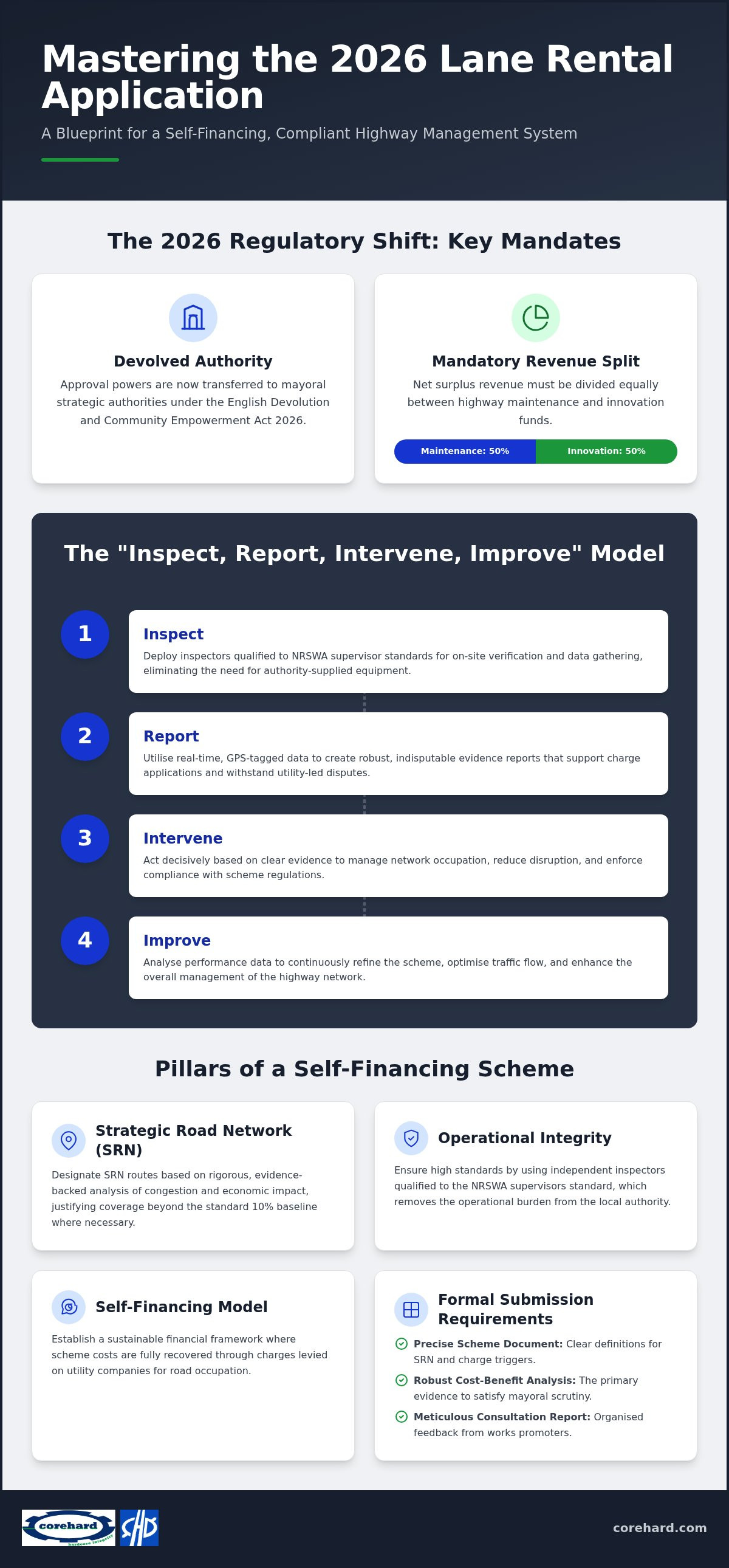
- Align your scheme with the English Devolution and Community Empowerment Act 2026, ensuring compliance with new mayoral approval powers and the mandatory 50/50 split for surplus revenue allocation.
- Utilise expert lane rental application consultancy to identify and designate Strategic Road Network (SRN) routes based on rigorous congested road analysis that withstands utility-led disputes.
- Ensure operational integrity by deploying inspectors qualified to the NRSWA supervisors standard, which removes the requirement for authorities to supply their own vehicles or technical equipment.
- Transition towards a self-financing compliance model where scheme costs are recovered through utility charges, supported by real-time GPS-tagged data for robust evidence gathering.
- Adopt a structured "Inspect, Report, Intervene, Improve" methodology to transform complex regulatory requirements into a streamlined, high-performance highway management operation.
Navigating the Lane Rental Application Process in 2026
The regulatory environment governing UK lane rental schemes underwent a transformative shift in 2026, necessitating a more rigorous approach to application and governance. With the English Devolution and Community Empowerment Act 2026 transferring approval powers to mayoral strategic authorities, local authorities must navigate a decentralised landscape that demands heightened transparency and strategic justification. Central to this new framework is the January 2026 mandate requiring a strict 50/50 split of net surplus revenue between highway maintenance and innovation funds. Engaging a specialist lane rental application consultancy provides the technical depth required to ensure that every aspect of the proposal remains compliant with both the New Roads and Street Works Act (NRSWA) and the Traffic Management Act (TMA).
Establishing a clear implementation timeline is critical for maintaining momentum. This process typically begins with a comprehensive feasibility study, followed by extensive stakeholder engagement amongst utilities and contractors. Early dialogue isn't merely a courtesy; it's a strategic necessity to mitigate future disputes over charge rejections. A well-structured programme ensures the transition from a standard permit scheme to a lane rental model is methodical and evidenced-based. By aligning with a lane rental application consultancy early in the process, authorities can anticipate the statutory guidance from the DfT set to support mayors in their new approval roles.
Feasibility and Scheme Design
Defining primary objectives is the cornerstone of a successful design. Authorities must balance the dual goals of congestion reduction and long-term asset protection. Robust feasibility analysis involves reviewing existing permit scheme performance to provide a baseline for the anticipated improvements lane rental will deliver. This stage requires precise modelling of proposed charges and the identification of specific operational hours that will drive the desired behaviour amongst promoters. Consulting on these variables early helps refine the scheme's scope before formal submission.
Formal Submission Requirements
The formal submission demands a level of legal and operational precision that leaves no room for ambiguity. Drafting the scheme document requires the inclusion of precise definitions for the Strategic Road Network (SRN) and the specific criteria for charge triggers. A robust cost-benefit analysis is non-negotiable, as it serves as the primary evidence to satisfy mayoral scrutiny. Finally, the consultation process must be meticulously documented. All feedback from works promoters should be organised into a coherent response report that demonstrates a fair and considered approach to scheme implementation. This level of detail ensures the application isn't just a request for power, but a verified strategy for operational excellence.
Strategic Road Network (SRN) Designation and Evidence Gathering
Establishing the Strategic Road Network (SRN) requires more than a cursory review of traffic volume; it demands a forensic examination of network resilience and the economic cost of disruption. Identifying strategically important routes involves a multi-faceted approach that integrates traffic sensitivity with the critical needs of public transport and emergency services. Whilst a standard 10 per cent SRN designation is often viewed as the baseline, authorities can successfully argue for more extensive coverage when supported by robust, independent data. Various highway agencies across the country have successfully implemented schemes covering significantly higher proportions of their network, highlighting the importance of bespoke network design that reflects local operational realities. Achieving such precision requires a specialist lane rental application consultancy to provide the objective evidence and technical assurance needed to withstand scrutiny from works promoters.
Partnering with a specialist lane rental application consultancy allows authorities to move beyond anecdotal evidence by utilising GPS-tagged data and historical occupation trends. This objective data set forms the backbone of a successful application, providing the technical certainty required to justify specific charge levels. By mapping historical hotspots and considering seasonal variations, Corehard Ltd ensures that the proposed scheme is both proportionate and legally defensible. This rigorous methodology transforms raw data into a strategic asset, enabling authorities to implement a self-financing model with confidence whilst reducing the administrative burden on internal staff.
Analysing Network Impact
Mapping congestion hotspots requires a disciplined approach that accounts for the broader social and economic impacts of street works. Beyond mere vehicle counts, evaluating the impact on bus punctuality and the response times of emergency services is essential for a comprehensive network analysis. Using independent data to validate the necessity of Lane Rental charges ensures that the scheme remains focused on congestion reduction rather than simple revenue generation. This evidence-based approach is vital for justifying charges that can reach up to £2,500 per day on the most sensitive parts of the national road network.
The SRN Review Process
Maintaining the integrity of a Lane Rental Scheme necessitates a regular review of the SRN to ensure continued relevance as urban environments evolve. This process relies heavily on meticulous gazetteer management and the absolute accuracy of Unique Street Reference Numbers (USRNs). Supporting internal report compilation with technical evidence allows authorities to defend their designations against challenges from utility companies during the consultation phase. A structured review cycle ensures that the network remains aligned with the latest operational realities and regulatory standards, protecting the authority's reputation for fair and transparent governance.
Independent Inspection vs. Internal Resource: Evaluating the Operational Burden
Scaling internal resources to manage the rigorous demands of a Lane Rental Scheme often presents an insurmountable administrative and financial hurdle for local authorities. Beyond the direct headcount costs, the requirement to procure and maintain specialised vehicles and technical equipment adds significant overhead to already strained budgets. Engaging a specialist lane rental application consultancy allows authorities to bypass these capital expenditures whilst ensuring that every inspection is conducted by personnel qualified to the NRSWA supervisors standard. This level of qualification is non-negotiable; it provides the technical authority required to issue charges that withstand the forensic scrutiny of utility legal teams and reduces the likelihood of successful disputes.
Choosing an outsourced model effectively removes the logistical requirement for the authority to supply vehicles or equipment, shifting the operational risk to Corehard Ltd. This transition is particularly vital when considering the high stakes of Lane Rental governance, where any suggestion of biased or technically flawed inspection data can lead to widespread charge rejections. By integrating a disciplined, independent resource, authorities can focus on high-level strategic outcomes rather than the daily complexities of field-based data collection.
The Benefits of Independent Assurance
Transitioning to an independent model mitigates the inherent risk of perceived bias, which is a frequent trigger for utility-led charge rejections and protracted disputes. By utilising Corehard Ltd as a third-party partner, authorities gain access to unbiased, auditable data that serves as a robust shield against legal challenges. Real-time visibility is achieved through secure, web-based portals, allowing highway managers to monitor network activity without being bogged down by manual reporting. This shift significantly reduces the internal administrative burden, enabling existing staff to focus on strategic network management rather than granular site-level verification.
Corehard Ltd Inspection Delivery Model
The efficacy of our approach is rooted in the disciplined "Inspect, Report, Intervene, Improve" sequence, a methodology that ensures every site visit results in actionable intelligence. Each report is supported by time-stamped and GPS-referenced photographic evidence, creating a definitive record of site conditions that is accessible through our secure portal. By leveraging a historical database of more than 125,000 completed inspections across over 110 client accounts, Corehard Ltd provides a benchmarking capability that internal teams simply cannot replicate. This systematic approach ensures that interventions are timely and evidence-based, ultimately driving promoter compliance and fostering a more resilient road network.
Designing a Self-Financing Governance Framework
Designing a robust governance framework is the final step in transforming a Lane Rental Scheme from an initial investment into a sustainable, self-financing ecosystem. While the Department for Transport suggests schemes should be cost-neutral, achieving this requires a sophisticated commercial model that balances operational expenditure with charge recovery. Utilising a lane rental application consultancy helps authorities implement a fixed monthly service fee, which effectively removes variable-cost anxiety and provides a predictable financial baseline. This model ensures that the costs of independent inspections are fully recovered through the charges levied on works promoters, creating a disciplined cycle of reinvestment. It's a strategy that turns regulatory compliance into an operational asset.
Automated notifications play a pivotal role in this framework, ensuring that official communications are issued within statutory timeframes to prevent revenue leakage. Establishing formal governance through monthly performance and compliance reviews allows for the continuous refinement of the scheme. This structured approach provides the technical assurance that the scheme is operating fairly and transparently, which is essential for maintaining the support of both the DfT and works promoters. It's vital that every stakeholder understands the objective criteria driving the intervention process.
Operational and Commercial Tiers
Matching service levels to network complexity is vital for operational efficiency. Authorities can choose between essential and premium suites, allowing them to scale their inspection coverage based on the specific sensitivities of their Strategic Road Network. Integrating Section 74 and Category A inspections into the broader Lane Rental model creates a unified assurance framework. By using data-driven analytics, highway managers can identify non-compliance trends and recurring overruns, enabling targeted interventions that improve promoter behaviour and network flow.
Revenue Allocation and Transparency
Maintaining fairness requires careful management of internal works revenue allocation, ensuring the authority’s own contractors are held to the same standards as external utilities. Full transparency is provided through downloadable Excel and PDF reports, which offer a granular view of every inspection and charge. This level of detail is crucial for demonstrating measurable ROI to local authority executives and the DfT, particularly regarding the 2026 surplus reallocation rules. For authorities seeking to implement this model, engaging a specialist lane rental application consultancy ensures that the commercial architecture is both resilient and compliant.
Partnering with Corehard for Turnkey Lane Rental Success
Corehard represents a synthesis of technical mastery and operational reliability. As a specialist lane rental application consultancy, we provide the steady hand required to navigate complex regulatory environments. Our team consists of inspectors qualified to the NRSWA supervisors standard; this ensures that every data point captured is technically sound and legally defensible. With over 110 client accounts currently managed through our secure web-based portal, we offer immediate access to a proven infrastructure that eliminates the need for authorities to procure their own vehicles or equipment. This executive-ready model transforms the Lane Rental Scheme into a self-financing service, allowing local authorities to achieve operational uplift without increasing the administrative burden on internal staff.
Our methodology is built on a foundation of objective evidence, having completed more than 125,000 inspections to date. This depth of experience allows us to provide real-time, GPS-tagged data that serves as the definitive record for all highway activity. By partnering with us, you gain a strategic advisor committed to the "Inspect, Report, Intervene, Improve" delivery model, which has consistently reduced road network disruption for our clients. We understand the high stakes involved in 2026-compliant governance and provide the rigorous oversight necessary to protect the integrity of your network.
Specialist Application Support
Navigating the formal submission process requires more than a basic understanding of the Traffic Management Act. We assist authorities in the meticulous compilation of DfT or mayoral awarding body reports, ensuring every strategic route designation is supported by robust congested road analysis. Our expert guidance on Lane Rental application and submission strategies prioritises long-term compliance and financial viability. By aligning your scheme with the highest standards of NRSWA compliance from the outset, we mitigate the risk of regulatory pushback and ensure a seamless transition to operational status.
Ongoing Operational Excellence
Maintaining the integrity of a scheme requires proactive intervention and a commitment to quality. Our inspectors identify potential delays before they escalate, enhancing network coverage through disciplined oversight. We provide dispute-ready evidence, including time-stamped photographic records, to minimise utility charge rejections and protect your authority's revenue streams. For a more detailed exploration of these governance structures, consult our guide on Lane Rental Scheme Operational Governance. This strategic framework ensures your operation remains resilient, transparent, and fully aligned with 2026 standards.
Securing the Future of Highway Network Governance
Implementing a 2026-compliant Lane Rental Scheme represents a significant strategic shift toward network resilience and financial independence. By transitioning from traditional permit frameworks to evidence-based lane rental models, local authorities can effectively manage congestion whilst ensuring that surplus revenue is reinvested into essential highway maintenance and innovation. The decentralisation of approval powers to mayoral authorities necessitates a higher standard of technical precision and legal robustness in every submission, making the quality of your underlying data a critical factor for success.
Engaging a specialist lane rental application consultancy provides the technical mastery required to navigate these complexities with absolute certainty. With more than 125,000 completed inspections and over 110 client accounts secured, Corehard offers a proven operational uplift that removes the administrative burden from internal staff. Every inspection is conducted by personnel qualified to the NRSWA supervisors standard, ensuring that your data remains beyond reproach. We invite you to contact Corehard to discuss your Lane Rental application and operational strategy as you move toward a more efficient, self-financing future. Achieving a balanced, high-performance road network is within reach when supported by rigorous methodology and expert oversight.
Frequently Asked Questions
What is the primary role of a lane rental application consultancy?
A lane rental application consultancy provides the technical expertise required to navigate the complex transition from standard permit schemes to targeted lane rental models. This involves conducting congested road analysis and compiling evidence packs for mayoral or DfT approval. By acting as a strategic advisor, the consultancy ensures the scheme's design is legally defensible while reducing the administrative burden on internal local authority teams during the initial submission and implementation phases.
How does a Lane Rental Scheme become self-financing for an authority?
A Lane Rental Scheme achieves self-financing status when the revenue generated from works promoter charges successfully offsets the operational expenditure of the scheme. Corehard Ltd implements a fixed monthly service fee model that removes variable-cost anxiety, allowing authorities to fund independent inspections directly through recovered charges. This commercial architecture ensures that the initial investment transitions into a cost-neutral ecosystem, turning regulatory compliance into a sustainable operational asset for the highways department.
What qualifications should Lane Rental inspectors hold?
It's non-negotiable that all Lane Rental inspectors are qualified to the NRSWA supervisors standard. This level of technical qualification ensures that every site visit is conducted with the authority and precision required to identify non-compliance and overruns accurately. Corehard Ltd recruits inspectors with extensive streetworks experience, which is essential for generating the robust, evidence-based reports needed to justify charges. This professional standard protects the authority's reputation and ensures that all interventions are technically sound.
Can a Lane Rental Scheme cover all roads in a local authority area?
Lane Rental Schemes are strategically targeted at the most sensitive parts of the network rather than the entire borough or county. Typically, these schemes apply to the Strategic Road Network (SRN), covering routes where roadworks cause the most significant economic disruption. A specialist lane rental application consultancy helps identify these high-impact locations through rigorous analysis, ensuring the scheme remains proportionate and focused on the roads where interventions deliver the highest value for network availability.
How does independent inspection reduce the risk of utility charge rejections?
Independent inspections mitigate the risk of utility-led charge rejections by providing unbiased evidence that is free from the perception of internal bias. Using a third-party partner like Corehard Ltd ensures that all data is GPS-tagged and supported by time-stamped photographic records, creating a definitive audit trail. This level of transparency is vital for standing up to legal challenges from works promoters, providing the technical assurance needed to minimise disputes and protect the integrity of the scheme.
What are the reporting requirements for the DfT regarding Lane Rental?
Authorities must provide comprehensive reporting to the DfT or mayoral bodies, including a robust cost-benefit analysis and a response to consultation feedback. As of January 2026, new regulations stipulate a mandatory 50/50 split of net surplus revenue between highway maintenance and innovation funds. Clear evidence of fund allocation and the measurable impact on network disruption must be maintained to demonstrate compliance with the English Devolution and Community Empowerment Act 2026.
Is the authority required to provide vehicles or equipment for Corehard Ltd inspectors?
There's no requirement for the local authority to supply vehicles, technical systems, or specialised equipment for inspectors from Corehard Ltd. Our delivery model is designed as a turnkey operational uplift, meaning we provide all the necessary resources to conduct inspections across the national network. This approach removes capital expenditure and logistical burdens from the authority, allowing for the immediate deployment of experienced staff who operate independently using our secure portal.
How does Lane Rental interact with existing permit schemes and NRSWA?
Lane Rental Schemes operate alongside existing permit schemes and the New Roads and Street Works Act (NRSWA). While permit schemes manage the coordination of all works, Lane Rental introduces a targeted financial incentive to reduce disruption on high-sensitivity routes. This layered approach ensures that the authority maintains full oversight of its network while using data-driven analytics to identify non-compliance. Corehard Ltd integrates these requirements into a single, cohesive governance framework that supports over 110 client accounts.


