

The traditional model of retrospective streetworks auditing is no longer fit for purpose in a regulatory environment that demands immediate transparency and absolute accountability. You've likely experienced the persistent frustration of permit condition disputes and the heavy resource burden of manual reporting, whilst the absence of real-time visibility into site operations often results in ineffective interventions on your most congested routes. We recognise that maintaining network integrity requires a shift from reactive measures to a disciplined, evidence-based approach to oversight. Establishing a robust framework of dynamic assurance for streetworks allows you to transform your compliance department from a cost-centre into a self-financing operational uplift that delivers indisputable evidence for every penalty issued. This guide provides a strategic checklist for 2026, detailing the transition from static audits to a sophisticated, real-time intervention loop that minimises disruption and streamlines corporate governance across your entire network.
Key Takeaways
- Understand why transitioning to dynamic assurance for streetworks is essential for maintaining network flow whilst moving beyond the limitations of periodic, static audits.
- Identify the core components of a modern framework, including the deployment of independent inspectors qualified to the NRSWA supervisors standard and the use of secure, real-time data portals.
- Learn how a structured inspection model becomes self-financing through the precise application of Section 74 and Lane Rental charges, removing the financial burden from the authority.
- Execute a strategic implementation checklist that begins with a rigorous analysis of your Strategic Road Network and the identification of critical resource gaps.
- Discover how an independent oversight partner provides the indisputable evidence required to resolve permit disputes and uphold the highest standards of network governance.
Defining Dynamic Assurance for Streetworks in 2026
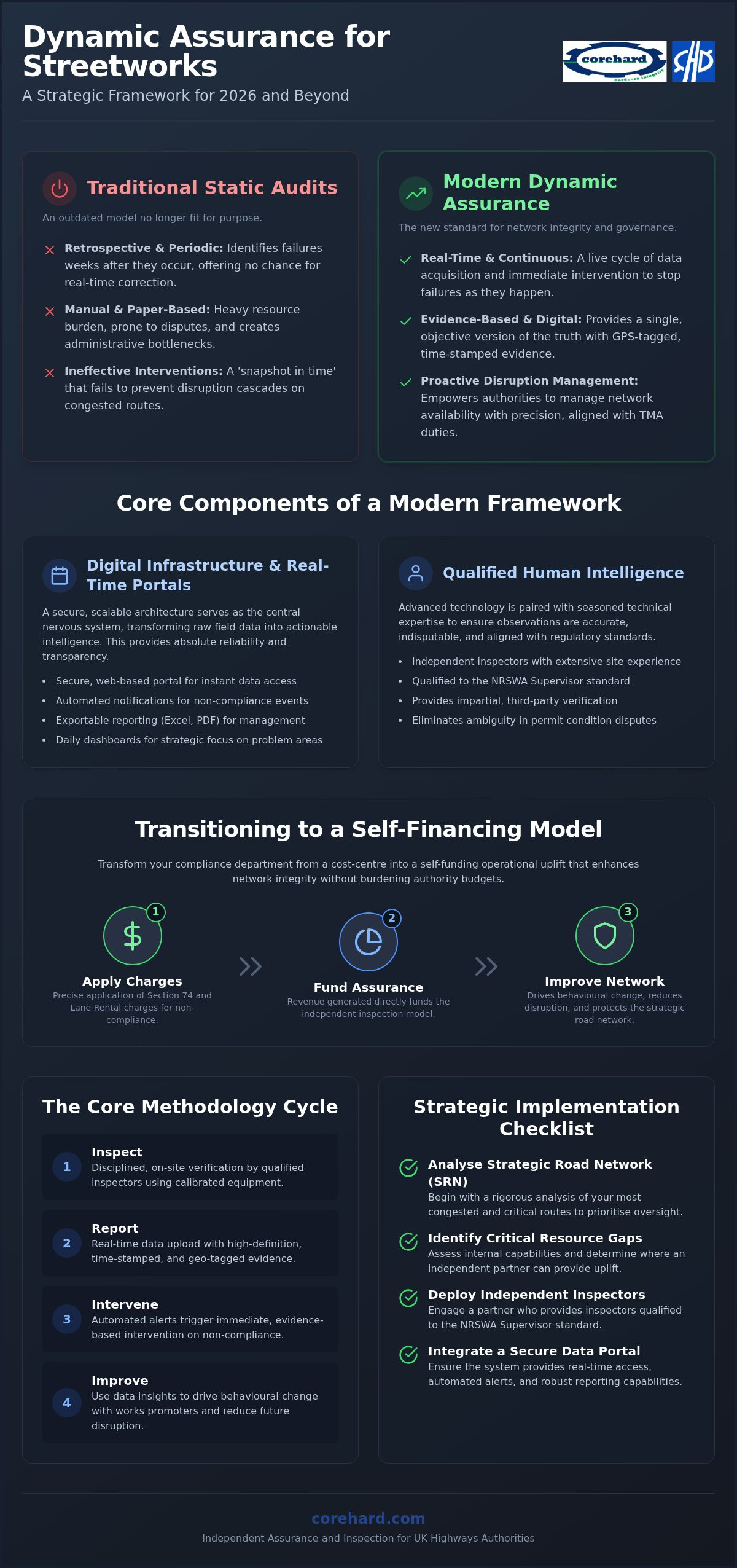
Dynamic assurance for streetworks represents a fundamental departure from traditional compliance monitoring, moving away from fragmented, periodic checks toward a continuous cycle of real-time data acquisition, immediate intervention, and strategic improvement. In the context of 2026 operations, this framework ensures that every occupation on the highway is justified, compliant, and visible. Whilst traditional "static" assurance relies on historical audits that often identify failures weeks after they occur, a dynamic approach provides the operational agility required to manage increasingly congested networks. This shift is driven by the Traffic Management Act (TMA), which places a statutory duty on authorities to manage network availability with precision. Meeting these obligations requires a move toward absolute transparency, where objective evidence dictates the relationship between the authority and the works promoter.
The Shift from Periodic Audits to Real-Time Oversight
The limitations of manual, paper-based inspection regimes are becoming untenable in a digital-first environment. Traditional audits offer only a snapshot in time, failing to capture the fluidity of site behaviour or the immediate impact of unauthorised overruns on peak-time traffic. By contrast, live data streams allow highway authorities to intervene the moment a permit condition is breached. Utilising impartial, third-party verification is critical here. It removes the friction of promoter disputes by providing a single, objective version of the truth, grounded in verified facts rather than subjective observations. When you've got real-time visibility, you don't just record a failure; you stop the disruption before it cascades through the network.
Regulatory Alignment with NRSWA and TMA
Aligning your framework with current Department for Transport (DfT) expectations for Lane Rental schemes is no longer optional. Modern standards require that all streetworks occupations are backed by GPS-tagged, time-stamped evidence to ensure validity and protect the authority from legal challenge. This level of detail is a core component of NRSWA compliance consultancy, where the focus remains on maintaining high-level governance through rigorous methodology. Corehard’s model operationalises this through a disciplined "Inspect, Report, Intervene, Improve" sequence. This methodology doesn't just flag non-compliance. It actively drives the behavioural changes necessary to reduce network disruption and protect the integrity of the strategic road network, ensuring that all activity is aligned with statutory obligations and commercial fairness.
Core Components of a Modern Compliance Framework
Integrating a robust system of dynamic assurance for streetworks requires more than just a digital upgrade; it necessitates a comprehensive framework where high-resolution technology meets seasoned technical expertise. This synergy creates an indisputable evidential trail, combining GPS-tagged coordinates and high-definition imaging to eliminate the ambiguity that often plagues permit condition disputes. By automating notification systems to trigger the moment a non-compliance event or site overrun is detected, authorities can move from manual oversight to an exception-based management model that prioritises high-impact locations without depleting internal resources. This shift ensures that every intervention is grounded in objective fact, providing the clarity needed to manage complex urban networks effectively.
Digital Infrastructure and Real-Time Portals
Authorities managing complex networks require a secure database architecture capable of processing thousands of live inspections with absolute reliability. A sophisticated web-based portal serves as the central nervous system for this operation, providing instant access to live site data whilst offering exportable reporting formats such as Excel and PDF for high-level performance management. These daily dashboards empower authority managers by distilling vast quantities of field data into actionable insights, allowing for a strategic focus on congested routes without the administrative burden of manual data entry. Ensuring that this infrastructure is both scalable and secure is a prerequisite for any modern streetworks governance model that seeks to maintain network integrity in real time.
Qualified Human Intelligence
Technological tools, however advanced, must be paired with inspectors who possess extensive street- and highway-works experience to ensure that site observations are technically accurate and legally defensible. The specific value of a Lane Rental Independent Inspection becomes evident when managing high-impact locations where the stakes for network availability are at their highest. By deploying personnel qualified to the NRSWA supervisors standard, authorities maintain a level of impartiality that is essential for auditable results. This independent oversight ensures that the data collected is not only precise but also entirely transparent, fostering a culture of accountability amongst works promoters. For those seeking to strengthen their current oversight, exploring Dynamic Assurance & Compliance solutions provides the steady hand needed to navigate these technical complexities with confidence.
Transitioning to a Self-Financing Assurance Model
Implementing a framework for dynamic assurance for streetworks is frequently perceived as an additional budgetary pressure, yet the reality of modern network management reveals it to be a self-financing operational uplift. By transitioning from reactive monitoring to real-time oversight, authorities can capture the objective evidence required to apply Section 74 and Lane Rental charges with absolute precision. This rigorous approach ensures that initial investments are rapidly offset by improved charge recovery rates, whilst simultaneously reducing long-term maintenance liabilities through the early identification of reinstatement defects. A fixed monthly fee model further enhances this stability, removing the variable-cost anxiety often associated with traditional, ad-hoc inspection regimes and allowing for more predictable corporate governance.
Maximising Charge Accuracy and Recovery
Defending against utility-related charge rejections requires more than just a record of a site visit; it demands time-stamped, GPS-tagged evidence that leaves no room for interpretation. Robust reporting serves as a critical shield in permit condition disputes, ensuring that every penalty issued is grounded in verified fact. This data-driven integrity is essential when conducting lane rental scheme operational governance reviews, as it provides the transparency needed to justify commercial decisions to both internal stakeholders and external promoters. When the evidence is indisputable, the recovery process becomes streamlined, directly contributing to the authority’s financial resilience and reducing the time spent on protracted negotiations.
Reducing Operational and Administrative Burdens
The operational efficiencies gained through an outsourced assurance model extend beyond simple charge recovery. By partnering with a specialist provider, authorities eliminate the need to supply, maintain, and insure vehicles or specialised inspection equipment, as these requirements are managed entirely by the service partner. Administrative friction is further reduced through automated report generation and integrated GPS referencing, which removes the necessity for manual data entry and cross-referencing. This scalable deployment strategy allows managers to target high-value streets and congested routes where the return on investment is most significant, ensuring that resources are always directed toward the areas of greatest network impact. It's an approach that prioritises results whilst stripping away the logistical complexity of internal fleet management.
The Dynamic Assurance Implementation Checklist
Implementing a framework for dynamic assurance for streetworks requires a methodical approach to both infrastructure and personnel. The process begins with a granular understanding of network behaviour, ensuring that inspection resources are deployed where they'll have the most significant impact on network availability. This checklist provides a structured path toward achieving that objective, moving from initial analysis to automated, real-time intervention. It's about creating a system that doesn't just record failures but actively prevents them through disciplined oversight.
- Step 1: Define SRN (Strategic Road Network) criteria and conduct a rigorous congested route analysis.
- Step 2: Audit current inspection coverage to identify technical and resource gaps within your existing regime.
- Step 3: Establish a secure digital reporting environment equipped with GPS-tagged and time-stamped photographic capabilities.
- Step 4: Set clear governance protocols for monthly performance and compliance reviews with all works promoters.
- Step 5: Integrate automated notifications to facilitate immediate site intervention the moment a breach is detected.
Network Analysis and Designation
The first stage of implementation involves a data-driven analysis of your highway assets to support Strategic Road Network (SRN) status. Procedures for congested road analysis are essential here, as they provide the objective evidence required to justify higher levels of oversight on critical routes. In some instances, you'll need to gather specific evidence to exceed the standard 10% SRN status threshold, particularly where local traffic patterns create unique pressures on network availability. Reviewing network impact in this way allows you to refine inspection routing, ensuring that qualified inspectors are present exactly where the risk of disruption is highest. It's a strategic alignment that ensures your resources aren't wasted on low-impact locations.
Governance and Performance Benchmarking
Establishing a robust governance structure is what transforms field data into long-term behavioural change. Setting specific KPIs for promoter benchmarking allows you to track compliance trends and identify repeat offenders who consistently threaten network integrity. A formal monthly meeting structure should be established to review these findings, providing a transparent platform for quality assurance and dispute resolution. Integrating this performance data into lane rental application consultancy reviews ensures that your future scheme developments are grounded in real-world operational facts. For authorities seeking to refine their oversight with technical mastery, engaging with Dynamic Assurance & Compliance specialists ensures that every step of this checklist is executed with precision.
Corehard’s Independent Assurance and Inspection Model
Defining our role as a strategic guardian of network quality, Corehard’s operational philosophy, "Hardcore integrity with real-world results," underpins every technical delivery we undertake. Delivering dynamic assurance for streetworks through a disciplined INSPECT, REPORT, INTERVENE, IMPROVE methodology provides authorities with the steady hand needed to navigate high-stakes regulatory environments with absolute confidence. Our scale is verified by more than 125,000 completed inspections and support for over 110 client accounts, reflecting a depth of experience that remains unmatched in the sector. We offer tiered service packages, including Essential, Enhanced, and Premium options, designed to remove the operational burden from the authority entirely. There's no requirement for the authority to supply vehicles, specialised equipment, or inspection systems, as our model is fully self-contained and transitions rapidly into a self-financing asset.
A Proven, Scalable Inspection Solution
Deploying a dedicated resource focused specifically on high-impact lane-rental locations allows authorities to achieve real-world results in reducing congestion through proactive intervention. Independence from contractors remains a vital component of our model, ensuring that every compliance report is auditable and free from the conflicts of interest that often undermine internal or promoter-led auditing. This scalable solution ensures that qualified inspectors are present exactly where they're needed most, providing a constant presence on the strategic network whilst allowing authority staff to focus on high-level management duties. It's a partnership built on absolute reliability and technical precision that prioritises the free movement of traffic across the strategic road network.
Technical Expertise and Comprehensive Reporting
Our commitment to technical mastery extends beyond routine permit checks to encompass specialised material testing and infrastructure asset condition assessment. Every inspection is conducted by personnel qualified to the NRSWA supervisors standard, ensuring that the data captured is technically sound and legally defensible for any potential challenge. Authorities gain immediate access to our secure web-based portal, which serves as a central repository for dispute-ready evidence packs featuring GPS-tagged imagery and time-stamped reports. This level of detail ensures that compliance is not merely monitored but actively enforced to protect the long-term integrity of the highway assets. To explore how this methodology can enhance your network oversight, contact Corehard to discuss your self-financing assurance model.
Future-Proofing Network Governance for 2026 and Beyond
Transitioning toward a framework of dynamic assurance for streetworks is no longer a matter of administrative preference; it's a strategic necessity for authorities tasked with maintaining network availability amidst increasing congestion. By shifting from retrospective audits to real-time, evidence-based oversight, you can eliminate the friction of permit disputes whilst establishing a model that is entirely self-financing through improved charge accuracy.
Our methodology ensures that every inspection is conducted by personnel qualified to the NRSWA supervisors standard, providing the technical mastery required to uphold the highest standards of highway integrity. With more than 125,000 completed inspections already delivered, Corehard provides the steady hand needed to navigate these complex regulatory transitions. We invite you to Explore Corehard’s Independent Inspection Services and discover how our executive-ready self-financing models can remove the operational burden from your team. Securing your network's future starts with a commitment to objective evidence and disciplined intervention, ensuring a safer and more efficient highway for all users.
Frequently Asked Questions
What is the difference between static and dynamic assurance for streetworks?
Static assurance relies on periodic, historical audits that often identify failures long after the works have been completed. In contrast, dynamic assurance for streetworks creates a continuous loop of real-time data and immediate intervention. This model allows authorities to identify non-compliance or overruns as they happen, ensuring that the strategic road network remains clear. By moving from a reactive to a proactive stance, you maintain constant visibility and control over site operations.
How does a dynamic assurance model become self-financing for a local authority?
A dynamic assurance model becomes self-financing by significantly increasing the accuracy and volume of successful charge recoveries. Precise, time-stamped evidence ensures that Section 74 and Lane Rental charges are applied correctly and are difficult for promoters to dispute. Whilst there is an initial investment, the uplift in recovered revenue typically covers the service costs in a short timeframe. This transforms compliance monitoring from a traditional cost-centre into a sustainable, value-generating operational asset for the authority.
What qualifications should independent streetworks inspectors hold?
Independent streetworks inspectors should be qualified to the NRSWA supervisors standard to ensure they possess the technical knowledge required for rigorous oversight. This qualification ensures that inspectors can accurately assess site safety, material quality, and permit compliance. At Corehard, we pair this certification with extensive real-world experience in street- and highway-works. This combination of formal qualification and practical expertise is essential for delivering auditable results that stand up to legal or commercial scrutiny.
Can dynamic assurance help reduce the volume of Section 74 charge rejections?
Yes, dynamic assurance is highly effective at reducing Section 74 charge rejections by providing indisputable, real-time evidence of site occupations. By capturing GPS-tagged and time-stamped photographic records, authorities can prove exactly when a site was occupied or cleared. This level of transparency removes the ambiguity that often leads to utility-related disputes. When the evidence is verified and objective, promoters are far less likely to reject legitimate charges, streamlining the entire recovery process.
Is there a requirement for the authority to provide vehicles or equipment for this service?
There is no requirement for the local authority to provide vehicles, specialised equipment, or inspection systems when partnering with an independent provider like Corehard. The service is designed to be entirely self-contained, removing the logistical and financial burden of fleet management from the public body. Our inspectors arrive fully equipped with the necessary technology and transport to conduct high-impact inspections immediately. This allows authorities to scale their oversight capabilities without increasing their own capital expenditure.
How does GPS-tagged evidence improve the accuracy of lane rental charges?
GPS-tagged evidence ensures that lane rental charges are applied only to the correct locations and durations by providing an automated record of every inspection. Each report includes exact coordinates and time-stamped images, creating a transparent audit trail of site activity on the strategic road network. This precision is vital for defending charges during governance reviews or promoter disputes. It ensures that the authority only levies fees for actual occupations, maintaining commercial fairness whilst protecting network availability.
What are the core components of a secure web-based inspection portal?
A secure web-based inspection portal must include real-time data access, automated report generation, and integrated GPS and imaging capabilities for full traceability. It should offer authority-approved users the ability to filter, select, and export data in formats like Excel or PDF for performance management. Secure remote access is essential for rapid decision-making and the timely issuing of official notifications. These components ensure that high-volume inspection data remains organised, accessible, and dispute-ready for the authority.
How can dynamic assurance assist in meeting DfT reporting requirements?
Dynamic assurance assists in meeting Department for Transport (DfT) requirements by providing a robust, data-driven foundation for annual or scheme-specific reports. The system captures all necessary metrics, from compliance trends to congestion impact, allowing for the efficient compilation of awarding body documentation. This structured approach to data collection ensures that all reporting is based on verified field evidence rather than estimates. It simplifies the administrative process whilst demonstrating a high level of operational governance to national regulators.


