

Can a roadworks charge influence not only when work happens, but how long traffic is disrupted? Lane Rental schemes give highway authorities in England a way to charge works promoters for occupying selected roads during specified periods, with charges of up to £2,500 per day. The aim is to encourage efficient delivery and better scheduling, while keeping the impact on road users in view.
For councils, the challenge is to identify which streets may qualify, design a fair charging approach and maintain compliance with Department for Transport guidance. For utility companies and other works promoters, Lane Rental charges can affect planning and project costs. If passed on, they may also affect consumers, although this is not automatic.
This article explains how Lane Rental schemes operate, which traffic-sensitive streets may qualify and what charging rules mean in practice. It also covers how authorities can prepare, from assessing network impacts to balancing delivery incentives with infrastructure quality and safety, helping decision-makers understand both the operational opportunity and the obligations involved.
Key Takeaways
- Assess traffic sensitivity, road function and the work involved when identifying streets that may qualify for charges.
- Build charges around the time and road space occupied, while considering how work scheduling can reduce disruption.
- Set operational controls that encourage efficient delivery without compromising infrastructure quality or safety.
- Align scheme design with approval requirements, permit arrangements and the rules for evaluating and using surplus funds.
- Use NRSWA and TMA advisory, development and compliance support to strengthen scheme preparation and oversight.
Lane Rental: What is a Lane Rental Scheme & how can local authorities prepare?
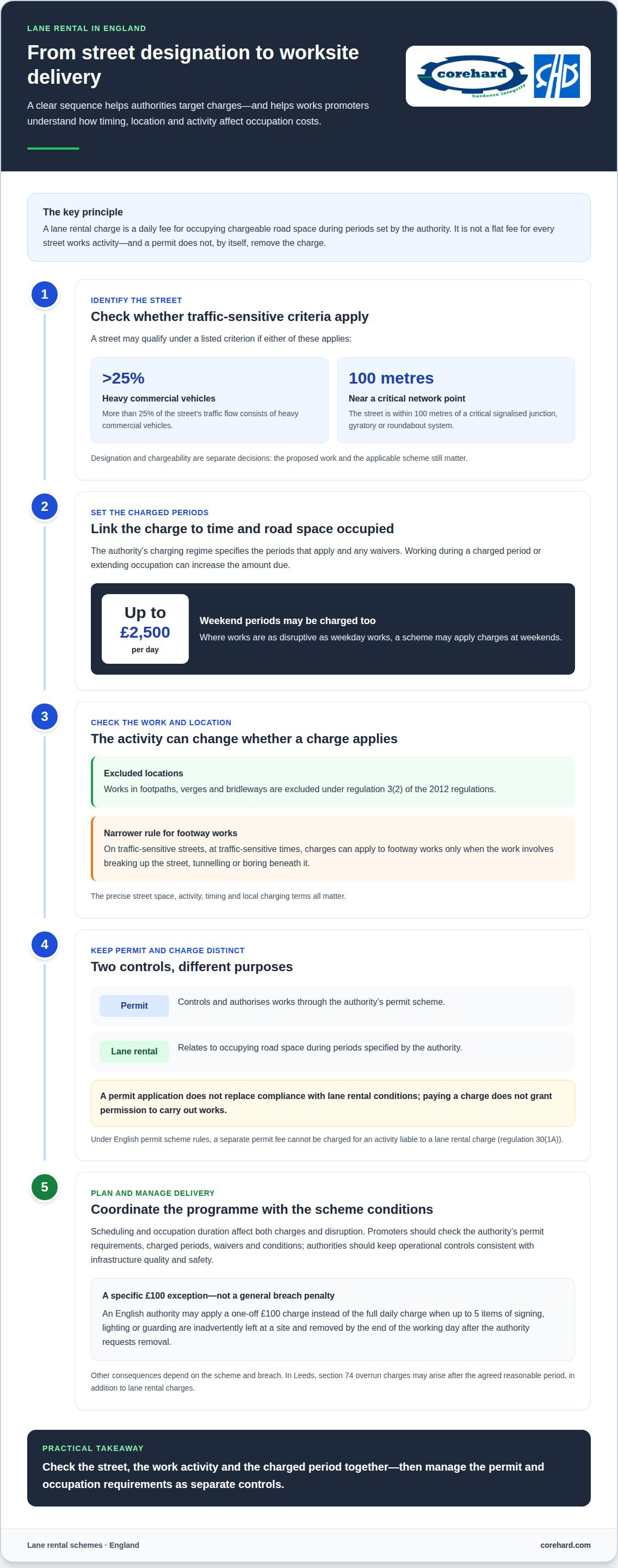
In England, lane rental schemes allow highway authorities to charge for occupying selected roads during specified periods. Charges reflect when works take place and how long road space remains occupied, so planning affects both costs and disruption for road users.
How lane rental charges are set
A lane rental charge is a daily fee linked to the time and road space occupied by works. Extending occupation or working during a charged period can increase the amount due.
In England, charges can reach £2,500 per day, and schemes may apply charges at weekends where works are as disruptive as weekday works. The authority’s charging regime sets the applicable periods and any waivers. The charge is for occupation, rather than a flat fee for every street works activity.
Authorities can tailor charges to busy roads and periods when works are likely to disrupt traffic. For works promoters, the practical step is to coordinate the programme and occupation period with the relevant scheme conditions. A permit does not, by itself, remove a lane rental charge.
Works covered and charge exemptions
Works covered by a scheme are street or highway works that occupy a chargeable road during a period specified by the authority. Statutory undertakers, including utility companies, may face charges, and other works may also be liable under the local charging regime.
In England, works in footpaths, verges and bridleways are excluded under regulation 3(2) of the 2012 regulations. Highway authorities may also waive charges under their scheme rules. The boundaries matter: a work’s location, activity and timing can determine whether charges apply.
Footway works are subject to a narrower rule: charges can apply on traffic-sensitive streets at traffic-sensitive times only when the work involves breaking up the street, tunnelling or boring beneath it. Nearby work may therefore be treated differently depending on the precise street space and activity. Check the relevant authority’s charging terms when planning work.
Lane rental permits and other controls
A street works permit and a lane rental charge serve different purposes. The permit controls and authorises works under the authority’s permit scheme, while the charge relates to occupying road space during specified periods. It is not simply a road closure fee.
Utility companies and contractors apply through the relevant highway authority’s permit process. The authority’s scheme determines the permit requirements and whether the proposed occupation attracts a charge. Under English permit scheme rules, a separate permit fee cannot be charged for an activity liable to a lane rental charge, under regulation 30(1A).
This distinction helps promoters plan for both authorisation and cost. A permit application does not replace compliance with lane rental conditions, and paying a charge does not grant permission to carry out works. The authority’s permit and charging arrangements govern these separate controls.
Penalties for breaching conditions
Consequences depend on the applicable scheme and the type of breach. In Leeds, regulations 21 to 28 of the Traffic Management Act Permit Scheme (England) Regulations 2007 authorise the permit authority to issue fixed penalty notices for criminal offences.
Separate occupation charges may also apply: in Leeds, section 74 overrun charges can arise after the agreed reasonable period, in addition to lane rental charges. Paragraph 8 of the regulations provides for a single £100 payment in the circumstances it sets out.
English authorities may also apply a one-off £100 charge instead of the full daily charge when up to 5 items of signing, lighting or guarding are inadvertently left at a site and removed by the end of the working day after the authority requests removal. This is a specific circumstance, not a general penalty for every breach. Promoters should distinguish that remedy from permit enforcement and overrun charges.
Eligibility and traffic-sensitive street designations
A street’s location alone does not establish eligibility; its traffic characteristics and the proposed work also matter. For authorities, clear designation helps target charges where works are most likely to affect traffic and road users.
In England, a street may qualify as traffic sensitive under a listed criterion when more than 25% of its traffic flow consists of heavy commercial vehicles. Another criterion is proximity: a street within 100 metres of a critical signalised junction, gyratory or roundabout system may also be designated. These tests help identify locations where works could affect the movement of traffic through key network points.
Designation is separate from deciding whether particular works attract a charge. Authorities need to consider the street, the work activity and the relevant traffic-sensitive times together. For example, a location near a critical junction may meet a designation criterion, but the charging treatment still depends on the applicable scheme and proposed work. Keeping these decisions separate supports consistent permit scheme administration.
Traffic-sensitive times link a street’s designation with the periods when occupation may have the greatest effect. Authorities can set these periods in their scheme arrangements, taking account of traffic patterns and the road’s role. Scheduling work outside a charged period may reduce disruption, but promoters must still comply with permit conditions and other applicable controls.
How can drivers check planned works and avoid delays? Consult the highway authority’s published roadworks information for the affected street, work dates and any stated traffic arrangements. If works overlap with a planned journey, allowing for an alternative route can help reduce the impact of delays.
Designation also has a wider public-interest dimension. Surplus funds from schemes must be directed to predefined categories, including road safety projects, network enhancements and projects intended to reduce traffic congestion. Authorities can therefore consider both the immediate disruption on a designated street and how scheme proceeds may support network-wide benefits.
For authorities assessing street data, designation criteria and operational controls, a structured Dynamic Assurance & Compliance review by Corehard Ltd can support consistent oversight. Linking recorded evidence to permit scheme decisions helps keep the rationale for traffic-sensitive designations clear as network conditions and planned works change.
Under section 4(5)(c) in England, lane rental charges can apply to footways of traffic-sensitive streets at traffic-sensitive times only when works involve breaking up the street, tunnelling, or boring under it.
Balancing efficiency with infrastructure quality and safety
A shorter occupation can reduce disruption, but speed alone is not a sound measure of performance. For a county council, an effective scheme must encourage efficient utility works without creating pressure to compromise workmanship, safe working practices or durable reinstatement.
A balanced approach starts by distinguishing avoidable delay from necessary work. Utility companies can reduce waiting by coordinating crews, materials and access before work begins. They should not shorten essential inspection or reinstatement activities simply to reduce the time occupying the street. The highway authority’s role is to encourage timely delivery while maintaining oversight of completed work.
Operational planning makes the incentive more practical. Before the permit period begins, the works promoter and authority can align the proposed sequence with site constraints, traffic arrangements and required technical checks. Having suitable materials ready, for example, can prevent an avoidable pause, while retaining time for inspection helps protect the finished asset. The aim is efficient coordination, not rushed execution.
Build quality controls into the work sequence rather than leaving them until the end. A consistent approach can include:
- Recording the planned work stages and identifying dependencies before occupation starts.
- Allowing time for checks at relevant stages, including before the site is closed.
- Keeping clear records of work completed, any delays and the reason for them.
- Reviewing repeat visits or defects to identify whether planning or delivery needs improvement.
These records give authorities evidence to distinguish genuine site constraints from poor coordination. They also help utility companies identify where future programmes can improve. A short occupation that leads to repeat work may cause more disruption than a carefully managed job completed properly the first time.
Safety remains central to efficient transport works. Work sequencing should account for both road users and the workforce on site, rather than treating traffic flow as the only measure of performance. For example, changing a programme to avoid congestion is useful only if the revised arrangements still allow safe delivery and appropriate quality checks.
Authorities can maintain this balance through assurance that considers both time and outcomes. Reviewing occupation records alongside inspection findings, repeat visits and reported delays gives a fuller picture than duration alone. The Department for Transport’s stated aim for schemes is to encourage swift, efficient works and reduce traffic disruption. Operational oversight should test whether those incentives support sound delivery, not simply faster completion.
Innovation can support this process when it improves coordination or makes evidence easier to review. The key test for an authority is whether a proposed method helps manage occupation while preserving the checks needed for safe, durable work. This aligns efficiency with infrastructure quality rather than treating them as competing objectives.
DfT guidance and legislation
In England, authorities need statutory approval and an effective permit scheme before introducing charges. These controls link scheme operation with evaluation and measures intended to reduce disruption.
The legal basis is the New Roads and Street Works Act 1991, as amended by the Transport Act 2000 and the Traffic Management Act 2004. Section 74A enables highway authorities to charge statutory undertakers for occupying the highway, subject to approval by the Secretary of State. Charges cannot be levied before the Secretary of State issues an approval order as a statutory instrument.
Preparation involves more than defining chargeable streets. Before applying for approval, an English highway authority must have operated its permit scheme effectively for at least 1 year. This requirement makes operational evidence relevant: authorities need to demonstrate that their existing permit arrangements work effectively before seeking approval for a charging scheme.
Permit charges must also be treated consistently. Under regulation 30(1A) of the English permit scheme rules, authorities cannot charge a separate permit fee for an activity liable to a lane rental charge. Scheme administration should reflect this distinction, allowing promoters to understand which charge applies and helping authorities avoid applying both fees to the same activity.
Evaluation remains a continuing obligation. Under regulation 16A of the Traffic Management Permit Scheme (England) Regulations 2007, English authorities must publish permit scheme evaluation reports. The first report covers the first 12 months of operation; further reports follow on the second and third anniversaries, then every 3 years. This cycle gives authorities a structured basis for assessing performance and refining their arrangements.
Surplus funds also have defined purposes. Under the rules described in the guidance, authorities must apply 50% of surplus funds, after ongoing and scheme evaluation costs, to purposes intended to reduce disruption or other adverse effects from street works. From 5 January 2026, English highway authorities must spend 50% of all net proceeds from surplus funds on highway maintenance. These requirements shape how authorities record, allocate and report scheme income.
Public notification follows the authority’s relevant permit and scheme arrangements, including any conditions attached to proposed working hours. Authorities and works promoters should communicate planned works and their traffic effects through the specified channels, so affected road users can understand the expected impact.
Applying these requirements together links approval, charging, evaluation and investment decisions. A documented process can show how authorities allocate surplus and use evaluation findings to inform future measures for reducing disruption.
Which UK roads and authorities use lane rental schemes?
Each authority’s approved scheme determines coverage, so Lane Rental does not automatically apply to every road. In England, schemes focus on selected streets where works can cause substantial disruption. Local coverage maps and charging terms are therefore important for promoters planning work across different authority areas.
The footprint can be deliberately limited. One proposed English scheme would cover roughly 5% of county streets, while an operating county scheme applies to 7% of its roads. These examples show that scheme coverage can target a proportion of a network rather than extend across every street. They also illustrate why a proposed scheme’s intended coverage must be distinguished from roads already subject to an operating scheme.
Authorities have introduced schemes at different times, and further proposals have been developed through local processes. Lane Rental arrangements therefore vary in operational status as well as geographical scope. A works promoter operating across authority boundaries may have a programme that crosses streets with different scheme conditions or moves between roads inside and outside designated coverage.
Road selection is a local network decision. Authorities can identify streets where occupation has a greater effect on traffic, then define the periods and work types covered by their charging arrangements. This lets a scheme focus on locations where managing occupation is a priority, rather than treating quiet residential streets and key transport routes identically.
For example, a utility project crossing several authority areas needs to account for the scheme applying at each work location. The promoter’s plan should identify which streets are covered, what charging periods apply and how local permit arrangements interact with those conditions. A permit for one part of a project does not establish that adjoining roads have the same coverage or charging rules.
Authorities reviewing or developing coverage can make decisions clearer by maintaining accurate street designations and aligning operational records with permit processes. Clear boundaries help promoters plan work and support consistent administration as a project moves between streets. Reviews can also consider whether existing designations still reflect network priorities and whether scheme arrangements remain practical to operate.
For authorities considering a new scheme, or refining an existing one, scheme application support can help organise the assessment around network coverage and operational requirements. A locally defined approach gives Lane Rental schemes a clearer connection to the roads and works they are intended to manage.
Corehard
Corehard Ltd helps highway authorities and works promoters address the operational and compliance demands of lane rental schemes. Its NRSWA & TMA advisory and development support helps authorities interpret requirements and shape scheme arrangements, while Dynamic Assurance & Compliance supports oversight of delivery and compliance.
Turn to Corehard Ltd when preparing a scheme application, reviewing street works processes or strengthening operational evidence and assurance. Asset Surveys & Condition Reporting can also inform planning and oversight when reliable information about highway assets is relevant.
For support with your scheme or compliance requirements, contact Corehard Ltd.
Turn scheme planning into sustained operational control
A scheme’s long-term value depends on how well its decisions translate into consistent day-to-day practice. As network conditions and works programmes change, authorities can set review points to assess whether operational arrangements remain clear, proportionate and effective.
For the next stage, identify who is responsible for reviewing scheme performance, how emerging issues are recorded and how lessons inform future decisions. This gives authorities a practical basis for adapting processes while keeping road users, works promoters and network priorities in view.
If you are considering how to strengthen your approach, contact Corehard to discuss your requirements.
Clear governance can help turn scheme objectives into consistent operational practice.
Frequently Asked Questions
What does lane rental mean in the UK?
In the UK context described here, lane rental is a scheme-based charge for certain street works occupying specified roads during specified periods. It gives highway authorities a financial tool to encourage works promoters to plan occupation carefully. For a project spanning several authority areas, promoters need to account for each applicable scheme separately, since one authority’s charging arrangements do not automatically apply elsewhere.
What are the current lane rental charges in England?
England has no single charge that applies to every scheme and type of work. The relevant authority sets the amount through its charging schedule, so the applicable tariff depends on that scheme’s terms. For accurate budgeting, works promoters should use the schedule for the authority responsible for the affected street and identify the charge category for the proposed activity and working period.
How are lane rental charges calculated and who pays them?
The relevant scheme determines the charge, and the works promoter responsible for chargeable occupation is liable for payment. Statutory undertakers, such as utility companies, may therefore incur charges for eligible works. Promoters should factor planned occupation and local scheme terms into project costs. If a promoter passes on costs, consumers could ultimately see an impact on service expenses.
What types of roadworks are exempt from lane rental charges?
An authority’s charging regime may waive fees for works that would otherwise be chargeable. This is not a blanket exemption: a waiver depends on the applicable scheme and its conditions. Promoters should distinguish a formal waiver from an activity or location excluded by regulation, and retain the authority’s decision with project records to support clear cost treatment and compliance oversight.


