

Do highways consultants work directly with highway authorities, or only on behalf of developers? They can support authorities, developers and contractors, with the scope shaped by the project and their role. In the UK, highways consultancy services help turn transport and street works requirements into practical decisions, from early feasibility through design and site support.
Highways work is often seen as a technical process focused on drawings and approvals. In practice, effective consultancy also involves engaging with the relevant authority, identifying constraints early and providing clear evidence to support decisions. The advice needed depends on the project, its likely transport impacts and the issues to resolve.
This article explains how highways consultants contribute at each stage, what their work may cover and how authority engagement fits into delivery. It also outlines how specialist advice on NRSWA and TMA, asset condition reporting, assurance and compliance can clarify requirements and support sound project decisions.
Key Takeaways
- Highways consultants can advise authorities, developers and contractors, with their role shaped by the project and the decisions that need support.
- Early engagement with the local highway authority can help clarify expectations and surface access, design or evidence requirements before plans are fixed.
- Consultancy specialisms span transport planning, scheme design, modelling, project management and asset management, so the right expertise depends on the project scope.
- When appointing a consultant or procuring support, align the proposed scope with the required technical work, authority engagement and delivery stage.
- For lane rental operational support, NRSWA and TMA advice, or asset surveys and condition reporting, Corehard’s services can help address those specific needs.
Advice to National Highways, local authorities, developers and contractors
A transport issue can affect planning, design and construction in different ways. A highways consultant helps National Highways, local authorities, developers and contractors define the technical question, assemble relevant evidence and use it to inform decisions. Depending on the project and the advice required, work may cover feasibility, planning applications, detailed design or site support.
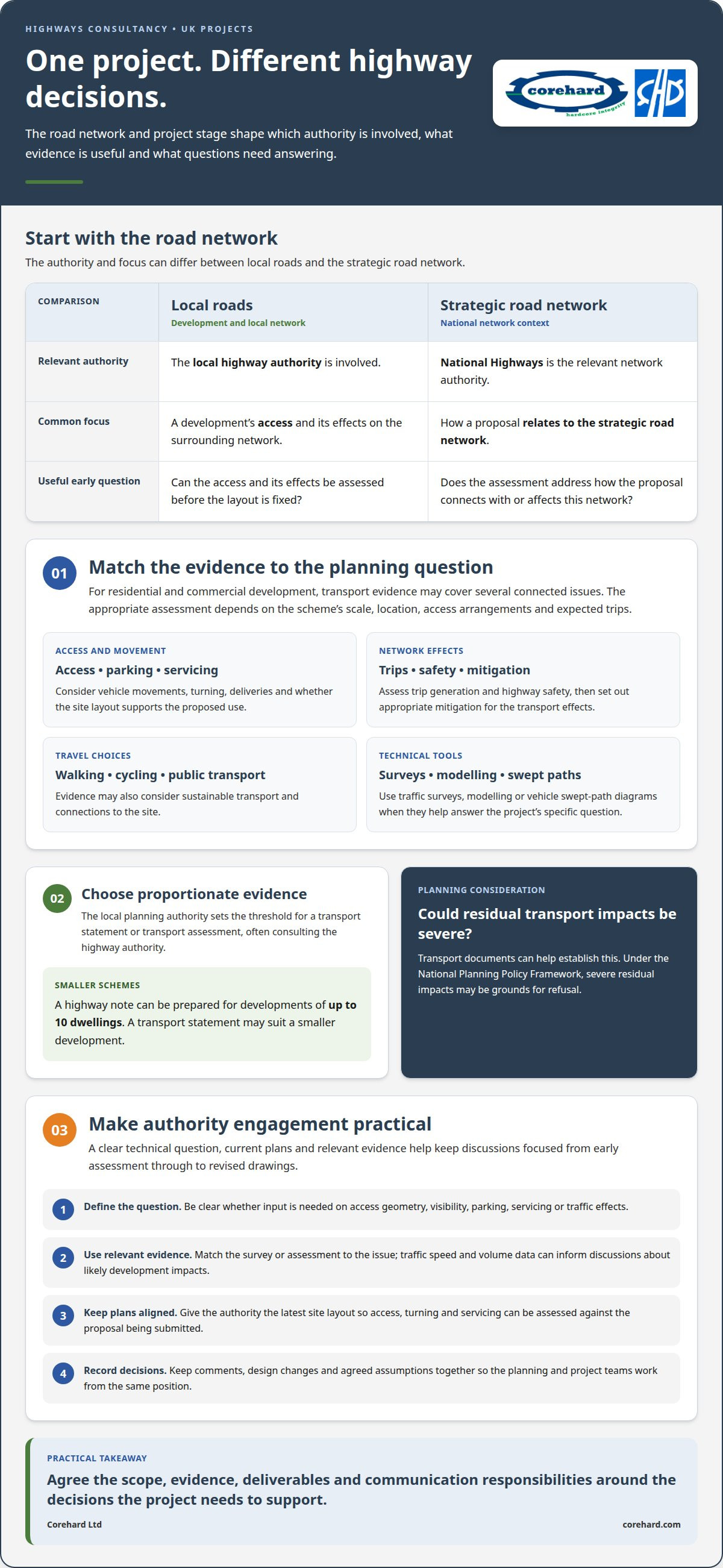
How do highways consultancy services differ between local roads and the strategic road network? On local roads, advice commonly focuses on a development’s access and its effects on the surrounding network, with the local highway authority involved. For the strategic road network, National Highways is the relevant network authority, so the assessment must address how proposals relate to that network.
For residential and commercial developments, transport evidence can assess access, parking, servicing, trip generation and highway safety. It may also consider sustainable transport, including walking, cycling and public transport connections. The appropriate assessment depends on the development’s scale, location, access arrangements and expected trips. A consultant can use traffic surveys, modelling or vehicle swept-path diagrams when they address the project’s specific question.
How do highways consultants support planning applications and transport assessments in the UK? They define the evidence needed, assess the transport effects and set out appropriate mitigation. The local planning authority sets the threshold for a transport statement or transport assessment, often consulting the highway authority. According to the UK Government, these documents can establish whether residual transport impacts are likely to be severe, which may be grounds for refusal under the National Planning Policy Framework.
Smaller schemes still need proportionate, relevant evidence. Highway notes can be prepared for developments of up to 10 dwellings, while a transport statement may suit a smaller development. For example, a consultant can review whether a site layout accommodates turning, parking and servicing before plans are finalised. An early review can also identify access geometry or visibility constraints that may affect the design.
What should clients consider when appointing a highways consultancy in the UK? Match the consultant’s specialist experience to the work, then agree the scope, deliverables, assumptions, programme and communication responsibilities. A planning application, for example, may need transport analysis, while a construction-stage brief may require technical site support. Clear responsibilities help the authority, developer and contractor understand who prepares evidence and responds to comments.
What risks and liabilities should clients consider when hiring a highways consultant? An unclear scope, unsuitable traffic data or undocumented assumptions can weaken advice and lead to disagreement about responsibility. Define the intended use of each report, the information provided, review stages and how changes will be managed. Survey timing matters too: school holidays, roadworks and unusual network conditions may make traffic data unrepresentative, so the consultant should explain how these conditions affect its interpretation.
Local highway authority engagement
Local highway authority engagement works best when the right technical question reaches the right team early. A consultant can map the project boundary, identify the relevant highway authority and establish which decisions need its input. For a residential access, that might mean discussing visibility, vehicle movements and pedestrian connections before the layout is fixed. A commercial site may also need consideration of servicing and delivery movements.
How can clients find a highways consultancy with relevant experience in their area of the UK? Look for evidence of work involving the relevant authority, road type and development context, rather than relying on a general regional claim. Experience with a nearby residential scheme, for example, may show familiarity with local network issues, but the consultant should still assess the current site and authority requirements.
Engagement can begin with a pre-application discussion or a response to validation comments, helping clarify what an authority expects in a submission. A consultant can organise the technical evidence, record the authority’s comments and explain how the design responds. This provides a clear route from initial assessment to revised drawings, rather than leaving access or sustainable transport issues unresolved late in planning.
- Define the question: Set out whether the authority needs to consider access geometry, visibility, parking, servicing or traffic effects.
- Use relevant evidence: Match a survey or assessment to the issue. Traffic speed and volume data can inform discussions about a development’s likely impact.
- Keep plans aligned: Use the latest site layout so the authority can assess vehicle access, turning and servicing against the proposal being submitted.
- Record decisions: Keep comments, design changes and agreed assumptions together, so the planning team and project team work from the same position.
Local authorities may have different concerns because their roads, land uses and network conditions vary. A junction near a school, for example, raises different design questions from an industrial access serving delivery vehicles. The consultant’s role is to present those context-specific issues in evidence the authority can assess, while considering pedestrian, cycle and public transport connections where relevant.
Traffic survey timing also matters. School holidays, roadworks and unusual network conditions can make some survey periods unrepresentative, so the consultant should explain the context behind the data. If asset condition evidence is relevant to an authority discussion, well-organised compliance evidence can help make the technical record clearer. The result is a more traceable exchange: the authority’s concern, the evidence considered and the design response remain connected throughout planning.
Top specialisms for UK highways consultancies
Highways consultancies in the UK cover several disciplines, rather than offering one standard package. Common specialisms include transport planning, scheme design, structural assessment, pavement engineering, modelling and project management. Asset management is another distinct area, focused on understanding infrastructure condition and supporting maintenance decisions. A development requiring access evidence needs different expertise from a road asset inspection.
Transport planning supports decisions about how a proposal interacts with the network. A specialist may assess trip generation, access, parking, servicing and sustainable transport connections. A residential scheme, for example, could need evidence about pedestrian links and vehicle access, while a commercial proposal may also require consideration of deliveries and servicing. The scope should reflect the planning or operational question.
Design and engineering specialisms turn requirements into workable infrastructure proposals. Scheme designers develop highway layouts, while structural assessment examines the condition or capacity of structures. Pavement engineering focuses on road surfaces and their performance. These areas may overlap, but the evidence required differs: a junction layout needs design expertise, whereas pavement condition calls for assessment of the existing asset.
Modelling and project management support complex decisions and coordinated delivery. Modelling can help assess transport scenarios, while project managers coordinate inputs, decisions and delivery stages. These disciplines are most useful when their outputs are connected to the project brief, rather than commissioned as standalone work without a clear purpose.
To identify the right specialism, match the project need to the relevant expertise:
- Planning and transport: Choose transport planning expertise for trip impacts, access, parking or sustainable travel evidence.
- Highway layout: Seek scheme design input where access geometry, junction arrangements or road layouts need development.
- Existing infrastructure: Use structural assessment, pavement engineering or asset management where the decision depends on condition or performance.
- Technical options: Consider modelling where comparing transport scenarios would inform a design or planning decision.
- Co-ordination: Project management can help align technical inputs, authority discussions and delivery milestones.
Assess a consultancy’s experience against the specific output required. A transport planning brief, for instance, should demonstrate capability in transport evidence, while an asset-focused brief should centre on inspection, condition assessment or reporting. If a project combines planning and existing infrastructure concerns, agree how the disciplines will share assumptions and findings. This clarifies the links between evidence, design and decisions, and helps prevent gaps between specialist workstreams.
Choosing a highways consultancy in the UK
A consultancy’s suitability depends on the decision your project needs to support. Start by defining the required output, such as a transport assessment, access design, asset inspection or compliance review. A residential planning proposal and a street works assurance brief require different expertise, evidence and delivery arrangements. A clear brief lets a consultancy explain its proposed scope, assumptions and responsibilities.
Assess relevant experience by matching previous work to your project’s technical demands. A consultant preparing traffic modelling, for example, should demonstrate experience with comparable transport questions, while an asset survey brief calls for inspection and reporting capability. Ask for project examples that explain the consultant’s role, the evidence produced and how findings informed a decision. This is more useful than a general claim of highways expertise.
- Scope and deliverables: Specify whether the appointment covers feasibility, planning evidence, detailed design, site supervision or compliance. For an access review, identify the drawings and assessment outputs expected.
- Authority engagement: Set out who will coordinate discussions and record comments. A proposal involving a local highway authority should clarify how feedback will be reflected in technical documents.
- Evidence and assumptions: Agree the data sources, survey requirements and limitations. If traffic counts inform a report, the consultant should explain how survey conditions affect interpretation.
- Technical coordination: Identify how transport, design and asset inputs will connect. For a development with an existing road constraint, agree how inspection findings inform the design response.
- Quality and accountability: Define review stages, document control and approval responsibilities. A clear process helps project teams track revisions and understand who owns each deliverable.
Check that the proposed programme accounts for dependencies, not just a final submission date. A transport assessment may depend on receiving a current site layout, traffic data and development assumptions. If those inputs change, the analysis may need review. Agree how revisions will be managed, who approves updated documents and how the consultant will communicate issues that affect the planned work.
Compare proposals against the same brief, rather than choosing on headline scope alone. One submission may include survey planning and authority liaison; another may cover only report preparation. These differences affect what the project team must coordinate. Ask each consultancy to identify exclusions, client inputs and decision points in writing, so responsibilities remain clear from appointment through delivery.
Finally, consider whether the consultant’s specialism suits the stage where support is needed. A planning-stage appointment may prioritise transport evidence, while construction-stage support may focus on assurance and compliance processes. For work involving street works requirements, assess whether Dynamic Assurance & Compliance fits the specific oversight need. A sound appointment has a defined scope, relevant expertise and a practical route from evidence to decision.
How are highways consultancy contracts procured by UK local authorities and National Highways?
For a highways consultancy contract, the procurement route shapes how the work is scoped, assessed and appointed. UK local authorities and National Highways set out their requirements through their own procurement processes. The opportunity documents explain the services needed, submission requirements and evaluation criteria. Details vary by contract, so providers should respond to the stated brief rather than assume every authority follows the same approach.
The process usually starts with a defined need. An authority may require transport modelling, design support, asset assessment or compliance assurance, for example. It then sets out the expected outputs, programme, technical requirements and contract arrangements. A well-defined scope helps bidders understand the work and enables the authority to compare responses against consistent criteria.
For a consultancy bidding for work, a clear response links relevant expertise to each requirement. It should explain the proposed method, team responsibilities, deliverables and approach to managing technical quality. For an asset survey contract, that means describing how inspection findings will provide usable condition information. For a design brief, it means showing how the proposed work addresses the specified design problem.
- Read the opportunity documents: Identify the required services, submission format, timetable and evaluation criteria.
- Map evidence to requirements: Connect relevant project experience and technical capability to each requested output.
- Set out delivery controls: Explain how responsibilities, reviews, changes and reporting will be managed.
- Clarify assumptions: State what information the authority must provide and how changes could affect the work.
Evaluation may consider how well a proposal meets the technical brief, alongside its delivery approach and commercial submission. The authority’s published criteria should guide the response. A tender that discusses broad highways experience without addressing the specific service may leave important requirements unanswered. A concise, structured submission makes it easier to link each requirement to a proposed task or deliverable.
After appointment, contract management turns the submission into a working arrangement. The authority and consultant need shared records of decisions, agreed outputs, review comments and approved changes. If updated traffic information changes a modelling assumption, for example, the project team needs to understand the effect on the deliverable and programme. Clear reporting supports accountability throughout the assignment.
For authorities, developers and contractors, the same discipline helps define specialist support before work begins. A clear brief identifies the decision to support, the evidence required and how advice will be used. For highways assurance needs, discuss compliance support as part of the project’s delivery planning.
Corehard: Lane Rental Operational Services
Corehard provides Lane Rental - Operational Services for organisations managing street works that need operational support for lane rental. The service supports compliant and commercially accountable lane-rental delivery. Consider it when lane rental processes are part of your street works responsibilities.
For wider street works requirements, NRSWA & TMA Expertise and NRSWA & TMA Development support statutory obligations, codes of practice, conformance and operational governance. Asset Surveys & Condition Reporting provides evidence-led reporting when infrastructure condition informs decisions about compliance, asset integrity or remediation. The right support depends on the issue, available information and decisions your team needs to make.
For support with lane rental operations or related highways advisory needs, contact Corehard.
Turn your project requirements into a clear next step
The value of highways consultancy services in the UK depends on how effectively specialist advice supports project decisions. Start by defining the issue, the available evidence and the decision the work must inform. This gives you a practical basis for discussing scope, responsibilities and the right technical input.
Corehard offers NRSWA & TMA Expertise and NRSWA & TMA Development for street works requirements, alongside Asset Surveys & Condition Reporting when infrastructure condition informs project decisions. These services support specific advisory, development and asset evidence needs for authorities, developers and contractors.
Bring your project requirements into focus and discuss the appropriate support with Contact Corehard about your highways project. A clear brief is a constructive starting point for the work ahead.
Frequently Asked Questions
Do you work with highway authorities directly, or only on behalf of developers?
Corehard supports highway authorities and other organisations responsible for highways and street works, as well as contractors and project teams. Its advisory and compliance work helps authorities address operational governance, while developers and contractors may need technical support aligned with their project responsibilities. For example, an authority managing street works can draw on NRSWA and TMA expertise, while a contractor may need evidence-led compliance support for active works.
What services do highways consultancies in the UK provide?
Services vary by consultancy and brief, but can include regulatory advisory, compliance assurance, asset surveys, condition reporting, testing and lane rental support. Corehard’s offer includes NRSWA & TMA Advisory, Asset Surveys & Condition Reporting, and a UKAS Accredited Testing Laboratory 2580. A practical distinction is whether you need advice on processes, evidence about an asset’s condition, or independent testing. Defining that need helps identify the relevant specialist service.
What qualifications and accreditations should UK highways consultants have?
There is no single qualification that applies to every highways consultancy task; relevant competence depends on the work being commissioned. For lane rental inspections, Corehard’s inspectors are qualified to NRSWA supervisors standard. For laboratory testing, its UKAS Accredited Testing Laboratory 2580 provides accredited testing. These credentials relate to particular services, so consider whether the evidence applies to your required task, such as inspection oversight or materials testing.
Which UK highways consultancies specialise in transport planning, design and asset management?
Highways consultancies in the UK commonly specialise in transport planning, scheme design, modelling and asset management. Corehard’s services include Asset Surveys & Condition Reporting, which provides evidence-led reporting for infrastructure oversight, compliance, asset integrity and remediation.
What UK standards and regulations apply to highway design and consultancy work?
The National Planning Policy Framework and Planning Practice Guidance cover transport statements and assessments. Corehard’s NRSWA & TMA Expertise supports statutory obligations, codes of practice, conformance and operational governance.
Which highways consultancies serve my area in the UK?
Look for a consultancy with evidence of work involving your relevant highway authority, road type and development context.


