

A streetworks site can appear orderly while its reinstatement, safety measures or records still fall short of the required standard. Effective NRSWA inspections provide a structured way to identify issues, monitor work quality and assess compliance with the relevant Code of Practice.
That oversight matters throughout a project, not just when work is complete. Inspections build an evidence-based picture of site conditions and highlight where corrective action may be needed. The requirements applied depend on the work and the relevant standards.
This guide explains what inspections cover, how they support safety and compliance, and which records help show that work has been monitored. It also outlines how findings can inform decisions about quality and follow-up, giving infrastructure and streetworks teams a clearer basis for managing risk and maintaining consistent standards.
Key Takeaways
- Use inspections to identify concerns with work quality, site safety and compliance while there is still an opportunity to address them.
- Set inspection arrangements around the type of work and location, rather than assuming one schedule suits every street.
- Understand how responsibilities are shared between the highway authority and the undertaker so inspection findings lead to clear action.
- Keep inspection records and supporting evidence organised to demonstrate how work was monitored and what follow-up took place.
- Assess work against the relevant Code of Practice to make compliance decisions consistent and evidence-based.
Monitoring compliance, quality control and safety
Street works inspections provide a practical view of whether work follows its plan, meets quality expectations and protects people using the street. NRSWA supervisors monitor progress, oversee operatives and identify issues that could affect compliance, safety or the condition of roads and street assets.
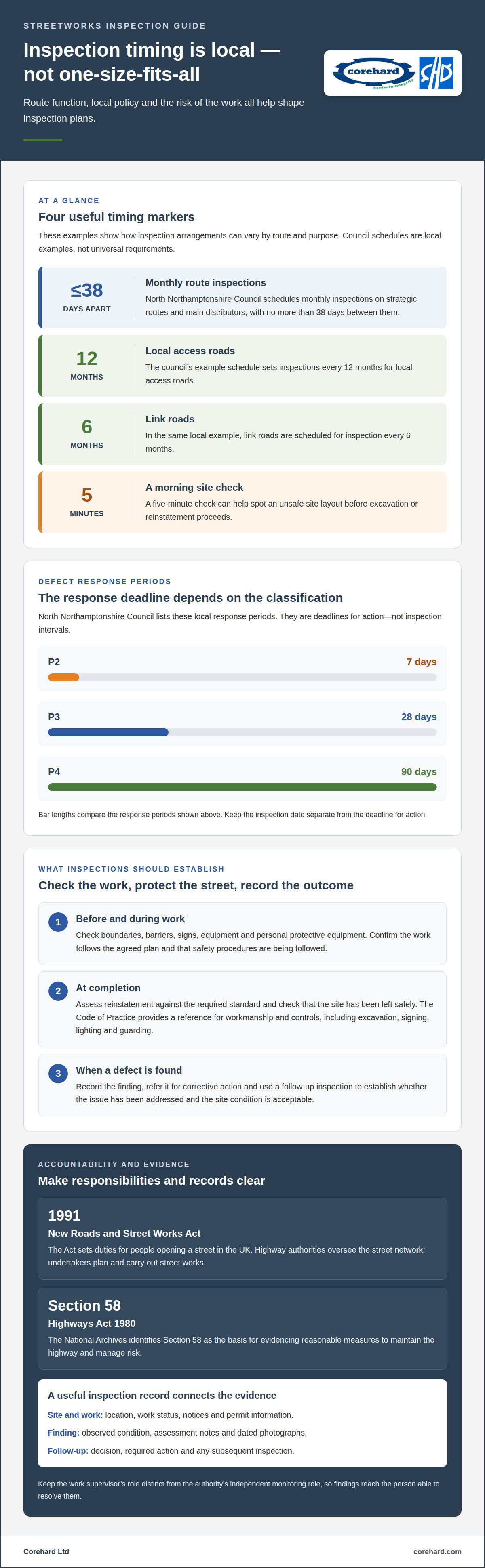
Inspection schedules can reflect the route’s use and risk. North Northamptonshire Council plans monthly inspections for strategic routes and main distributors, with no more than 38 days between inspections scheduled monthly. This is a council schedule, not a universal frequency for every street. Its example shows why inspection planning should account for location and function.
Safety monitoring starts before work begins. Supervisors check that site boundaries, barriers, signs and equipment are in place, and that operatives have the required personal protective equipment. A five-minute site check each morning can help identify an unsafe layout before excavation or reinstatement proceeds. Risk assessments and method statements also help teams identify hazards and plan controls.
Underground apparatus creates particular risks during excavation. Supervisors oversee whether work follows the agreed plan, safety procedures are followed and operatives are competent for their tasks. Their role includes applying health and safety protocols, identifying hazards and taking steps to mitigate them. Training supports consistent supervision, while inspection provides evidence of how procedures are applied on site.
Quality control continues through completion. A final inspection checks the finished work and site condition, including whether reinstatement meets the required standard and the area has been left safely. Findings should distinguish an observed defect from a compliant result, making any follow-up clear and evidence-based.
If an inspection identifies a defect or reinstatement failure, record the finding and refer it for corrective action. The required response depends on the nature and risk of the defect. A follow-up inspection can establish whether the issue has been addressed and the site condition is acceptable.
Inspection records also support a defensible approach to highway maintenance. The National Archives identifies Section 58 of the Highways Act 1980 as the basis for evidencing reasonable measures to maintain the highway and manage risk. Clear findings, accurate site details and recorded follow-up help show how conditions were assessed, rather than relying on an undocumented judgement.
Quality assurance depends on consistent methods as well as individual competence. Supervisors need training to oversee street works, assess work against applicable requirements and report findings accurately. Reviewing inspection records can reveal recurring problems, gaps in site controls or training needs, helping teams improve future work.
NRSWA and Code of Practice compliance
Compliance assessment connects the legal framework with the work carried out on the highway. It checks whether excavation, reinstatement and site controls protect infrastructure and the public.
Inspection Responsibilities
The New Roads and Street Works Act 1991 sets duties for people opening a street in the UK, according to The National Archives. Highway authorities oversee the street network, while undertakers plan and carry out their street works. Inspection responsibilities therefore involve both parties, although their roles differ.
In England, Scotland and Wales, authorities may set local inspection priorities and operational arrangements. The underlying Act applies across the UK, but the practical schedule and processes can vary by authority. North Northamptonshire Council’s approach is one local example, not a national timetable.
For each project, distinguish who performs the work from who independently monitors the highway. The undertaker’s supervisor manages work on site; the authority assesses whether the street’s condition and public protections meet requirements. Clear responsibilities help findings reach the person able to resolve them.
Inspection Types and Timing
Inspection activity can cover work in progress, completed reinstatements and follow-up where a defect has been identified. The relevant Code of Practice provides a reference for assessing safety controls and workmanship, including excavation, signing, lighting and guarding.
There is no single inspection frequency that can be applied to every authority and street. Route function, local policy, the nature of the work and observed risk shape inspection timing. North Northamptonshire Council, for example, schedules local access road inspections every 12 months and link road inspections every 6 months.
Defect classification can also affect the required response. North Northamptonshire Council lists P2 defects as requiring a 7-day response, P3 defects a 28-day response and P4 defects a 90-day response. These are local response periods, not universal inspection intervals. Records should distinguish the inspection date from the deadline for action.
Notices, Records and Evidence
Accurate records connect each inspection to the street, the work and the outcome. NRSWA supervisors maintain records of site activities, including inspections, audits and incidents. A useful entry identifies the location, observed condition, decision and any required follow-up.
Keep relevant notices and permit information with inspection records so the work’s status is clear. Supporting evidence may include dated photographs, assessment notes, site plans and details of the apparatus or reinstatement examined. Together, these items show what was inspected and why a finding was made.
When recording a defect, preserve the original finding and document subsequent action separately. This creates a traceable sequence from observation to resolution without obscuring the initial condition. Consistent records can also reveal recurring issues and help target future training.
Risks and Penalties for Non-compliance
Failure to manage inspections can leave unsafe traffic arrangements, damage to the highway or poor reinstatement unaddressed. It can also weaken the evidence available to explain how risks were assessed and managed. The National Archives identifies Section 58 of the Highways Act 1980 as a basis for evidencing reasonable measures to maintain the highway and manage risk.
Penalties depend on the specific offence, so a breach of an inspection process should not be confused with a permit-detail offence. Current regulations, as described in the research facts, allow fines of up to £5,000 for streetworks permit-detail offences. That figure relates to permit details, not a general penalty for every inspection failure.
Authorities and undertakers can reduce avoidable exposure by assigning inspection responsibilities, recording findings accurately and tracking corrective action to completion. Where local requirements or evidence systems need alignment, NRSWA and TMA advisory support can help clarify compliance processes.
Which inspections are required under NRSWA and when must they be carried out?
Inspection timing depends on the work and the highway authority’s local programme, not on a single national timetable. For street works, the practical sequence may include monitoring during the work, checking completed reinstatements and arranging follow-up where defects need attention.
Inspections during work let supervisors monitor progress and identify issues while operatives are still on site. A final inspection follows completion and focuses on work quality and site condition. The stages serve different purposes: one reviews how the work is being carried out; the other assesses the finished result.
Highway condition inspections follow route type and use. North Northamptonshire Council’s programme gives a practical example of how frequencies can vary:
- Strategic routes and main distributors: monthly, with no more than 38 days between inspections scheduled monthly.
- Primary walking routes in busy urban shopping areas: every month; secondary walking routes with medium usage: every three months.
- Link roads: every six months; local access roads: every 12 months.
- Cycle routes remote from the carriageway and metalled or urban Public Rights of Way: every six months.
Local authority planned intervals are not a single inspection cycle for every UK authority. A road’s function, pedestrian or cycle use and local assessment help determine an appropriate schedule. Inspection plans should identify the route category and frequency, so teams know when the next assessment is due.
Some assets need a separate specialist inspection cycle. North Northamptonshire Council schedules Open Box Beam Vehicle Restraint Systems on a five-year cycle and Tensioned Corrugated Beam Vehicle Restraint Systems on a two-year cycle. These intervals illustrate why a general road inspection schedule may not cover every highway asset.
After an inspection, findings guide the next step. A recorded defect may require a response, while a completed reinstatement can be assessed against the relevant standard. North Northamptonshire Council lists a seven-day response for P2 defects, 28 days for P3 defects and 90 days for P4 defects. These are local response periods, not universal inspection frequencies.
For project planning, distinguish the inspection date from any corrective-action deadline. The sequence is clear: schedule the inspection, record findings, assign follow-up where needed, then document the outcome. A consistent schedule helps authorities and undertakers track work and maintain an accurate record of highway condition.
Who is responsible for NRSWA inspections: the highway authority or the undertaker?
Both the highway authority and the undertaker have roles in street works inspection, but their responsibilities differ. The undertaker arranges and carries out the work, while its NRSWA supervisor monitors progress, site safety and work quality. The highway authority oversees the public highway and inspects to assess street condition and compliance.
An undertaker’s supervision does not replace the authority’s inspection. The supervisor checks that operatives follow the work plan and safety procedures, and arranges a final inspection after completion. The authority provides oversight of work affecting its highway, including whether reinstatement and site conditions meet applicable requirements.
The National Archives records the highway authority’s duty to maintain the highway under Section 41 of the Highways Act 1980. That maintenance role gives the authority a direct interest in identifying defects and understanding the condition of roads and street assets. It does not remove the undertaker’s responsibility for managing the work it undertakes.
In practice, responsibilities can be viewed through the work sequence:
- Before work: the undertaker arranges the work and ensures necessary permits and licences are obtained; the authority administers its highway processes.
- During work: the undertaker’s supervisor monitors progress, operatives and safety controls; the authority may inspect the site for compliance and highway impacts.
- After completion: the undertaker’s supervisor checks work quality and site condition; the authority can assess the completed reinstatement and record any defect.
These tasks require coordination, not duplicated ownership. If an authority inspection identifies a reinstatement concern, the finding needs to reach the undertaker responsible for the work. The undertaker can assess the issue, arrange corrective action and record the response. The authority can then use a follow-up inspection to assess the resulting condition.
Clear records help both parties understand what happened. An inspection entry should identify the location, date, observed issue and next action. The undertaker’s site records can document supervisor checks, incidents and corrective work, while the authority’s records support its oversight of highway condition. Consistent information reduces uncertainty when a defect is reviewed later.
Responsibilities also include communication. NRSWA supervisors liaise with local authorities, utility companies and other stakeholders to coordinate works and minimise disruption. When a project involves several undertakers, clear contact points and timely sharing of findings help each party respond to issues affecting its work. The authority retains oversight of the street, while each undertaker manages its operations and evidence.
What notices, records and evidence must be kept for NRSWA inspections?
A useful inspection record lets a reviewer connect the street, the work, the finding and any follow-up. NRSWA supervisors maintain records of site activities, including inspections, audits and incidents. Keeping these records together makes it easier to understand what happened and how an issue was handled.
Project files should bring together notices and work information relevant to the inspection. This may include permit details, work location, planned activity and dates associated with the site. Supervisors ensure necessary permits and licences are obtained before work begins, so these records establish the administrative context for the inspection.
For each inspection, record the location, date, work stage and observed condition clearly. “Reinstatement concern” is less useful than a description of the affected area and what the inspector observed. Keep supporting photographs with the corresponding inspection entry and identify what they show.
- Inspection records: document the site, inspection stage, observations and outcome.
- Work records: retain relevant notices, permit information and details of the street works activity.
- Safety records: record relevant audits, incidents and site-control observations.
- Follow-up evidence: link defect reports, corrective action and subsequent findings to the original inspection.
Evidence should show the sequence, not just the final result. If an inspection identifies a defect, retain the initial finding and record the action taken separately. Link a later inspection to the original entry to show whether the concern was addressed and what condition remained.
Consistent identifiers help connect project documents. Use the same location description and work reference on notices, inspection records and photographs. When several works take place on one street, precise descriptions help prevent evidence being assigned to the wrong activity or reinstatement.
Records also support reviews of recurring issues. An audit may, for example, reveal similar reinstatement concerns at different sites. Comparing inspection findings with incident and follow-up records helps teams identify patterns and consider whether procedures or training need attention.
Retention and access arrangements should make relevant records available to the people responsible for oversight and follow-up. A clear file structure, consistent naming and a documented outcome for each finding help maintain an accurate project history. For support aligning inspection processes and evidence, request NRSWA and TMA advisory support.
Before closing a file, check that notices, inspection entries, photographs and follow-up evidence can be read together, and clearly record any unresolved concern.
Street works must be carried out in accordance with the New Roads and Street Works Act (NRSWA) requirements. Organised records support a clear account of the work and provide a practical basis for reviewing findings, actions and later inspection results.
Corehard
Corehard helps organisations bring clarity to NRSWA inspection responsibilities, evidence and compliance processes. Its NRSWA & TMA Advisory and Dynamic Assurance & Compliance services can support teams reviewing how inspections are planned, recorded and followed up.
Where findings point to wider issues with highway condition or reporting, Asset Surveys & Condition Reporting can provide a structured basis for assessment. NRSWA & TMA Development supports capability development on legislation, codes of practice and specifications. These services help authorities and infrastructure organisations address gaps in oversight and strengthen compliance arrangements.
For support with inspection governance, records or assurance, contact Corehard to discuss your requirements.
Put inspection assurance into practice
Reliable oversight is part of everyday project decisions, not something to add only after a concern appears. Treat NRSWA inspections as part of a wider assurance approach: use findings to inform work planning, consistent application of standards and operational improvements. This connects site observations to organisational oversight and keeps decisions grounded in evidence.
Start by identifying where your current arrangements need greater clarity, whether in inspection governance, reporting or capability development. Corehard’s advisory, development and assurance services can support your street works operations, while asset surveys and condition reporting can inform a broader view of infrastructure condition.
Discuss your NRSWA inspection requirements with Corehard and take a considered next step towards consistent, evidence-led oversight.
Frequently Asked Questions
What are NRSWA inspections?
NRSWA inspections assess street works against requirements for safe working, permit conditions and highway condition. They can help an authority review a site where traffic management, pedestrian access or excavation protection raises concern. For example, an inspector can assess whether pedestrians can pass safely and barriers protect the work area. Findings provide a basis for deciding what action is needed and recording the outcome.
What are the NRSWA inspection stages and defect categories?
For NRSWA Inspections, a Category A inspection examines works in progress, with sites selected through sources such as Street Manager notifications, complaints, network concerns or an authority’s sampling regime. Findings distinguish Immediate Danger, such as an unprotected excavation, from Non-Immediate Danger, such as incorrect signage. Both categories must be recorded and notified through the prescribed process, with urgent action for immediate danger.
What training or qualifications are required for NRSWA inspectors?
Training should reflect the inspection duties, including assessing street works compliance, safety controls and reinstatement. Inspectors carrying out NRSWA Inspections need a sound understanding of the applicable standards and the ability to document findings accurately. Supervisor training covers compliance, quality and safety oversight. Work involving installation, renewal, maintenance or inspection of underground apparatus in the highway must be controlled by competent persons holding a valid Street Works card, with competence aligned to the role.


