

A Category A (CAT A) inspection is an inspection of street works in progress under the New Roads and Street Works Act 1991 (NRSWA) and the Traffic Management Act 2004 (TMA). It is not a vehicle check and has nothing to do with vehicle maintenance. It focuses on the signing, lighting and guarding of works, appropriate traffic management, necessary barriers and the proper use of PPE, so that personnel, vehicular traffic and pedestrians are protected. Failing to comply with these statutory requirements can result in fines for the undertaker.
Key Takeaways
- CAT A inspections cover works in progress under NRSWA 1991 and TMA 2004, not vehicles.
- Inspectors assess signing, lighting, guarding, barriers, traffic management and PPE.
- Non-compliance with statutory requirements can lead to fines for the undertaker.
- All defects must be recorded and notified.
- Records are uploaded to Street Manager or the authority's inspection system.
What a CAT A inspection checks
A CAT A inspection takes place while works are under way. Its purpose is to make sure street works are carried out safely, in line with statutory requirements, and with minimum disruption to highway users.
Signing, lighting and guarding
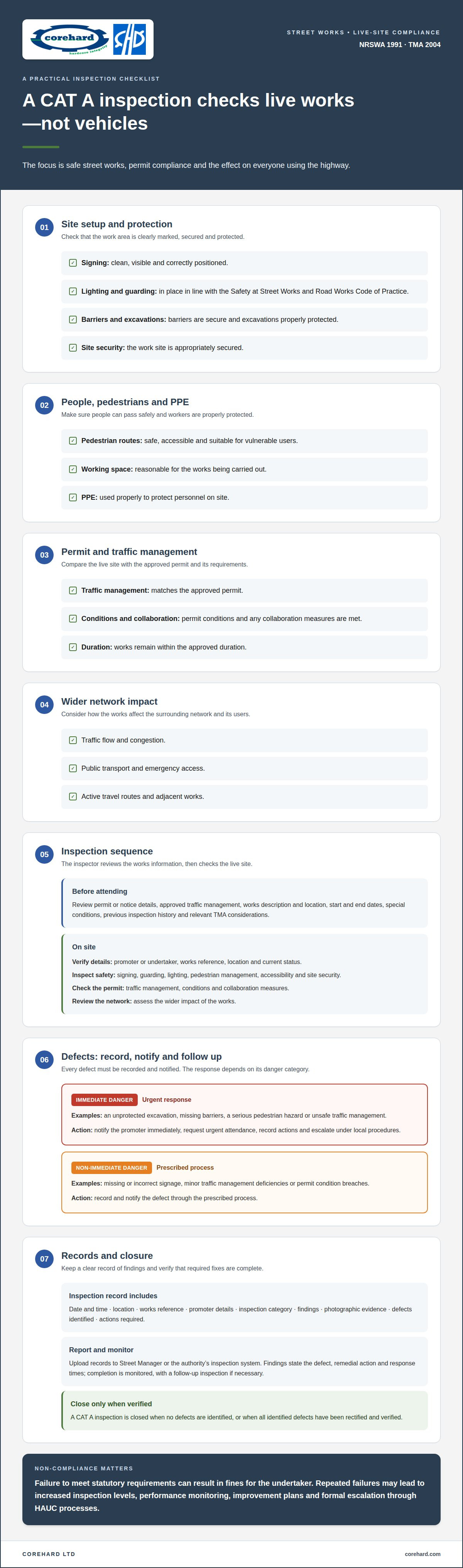
The inspector assesses compliance with the Safety at Street Works and Road Works Code of Practice. That covers signing, guarding and lighting, along with pedestrian management, accessibility and site security. Signs should be clean, visible and correctly positioned. Barriers should be secure, and excavations properly protected.
Traffic management and pedestrians
Traffic management on site must match the approved permit. Pedestrian routes should be safe, and vulnerable users should be accommodated. Working space should be reasonable, and the works should remain within the approved duration.
PPE and protection of people
The proper use of PPE is part of the safety picture. It protects the people working on site, while signing, lighting, guarding and barriers protect vehicular and pedestrian traffic passing the works.
Network management review
The inspector also considers the effect of the works on traffic flow, congestion, public transport, emergency access, active travel routes and adjacent works.
How an inspection is carried out
Selecting sites
Sites can be chosen from Street Manager notifications, the live permit register, customer complaints, network management concerns, high-risk or traffic-sensitive locations, and random sample selection in line with the authority's inspection regime. Priority goes to traffic-sensitive streets, works causing significant occupation, sites with previous compliance failures and major works affecting network performance.
Pre-inspection review
Before attending, the inspector reviews the permit or notice details, approved traffic management, works description and location, start and end dates, special conditions, previous inspection history and relevant TMA considerations.
On-site steps
- Verify site details: confirm the promoter or undertaker, works reference number, location and current works status.
- Safety inspection: assess signing, guarding, lighting, pedestrian management, accessibility and site security.
- Permit compliance: confirm traffic management matches the permit and that conditions and any collaboration measures are met.
- Network management review: assess the impact on the wider network.
Defects, outcomes and fines
Defect categories
Defects fall into two categories. Immediate Danger includes an unprotected excavation, missing barriers, a serious pedestrian hazard or unsafe traffic management. Non-Immediate Danger includes missing or incorrect signage, minor traffic management deficiencies and permit condition breaches. All defects must be recorded and notified.
For Immediate Danger, the promoter is notified immediately and urgent attendance is requested. Actions are recorded and the matter is escalated under local procedures. Non-Immediate Danger defects are recorded and notified through the prescribed process.
Fines and escalation
Failing to comply with the statutory requirements can result in fines for the undertaker. Repeated compliance failures may also lead to increased inspection levels, performance monitoring, improvement plans and formal escalation through HAUC processes.
Records, reports and closure
Each inspection record includes the date and time, location, works reference, promoter details, inspection category, findings, photographic evidence, defects identified and actions required. All records are uploaded to Street Manager or the authority's inspection system.
Inspection findings are issued within prescribed timescales with supporting photographs. They state the nature of the defect, the required remedial action and the response times. Completion is monitored, and a follow-up inspection is arranged if necessary.
A CAT A inspection is closed only when no defects are identified, or when all identified defects have been rectified and verified. For related reading, see NRSWA Cat A Inspections: Live Works Compliance Guide and Street-works NRSWA Inspection.
Corehard
Corehard supports organisations with NRSWA and TMA compliance through advisory, development and assurance services. NRSWA & TMA Advisory helps clarify statutory obligations and codes of practice, while Asset Surveys & Condition Reporting offers evidence-led reporting.
To discuss your street works inspection requirements, contact Corehard.
Frequently Asked Questions
What is a CAT A inspection in the UK?
It is an inspection of street works in progress under NRSWA 1991 and TMA 2004. It checks that works are carried out safely, in line with statutory requirements and with minimum disruption to highway users.
What does a CAT A inspection cover?
It covers signing, lighting and guarding, barriers, traffic management, pedestrian safety, site security, permit compliance, network impact and the proper use of PPE.
What happens if an undertaker fails to comply?
Non-compliance with the statutory requirements can result in fines for the undertaker. Repeated failures may also lead to increased inspection levels and formal escalation.
What records are required after a CAT A inspection?
The date and time, location, works reference, promoter details, category, findings, photographs, defects and required actions are recorded and uploaded to Street Manager or the authority's inspection system.


