

The amount depends on the road category, street status and length of the overrun, so understanding how to avoid Section 74 charges starts with knowing how these factors affect the calculation.
It is understandable to want a clear figure when a programme slips, but the applicable rate is only part of the picture. Notice requirements, the reasons for the delay and the available evidence can all affect how an authority assesses an overrun and whether it considers reducing or waiving a charge.
This article explains how Section 74 charges are calculated, what can influence the total and when a reduction or waiver may be considered. It also covers practical ways to manage work durations, notices and records to reduce the risk of an avoidable overrun.
Key Takeaways
- Understand how road category, street status and the length of an overrun shape the Section 74 charge.
- Keep work durations and notices aligned with progress on site to help reduce avoidable compliance risks.
- Recognise when an authority may consider reducing or waiving a charge under regulation 10.
- Build a clear evidence trail so work dates, delays and site status can be substantiated if a charge is disputed.
- See how specialist NRSWA and TMA advice can support stronger assurance and compliance processes.
What Is Section 74 of the Street Works Act?
Section 74 addresses unreasonably prolonged occupation of a public highway by street works. For undertakers, the agreed duration, accurate notices and evidence of site activity can affect how an overrun is assessed.
The Street Works Act provision
Section 74 of the New Roads and Street Works Act 1991 allows highway authorities to charge undertakers when street works occupy the highway unreasonably beyond the relevant period. The charge makes the planned duration and actual use of the street financially significant.
Section 74’s charges regime applies in England under its own regulations; the whole United Kingdom does not have one uniform street works regime. Street works requirements and notification arrangements can differ across jurisdictions. Check which statutory framework governs the works before applying England’s rates or deadlines.
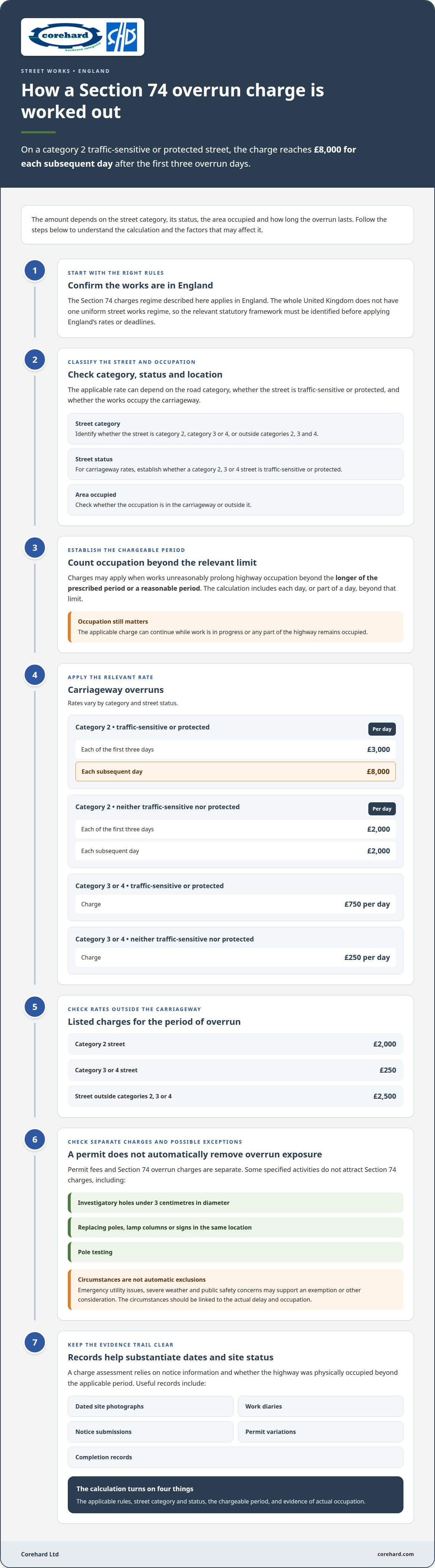
For works outside the carriageway, listed charges vary by road category: £2,000 for a category 2 street, £250 for category 3 or 4, and £2,500 for a street outside categories 2, 3 or 4, for the period of overrun. These figures show why identifying the street category and occupied area matters when assessing potential exposure.
Works duration and notification deadlines
A works duration is the expected period for completing an activity; an extension updates that estimate when completion is no longer achievable. In England, submit a revised duration as soon as possible if works cannot finish within the original estimate. A revised estimate helps keep the notice record aligned with the programme, although it does not itself remove charge exposure.
For major street works, send a confirmation notice at least 10 working days before the estimated start date. The actual start date notice must be received no later than the next working day after work begins, except for immediate works. Send a works stop notice no later than the next working day after completion.
For works starting or stopping between 8:00am and 4:30pm, the notice must be received within 2 hours. For work between 4:31pm and 11:59pm, it must be received by 10:00am the next day. Weekend start and stop notices also matter: England’s charges regulations were amended in April 2023 to require them.
Remedial work can create a separate Section 74 exposure if the applicable permit scheme treats it as a new activity. In that case, the remedial activity requires its own permit, and any overrun is charged at the applicable rate under the regulations. The original activity’s completion therefore does not automatically settle the permit or duration requirements for remedial work.
Limitation and prosecution procedures are distinct from calculating an overrun charge. In England, an authority must give a written account of a street works charge within three months after receiving a works clear or works closed notice. Separately, a fixed penalty notice for an offence must be served no more than 91 calendar days after the offence, and the undertaker has 36 calendar days from receiving it to pay. These FPN time limits concern offences, not the calculation of a Section 74 overrun charge.
Section 74 overrun charges
Section 74 charges depend on the street, the area occupied and how long works continue beyond the applicable period. Permit fees are separate from overrun charges, so identifying which charge an assessment relates to is important.
When works incur overrun charges
In England, charges may apply when street works unreasonably prolong occupation of a highway beyond the longer of the prescribed period or a reasonable period. The calculation includes each day, or part of a day, beyond that limit.
If work remains in progress, or any part of the highway remains occupied, the applicable charge can continue. A permit scheme manages permitted activity, but a permit does not automatically remove Section 74 exposure when occupation runs on. The relevant reference points are the activity’s duration and the charge category for the street.
For carriageway overruns, rates vary by road category and by whether the street is traffic-sensitive or protected.
- On a category 2 traffic-sensitive or protected street, the charge is £3,000 for each of the first three days and £8,000 for each subsequent day.
- On a category 2 street that is neither traffic-sensitive nor protected, the charge is £2,000 for each of the first three days and £2,000 for each subsequent day.
- On a category 3 or 4 traffic-sensitive or protected street, the charge is £750 per day; on a street in those categories that is neither, it is £250 per day.
For category 3 or 4 streets outside the carriageway, the listed charge is £250 for the period of overrun. The relevant table and actual occupation therefore matter as much as the planned activity.
Possible exemptions from penalties
Some activities in England do not attract Section 74 charges, including specified works that do not break up the street or involve tunnelling or boring. Exempt examples include investigatory holes under 3 centimetres in diameter, replacing poles, lamp columns or signs in the same location, and pole testing.
Emergency utility issues, severe weather and public safety concerns may support an exemption or other consideration. Link the circumstances to the actual delay and occupation: they are not automatic exclusions from a permit scheme or charge.
Permit fees and Section 74 overrun charges are separate financial items. Keeping the relevant records distinct helps authorities and undertakers identify which activity and charge each account entry relates to.
Evidence for a Section 74 charge
A charge assessment relies on notice information and whether the highway was physically occupied beyond the applicable period. When a works promoter disputes dates in a Section 74 notice, evidence showing those dates are incorrect is needed for the charge to be based on that evidence.
Useful records include dated site photographs, work diaries, notice submissions, permit variations and completion records. If the evidence does not show that physical occupation ended earlier, the notice information may be used to assess the charge.
If police or a regulator investigates a possible offence, preserve relevant notices, permit records, site evidence and correspondence, then respond through the formal process. An investigation is distinct from the authority’s assessment of a Section 74 charge.
For organisations strengthening their control of notice records and compliance processes, Dynamic Assurance & Compliance can provide a practical next step.
Factors affecting Section 74 charges
The amount depends on more than the planned finish date. In England, the street, area occupied, applicable period and evidence explaining a delay all affect the assessment.
Authorities first consider the prescribed period or a reasonable period, whichever is longer. Charges may apply for each day, or part of a day, beyond that point, so even a short additional occupation can matter. If work continues or any part of the highway remains occupied, the full applicable charge may continue.
Road category, traffic sensitivity, protected status and whether work occupies the carriageway also influence the rate. Traffic volume and the length of the overrun affect the calculation, making an accurate description of the site essential. A site plan, dated photographs and clear records of when the highway was released can help explain the actual extent of occupation. Understanding how to avoid section 74 charges starts with reliable records of these site conditions.
The works application and permit scheme provide another important reference point. In Buckinghamshire, durations are managed through permit applications, approvals and variations, while the Section 74 regulations still apply. If delivery changes, a revised duration and supporting explanation can show how the estimate was managed. An update alone does not remove charges, but accurate records help authorities assess what happened.
The following operational details can influence the assessment:
- Whether the entire highway was released, or equipment or work continued to occupy part of it.
- Whether the actual completion and works clear or closed notification match site records.
- Whether an unforeseen event affected the programme, and whether practical evidence supports that explanation.
- Whether reinstatement was completed to the required standard before the highway was fully reopened.
A mitigated charge may apply in England where its conditions are met. The charge is £100 if no more than five items of signing, lighting and guarding equipment remain on the highway. Remaining equipment must be removed by the end of the next working day. These requirements make the site’s condition after completion a factor in the amount assessed, not simply an operational detail.
Coordination can also influence how an authority views an overrun. Section 59 of the New Roads and Street Works Act 1991 requires authorities to use their best endeavours to coordinate works, while section 60 requires undertakers to cooperate. Section 16 of the Traffic Management Act 2004 requires authorities to manage road networks with regard to the expeditious movement of traffic. Clear communication about a programme change helps establish how coordination and practical constraints contributed to the delay.
For teams considering how to avoid section 74 charges, a clear record linking the application, duration changes, notifications and site evidence helps distinguish a justified extension from avoidable prolonged occupation. Authorities should assess each proposed overrun charge on its individual merits.
Highway authority power to reduce or waive charges
A Section 74 assessment is not always the final amount. In England, regulation 10 allows a highway authority to reduce or waive overrun charges, making the reasons for delay and supporting evidence important to undertakers.
An overrun does not automatically qualify for a reduction. Authorities should assess each proposed charge on its merits and should not unreasonably refuse an extension supported by clear, practical evidence of unforeseen circumstances. A strong request links the event to its effect on the programme and the additional period of highway occupation.
For example, an unexpected utility issue may disrupt planned work and prevent completion within the agreed duration. A useful submission explains when the issue arose, which work it affected, how the programme changed and when the highway was released. A dated sequence of events gives the authority a clearer basis for assessment than a general claim that the work was delayed.
Distinguish evidence that explains a delay from records that establish the actual overrun. Bring together the relevant duration, notices, site records and reason an extension became necessary. If the dispute concerns the charge calculation, identify the specific point, such as the recorded completion date or extent of occupation, and provide evidence that addresses it.
Undertakers can organise a request for a reduction or waiver around these practical questions:
- What unforeseen event affected the works, and when did it occur?
- Which activity or part of the highway did it affect?
- How did the event alter the expected completion date?
- What records support the explanation and revised duration?
- When did the works finish, and when was the highway clear?
This structure helps the highway authority assess the circumstances against the charge, rather than relying on an unsupported request. It also separates a request for discretion from a factual challenge to dates or occupation. The explanations differ: one sets out why an overrun occurred; the other disputes whether it happened as recorded.
A solicitor can help assess the legal basis of a charge, organise the evidence and present grounds for challenging or resolving it. Their review can also help separate a dispute about the authority’s records from a request for reduction under regulation 10.
For undertakers, the priority is a clear, contemporaneous record linking the unforeseen event to the revised programme and site status. When evidence supports an extension, the authority has a concrete basis to consider the request on its merits.
What evidence is needed to bring a Section 74 charge?
A Section 74 assessment depends on the notice information and whether the highway remained occupied beyond the applicable period. For undertakers, the key evidence connects recorded dates with the work and the actual condition of the site.
Notices and recorded dates
The authority’s notice record provides a reference for the works, their expected duration and reported completion. In Buckinghamshire, a works promoter disputing dates in a Section 74 notice must provide evidence that those dates are incorrect for charges to be based on that evidence.
Compare the dates in the original notice, any revised duration, permit variations and works-clear or closed notification. If a notice records a later completion than the site diary, for example, the diary should identify the date, activity and person who recorded the update. A discrepancy without supporting context may not explain why the records differ.
Evidence of highway occupation
Dates alone may not establish whether the highway remained physically occupied. Site photographs, inspection records and work diaries can help show whether crews, equipment or unfinished work remained on the street after the recorded completion date.
Arrange evidence chronologically and link each record to the location and activity. A dated photograph of the cleared work area, alongside a completion entry, may help establish when occupation ended. Photographs of remaining equipment or unfinished work can also support the dates recorded in the notice.
A practical evidence file can include:
- The original works notice and subsequent duration changes.
- Permit applications, approvals and variations relevant to the activity.
- Dated site photographs, inspection records and daily work logs.
- Works clear or closed notifications and records of reinstatement.
- Correspondence explaining unforeseen delays and their effect on the programme.
Each item should relate to a specific date, location or activity. For example, correspondence about a utility conflict is more useful when accompanied by a work log showing when the conflict affected progress. This creates a traceable account instead of a collection of documents with no clear connection to the charge.
In Buckinghamshire, where a works promoter cannot provide evidence that physical overrunning did not occur, the council applies Section 74 charges using the information in the notice. This makes accurate notifications and contemporaneous site records important throughout the works, not only after a charge arrives.
When disputing a notice, identify the specific date or site fact in question, then provide records that address it directly. Keep the explanation consistent across the permit record, site diary and completion notification. Conflicting accounts make it harder to establish what happened and when.
For structured support with street works records and compliance controls, strengthen your evidence and assurance processes.
Corehard
Corehard supports organisations with NRSWA and TMA compliance, works records and street works processes. Its NRSWA & TMA Advisory and Dynamic Assurance & Compliance services can help teams review procedures, address assurance gaps and strengthen the management of notices and duration changes.
Where recurring issues point to wider process or capability needs, NRSWA & TMA Development can support improvements to operational practice. Asset Surveys & Condition Reporting may also be relevant when reliable asset information and condition evidence form part of the wider highways picture.
Consider Corehard for structured technical support to strengthen compliance oversight and street works processes. Contact Corehard to discuss your organisation’s requirements.
Make compliance part of programme control
Section 74 risk is easier to manage when duration, site progress and notice responsibilities are treated as connected parts of programme governance. Assigning clear ownership for updates, recording decisions as they happen and reviewing recurring causes of delay can help teams build stronger controls into future street works, rather than treating each overrun as an isolated event.
Start by assessing whether your current processes help project teams identify changing durations consistently and preserve an accurate operational record. Reviewing completed works can turn lessons into clearer procedures for planning and delivery, while helping decision-makers allocate responsibilities across teams and projects.
If you’re considering how to avoid Section 74 charges through stronger NRSWA processes, discuss NRSWA advice with Corehard. A considered approach can help your organisation move forward with greater clarity and control.
Frequently Asked Questions
I am a contractor and have been warned about receiving a Section 74. What is it?
It is a warning that a highway authority may charge the undertaker for unreasonably prolonged occupation of the highway. It is not the charge itself, and it is distinct from a fixed penalty notice for an offence. Treat it as a prompt to review the works record: establish which activity and dates the warning concerns, then identify whether the notice reflects what happened on site.
What are Section 74 charges in UK law?
Section 74 of the New Roads and Street Works Act 1991 allows highway authorities to charge undertakers when street works unreasonably prolong occupation of the highway. The detailed charges and processes depend on the applicable jurisdiction and regulations. England’s charge tables should not automatically be treated as the rules elsewhere in the UK; street works legislation and notification arrangements differ across jurisdictions.
How can a person lawfully avoid or prevent a Section 74 charge?
Plan work around an achievable duration, manage changes through the relevant notice or permit process, and keep site activity and records aligned as work progresses. If, for example, a delivery issue disrupts a planned activity, document its effect promptly and update the duration through the applicable process. An accurate completion record can help prevent an incorrect end date being used in an assessment.
What are common defences to a Section 74 charge in the UK?
A challenge may question whether an overrun occurred, whether recorded dates or occupation are accurate, or whether the activity falls within an exemption. Dated site records, photographs and permit information can support a factual dispute. If unforeseen circumstances caused the delay, evidence may support a request for a reduction or waiver, but that is distinct from proving the charge’s underlying facts are wrong.


