

No single yes-or-no rule covers every street work: the application and notice route depends on its category. Minor works lasting three days or less require at least three working days’ notice, while standard works lasting 4-10 working days require at least 10 working days’ notice. Major works typically require Provisional Advance Authorisation about three months before the start, according to the Department for Transport. NRSWA & TMA inspections help authorities assess how works are carried out and whether they meet relevant safety and compliance requirements.
Permit requirements, inspection stages and possible charges can be difficult to distinguish, especially when works need coordinating with other activity on the highway. This guide explains how works are categorised, what inspections cover, and when inspection charges or non-compliance notices may apply. It also shows how inspection findings support oversight of safety, reinstatement quality and compliance, helping you understand the process and its practical implications before work begins.
Key Takeaways
- Identify the street-works category early to understand the applicable notice or authorisation route and plan work accordingly.
- Use sample inspections to monitor undertaker performance and support evidence-based compliance oversight.
- In England, chargeable inspections cost the undertaker £50.00 each, with random inspections covering at least 5% of works in each inspection category.
- In England, section 72 of the New Roads and Street Works Act 1991 empowers street authorities to carry out investigatory works to check undertakers’ site safety and reinstatement duties, according to The National Archives.
- Structure oversight around inspection stages, and consider Corehard Ltd’s NRSWA & TMA Advisory when specialist compliance support would help.
Sample inspections and performance monitoring
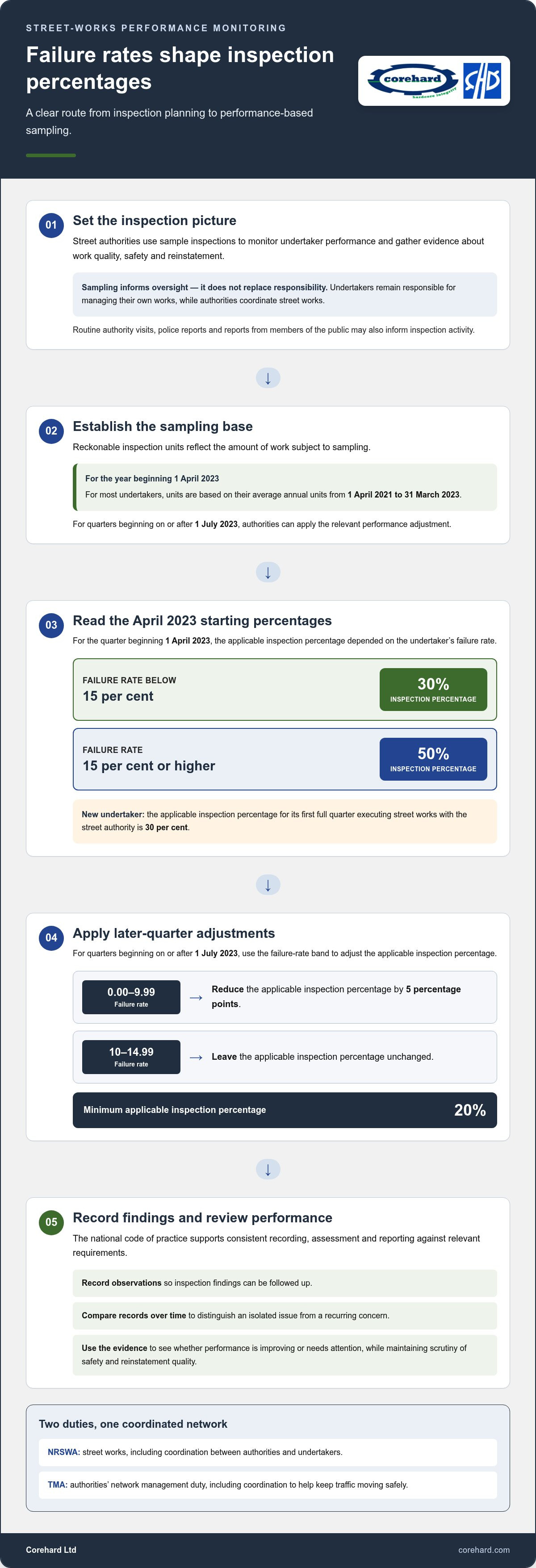
Street authorities use sample inspections to monitor undertakers’ performance while retaining responsibility for coordinating street works. Inspections provide evidence about work quality, safety and reinstatement. They do not replace the undertaker’s responsibility for managing its own works.
How do NRSWA and TMA inspection requirements differ? NRSWA concerns street works, including coordination between authorities and undertakers. The TMA places a network management duty on authorities, including coordinating activities to help keep traffic moving safely.
Who arranges and carries out street works inspections? Street authorities arrange and carry out sample inspections to monitor performance. Undertakers manage their works and must cooperate with coordination. Routine authority inspections, police reports and reports from members of the public may also inform inspection activity.
A national code of practice sets out procedures for inspections, investigatory works and performance monitoring. Inspectors can use its framework to record observations consistently, assess work against relevant requirements and report findings for follow-up. Clear records help distinguish an isolated issue from a recurring performance concern.
How do local highway authorities apply NRSWA and TMA inspection rules? Under NRSWA, they coordinate street works and monitor undertaker performance. Under TMA, they manage the road network. Sample inspections, routine visits and reports help inform this oversight.
In England, inspection percentages reflect failure rates and the relevant quarter. For the quarter beginning 1st April 2023, an undertaker with a failure rate below 15 per cent has an applicable inspection percentage of 30 per cent. For the quarter beginning 1st April 2023, an undertaker with a failure rate of 15 per cent or higher has an applicable inspection percentage of 50 per cent.
For subsequent quarters in England, the minimum applicable inspection percentage is 20 per cent for a quarter beginning on or after 1st July 2023. From quarters beginning on or after 1st July 2023, a failure rate from 0.00 to 9.99 reduces the applicable inspection percentage by 5 percentage points. A failure rate from 10 to 14.99 leaves the applicable inspection percentage unchanged.
A new undertaker’s applicable inspection percentage for its first full quarter executing street works with the street authority is 30 per cent. This gives the authority a defined basis for sampling when that undertaker begins operating in its area.
Inspection planning also uses reckonable inspection units, which reflect the amount of work subject to sampling. For the year beginning 1st April 2023, reckonable inspection units for most undertakers are based on their average annual units over the period from 1st April 2021 to 31st March 2023. From quarters beginning on or after 1st July 2023, authorities can then apply the relevant performance adjustment.
For example, an authority reviewing a low failure rate can apply the stated reduction when setting the applicable percentage. Comparing inspection records and reports over time helps establish whether performance is improving or needs attention. This evidence supports proportionate monitoring while maintaining scrutiny of street safety and reinstatement quality.
Inspection charges and non-compliance notices
An inspection can have a direct financial consequence for an undertaker. In England, section 75 of the New Roads and Street Works Act 1991 requires undertakers carrying out street works to pay the street authority a prescribed fee for each authority inspection. The charge applies to chargeable inspections, not automatically to every visit or report.
The Street Works (Inspection Fees) (England) Regulations 2022 came into force on 1st April 2023. Under the England scheme, an undertaker must pay the street authority £50.00 for each chargeable inspection of works. The regulations replaced the 2002 regulations and four subsequent amendment regulations, setting the framework for inspection fees in England.
For an undertaker, the practical step is to distinguish a chargeable inspection from other oversight. A street authority may carry out a routine inspection, investigate a concern or review work after a report. The inspection’s type and purpose matter when considering a fee. Keep relevant work records together, including inspection reports, reinstatement details and correspondence, so the basis for a charge is clear.
Defective reinstatement can lead to further inspections as remedial work progresses. Inspections may take place before, during and after remedial work, and the relevant undertaker may be charged fees. If an inspection identifies a defect, for example, the authority can record it, assess the repair and inspect the reinstatement again. This sequence provides evidence of both the defect and the corrective action.
Non-compliance notices address failures to meet applicable street-works requirements. The non-statutory code of practice gives practical guidance on inspection procedures, investigations, improvement plans, fee arrangements and reports. Authorities can use these processes to document a concern and set out the required response. For an undertaker, a notice should prompt a review of the finding, site evidence and corrective action, with clear records kept for follow-up.
The notice and inspection record also support accountability. A useful review links each issue to the relevant work, inspection evidence and action taken. If a reinstatement defect is involved, retain records from each remedial stage, as inspections may take place during and after repairs. This creates a traceable account for both the authority and the undertaker.
Authorities can use inspection charges and notices as part of compliance oversight and cost recovery from utility companies and other contractors. The mechanisms are distinct: a charge relates to a chargeable inspection, while a notice addresses non-compliance. The code of practice helps authorities apply inspection and reporting procedures consistently. Documented findings also give undertakers a clear basis for responding and improving site practice.
Chargeable inspections and inspection categories
Inspection categories determine how works are sampled and counted under England’s chargeable inspection scheme. The scheme requires random inspections of at least 5% of works from each inspection category. This minimum applies category by category, so authorities can monitor different stages rather than relying on one broad sample across all highway works.
Duration also affects how excavation work is counted. Under the England street works inspection scheme, excavation works lasting 15 working days or less count as one inspection unit. Works lasting 16 to 30 working days count as two units, while works lasting more than 30 working days count as three.
These unit bands give authorities a structured way to account for excavations of different durations. For example, an excavation lasting 15 working days falls into the one-unit band; an excavation lasting 16 working days falls into the two-unit band. Recording the duration accurately helps ensure the work is assigned to the correct unit category.
- One inspection unit: excavation works lasting 15 working days or less.
- Two inspection units: excavation works lasting 16 to 30 working days.
- Three inspection units: excavation works lasting more than 30 working days.
Reinstatement timing determines further inspection categories. One category covers inspections within six months of reinstatement. Another covers an inspection just before the expiry of two years following reinstatement. These stages allow highway authorities to examine reinstatement at different points, not only at completion.
For an undertaker, keep clear records of the work’s duration, reinstatement date and inspection history. These details help distinguish which category applies and support accurate assessment of inspection records. They also connect a finding to the stage at which the highway was examined.
Consider an excavation lasting 20 working days. Its duration places it in the two-unit band; its reinstatement date then helps identify relevant inspection timing. The authority can record the category, select works through random sampling and retain findings for performance monitoring. This makes the inspection trail easier to follow.
The statutory inspection framework and its guidance support consistent sampling and reporting. Categories help authorities organise inspections, while unit bands account for excavation duration. They also give undertakers a practical basis for reviewing work records and understanding how different works contribute to inspection planning.
Traffic management is a practical consideration during inspections: works occupy highway space, and inspection activity must be coordinated with the site. Recording the inspection category alongside site observations links compliance findings to the work being assessed. This creates a more useful record for follow-up, particularly when findings call for corrective action.
For local authorities, applying the 5% minimum separately to each inspection category creates a defined sampling baseline. Combining that baseline with the relevant inspection units helps structure oversight across work types and reinstatement stages. For undertakers, accurate records of duration and reinstatement provide the clearest route to understanding how works are counted.
Improving contractor and utility compliance
Compliance improves when authorities turn inspection findings into clear, traceable actions. In the United Kingdom, highway authorities must ensure that street works undertakers in their area meet their legal obligations. A structured assessment links site observations to the work, the relevant requirement and any corrective action. This makes follow-up more consistent for the authority and the utility.
In England, section 72 of the New Roads and Street Works Act 1991 empowers street authorities to carry out investigatory works to check undertakers’ site safety and reinstatement duties, according to The National Archives. This gives authorities a statutory route to investigate compliance concerns. An inspection record should therefore identify the concern, describe the evidence and connect any further investigation with the duty being assessed.
Reinstatement quality is a practical compliance priority. Street works reinstatement should comply with the Specification for the Reinstatement of Openings in Highways, commonly shortened to SROH. When assessing a reinstated excavation, an authority can compare the site condition with the relevant specification, record any defect and document the required response. This evidence supports a focused discussion between the authority and undertaker.
Site competence is another part of compliance. In UK street works, at least one SWQR-qualified operative should be physically on site at all times. Authorities can record who is present during an inspection and relate that observation to the work underway. If the site record identifies a gap, the undertaker can address supervision and keep evidence of the corrective action.
Use a repeatable review process to turn findings into improvements:
- Record the evidence: identify the location, work activity and observed safety or reinstatement issue.
- Assess the requirement: compare the observation with the SROH, applicable legislation and local procedures.
- Track the response: document corrective action and any follow-up inspection in the work record.
For example, when an authority finds a defective reinstatement, it can record the location and condition, then assess the work against SROH. The undertaker can use that evidence to organise remedial action. A follow-up record shows whether the issue was addressed, helping both parties understand the outcome and any remaining compliance concerns.
Local and national Codes of Practice, HAUC guidance and current legislation give staff reference points for consistent decisions. Authorities can compare inspection records across sites, identify recurring issues and focus on relevant work practices. This supports a more targeted assessment than treating every finding as an isolated event.
For utility companies and contractors, practical improvement starts with keeping work, operative and reinstatement records together. Clear records help explain how site activity met applicable requirements and what happened after an inspection finding. For authorities, documented assessments support follow-up and accountability. Together, these steps make compliance easier to demonstrate and issues easier to resolve.
What inspection types and stages are required under NRSWA?
NRSWA inspection activity can include sample monitoring, routine authority inspections and investigations. Each serves a different purpose: sampling assesses undertaker performance, routine visits support oversight, and investigations examine a specific concern. Police and public reports may also inform inspection activity, providing authorities with additional information about work affecting the street.
A national code of practice covers inspection procedures, investigatory works and performance monitoring. For authorities, it provides a framework for recording observations, assessing work and reporting findings. For undertakers, understanding an inspection’s purpose helps connect site records with the issue under review, whether it concerns safety, traffic management or reinstatement.
Authorities may apply sanctions or issue fines where a breach of statutory requirements has been identified. However, any such action must follow a clearly defined process (such as joint meeting) and be supported by sufficient evidence that demonstrates the nature of the breach and the specific requirement that has not been complied with. Enforcement decisions must be based on objective facts and verifiable evidence, rather than subjective opinion, to ensure they are fair, consistent, and legally robust.
Inspections can continue after an excavation is first reinstated. In England, categories include an inspection within six months of reinstatement (Category B) and another just before the expiry of two years following reinstatement (Category C). These timings allow work to be assessed after completion and nearer the end of the reinstatement guarantee period. Organise the practical inspection sequence around the progress of the work:
- During active works: record site conditions and relevant safety observations while the work is underway.
- At reinstatement: assess the completed surface and record observations against the applicable requirements.
- After reinstatement: use the relevant inspection category to examine the work at a later stage.
- When a concern arises: document the issue and consider whether investigatory work is needed.
These steps offer a way to organise inspection activity, not a claim that every worksite receives every inspection. The inspection’s purpose and applicable category shape the authority’s approach. A clear record of dates, observations and work details helps relate a finding to the stage examined.
For example, if a later inspection identifies a reinstatement concern, the authority can compare the recorded condition with earlier inspection evidence. The undertaker can then review the work history and remedial records. This creates a traceable account of the issue and response, rather than relying on a single site visit.
Inspector training material describes coverage of undertakers’ works at all stages, including at the end of the reinstatement guarantee period. This scope helps inspectors understand how findings relate to the work’s lifecycle. It also supports consistent assessment when authorities review evidence from different points in a reinstatement’s history.
For street authorities, the key is to match each inspection to its purpose, record the evidence and identify any necessary follow-up. For undertakers, retaining work and reinstatement records makes later assessments easier to understand. A consistent inspection trail supports practical oversight from active works through subsequent review.
Corehard: NRSWA & TMA Advisory
Corehard provides NRSWA & TMA Advisory for organisations seeking clearer oversight of street-works obligations, inspection findings and compliance processes. Turn to this support when you need to interpret requirements, strengthen assurance arrangements or address recurring gaps in operational practice.
When the challenge concerns evidence about highway assets, Asset Surveys & Condition Reporting can provide a clearer view of their condition. NRSWA & TMA Development and Dynamic Assurance & Compliance can help organisations develop processes and maintain structured oversight as requirements and work programmes evolve.
Discuss your street-works compliance needs with Corehard to identify a suitable next step.
Turn inspection findings into stronger oversight
Inspection records can do more than show what happened on site. Used consistently, they help authorities and undertakers identify recurring issues, clarify responsibilities and improve how future works are planned and assessed. The next step is to ensure findings lead to practical action, with decisions and follow-up clearly recorded.
For organisations reviewing their approach to NRSWA & TMA Inspections, consider how evidence moves from site observation to operational learning. A clear process helps teams act on findings and maintain a reliable record as work programmes change. It also gives decision-makers a stronger basis for prioritising oversight and addressing compliance concerns.
Where specialist input would help shape that process, Corehard Ltd can support your organisation’s street-works requirements. Contact Corehard about inspection support to discuss a considered next step for your organisation.
Clearer oversight starts with a practical decision. Your next improvement can begin with the evidence already available.
FAQs
Do I always need a NRSWA permit for street works?
Not neccesarily, the required authorisation depends on the work and the organisation carrying it out. For immediate works, an application should be made within two hours of starting, or by 10:00 the next working day for out-of-hours work. In England, non-statutory undertakers usually need a Section 50 Street Works Licence from the highway authority. Identify the work type and your legal status before work starts.
Who must be on site for competence?
All operatives must be SWQR-qualified and evidence of such should be available or present on site throughout any works being undertaken. Street works qualification cards in England expire every five years. For practical site planning, record who is undertaking and supervising the work, and keep the relevant qualification records current.
What are NRSWA and TMA inspections in the UK?
NRSWA and TMA inspections are essentially checks that assess street-works compliance and the wider effect of works on the road network. NRSWA relates to undertaker works and coordination; TMA concerns authorities’ network management duties. At a site, an inspector may verify the promoter and works reference, the permit for the works, the permit conditions, compliance with the specific conditions, check approved traffic management, and assess pedestrian access, public transport and emergency access. Findings provide an evidence-based record for follow-up.
What are the TMA Code of Practice inspection categories and defect levels?
Inspection timing categories and defect levels describe different things. The defect levels are “Immediate Danger” and “Non-Immediate Danger”. An unprotected excavation or serious pedestrian hazard indicates Immediate Danger and requires immediate notification and urgent attendance. Incorrect signage or a minor traffic-management deficiency is an example of Non-Immediate Danger; it must still be recorded and notified through the prescribed process, with follow-up tracked.
How often must street works be inspected under NRSWA and TMA?
There is no single inspection interval for every worksite. The authority’s inspection regime, work category and undertaker performance inform its programme, while site concerns may lead to additional scrutiny. Keep permit details, work status and inspection history accessible so the authority can relate a visit to the specific work and assess findings against the correct records.
What qualifications or training do NRSWA street works inspectors need?
Inspector training should cover safe working in a highway environment, relevant health and safety requirements, and assessment of NRSWA and permit compliance. It should also prepare inspectors to apply local procedures consistently and record findings clearly. This differs from an operative’s SWQR qualification: inspector competence centres on assessing work, identifying evidence and explaining or understanding any required corrective action. This may differ across different regions where local knowledge may affect decision making, but the statutory and specification requirements will remain.
What are the penalties for failing to comply with NRSWA or TMA inspection requirements?
Non-compliance can result in a notice requiring corrective action. Repeated failures may trigger formal escalation or consideration of permit enforcement. A useful response is to review the inspection evidence, identify the defect and document the remedy. Findings should clearly describe the issue and required action, include supporting photographs, and be tracked through completion. The authority can then arrange a follow-up inspection where needed. Where regular or consistent failure occurs, the authority may assign an improvement notice on the undertaker to action remedy and ensure compliance.


