

A street works permit is only the start of compliance, not the finish. In England, streetworks permit compliance sits within the New Roads and Street Works Act 1991 and the Traffic Management Act 2004, while the right application route and notice period depend on the work and the local permit scheme.
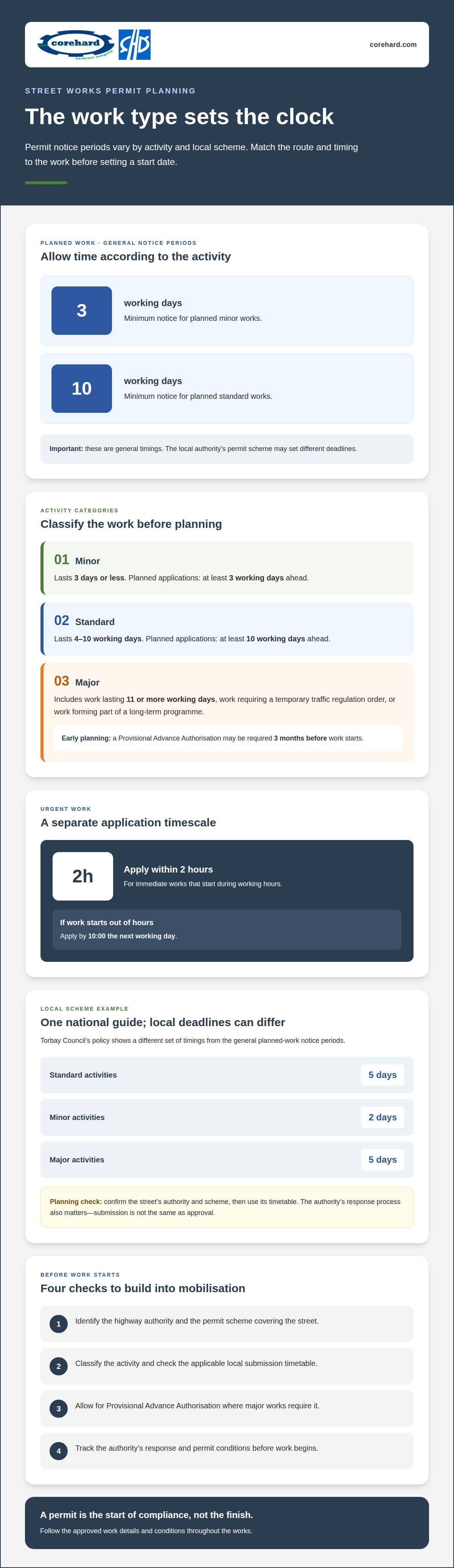
That variation can make planning difficult: a standard job, a minor activity and an urgent repair may each have different requirements, and a permit can carry conditions that need to be met throughout the works. For planned work, the stated minimum notice is 10 working days for standard activities and 3 working days for minor activities; immediate works have a separate application timescale.
This guide explains when a permit or a Section 50 Street Works Licence is needed, what authorities may require and why applications can be refused. It also covers the national permit scheme conditions, deadlines and enforcement, so you can see how to manage the requirements from application through to completion.
Key Takeaways
- Identify whether the work needs a permit or, for some non-statutory undertakers in England, a Section 50 Street Works Licence.
- Match the application route and submission timing to the activity type, local scheme and planned start date.
- Understand how incomplete or unsuitable applications can affect approval, and what authorities consider when setting permit conditions.
- See how non-compliance can lead to Fixed Penalty Notices, prosecution or overrun charges, depending on the circumstances.
- Use national permit conditions to guide safe site arrangements and maintain compliance throughout the works.
Do I always need a NRSWA permit for street works?
No: the requirement depends on the work, the person carrying it out and the local authority’s permit scheme. In England, permit schemes operate under the Traffic Management Act 2004 and the New Roads and Street Works Act 1991 (NRSWA).
Street works permit meaning and eligibility
A street works permit is the highway authority’s approval for specified work on a street covered by its permit scheme. Statutory undertakers, such as utility companies, apply for permits; in England, non-statutory undertakers usually need a Section 50 Street Works Licence to open the highway. A permit sets the approved work details and conditions, so the work must follow them. NRSWA also requires people doing public-highway work to hold certification appropriate to their role.
Permit categories and application lead times
Permit categories classify work by duration, urgency and impact, and the category determines the application notice period. Minor street works last 3 days or less; standard works last 4-10 working days; major works include work lasting 11 or more working days, requiring a temporary traffic regulation order, or forming part of a long-term programme. Apply at least 3 working days ahead for planned minor works and 10 working days ahead for planned standard works. For immediate works, apply within 2 hours of starting, or by 10:00 the next working day if work starts out of hours. Major work may require provisional advance authorisation 3 months before starting.
Records are the evidence trail for street works permit compliance: applications, notices, permit decisions and variations, completion information, reinstatement registration, inspection findings and workforce certification records. Digital systems support applications, project tracking, certification records and compliance reporting. Authorities inspect work and reinstatements; accurate records help show what was authorised, when work took place and how defects were addressed.
Overrun charges apply when works exceed their agreed duration. Section 74 of NRSWA allows charges when works exceed a prescribed duration and are not completed within a reasonable period, according to UK Government, legislation.gov.uk.
Permit fees and charges vary by council, activity and street type. Its proposed Provisional Advance Authorisation charge is £105 on traffic-sensitive streets. Torbay lists some exemptions, including fire-hydrant work with no fee; these examples should not be treated as a national tariff.
Training supports consistent decisions and site practice. A council in the English Midlands commissioned training and assessment for nine new staff in December 2021, covering City & Guilds 6033 Units 301 and 321. The training covered local and national Codes of Practice, HAUC guidance and current legislation; relevant streetworks personnel should receive refresher training when necessary.
Local authority requirements and submission deadlines
A highway authority is the public body responsible for coordinating street works on its roads. Under the New Roads and Street Works Act 1991 (NRSWA), authorities coordinate works to promote public safety, reduce inconvenience and protect roads and underground apparatus. Their permit schemes translate those responsibilities into application, coordination and permit-condition requirements.
Application deadlines depend on the authority’s scheme, so a national notice period may not tell the whole story. The general timings are 10 working days for planned standard works and 3 working days for planned minor works, but Torbay Council’s policy also shows a different set of timings: at least 5 days for standard activities, 2 days for minor activities and 5 days for major activities. These examples show why the relevant council’s scheme matters when planning a start date.
For immediate works, the stated application deadline is within 2 hours of starting, or by 10:00 the next working day if work begins out of hours. Under the Cumbria scheme, applications and variations have response times measured in working days. An application timeline should therefore account for both the submission deadline and the authority’s response process, rather than treating submission as approval.
A Provisional Advance Authorisation (PAA) is an early authorisation used to plan major street works before the full permit application. The typical lead time is 3 months before major works start. This early stage supports coordination and assessment before detailed work planning is finalised; the subsequent permit application still needs to meet the applicable scheme requirements.
Highway authorities must coordinate work while maintaining highways in a safe and serviceable condition for road users. Torbay Council operates its permit scheme under the Traffic Management Permit Scheme (England) Regulations 2015. Authorities can set conditions and manage works through their scheme, while permit charges may vary by activity and street.
For effective deadline control, build the authority’s requirements into mobilisation planning:
- Identify the highway authority and the permit scheme covering the street.
- Classify the activity and use the applicable local submission timetable.
- Allow for PAA where major works require advance authorisation.
- Track the authority’s response and any permit conditions before work starts.
Clear coordination between applications, planned dates and permit conditions supports safe delivery and reduces avoidable disruption to the public. For a structured approach to ongoing oversight, street works compliance support can help align operational controls with permit requirements.
Street works coordination is governed by the New Roads and Street Works Act 1991 (NRSWA), while local permit schemes set application, coordination and permit-condition requirements. In England, Torbay Council operates its scheme under the Traffic Management Permit Scheme (England) Regulations 2015.
Permit application requirements and common refusal reasons
A complete application links the proposed work to its location and likely impact on the highway. Missing or conflicting information can make it difficult for the authority to assess the project properly—a challenge familiar across the wider construction sector, where developers and contractors managing major US schemes frequently rely on expediters like Cornerstone Permit Company to navigate complex municipal filings and avoid submission delays.
Permit types and classes
A permit type identifies the activity and its urgency; a class groups work by duration and impact. Planned minor works last 3 days or less, standard works last 4-10 working days, and major works include activities lasting 11 or more working days. A temporary traffic regulation order or a long-term programme can also make works major. The category helps authorities assess duration, coordination and traffic management needs.
A clear application should describe the street location, work activity, proposed start and end dates, and traffic management arrangements. Keep information consistent across the application and supporting notices. For example, the stated duration should reflect the planned work sequence, and the traffic management details should explain how public access will be maintained. This gives the authority a consistent basis for assessment.
Application lead-in times
Application lead-in time is the minimum notice required before the proposed start date. Planned minor applications generally need 3 working days’ notice, while standard applications need 10 working days. Major work may require Provisional Advance Authorisation 3 months before starting. Immediate work follows a separate process: apply within 2 hours of starting, or by 10:00 the next working day when work begins out of hours.
Local schemes can set different timings. Torbay Council’s policy lists another set of deadlines: 2 days for minor activity, 5 days for standard activity and 5 days for major activity. Treat the authority’s applicable scheme and the activity category as linked checks. An application submitted against the wrong class may not fit the planned duration or the council’s assessment route.
Common practical reasons for refusal or requests for revision include incomplete location information, unclear work scope, dates that conflict with the proposed duration, and inadequate traffic management details. A council may also need changes where the proposed timing or arrangements cannot be coordinated with other works. Under regulation 15, the Cumbria permit authority may review, vary or revoke permits and conditions. The decision therefore concerns both application quality and the conditions needed for safe, coordinated delivery.
Before submission, contractors can use a short consistency review:
- Match the permit class to the activity and duration.
- Confirm that location, scope, dates and supporting notices agree.
- Describe traffic management in a way that reflects the site arrangements.
- Allow the relevant authority’s lead-in time before mobilisation.
For streetworks permit compliance, accurate applications help authorities assess proposals against scheme requirements, coordinate work and set clear conditions. Where a lane rental scheme applies, a Lane Rental Scheme Application can support the application process. Additionally, where broader infrastructure works or licensing agreements require commercial guarantees, contractors managing complex underwriting or credit profiles can consult hard2placebonds.com for specialist surety bond support.
Fixed Penalty Notices and enforcement
A Fixed Penalty Notice (FPN) is a financial penalty issued for a specified street works offence. In England, permit authorities can use FPNs for offences under Regulations 21 to 28, while other breaches may lead to charges or prosecution. The consequence depends on the offence, the permit conditions and the authority’s scheme.
Working without a required permit and breaching permit conditions are distinct failures, with different penalties. Late registration of reinstatement also carries a £240 FPN, with the same stated discount period. The Street and Road Work Charges and Penalties Regulations 2025 increased FPN rates for street works offences.
Payment deadlines matter. In England, an undertaker may face Magistrates’ Court proceedings if an FPN remains unpaid after 36 days. If an authority considers prosecution more appropriate under the Cumbria scheme, it must withdraw the FPN before prosecuting, under regulation 27. Proceedings for an original street works offence must be brought within six months under section 127 of the Magistrates’ Courts Act 1980.
Overrun charges address work that continues beyond its agreed duration. Section 74 charges apply where street works exceed a prescribed duration and are not completed within a reasonable period. The 2025 regulations extended overrun charges to weekends and bank holidays when works exceed their agreed duration. A programme that overruns across a weekend can therefore have consequences beyond the original planned working days.
Enforcement may also involve inspections and charges for defects. Accurate permit records, notices and completion information help a street manager identify deadlines and resolve discrepancies. Digital systems can support project tracking and compliance reporting, linking site activity with its recorded status.
Practical controls can reduce avoidable enforcement exposure:
- Record the permitted duration, conditions and changes in the project record.
- Submit notices accurately and retain evidence of completion and reinstatement registration.
- Escalate a potential overrun promptly, then follow the authority’s permit process.
- Log inspection findings and remedial work so the audit trail reflects the site.
Statutory guidance on permit scheme conditions applies in England from 5 January 2026. Consistent records help demonstrate how works were managed against those conditions, while prompt attention to FPN deadlines keeps the enforcement process clear.
National permit scheme conditions
National conditions provide the framework for permits, while authorities apply them through local schemes. Understanding which requirements are national and which are scheme-specific helps utility companies plan work and manage traffic impacts.
In England, permit schemes are enabled by Part 3 of the Traffic Management Act 2004 and operate alongside the New Roads and Street Works Act 1991 (NRSWA). Wales, Scotland and Northern Ireland have distinct devolved roadworks arrangements, so England’s permit conditions should not be treated as rules for all four nations.
National permit scheme conditions are standard requirements authorities follow when setting conditions on permits. New national conditions took effect on 3 April 2023. Statutory guidance on street works permit scheme conditions applies in England from 5 January 2026, giving authorities a national reference for applying conditions consistently.
Permit conditions matter throughout the work, not just during application assessment. They can set requirements for site operations, including timing and traffic management. Authorities must apply conditions in line with the scheme, and the works promoter is responsible for carrying out the work as permitted.
Site safety is a practical part of meeting these conditions. Street works sites should be correctly signed, guarded and lit to protect workers and the public. At least one SWQR-qualified operative must be physically on site at all times during street works. Maintain these controls as site conditions change, rather than treating them as application-stage paperwork.
Inspections provide another compliance measure. In England, authorities must inspect at least 5% of works in each inspection category. Work lasting 16 to 30 working days counts as two inspection units, affecting how work is grouped for inspection. If an undertaker’s combined failure rate is below 9.99%, its sample rate decreases by 5 percentage points. This makes reinstatement quality and inspection outcomes relevant to ongoing oversight.
National rules also connect permit compliance with enforcement. Fixed penalty notices can apply to street works offences, while overrun charges address work that exceeds its agreed duration. The Street and Road Work Charges and Penalties Regulations 2025 extended overrun charges to weekends and bank holidays when works exceed their agreed duration. Accurate records of permit conditions, site activity and completion help demonstrate how a utility or contractor managed its obligations.
For authorities and works promoters, the practical takeaway is to translate each permit condition into a site control, responsible role and recorded check. Strengthen street works compliance oversight with a structured assurance approach.
Corehard: Dynamic Assurance & Compliance
Corehard provides Dynamic Assurance & Compliance to help organisations assess how street works controls operate in practice. This can support a consistent assurance approach when permit conditions, site activity, records and inspection findings need to be considered together.
For broader regulatory or operational questions, NRSWA & TMA Advisory supports decision-making on relevant requirements. Asset Surveys & Condition Reporting provides structured information on asset condition to inform maintenance or compliance planning. The appropriate support depends on whether the need is ongoing assurance, regulatory interpretation or condition reporting.
Specialist support can help internal teams gain a clearer view of compliance controls, evidence and project risks. Contact Corehard to discuss your street works assurance requirements.
Make compliance part of project delivery
Treat streetworks permit compliance as an operational control built into planning, delivery and review, not as a separate paperwork task. Clear ownership of permit conditions, accurate project records and timely attention to site changes help teams maintain a consistent view of obligations throughout a works programme.
Where internal teams need regulatory interpretation or stronger processes, Corehard offers NRSWA & TMA Advisory and NRSWA & TMA Development. Asset Surveys & Condition Reporting can support evidence-based decisions about infrastructure condition. Choose the starting point according to whether the priority is advice, process development or asset information.
Bring the relevant project context, current controls and areas of uncertainty into the discussion. That creates a practical basis for identifying the support that fits your requirements, without losing sight of delivery priorities. Contact Corehard about street works permits to discuss your next step and strengthen your approach with confidence.
Frequently Asked Questions
What is a permit scheme and why is it important?
A permit scheme defines which roads and activities require permits and sets out the authority’s process for managing them. Its boundaries matter: the Cumbria scheme covers streets maintained by or on behalf of Cumbria County Council, but excludes motorways and trunk roads where Highways England is the highway authority. Identifying the applicable scheme first helps prevent an application being sent to the wrong authority or process.
How are permits managed?
Permit management includes recording the authority’s decision and tracking whether a permit is granted or deemed granted. Under the Cumbria scheme, no permit fee is payable when a permit is deemed granted because the authority did not respond within the specified time. This provision is specific to that scheme, not a general rule for every authority. Interpret the permit’s status in the context of the relevant scheme.
What about pedestrians and accessibility?
Accessible arrangements should provide a safe route for people with different mobility needs, including vulnerable users. In England, where a footway cannot be maintained, a temporary pedestrian route should be at least 1 metre wide. The route should be planned around the site layout, with barriers and excavations managed so pedestrians can follow it safely. A route that exists on a plan but is obstructed on site does not serve its purpose.
What does ‘Chapter 8 compliant’ actually mean?
‘Chapter 8 compliant’ means that the traffic control design and its operation follow the relevant requirements of the Traffic Signs Manual. For example, give-and-take control should not be used on roads with a speed limit over 30 mph, on sites longer than 50 metres, or where visibility beyond the site is less than 50 metres. These limits help determine whether that control method suits the road and site conditions.
Who must be on site for competence?
People carrying out street works must hold certification appropriate to their roles under NRSWA. Competence also relates to the specific duties involved: City & Guilds Unit 301 assesses an inspector’s ability to work safely in a highway environment and within health and safety legislation. This provides a practical example of role-based assessment, rather than assuming one qualification automatically covers every task or responsibility on a project.
How do you apply for a street works permit, and what information and documents are required?
Submit an application through the highway authority’s permit process, stating the work location, scope, planned dates and traffic management arrangements. The authority uses this information to assess the proposed activity and its effects. Under the Cumbria scheme, application and variation response times are measured in working days. If a permit is deemed granted because the authority did not respond within the specified time, no permit fee is payable under that scheme.
What are the different permit categories, durations and conditions for street works?
Categories classify activities, while conditions set the requirements for a particular permit. A local scheme may also classify work according to its nature. In Torbay, major works requiring a Temporary Traffic Regulation Order are classed as major activities unless they are immediate works. This shows why the activity’s circumstances matter alongside its duration, and why conditions should be read in relation to the work actually authorised.
What traffic management, signage and safety requirements apply during permitted street works?
Road width can affect the traffic management arrangement required in England. Traffic management is required below 6.75 metres on a normal-traffic carriageway and below 5.5 metres on a restricted carriageway. Where shuttle lanes are used, the minimum width is 3.0 metres for normal traffic and 2.5 metres for restricted traffic. These dimensions help inform the layout; the selected arrangement must also suit the particular site and traffic conditions.


