

Funding decisions are harder to defend when an asset’s condition is unclear. Well-planned asset surveys & condition reporting provide evidence of what is happening on the ground, helping decision-makers connect observed condition with maintenance priorities and funding needs.
Fieldwork is an important part of that evidence, but survey results do not make funding decisions on their own. Their value depends on how information is collected, interpreted and used alongside operational priorities. Understanding the survey approach helps you assess what the data shows, where its limits lie and how it can support an evidence-led case for investment.
This article explains how asset survey fieldwork informs funding decisions, how to access and revise data, and where to find the methodology and technical reports behind it. It also shows how these materials can clarify the basis for reported condition findings and support more confident planning and decision-making.
Key Takeaways
- Use annual fieldwork findings to understand asset condition, while considering how the survey approach shapes what the data can show.
- Connect condition evidence with maintenance priorities to make funding cases clearer and more grounded.
- Understand how survey data can be accessed and revised so decisions are based on the relevant information.
- Consult methodology and technical reports to see how findings were gathered, assessed and reported.
- Identify the asset details that help turn survey observations into practical condition assessments and planning evidence.
Annual survey fieldwork
Annual survey fieldwork is the planned inspection and recording of asset condition during a recurring survey cycle. It turns observations made on site into evidence that can support maintenance planning and funding decisions. The value comes not simply from collecting records, but from applying a consistent approach and making clear what each observation represents.
For example, Scotland’s Scottish House Condition Survey is the country’s largest single housing research project and its only national survey examining both the physical condition of homes and householders’ experiences. It is an integrated component of the Scottish Household Survey. This shows how a survey can combine information about an asset with context about how people experience it. It does not mean every asset survey has the same scope: the assets, inspection purpose and questions being investigated shape the fieldwork.
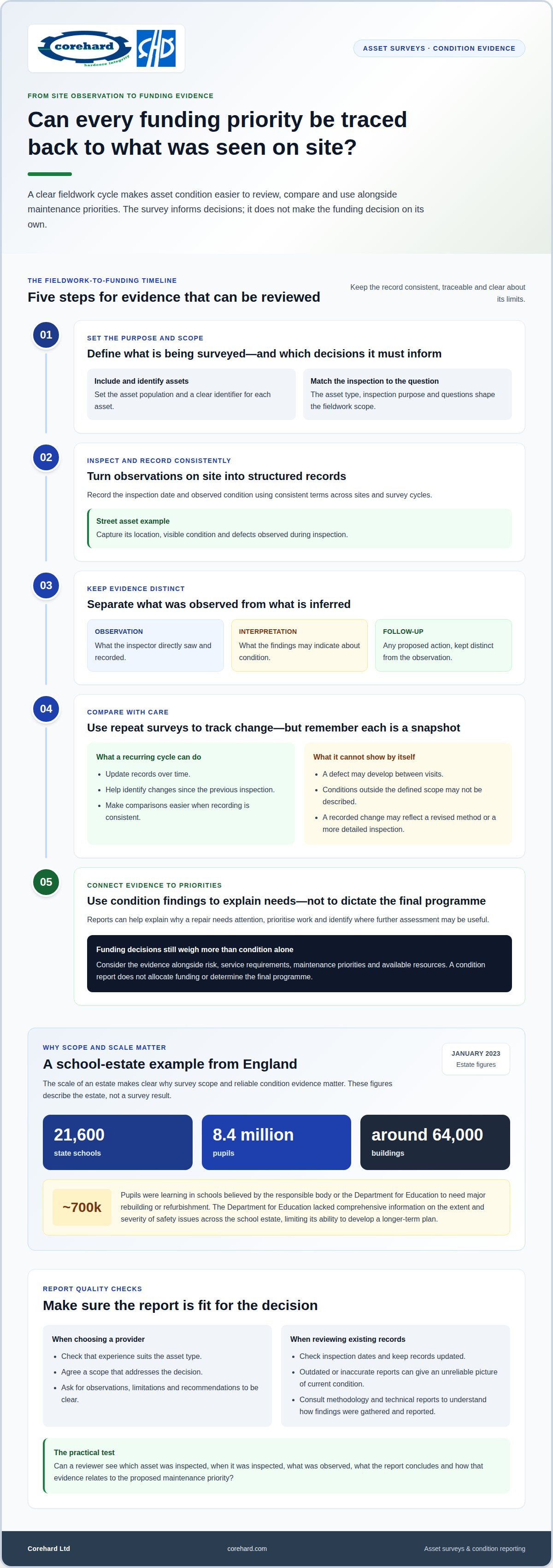
A useful fieldwork cycle starts by defining the asset population and the decisions the survey must inform. Inspectors then record observations using a consistent structure, so findings can be compared and reviewed. For a street asset, this might mean recording its location, visible condition and defects observed during inspection. The record should distinguish direct observations from interpretation or follow-up actions. This helps decision-makers understand the evidence without mistaking an observation for a complete diagnosis.
Survey frequency affects what the evidence can show. A recurring cycle provides an opportunity to update records and identify changes since the previous inspection. However, each survey is still a snapshot: a defect may develop between visits, and an inspection cannot describe conditions outside its defined scope. Clear dates, asset identifiers and consistent recording are therefore important when comparing results. A change in recorded condition may indicate deterioration, but it could also reflect a revised method or a more detailed inspection.
England’s state-school estate illustrates why fieldwork needs a clear purpose. In January 2023, England had 21,600 state schools, educating 8.4 million pupils across around 64,000 buildings. The responsible body for a school must manage building condition and ensure buildings are safe. Survey evidence can help organise the picture of an estate, but it must be understood alongside the inspection scope and the decisions it is intended to inform.
To make annual fieldwork useful, keep its evidence traceable:
- Define which assets are included and how each is identified.
- Record the inspection date and the observed condition.
- Use consistent terms across sites and survey cycles.
- Separate direct observations from interpretation and proposed action.
These steps make survey findings easier to review against asset priorities. They also clarify what needs attention and whether further assessment may be required.
Condition surveys and funding decisions
Condition evidence can inform which assets receive attention and how funding needs are explained. Its value depends on accurate records, clear priorities and a realistic understanding of what the findings cover.
Choosing a condition reporting provider
A condition reporting provider assesses assets and records findings in a format that supports operational decisions. When choosing a surveyor in the UK—whether engaging structural specialists or aerial surveying services such as Impact Aerial—consider whether their experience suits your asset type and whether the proposed scope addresses your decision. Agree how observations, limitations and recommendations will be presented. A useful report distinguishes evidence from interpretation, making its findings easier to assess against maintenance plans and funding priorities.
Benefits for facilities and property managers
Asset surveys give facilities and property managers structured evidence about the condition and needs of the assets they oversee. This can help them prioritise work, explain why a repair needs attention and identify where further assessment may be useful. For example, a manager responsible for several sites can compare consistent records of reported issues and prepare a more informed discussion about investment priorities.
Risks of outdated condition reports
An inaccurate or outdated condition report gives decision-makers an unreliable picture of an asset’s current state. If deterioration or a safety concern is missing from the record, planned work may not address the issue on site. If the report overstates the need, resources may be diverted from other priorities. Clear inspection dates and updated records help facilities teams keep assessments relevant to decisions.
The funding challenge is visible in England’s schools: around 700,000 pupils were learning in schools believed by the responsible body or the Department for Education to need major rebuilding or refurbishment. The Department for Education lacks comprehensive information on the extent and severity of safety issues across the school estate, limiting its ability to develop a longer-term plan. Better evidence can make the scale and urgency of needs easier to assess, though survey findings must still be considered alongside other priorities.
Funding choices also depend on whether organisations can plan work or have to respond to urgent problems. The Department for Education says school-building funding is often spent on urgent repairs rather than planned maintenance, risking poor long-term value for money. A condition report can explain which interventions are needed and why, but it does not allocate funding or determine the final programme. Decision-makers must weigh condition evidence against risk, service requirements and available resources.
In 2017, the National Audit Office reported that the Department for Education was making progress in improving England’s school buildings in the worst condition. This illustrates why funding decisions need both an estate-wide view and asset-level evidence: urgent work can address immediate concerns, while a clearer condition picture supports consideration of longer-term needs.
For a practical next step, connect observed defects to their location, likely consequence and proposed action. A structured asset survey and condition reporting service can support that evidence-gathering process when an organisation needs clearer condition records for planning.
Survey data access and revisions
Survey data access means retrieving records for review or operational use. A clear process helps teams find the relevant asset, understand its recorded condition and use the right version for planning.
Start by identifying who controls the dataset and what access they provide. Records may sit in a central system, project file or asset-management platform. The process depends on the survey arrangement, so define authorised users, permitted uses and the required format before relying on the data. For example, a highways team preparing a maintenance plan may need asset-level records, while a senior review may need a summary across locations.
Once access is arranged, locate each record using consistent identifiers. A road segment, lighting column or drainage asset should be traceable to its inspection and condition entry. Then identify the fields relevant to the decision, such as inspection date, observed defect, assessment and follow-up status. This prevents a spreadsheet extract from losing context when separated from the full record.
- Confirm the asset identifier and location used in the dataset.
- Record the survey date and the version being reviewed.
- Keep definitions for condition categories alongside exported data.
- Note the purpose and date of each extract shared with a team.
A data revision is a documented change to a survey record after its initial issue. Revisions can affect trend analysis and funding priorities, so records should show what changed, when and why. For instance, correcting an asset location may move a finding to a different site without changing the observed defect. A revised condition assessment may have a more direct effect on prioritisation.
When a record needs correcting, preserve the original entry and log the amendment rather than silently replacing it. Note the asset reference, field changed, reason, revision date and responsible role. If new inspection evidence supports a changed assessment, retain that evidence with the amended record. This creates an audit trail, a sequence of recorded changes that lets reviewers follow the decision.
Before using revised data, compare the new extract with the previous version and identify changes relevant to the decision. A facilities team might find that a defect has been reclassified, an asset identifier corrected or an inspection date updated. Each change has different implications. A new date may affect how current the assessment is; a revised classification may change the order in which work is considered.
Finally, align the dataset with the reporting period and decision. Keep a dated copy of the records used for a funding submission and note any amendments received afterwards. This helps reviewers understand what evidence informed the recommendation and whether a later revision changes its basis.
Survey methodology and technical reports
In the UK, asset surveys can cover an inventory, overall condition, a specific defect or compliance evidence. A survey methodology explains how its scope, observations and reporting approach support a particular decision.
Types of asset surveys
An asset survey is an inspection or review that records information about an asset. An inventory survey establishes what assets exist and where; a condition survey records their visible state; and a defect-focused survey investigates a defined issue. A compliance-oriented inspection considers evidence against relevant requirements. For example, a highways authority may need an inventory for asset planning, followed by a closer inspection of a reported defect.
These are practical differences in scope, not a universal classification for every UK asset. The purpose determines which approach fits: mapping an estate requires reliable identifiers, while assessing deterioration requires observations that describe condition. Combining scopes can help when a decision requires both an asset list and a view of current issues.
Asset condition survey information
An asset condition survey records an asset’s identity, observed state and inspection context. A report may include its location or reference, inspection date, visible defects, condition assessment and supporting notes. For a street-lighting asset, an entry might identify the column and location, describe visible damage and record the surveyor’s observation separately from any recommended action.
That distinction matters. An observation describes what was seen during inspection; an assessment interprets its significance against the survey’s criteria. When a report includes both, readers can follow the path from evidence to conclusion. Photographs or diagrams can add useful context when they form part of the agreed survey outputs.
Survey methodology
Survey methodology is the documented approach for selecting, inspecting and assessing assets. It should explain the survey purpose, coverage, inspection process, recording rules and criteria used to classify findings. For example, a methodology might define how inspectors record a defect and distinguish it from general wear, so separate records can be interpreted consistently.
Methodology also defines the boundaries of the work. A visual inspection records visible evidence, while a targeted investigation may be needed to examine a particular issue. The report should make clear which assets and conditions were covered, how findings were assessed and what limitations apply. This helps funding teams avoid treating a scoped inspection as a complete account of every asset risk.
A technical report presents survey results alongside the methods and criteria used to produce them. Review the evidence in sequence: survey scope, asset references, observations, assessment criteria, results and recommendations. If a recommendation relies on a condition category, the report’s definitions should explain what that category means. This makes conclusions easier to assess and reduces the risk of comparing unlike findings.
For a practical review, record the following details for each report used in a decision:
- The survey purpose and assets included.
- The inspection approach and condition definitions.
- The date and location associated with each finding.
- Any stated limitations or follow-up investigations.
These details help readers understand what the evidence supports. For instance, a funding proposal based on a defect-focused survey should make clear that the inspection addressed that issue, not every condition across the estate.
What information is included in an asset condition survey?
An asset condition survey is a structured record of an asset’s identity, observed state and inspection context. Its fields should connect each finding to a specific asset and show how the finding was reached. For a road sign, for example, the record could identify its location, describe visible damage and note when the inspection took place.
Asset identification gives each record a clear reference, such as an asset number, location or site name. This helps distinguish similar items, such as two signs on the same road or separate lighting columns near an intersection. A survey may also record asset type, component or owner where relevant. These details support accurate grouping and help prevent findings being assigned to the wrong item.
Condition evidence describes what the surveyor observed using the agreed recording approach. A report might note cracking, corrosion, deformation or missing components where relevant to the asset. Notes should specify the location and nature of a defect. For instance, “corrosion at the base” is more useful than “poor condition” because it identifies an observed feature and its position.
- Inspection context: date, location, survey scope and the asset reference.
- Observed evidence: defect description, affected component and supporting notes.
- Assessment: the condition category and criteria used to assign it.
- Follow-up: recommended action, priority rationale or further investigation.
Assessment criteria explain how observations become a condition judgement. If a report uses categories such as good, fair or poor, its methodology should define them. Otherwise, readers may interpret the same category differently. A clear assessment also separates observed evidence from professional interpretation, so reviewers can see whether a recommendation follows from the recorded condition.
Recommendations describe a possible response to a finding, rather than the original observation. A report might recommend monitoring a defect, arranging further investigation or considering maintenance. Linking each recommendation to the relevant asset reference and evidence helps facilities teams follow the reasoning. It also supports review when operational priorities or funding plans change.
Scope and limitations complete the record by showing what the inspection covered and what it did not assess. A visual inspection, for example, documents visible features rather than concealed components. This helps decision-makers judge whether further investigation is needed before committing to an intervention. Photographs can provide useful context when clearly linked to the correct asset and finding.
For records that support planning, request a structured asset condition survey that links each assessment to its evidence, criteria and recommended next step.
Corehard: Asset Surveys & Condition Reporting
Corehard provides Asset Surveys & Condition Reporting to help organisations build a clearer evidence base for asset planning, maintenance priorities and funding discussions. Use this service when records need updating, condition findings need documenting, or decision-makers need a structured view of an asset estate.
Survey findings can also relate to wider operational requirements. Corehard’s NRSWA & TMA Advisory, NRSWA & TMA Development and Dynamic Assurance & Compliance offerings address related advisory, development and assurance needs. The right support depends on the work required and the decisions the evidence must inform.
Contact Corehard to discuss your asset survey and condition reporting requirements.
Turn condition evidence into a clear next step
Funding discussions are stronger when evidence supports a defined decision rather than standing alone. Start by clarifying which assets the decision concerns, what outcome is being considered and what operational context matters. This keeps the investment case focused, especially when condition needs must be weighed against service priorities and planned work.
The ongoing value of asset surveys & condition reporting depends on keeping findings connected to decisions. Identify where evidence can inform planning, where uncertainty still affects the choice and what further assessment would strengthen the case. This creates a clear path from recorded condition to considered action without treating a survey as the decision itself.
As your organisation develops its next funding proposal, set out the decision, the supporting evidence and any context decision-makers need to understand. A well-framed case makes the survey’s purpose clear and gives the discussion a practical direction.
Contact Corehard about asset surveys to discuss your requirements and take the next step with confidence.
Frequently Asked Questions
What is an asset survey and condition report?
An asset survey gathers information about an asset, while its condition report communicates findings for operational decisions. For example, a survey of a drainage chamber might record its location, visible defects and access constraints. The report organises those observations so a maintenance team can understand the issue and decide whether to monitor it, investigate further or plan remedial work.
What UK standards and regulations apply to asset condition reporting?
The applicable requirements depend on the asset, survey purpose and work being assessed; one framework should not be assumed to cover every asset class. For street-works contexts, the New Roads and Street Works Act 1991 (NRSWA) and Traffic Management Act 2004 (TMA) may be relevant. The survey scope should also identify any applicable codes, specifications or organisational requirements that shape the inspection and report.
How is an asset survey carried out, step by step?
A survey typically moves from defining its purpose to recording evidence and issuing findings. For example, a survey team can follow this sequence:
- Set the scope, asset population and reporting requirements.
- Identify assets and inspect them using the agreed method.
- Record observations and supporting evidence against each asset.
- Review findings against the assessment criteria, then issue the report.
Where an observation needs closer examination, the report can recommend further investigation.
How are asset condition ratings and maintenance priorities determined?
Condition ratings classify observed state against the survey’s criteria, while maintenance priorities consider the implications of acting or delaying. A team might weigh defect severity, potential consequences, service impact and the available evidence. A rating alone does not set the work sequence: a less severe defect affecting a critical service could merit earlier attention than a more visible issue with limited operational impact.
How often should buildings and other assets be condition surveyed?
Survey frequency should reflect an asset’s deterioration, use, exposure and the consequences of an unnoticed change. An annual cycle can help organisations track condition consistently, but it is not a universal interval for every building or infrastructure asset. A new defect, incident, change in use or planned investment decision may justify an earlier review, particularly when existing evidence no longer supports the decision.


