

A defensible street lighting PFI handback depends on what can be verified, not simply what appears in the contract file. If asset records, condition evidence and transition responsibilities don’t align, important questions may surface when there’s less time to address them. A street lighting handback advisory can help authorities identify those questions early and check each requirement against the specific contract.
It’s understandable to be unsure whether the evidence is complete, whether maintenance or condition issues have been identified, and whether internal teams have the capacity to lead the process. The Infrastructure and Projects Authority’s Preparing for PFI contract expiry guidance advises authorities to start planning five to seven years before expiry. This allows time to review asset condition, information and transition needs.
This article provides a practical readiness checklist to help you assess handback evidence, identify gaps and compare internal preparation with specialist advisory support. It also sets out questions to put to your teams and potential advisers, so you can agree proportionate next steps based on the evidence and contract.
Key Takeaways
- Check whether asset information, condition evidence, maintenance history and contract records are current, traceable and accessible.
- Use a street lighting handback advisory checklist to identify evidence gaps and clarify which questions need contract-specific verification.
- Compare internal preparation and specialist support against your authority’s capacity, required scope and governance arrangements.
- Turn identified gaps into accountable actions by validating evidence, assigning decisions and reviewing progress.
- Before engaging an adviser, define the questions you need answered and confirm the proposed scope and responsibilities.
Why street lighting handback advisory matters before PFI expiry
As a street lighting PFI contract approaches expiry, an authority needs more than a file of documents. It needs clear evidence, understood responsibilities and accountable decisions. Asset condition, maintenance history and contract terms all shape the handback discussion. Reviewing them separately can leave gaps between what the records say, what is present on the network and what the agreement requires.
The Private Finance Initiative (PFI) model involved private finance and long-term arrangements for public infrastructure and services. As those agreements reach expiry, authorities must consider both the contractual end point and how the service will continue. The relevant PFI contract remains central: handback standards, deadlines and responsibilities vary, so check them against the agreement and seek appropriate legal or technical advice where needed.
Handback readiness means having traceable information, a sufficiently clear view of asset condition and ownership of the decisions still needed, assessed against the requirements of the specific contract. It’s a practical way to frame preparation, not a universal statutory checklist.
What does street lighting handback advisory cover?
Street lighting handback advisory is specialist support for examining PFI expiry and succession questions. It can help an authority consider how contract terms, asset information and future service arrangements connect, and identify where further verification or decisions may be needed. Corehard provides specialist guidance on PFI street lighting expiry and succession contracts. The authority retains its contract-management responsibilities and should confirm the precise scope of any proposed support.
That distinction matters. Advice can inform the authority’s assessment, but it doesn’t replace its obligations under the contract or substitute for contract-specific legal and technical verification.
Why assess handback readiness early?
An early review can bring missing records, unclear asset information and unresolved succession questions into view while there’s still time to consider options. For example, if maintenance records don’t explain the source or status of a condition concern, the authority can log what needs checking and assign responsibility for the next step, rather than leaving it as a last-minute handback query.
Condition evidence should inform the wider strategic discussion. Potential deferred maintenance concerns may affect the authority’s understanding of contract compliance and future service planning, but any conclusion depends on the evidence and the specific agreement. For broader context on expiry planning and handback, read the street lighting PFI expiry and handback guide.
Street lighting handback advisory checklist: review assets, condition and records
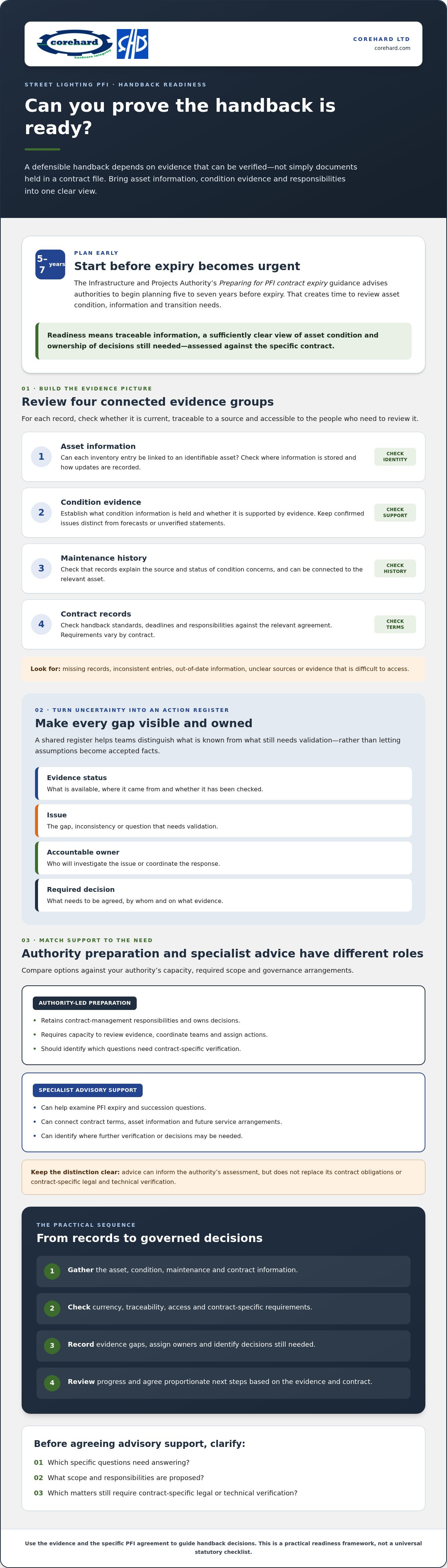
A record can look complete yet still be difficult to rely on if its source, date or connection to a particular asset is unclear. For a useful handback review, organise the evidence into four groups: asset information, condition evidence, maintenance history and contract records. For each item, check whether it is current, traceable to a source and accessible to the people who need to review it.
Use a simple register to turn gaps into actions, rather than allowing assumptions to become accepted facts. For each issue, record:
- Evidence status: what is available, where it came from and whether it has been checked.
- Issue: the gap, inconsistency or question requiring validation.
- Accountable owner: who will investigate or coordinate the response.
- Required decision: what needs to be agreed, by whom and on what evidence.
This gives teams a shared view of what is known and what remains uncertain. It also helps distinguish a confirmed condition issue from a forecast or an unverified statement about future maintenance.
Check the asset information and condition evidence
Start by establishing what inventory and condition information the authority holds, where it is stored and how updates are recorded. Check whether each entry can be linked to an identifiable asset and supporting information. Flag records that are missing, inconsistent, out of date or difficult to access. The aim is to expose evidence gaps that may affect handback planning, not to assume a particular survey method or universal evidence standard.
Keep observed or recorded condition separate from predictions and unconfirmed concerns. If, for example, a record suggests maintenance may be required but doesn’t identify its source or status, log it for validation rather than treating it as an established liability. For broader context on condition assessment, see this infrastructure asset condition assessment framework.
Review contract and operational records
Bring together the relevant contract provisions, schedules, maintenance history, known-issue records and correspondence. Check whether each item has an identifiable source and can be connected to the asset or obligation it concerns. Where the wording or effect of a contract provision is uncertain, refer it for appropriate specialist review. Don’t infer a handback requirement from a general record. The complexities of PFI handback reinforce why asset evidence and handover documentation need careful consideration together.
Where the register identifies questions about expiry or succession, Corehard provides Street Lighting PFI Transition Advisory. Confirm the proposed scope and retain contract-specific legal and technical verification where needed.
Compare street lighting handback advisory options against your authority’s needs
The choice isn’t simply between doing everything in-house and appointing an adviser. The right approach depends on your authority’s available expertise, the evidence already assembled, the decisions still outstanding and the circumstances of the specific PFI contract. Internal review may be enough for some tasks, while particular questions may call for specialist input.
Use consistent criteria to compare options, and record the evidence behind each conclusion. The official government guidance on PFI expiry can provide a broader framework for authorities considering expiry preparations. It doesn’t replace a review of the relevant contract or determine the support your authority needs.
| Assessment criterion | Question to ask | Evidence needed to answer it |
|---|---|---|
| Scope | Which expiry or succession questions need attention? | A list of outstanding questions, relevant contract provisions and decisions required. |
| Capacity | Are accountable internal roles and relevant expertise available? | Named responsibilities, team capacity and access to technical or contract knowledge. |
| Evidence | Can the authority substantiate its understanding of asset condition and maintenance history? | Available records, their sources, known gaps and any items needing validation. |
| Governance | How will advice, decisions and unresolved interpretations be recorded? | Decision-making responsibilities, review arrangements and escalation routes. |
When might internal preparation be sufficient?
Internal-led preparation may be appropriate where the authority has clear ownership of the work, access to relevant records and enough capacity to assess them against the contract. Review the questions in the table, then identify any gaps in expertise or evidence. Not every authority will need the same level of external support. Record unresolved interpretations for suitable professional review rather than treating assumptions as settled.
What should authorities ask a potential adviser?
Ask how the proposed support relates to PFI expiry and succession contract considerations. Request a clear explanation of scope, evidence inputs, responsibilities and reporting arrangements. Confirm which outputs are included instead of assuming that surveys, reports or other deliverables form part of the offer. Check how the adviser’s role will work alongside the authority’s contract-management responsibilities and any separate legal or technical advice required.
For street lighting handback advisory, distinguish confirmed service scope from assumptions before relying on a proposed approach. Compare the response with your authority’s documented needs, then decide whether internal preparation, specialist input or a combination is proportionate to the questions and evidence involved.
Turn the handback checklist into a governed action plan
A checklist identifies what needs attention; a governed action plan makes clear who will address it and how decisions will be recorded. Start with the relevant contract and the authority’s existing governance arrangements, then move from evidence gathering to validation, decision-making and progress review. This is a practical sequence, not a universal expiry timetable or statutory process. The contract and the authority’s circumstances should determine the appropriate milestones.
An action plan is only as reliable as the evidence it records and the checks that verify it. Keep a controlled record linking each issue to its evidence source, relevant contract provision, accountable owner, dependencies, required decision and current status. When a record changes or a question is resolved, retain a clear audit trail of what changed and why.
Prioritise issues without inventing risk ratings
Describe each issue in plain, specific terms, distinguish confirmed evidence from uncertainty, and state what clarification or decision is needed. For example, if two records give different information about an asset, note both sources and assign someone to establish which is current. Avoid creating generic risk scores unless they form part of the authority’s established governance approach.
Use existing decision-making arrangements to set priority, ownership and escalation. Where an issue depends on interpreting contract wording or assessing technical evidence, refer it for suitable professional review rather than allowing an assumption to become a decision.
Keep governance and succession decisions connected
Agree review points through the authority’s existing governance arrangements and in relation to relevant contract milestones. At each review, consider whether new condition evidence changes an outstanding handback question, a succession decision or both. This keeps asset findings connected to the decisions they may inform, rather than leaving technical and transition work in separate tracking systems.
- Gather: assemble relevant contract, asset and operational evidence.
- Validate: identify gaps, conflicting records and matters requiring further review.
- Assign: name the accountable owner and the decision-maker for each action.
- Review: update status, dependencies and decisions at agreed governance points.
Street lighting handback advisory can help authorities examine expiry and succession questions, but the proposed scope should be clear and contract-specific matters should be verified. Corehard provides specialist guidance on PFI street lighting expiry and succession contracts. Explore Corehard’s Street Lighting PFI Transition Advisory to review the service information.
Choosing street lighting handback advisory support and planning next steps
Choosing an adviser is a decision about fit and accountability, not simply a search for broad infrastructure experience. Before appointing support, clarify which PFI expiry or succession questions your authority needs to address, what expertise is available internally and where external input may add value. A clear brief makes it easier to compare proposed support with your actual requirements.
Assess fit, scope and accountability
Use a short selection check to establish whether an adviser’s proposed role is relevant and appropriately bounded:
- Relevant PFI focus: Can the adviser explain how their experience relates to street lighting PFI expiry and succession contract considerations?
- Defined scope: Which questions will the proposed support address, and what evidence will it rely on?
- Clear responsibilities: What remains with the authority, and who will coordinate information, review advice and make decisions?
- Transparent outputs: What work and outputs are included? Confirm these directly rather than assuming that surveys, reports or other deliverables form part of the scope.
Check how the proposed role complements existing authority capability and governance. General infrastructure experience alone doesn’t establish expertise in the specific obligations or interpretation of your PFI contract. Verify contractual requirements and legal or technical conclusions through appropriate professional review.
Prepare a focused first discussion
Share verified context before discussing potential support. This could include the relevant contract provisions, an overview of available asset information, the authority’s current understanding of the transition and a prioritised list of open questions. Clearly label information that is incomplete or awaiting validation, so it isn’t mistaken for an established fact.
Ask Corehard to clarify the scope of its street lighting PFI transition advisory in relation to your authority’s requirements. Corehard provides specialist guidance on PFI street lighting expiry and succession contracts; confirm the proposed responsibilities and outputs before relying on any specific service being included. Keep the authority’s contract-management role and any separate legal or technical verification clear.
For wider strategic context, read the 2026 strategic street lighting handback guide alongside this checklist. Together, these resources can help your team organise the issues to discuss, while the contract and verified evidence remain the basis for decisions.
If your authority is assessing its transition requirements, discuss your street lighting PFI transition requirements with Corehard.
Build a clearer path to street lighting PFI transition
A well-managed handback starts with decisions grounded in evidence and aligned with the specific contract. Use the checklist to bring asset information, condition records and maintenance history into view. Then record what remains uncertain, who will address it and which decisions need authority oversight. This gives internal teams and potential advisers a clearer basis for discussing priorities and responsibilities.
The right level of street lighting handback advisory support depends on your authority’s expertise, capacity and outstanding questions. Keep contract-specific obligations subject to appropriate verification, and confirm an adviser’s scope before relying on particular outputs.
Corehard lists Street Lighting PFI Transition Advisory among its services and provides specialist guidance on PFI street lighting expiry and succession contracts. If your authority is considering its next steps, discuss your street lighting PFI transition requirements.
With clear evidence, accountable decisions and suitable support, your team can approach the transition with greater structure and confidence.
Frequently Asked Questions
What does street lighting handback advisory involve?
Street lighting handback advisory involves specialist guidance to help an authority examine PFI expiry, handback and succession questions. It can help clarify which issues need consideration and where further evidence or professional review may be needed. The authority remains responsible for its own contract management, governance and decisions. Agree the precise scope clearly, based on the relevant contract, rather than assuming it from a general service description.
When should a local authority start preparing for street lighting PFI handback?
Start by checking the contract’s expiry date, handback milestones, notice periods and related decision points, then plan backwards to allow time to gather and validate evidence. There isn’t one timetable that applies to every agreement. Asset records, condition information, maintenance history and succession questions may take time to clarify, so identify gaps early and agree owners and review points through the authority’s governance arrangements.
What should a street lighting handback checklist include?
A practical checklist should cover the asset inventory, condition evidence, maintenance records and relevant contract provisions, schedules and correspondence. For each record, note its source, date, accessibility and relationship to the asset or obligation in question. Log missing or conflicting information as an issue to validate, not as an established fact. Include an evidence status, accountable owner and required decision, so gaps lead to clear actions and review.
How can an authority assess street lighting asset condition before handback?
Begin by reviewing the condition information the authority holds, checking how it relates to identifiable assets and whether its sources and dates are clear. Compare recorded observations with maintenance history and flag missing, conflicting or unverified details for follow-up. Keep observed condition separate from forecasts about future maintenance. Check any inspection method, condition standard or handback requirement against the specific contract and verify it with appropriate technical advice.
Is external street lighting handback advisory necessary?
Not necessarily. Whether external support is appropriate depends on the authority’s internal expertise and capacity, the quality of available evidence and the complexity of its contract-specific questions. An authority with clear ownership, accessible records and relevant technical and contract knowledge may be able to lead much of its preparation internally. Where uncertainties remain, identify the precise questions requiring specialist input rather than assuming all handback work must be outsourced.
What questions should we ask a street lighting handback adviser?
Ask how the proposed support relates to PFI expiry and succession, what is included in its scope and which evidence the adviser will need. Clarify who is responsible for supplying information, reviewing advice and making decisions, and how the work connects with the authority’s governance arrangements. Confirm which outputs are included rather than assuming surveys or reports form part of the offer. Establish which legal or technical matters require separate professional verification.
Can Corehard advise on street lighting PFI expiry and succession?
Yes. Corehard provides specialist guidance on PFI street lighting expiry and succession contracts, and lists Street Lighting PFI Transition Advisory among its services. Authorities can outline their relevant contract context and the questions they need to address, then confirm directly what support is within scope. Consider Corehard’s advisory role alongside the authority’s own contract-management responsibilities and any contract-specific legal or technical verification required.


