

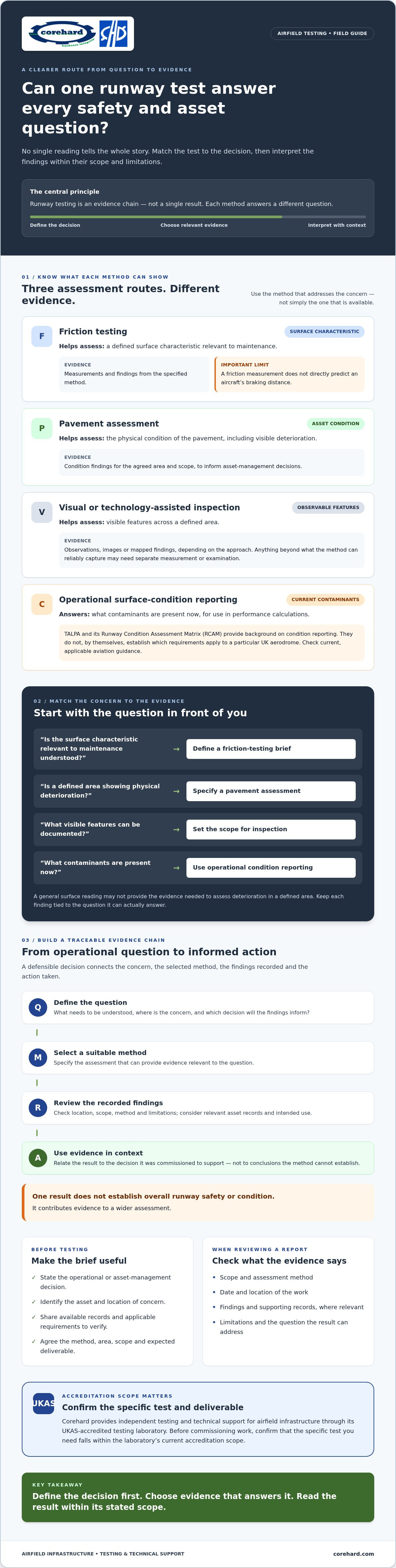
Could one runway test establish whether friction is adequate, pavement is deteriorating and current conditions support safe operations? Runway testing is an evidence chain, not a single reading. Each method answers a different question, so the first step is to define the decision the evidence needs to support.
For airfield teams, the distinction matters. A friction measurement can inform maintenance, but it does not directly predict an aircraft’s braking distance. A pavement condition assessment examines physical defects, while operational surface-condition reporting records current contaminants for use in performance calculations. Treating these as interchangeable can leave decision-makers with evidence that does not answer the question they need to resolve.
This guide explains what the main categories of runway testing can establish, how to match a testing brief to an operational concern, and what to look for in a clear, traceable report. It also explains why the test method, findings and accreditation scope should be confirmed before commissioning work. Corehard provides independent testing and technical support for airfield infrastructure through its UKAS-accredited testing laboratory. Confirm that the specific test you need falls within the laboratory’s current accreditation scope.
Key Takeaways
- Start with the operational or asset-management decision, then define the evidence needed before commissioning testing.
- Runway testing covers distinct assessment types. Match the method to the condition or question you need to investigate.
- Set out the asset, location and available records in your brief so the work can be focused and proportionate.
- Check that reports identify their scope, method, date, location and limitations, with supporting records where relevant.
- Before commissioning a laboratory, confirm that the requested test and deliverable fall within its current UKAS accreditation scope.
What runway testing assesses, and why one result is not the whole picture
A result can look decisive and still leave the central airfield question unanswered. A friction reading, a record of surface defects and an inspection image each provide different evidence. Relying on one as a complete account can lead to decisions that are not properly supported.
Runway testing is planned measurement or examination carried out to answer a defined question about an airfield asset or its condition. Before choosing a method, identify what needs to be understood, where the concern is, and what decision the findings will inform. This helps distinguish useful evidence from data that may be technically valid but does not address the decision at hand.
What questions can runway testing help answer?
Surface characteristics and pavement condition are related, but they are not the same. Friction testing examines a surface characteristic relevant to maintenance assessment. On its own, it does not establish an aircraft’s braking performance. Pavement assessment considers the physical condition of the asset, including visible deterioration, and can inform asset-management decisions. A visual inspection records what can be observed, while technology-assisted inspection may help capture or map observations. Neither should be treated as proof of conditions the method cannot assess.
Operational surface-condition reporting addresses another question: what contaminants are present now? Frameworks such as Takeoff and Landing Performance Assessment (TALPA) and its Runway Condition Assessment Matrix (RCAM) provide useful background on condition reporting. This reference does not establish which requirements apply to a particular UK aerodrome. Check current, applicable aviation guidance before specifying or interpreting a method.
Why should testing be treated as an evidence chain?
A defensible decision connects the operational or asset-management question to the selected method, the findings recorded and the action taken. If the concern is deterioration in a defined area, for example, a general surface reading may not provide the evidence needed to assess the pavement. The report’s location, scope and limitations help explain what a result does and does not show.
Context matters too. Interpret findings alongside relevant asset records and the intended use of the information, rather than in isolation. For airport operators managing complex airfield infrastructure—where physical assets operate alongside mission-critical systems and software engineered by specialists such as AAC LTD | All About Control—reliable data across all disciplines is essential for safe operations. No single result establishes overall runway safety or condition. It contributes evidence to a wider assessment.
Before commissioning work, identify the asset and location, the decision the findings must support, and any applicable requirements that need to be verified. Choose the method in response to those points. This gives the person carrying out the assessment a clear brief and helps the decision-maker judge whether the resulting evidence is fit for purpose.
Runway testing methods: distinguish friction, pavement and visual assessment
A useful report starts with the right method, not simply the method that is available. Friction testing, pavement assessment and visual inspection produce different kinds of evidence. Compare their findings only when they address the same question.
The table below can help shape an initial brief. Confirm the method, deliverable and applicable guidance for the specific airfield before work begins.
| Assessment type | Purpose | Evidence produced | Questions to confirm |
|---|---|---|---|
| Friction testing | Assess a defined surface characteristic relevant to maintenance. | Measurements and findings produced using the specified method. | Which method applies, where will measurements be taken, and how should results be interpreted? |
| Pavement assessment | Consider the physical condition of the pavement and asset-management concerns. | Condition findings for the agreed area and scope. | Which defects or condition features are in scope, and what decision must the assessment support? |
| Visual or technology-assisted inspection | Observe and document visible features across a defined area. | Records such as observations, images or mapped findings, depending on the approach. | What can the inspection method reliably capture, and what requires separate measurement or examination? |
What does runway friction testing tell an operator?
Friction testing addresses a specific surface question. It does not establish pavement integrity or provide a complete account of operational conditions. Roadgrip, for example, lists friction testing among its airfield services, but a service listing alone does not define the evidence a particular airfield needs. Before specifying work, verify the applicable measurement method and interpretation guidance against current requirements for the airfield.
Surface deposits, including accumulated rubber, may be relevant context when considering a friction concern. Recording or investigating a deposit is not the same as removing it or treating the surface. Those are separate interventions and should not be presented as testing evidence.
How do pavement assessment and visual inspection differ?
A pavement assessment addresses condition questions that a friction result cannot resolve. Visual inspection, including drone-assisted observation where appropriate, gathers evidence about visible features. It is not automatically laboratory testing, and its limits should be stated. For broader context, see this guide to airfield pavement condition surveys.
The FAA’s airport pavement guidance provides a reference point for US practice, but it should not be assumed to set requirements for a UK aerodrome. Check the applicable current aviation guidance and standards before naming or interpreting requirements. If considering a technical-testing partner, ask Corehard about its testing scope and confirm that the requested work falls within its current UKAS accreditation scope.
How to choose runway testing that answers the decision in front of you
A clear testing brief starts with the decision, not a preferred instrument or familiar method. Use this sequence to define the evidence needed and avoid commissioning work that produces findings without resolving the concern.
- State the question. Is the concern about a surface characteristic, visible deterioration, or the condition of a defined pavement area? Describe the decision the findings need to support.
- Identify the asset and location. Specify the runway or other relevant asset, the area of concern and its boundaries as clearly as possible.
- Gather available records. Share relevant inspection history, previous reports or other asset information so the proposed work can be considered in context.
- Agree the evidence required. Ask what findings and report format will help you make the decision, and whether field inspection, laboratory testing or a combination is justified.
- Check applicable requirements. Verify current guidance and standards for the airfield before specifying a method or acceptance criterion.
Select a testing method by the decision required, not by the equipment alone. A field inspection may help document visible features, while laboratory work may be appropriate where the question calls for a specified test. Combining approaches can strengthen the evidence when each contributes information the decision needs. Do not add methods by default.
What should an airfield testing brief specify?
Set out the question, asset area, requested evidence and intended use of the findings. Ask the provider to state the proposed method, assumptions, limitations and report format, and to identify any requirements that need confirming before work proceeds. Do not prescribe a method or acceptance criterion unless you have verified that it applies to the asset and decision.
Where pavement evaluation is being considered, the US Department of Defense’s Airfield Pavement Evaluation criteria offer a reference to consult, but they should not be assumed to govern a UK aerodrome. Confirm the applicable local guidance independently.
How should accreditation scope be checked?
A laboratory’s general UKAS accreditation does not establish that every test it performs is accredited. Ask whether the specific requested test appears within its current accreditation scope, and confirm the deliverable and any limitations before commissioning. For background on accreditation in a different infrastructure context, read about UKAS-accredited highways testing. That does not confirm runway-testing scope.
Corehard operates a UKAS-accredited laboratory and provides independent testing and technical support for airfield infrastructure. If considering Corehard as a potential testing partner, check its laboratory scope against the exact test and report you require before proceeding.
How to review runway test evidence and turn findings into action
A report is useful only if you can trace its findings back to the question that prompted the work. Before acting on a result, check what was assessed, where and how the evidence was collected, and what the report says it cannot establish.
What should a usable runway testing report contain?
Use this checklist to review whether the report provides a clear basis for consideration:
- Scope: Does it identify the work undertaken and the question it was intended to address?
- Method: Is the approach described clearly enough to understand how the findings were produced?
- Date and location: Can you identify when and where the assessment took place, including the area covered?
- Results and observations: Are measurements or observations recorded with enough context to interpret them?
- Limitations: Does the report explain assumptions, gaps or conditions that may affect how the findings should be used?
Photographs, location references and recorded measurements can support traceability where they are relevant to the method and scope. They help readers connect a reported observation to the part of the asset assessed, but supporting material does not remove the need to understand the method or its limitations. Do not assume a report will follow a particular format or include specific outputs. Agree those requirements with the provider in advance.
How can findings support proportionate follow-up?
Keep three stages distinct: test findings describe what was observed or measured; interpretation considers what those findings mean in context; and an operational or asset decision determines what action, if any, follows. A test report can inform a decision, but it should not be treated as the decision itself.
Compare the findings with the original question, the stated scope and relevant asset records. If the evidence leaves a material uncertainty, consider whether a further assessment is needed, following the organisation’s verified decision process rather than applying an unconfirmed threshold. The wider role of assessment in managing infrastructure is explored in this guide to infrastructure asset condition assessment.
For an evidence trail that supports review and follow-up, retain the report alongside relevant records and document how the findings informed the decision. If you are considering external support, discuss your airfield testing requirements with Corehard, and confirm that the requested work and deliverable fit the laboratory’s current UKAS accreditation scope before commissioning.
Where Corehard's airfield testing laboratory may fit
Select a testing provider according to the evidence your decision requires, rather than assuming one provider covers every part of a runway assessment. Corehard may be relevant where independent testing or technical support for airfield infrastructure fits the brief. Confirm the requested work against its current capabilities and accreditation scope before proceeding.
What Corehard's confirmed capabilities support
Corehard operates a UKAS-accredited testing laboratory that provides independent testing and technical support for airfield infrastructure. Condition assessments are also among its stated services. These capabilities may form part of an evidence plan, but they do not establish that every runway-related method or assessment is available, or that a specific test is covered by the laboratory’s accreditation.
Start with the question you need answered. If it calls for independent testing, ask whether the laboratory can undertake the specific work and provide evidence that is useful for the intended decision. If the concern relates to wider asset condition, clarify how any testing would relate to the condition assessment and what each element can establish. Laboratory findings may contribute to the evidence pathway, but should not be presented as a complete runway assessment unless the agreed scope supports that conclusion.
This distinction helps keep the brief proportionate: define the asset and issue, then confirm whether the proposed work can address them. Avoid assuming that a general reference to airfield testing confirms a particular runway method, equipment or accredited test.
What to confirm before commissioning a test
Before proceeding, discuss the brief and check the following points with the provider:
- Scope and capability: Can the laboratory undertake the specific requested work for the asset and location in question?
- Accreditation: Does the exact test appear within its current UKAS accreditation scope? A laboratory’s general accreditation does not automatically cover every test it may perform.
- Evidence and deliverables: What results or other outputs will be provided, and how will they address the question in the brief?
- Limitations and intended use: What assumptions or limitations should be understood, and how can the findings inform the decision?
These checks help establish a clear boundary between what the testing can demonstrate and what requires separate assessment or operational judgement. They also give both parties an opportunity to identify any mismatch before work is commissioned.
For airfield teams preparing a brief, a discussion can help establish whether the requested evidence aligns with Corehard’s confirmed scope. Contact Corehard to discuss airfield testing with the question, asset details and intended decision ready, and confirm the relevant test and accreditation scope before commissioning.
Make your next runway assessment decision-ready
Strong airfield decisions depend on evidence that answers the question being asked. Runway testing may involve different methods for surface characteristics, pavement condition or visual inspection, so define the asset, location and intended decision before choosing an approach. Then review the report’s scope, method, findings and limitations, and use them alongside relevant records and your organisation’s decision process.
Corehard operates a UKAS-accredited testing laboratory providing independent testing and technical support for airfield infrastructure. Confirm the specific runway work available and whether it falls within the laboratory’s current accreditation scope before commissioning.
Have a testing brief to discuss? Discuss your airfield testing requirements with Corehard, including the evidence you need and the decision it must support. A clear brief is a practical first step towards findings you can assess with confidence.
Frequently Asked Questions
What is runway testing?
Runway testing is planned measurement or examination used to answer a defined question about an airfield asset or its condition. The appropriate approach depends on the concern: friction testing examines a surface characteristic, pavement assessment considers physical condition, and visual inspection records observable features. These methods produce different evidence, so no single result should be treated as a complete statement of runway safety or condition.
What does runway friction testing measure?
Runway friction testing measures a defined characteristic of the pavement surface using a specified method. It can inform maintenance assessment, but it does not identify every pavement defect or directly predict an aircraft’s braking distance. Before relying on a result, check how it was measured, where the test took place and what interpretation guidance applies. Those details help establish what the finding can and cannot support.
How often should a runway be tested?
There is no single testing interval that can be recommended for every runway from the information available here. Frequency should be set against the relevant operational question, asset information and current requirements that apply to the aerodrome. Check applicable aviation guidance and local procedures, and consider whether previous findings or a change in condition call for further assessment. Avoid adopting an interval without verifying its basis and relevance.
Can runway testing identify pavement damage?
It can, if the selected work is a pavement assessment designed to examine condition. A friction result alone does not establish whether the pavement is damaged. Visual inspection may document visible defects, while other forms of assessment may be needed to investigate a specific concern. Define the location and issue first, then confirm that the proposed method can provide evidence relevant to that question and state any limitations.
What should a runway testing report include?
A useful report should identify the work undertaken, the question it addressed, the method, date and location, and the results or observations recorded. It should also explain relevant context, assumptions and limitations so readers can interpret findings appropriately. Photographs or other supporting records may help connect observations to the area assessed. Confirm the required outputs with the provider before commissioning, as formats and deliverables can vary.
Does UKAS accreditation mean every runway test is accredited?
No. A laboratory’s general UKAS accreditation does not mean every test it performs is covered. Check whether the specific requested test appears within the laboratory’s current accreditation scope, and confirm what the report will state about the work. Corehard operates a UKAS-accredited testing laboratory and supports independent testing for airfield infrastructure, but the accreditation scope for any particular runway test must be verified before commissioning.
Can a laboratory test replace an airfield inspection?
Not automatically. Laboratory testing and field inspection answer different questions and may produce complementary evidence. A laboratory result may not describe visible conditions across the runway, while an inspection may not provide the measurement or examination a particular question requires. Specify the decision to be supported, then establish whether inspection, laboratory testing or both are appropriate. Review each method’s scope and limitations before treating findings as a complete assessment.
How do I choose a runway testing provider?
Start with the decision you need to make, then identify the asset, location and evidence required. Ask the provider to explain its proposed method, assumptions, limitations and reporting, and verify any applicable requirements before agreeing the brief. If accreditation matters, check that the specific test is within the provider’s current scope—just as facility managers across airport estates verify certified scopes when working with independent laboratories like The Testing Lab PLC. A clear match between question, method and deliverable makes findings more useful for your decision.


