

A complete-looking streetworks record can still leave compliance teams without a clear view of site conditions. Streetworks assurance services bring together desktop risk assessments, site assessments, asset inspections, condition reporting and, where relevant, laboratory testing. This lets teams consider records alongside evidence from the street.
A desktop assessment can flag potential issues, while an inspection or test can help establish asset or reinstatement condition. Recording and reviewing this evidence against the requirements for the work helps teams make informed decisions.
This article explains how assessment tools support compliance, what the Red Book and the Specification for the Reinstatement of Highways cover, and how UK policy shapes assurance. It also explores how teams can use evidence to identify gaps, monitor reinstatement quality and focus attention on risk.
Key Takeaways
- Use desktop risk assessments alongside site inspections and condition evidence to build a more complete view of streetworks risk.
- Use the Red Book for safety practice and the Specification for the Reinstatement of Highways (SROH) to understand reinstatement requirements.
- According to the UK legislation register, street works in the UK are legally defined and governed by the New Roads and Street Works Act 1991.
- Compare assurance providers by the scope of their technical evidence, inspection capability and understanding of the requirements relevant to your work.
- Keep operative qualifications current: SWQR cards have a 5-year validity period, and working with an expired card can lead to site removal and legal non-compliance.
Safety codes and reinstatement requirements
A safe streetworks site depends on two linked controls: managing hazards while work is under way and restoring the road afterwards. The Red Book is the safety code of practice for streetworks, while the Specification for the Reinstatement of Highways (SROH) provides technical guidance covering streetworks design, delivery and guarantees. Together, they help teams assess work practices and reinstatement against the relevant requirements.
The Red Book focuses on safe working arrangements around an excavation, including how work is organised and risks to workers and road users are managed. An assessment should reflect the actual site, not rely solely on a standard description: a utility opening beside a busy junction presents different conditions from one on a quiet residential road. Recording the assessment and controls used gives compliance teams evidence to review.
SROH requirements matter because an excavation affects more than the visible road surface. Reinstatement must address the excavated area and the layers disturbed during the work, with the aim of restoring the highway appropriately. A sound surface finish alone may not show whether the underlying reinstatement has been carried out correctly. Inspections and condition reporting can help identify defects, document condition and inform any required repair.
For practical assurance, connect each works record to its site evidence. A useful review considers:
- Whether the documented safety assessment reflects the location and work being carried out.
- Whether reinstatement records and inspection findings correspond to the excavation.
- Whether any defect has been recorded, assessed and followed through to repair.
- Whether the relevant authority has access to clear evidence for its compliance assessment.
Warranty periods and inspection arrangements vary by jurisdiction. In Northern Ireland, street works undertakers are normally responsible for reinstatements for a warranty period of 2 years. DfI Roads inspects 10% of reinstated utility openings within the 3 months before the warranty period ends at Category C. These checks make condition evidence important throughout the warranty, not just when the initial reinstatement is completed.
Other Northern Ireland inspection categories provide different checkpoints. DfI Roads inspects 10% of utility street works in progress at Category A, then inspects 10% of reinstated utility openings within 6 months after completion at Category B. For a compliance team, those stages show why records should distinguish active works from completed reinstatements and retain dated evidence. A highway authority can then assess the works against the applicable safety practice and reinstatement requirements, while operators can identify issues early enough to organise a repair.
UK streetworks legislation and policy
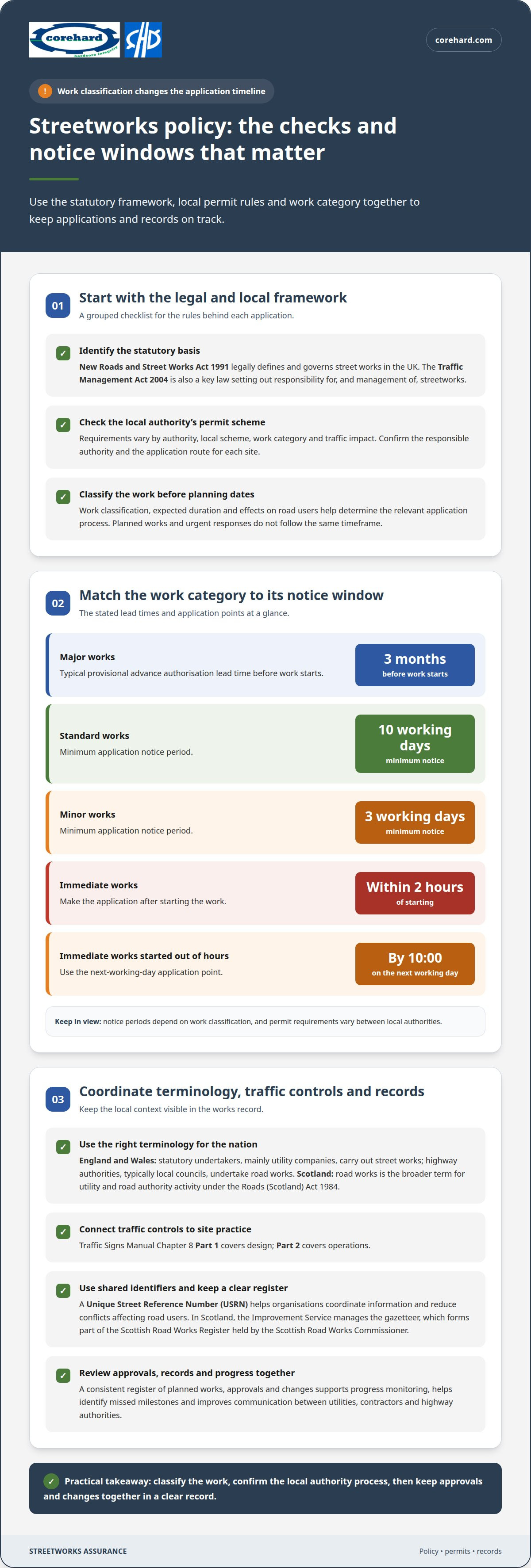
Permit requirements vary by local authority, reflecting local schemes, work categories and traffic impacts. Application notice periods depend on the work classification: the minimum is 10 working days for standard works and 3 working days for minor works.
In the UK, street works are legally defined and governed by the New Roads and Street Works Act 1991, according to the UK legislation register. The Traffic Management Act 2004 is one of the key UK laws setting out responsibility for and management of streetworks, according to the UK legislation register. These Acts provide the statutory framework, while local authority processes shape how applications and monitoring operate in practice.
For major works, the typical provisional advance authorisation lead time is 3 months before work starts. Applications for immediate works should be made within 2 hours of starting. If work starts out of hours, apply by 10:00 on the next working day. These distinct timeframes make accurate classification important: an application for planned works follows a different process from an urgent response.
Local permit schemes can set controls for works affecting roads and traffic, so contractors need to account for the authority responsible for each site. Work classification, expected duration and effects on road users help determine the relevant application route. A consistent register of planned works, approvals and changes helps teams monitor progress and identify missed milestones. It also supports clear communication between the utility, contractors and highway authority.
Legislation and terminology also differ across the UK. In England and Wales, statutory undertakers, mainly utility companies, carry out street works to install, maintain or repair apparatus beneath the street. Highway authorities, typically local councils, undertake road works to repair, maintain or improve roads and associated infrastructure. In Scotland, road works is the broader term for utility and road authority activity, under the Roads (Scotland) Act 1984.
Traffic controls and records connect policy with on-site practice. Traffic Signs Manual Chapter 8 Part 1 covers design, while Part 2 covers operations. The Unique Street Reference Number provides a shared identifier, helping organisations coordinate information and reduce conflicts affecting road users. In Scotland, the Improvement Service manages the gazetteer, which forms part of the Scottish Road Works Register held by the Scottish Road Works Commissioner.
Compliance teams can use dynamic assurance and compliance to structure monitoring around approvals, work records and evidence of progress. This helps bring authority requirements and operational records into one review, so gaps can be identified and addressed through the appropriate process.
What qualifications and accreditations should a streetworks assurance provider have?
Qualifications should match the work being assessed. Reviewing operative competence, inspecting reinstatement and conducting laboratory tests involve different skills, so one credential cannot demonstrate every capability. Compliance teams should distinguish qualifications held by individuals from accreditations that apply to a testing activity or facility.
For work involving street works operatives, the Street Works Qualification Register (SWQR) card is a relevant competence record. SWQR cards are described as having a validity period of 5 years. An expired card can result in site removal and legal non-compliance, making validity checks important when reviewing workforce records. The card is evidence of an operative’s qualification, not proof that every aspect of an assurance review is covered.
Reassessment arrangements also vary across the UK. In England and Scotland, Street Works re-assessment examinations contain 20 questions, and candidates must achieve a pass mark of 80%. In Wales and Northern Ireland, successful certificate re-registration renews registration for a further 5 years, without a multiple-choice examination. These differences mean that a compliance record should identify the relevant nation and renewal route, rather than treating every certificate process as identical.
For an assurance assignment, consider the capability required for each activity:
- Site assessment: identify the relevant street works competence and experience for the inspection being undertaken.
- Condition reporting: check that the assessor can document observations clearly and connect them to the asset or location.
- Laboratory testing: establish whether testing is undertaken by a UKAS-accredited testing laboratory when accredited testing is required for the work.
- Compliance review: confirm that the reviewer can interpret the applicable records, assessment evidence and requirements together.
UKAS accreditation is relevant to laboratory testing, not a universal credential for every advisory or inspection task. Its value depends on whether the laboratory’s accredited scope matches the test required. A test report should identify what was tested and provide results that can be considered alongside site findings. This distinction helps prevent laboratory accreditation from being mistaken for proof of competence across unrelated services.
Finally, assess how qualifications are maintained in practice. A useful assurance record links the named person to their relevant qualification, its validity and the work they completed. For example, a site assessment file can identify the assessor and connect their findings to the inspection date and location. This creates traceable evidence for internal review and supports a reasoned decision about whether further assessment, testing or remedial action is needed.
How do street works assurance providers compare in the UK?
Compare providers by the evidence they can bring together, not by a broad service label. A desktop review can flag risks in available records, while a site assessment documents conditions on the ground. Asset inspections and laboratory testing provide different evidence. Start with the decision your team needs to make, such as whether to review a risk classification or investigate an asset further.
Scope is the first useful distinction. One provider may focus on interpreting records and developing compliance processes; another may conduct inspections or condition assessments. Testing capability is a separate consideration, because it produces technical results for particular materials or assets. A team reviewing reinstatement quality, for example, may need both a documented site assessment and suitable test evidence. No single method answers every compliance question.
Compare how each approach turns findings into action. A useful output identifies the location and subject assessed, explains the evidence considered, records the finding and makes clear what follow-up is required. For a desktop risk classification, retain the basis for the assessment. For a site visit, connect observations to the relevant work or asset. Consistent records help teams compare findings across projects and trace decisions later.
Review cadence also matters. The Environment Agency and Street Works UK review the accuracy of Desktop Risk Assessment classifications quarterly. Organisations must include Desktop Risk Assessment findings in their quarterly reporting alongside site assessments and laboratory testing results. This makes it important to compare providers’ ability to support connected reporting, rather than assess each evidence stream in isolation.
When comparing proposals, consider these practical dimensions:
- Coverage: does the work address desktop risk, site conditions, assets, testing, or a defined combination?
- Traceability: can each finding be linked to a location, record and assessment basis?
- Reporting: can the outputs be brought into the organisation’s quarterly reporting?
- Follow-through: do findings help the team prioritise further assessment or corrective action?
For example, a utility with recurring desktop classifications may prioritise repeatable assessments and clear reporting. A local authority reviewing asset condition may place greater weight on inspection coverage and consistent condition records. These needs call for different emphases, even when both teams seek streetworks assurance. Comparing scope, evidence and reporting outputs keeps the decision aligned with operational requirements.
Finally, distinguish a one-off review from ongoing assurance. A single assessment can answer a specific question; repeated monitoring can reveal patterns across locations and work programmes. Compare how each provider’s approach supports the intended decision, available evidence and reporting cycle, then select a scope that addresses the compliance task.
What are the penalties and risks of non-compliant streetworks?
Non-compliance can affect safety, road condition, programme delivery and the evidence available to an authority. New fines and penalties for utilities were due to come in during 2025. The consequences in an individual case depend on the failure and applicable enforcement arrangements, so teams should distinguish known operational risks from specific legal sanctions.
An expired SWQR card presents a direct compliance risk. Working with an expired card can lead to site removal and legal non-compliance. Removal can disrupt planned work, particularly when the person’s role is needed to continue an operation safely. Checking qualification records before site deployment helps identify expiry issues and supports accurate workforce planning.
Safety failures can expose workers and road users to unmanaged hazards. For example, a worksite assessment that does not reflect actual conditions may miss a changed traffic layout or a newly exposed hazard. Clear records of site conditions, decisions and control measures help teams review whether practice matched the work being carried out. They also provide a basis for addressing gaps before the same issue recurs.
Defective reinstatement creates a separate risk after excavation work ends. A surface defect can prompt further inspection and repair, while incomplete records make it harder to establish what work was completed and when. Linking the location, reinstatement evidence and condition findings gives compliance teams a clearer audit trail. It also helps distinguish an isolated defect from a recurring issue across a work programme.
Permit and notice failures can undermine coordination with the relevant authority. For example, a missed application milestone may affect planned traffic arrangements or require changes to a works programme. A reliable register of applications, approvals, work status and amendments helps teams spot inconsistencies. Reviewing these records alongside site evidence gives managers a practical way to identify emerging compliance risks.
Risk reviews should distinguish immediate safety concerns from administrative and asset issues. An unsafe site needs prompt operational attention; incomplete documentation calls for record correction and process review. A defect in completed reinstatement requires condition assessment and a decision about repair. Categorising findings this way helps teams assign appropriate owners and track actions through to closure, rather than treating every exception alike.
A useful review can record:
- The requirement or expected control involved, such as a valid SWQR card.
- The evidence observed, including the relevant record, site finding or condition report.
- The potential consequence, such as site removal, disruption or a repair requirement.
- The corrective action, responsible role and follow-up record.
Where recurring gaps call for structured monitoring, Dynamic Assurance & Compliance can support a consistent review of findings and corrective actions. This helps teams turn individual exceptions into evidence for improving oversight and reducing repeat issues.
Corehard: NRSWA & TMA Advisory
Corehard provides NRSWA & TMA Advisory to help organisations interpret requirements and strengthen streetworks compliance. Turn to this support when regulations, assurance findings or operational processes need a clearer, more consistent approach.
When compliance teams need evidence from the network itself, Asset Surveys & Condition Reporting can improve understanding of asset condition. NRSWA & TMA Development and Dynamic Assurance & Compliance can address process and oversight needs, linking assessment activity with practical compliance management.
For teams reviewing a specific issue, the next step is to identify the relevant requirement, evidence gap or operational challenge. Corehard can help determine which of these advisory and assurance services best fits that need. Contact Corehard to discuss your streetworks requirements.
Turn assurance findings into a clearer next step
Choose a recurring point of uncertainty as the starting point for your next review. It might be a gap between assessment records and site evidence, unclear ownership of follow-up actions, or difficulty turning findings into consistent reporting. Define the decision the team needs to make, the evidence that supports it and who is responsible for acting on the outcome.
This focused approach helps ensure streetworks assurance services contribute to practical oversight, rather than producing records detached from day-to-day decisions. As the review develops, use emerging findings to refine risk assessment and action tracking across your programme.
If you’re ready to strengthen your approach, start a conversation with Corehard about the assurance challenge your team wants to address. A clear starting point can help turn complex requirements into more manageable decisions and support steady progress towards better compliance.
Frequently Asked Questions
What are the best practices that authorities can adopt?
Authorities can improve oversight by connecting assurance findings to internal responsibilities and decision-making. For example, agree how operational teams will share information when planned work changes, and how managers will record the reason for a revised decision. Review whether lessons from completed projects inform future planning. This makes assurance part of governance and helps prevent the same coordination gap from recurring across teams.
What are streetworks assurance services in the UK?
They are structured checks and technical activities that help organisations judge whether streetworks decisions are supported by suitable evidence. In practice, an assurance review can test whether a compliance process gives managers enough information to act, rather than merely confirm that a document exists. Its value lies in clarifying what a finding means, who needs to respond and how the organisation will record its decision.
What services do UK streetworks assurance providers offer?
Providers may offer advisory support, audits, asset assessments, condition reporting and technical testing, with the scope shaped by the organisation’s question. A team investigating an unexplained condition change, for instance, may need technical evidence as well as a written assessment. Before work begins, define the intended decision and required outputs so the agreed scope addresses the problem and produces information the team can use.
Which UK laws and regulations govern streetworks compliance and assurance?
The Highways Act 1980 is another key UK law setting out responsibility for and management of streetworks. For practical governance, map each internal procedure to the legal or operational requirement it supports, then identify who maintains that procedure when responsibilities change. This gives managers a clearer route from a requirement to the relevant control and record, without treating an assurance review itself as a substitute for legal duties.
How can a contractor arrange a streetworks compliance audit?
Start by defining the audit question and the decisions its findings must support. Set out the work or process in scope, the records available, the teams involved and the required reporting format. For example, an audit of handover controls should focus on how information passes between delivery and compliance teams. A clearly bounded request helps the auditor examine relevant evidence and produce findings that can be assigned internally.
What are the steps for a streetworks assurance audit or inspection?
For an audit, first agree its purpose and scope, then review relevant records and compare them with the organisation’s stated controls. Document gaps with supporting evidence, discuss factual accuracy with the responsible team, and distinguish immediate operational concerns from process improvements. Finish by assigning actions, recording ownership and setting a review point. This sequence assesses governance and follow-through without replacing any required site inspection.


