

Could your street lighting PFI end with the future service model undecided and asset condition evidence incomplete? More than 30 English local authorities entered street lighting PFI deals between 2000 and 2013, with the first contracts due to expire from 2028. Preparing for that point means more than arranging a handback: your authority needs to decide how the service should operate next and how that decision will be governed.
Technical, operational, commercial and governance teams may be working through different questions. Treating asset condition and handback planning separately from the future service model can leave important decisions disconnected. Official PFI expiry guidance recommends starting preparations at least seven years before contract end, giving authorities time to assemble evidence and plan a controlled transition.
This guide sets out a practical PFI street lighting succession strategy, from defining the service outcomes your community needs to comparing in-house, re-procured and hybrid models. It explains what evidence to gather, how to connect asset condition with handback and future operations, and how to assign clear governance, responsibilities and next steps. The aim is a well-informed transition plan, not a last-minute choice at contract expiry.
Key Takeaways
- Define succession as the plan for maintaining and governing street lighting after the PFI, not simply completing the handback.
- Build an evidence register covering contract information, asset records, service performance and unresolved questions.
- Use local service needs and consistent criteria to compare possible future delivery models without assuming one option will suit every authority.
- Develop your PFI street lighting succession strategy in a practical sequence, aligning each stage with verified contract dates and decision processes.
- Set out who owns decisions, reviews progress and escalates issues, and identify where specialist advice may help resolve evidence gaps or support option appraisal.
PFI street lighting succession strategy: define what must continue after expiry
If contract expiry is treated as a handback date alone, the authority may focus on asset transfer while leaving the future service, responsibilities and decision-making arrangements unresolved. The transition needs to protect continuity of public lighting and establish how the service will be managed once the PFI contract ends.
A PFI is a form of public-private arrangement in which private finance and delivery are used to provide public infrastructure or services. For a high-level background on the Private Finance Initiative (PFI), readers can review its history and structure. For an authority planning succession, the central question is practical: what must continue, and who will be accountable for it?
What does succession mean for a street lighting PFI?
A PFI street lighting succession strategy is the authority’s plan for continuing and governing public lighting after the existing contract expires. It connects three areas that shouldn’t be managed in isolation: service delivery, the condition and stewardship of lighting assets, and clear accountability for decisions and performance.
That makes succession broader than a contract-end checklist. Handback tasks may address the transfer of assets and records, but they don’t, by themselves, decide how faults will be handled, how maintenance will be planned or which team will oversee delivery in future. The appropriate approach depends on the authority’s requirements and verified contract details, including what the agreement says about handback and what information is available about the assets.
Which outcomes should the authority define first?
Before comparing possible service models, agree the outcomes the future arrangement needs to deliver. Ground these in locally approved priorities rather than assuming that bringing the service in-house, re-procuring it or using a hybrid approach is automatically the right answer.
Useful questions to resolve include:
- Continuity: What level of service must be maintained through the transition, and how will disruptions or unresolved issues be managed?
- Performance: How will the authority define acceptable performance, such as response expectations, maintenance priorities and reporting?
- Accountability: Which roles will oversee the service, make decisions and address performance concerns?
- Asset stewardship: What evidence is needed to make informed decisions about maintenance, renewal and the condition of assets?
Record each agreed objective alongside how it will be assessed and who will review the evidence. This gives technical, operational, commercial and governance teams a shared basis for evaluating options, while making trade-offs visible to decision-makers. It also helps prevent an early preference for a particular model from shaping the questions that follow.
Build the PFI street lighting succession strategy on asset and contract evidence
A service model is only as reliable as the information used to assess it. If asset records, contract obligations and performance reports sit in separate files, decision-makers may miss how a handback issue could affect future maintenance or operational responsibilities. Bring these sources together in an evidence register. For each item, record what it relates to, where it came from, whether it has been checked, any limitations, and what action is needed next.
The official government guidance on PFI expiry provides a framework for authorities preparing for contract expiry. Apply that evidence-led approach to street lighting by recording the source and status of each key item, rather than treating every record or opinion as equally certain.
What asset information should decision-makers review?
Start with available asset inventories, installation records, maintenance history and condition information. Check whether records are complete and detailed enough to support decisions about the assets the authority will inherit or manage. Log gaps, assign responsibility for resolving them and identify how material uncertainties will be validated, for example through record checks or further assessment where appropriate.
Keep three evidence categories distinct:
- Verified records: information checked against an identified source, such as an available inventory or maintenance record.
- Professional assessments: findings based on inspection or technical review, with the method and limitations recorded.
- Assumptions and open questions: points not yet confirmed, with an owner and next step for investigation.
For example, records may indicate that a group of LED luminaires was installed some time ago. That age is relevant context, but it doesn’t prove that the units are failing or need replacement. Check asset-specific evidence and decide whether further assessment is needed before drawing conclusions about maintenance or renewal.
How should contract and service records inform planning?
Map the contract provisions that matter to transition, including responsibilities, service arrangements and handback requirements. Then compare reported service performance with the authority’s documented outcomes. Note where reporting is incomplete or doesn’t provide enough evidence to support a decision. This connects contractual expectations with the operational picture and makes unresolved issues visible.
A practical street lighting handback advisory checklist can help organise contract-end questions, but the wider succession evidence register should also inform future service planning. It should show how asset condition, service performance and contractual responsibilities relate, without treating any one source as conclusive on its own.
Where evidence gaps or condition questions need specialist consideration, authorities can explore Street Lighting PFI Transition Advisory. Corehard Ltd also provides asset surveys, condition assessments and reporting. Confirm the scope of any support against the authority’s specific requirements.
Compare post-PFI street lighting service options against authority needs
The familiar option isn’t automatically the best fit. An in-house service, a newly procured arrangement or a hybrid model may each support different priorities, but their suitability depends on the authority’s documented objectives, available capacity and verified contract information. For organisations exploring modern turnkey models and zero-emission operations, providers such as Eco Light Services offer useful examples of how managed lighting services can be delivered. A consistent comparison helps decision-makers understand the trade-offs before settling on a preferred direction.
Use the evidence register developed for the PFI street lighting succession strategy as the starting point. The official government PFI expiry guidance can provide wider context for expiry planning, while the authority’s own objectives and contract details should inform its local assessment.
Which criteria help compare future service arrangements?
Assess each locally identified option against the same criteria. The aim isn’t to make every option appear equivalent, but to show where an arrangement supports the authority’s priorities and where further evidence or capacity may be needed.
- Service continuity: How would each option maintain the required service through transition and into ongoing operation?
- Accountability: Who would oversee delivery, make maintenance decisions and monitor performance?
- Asset evidence: Does the available condition and inventory information support informed maintenance and renewal planning, or are important uncertainties still unresolved?
- Governance and capacity: Can the authority oversee the proposed arrangement using its available skills, resources and decision-making processes?
- Dependencies: What assumptions, contract provisions or transition activities could affect the option’s feasibility?
Different advisers can help test different parts of the appraisal. Technical advisers can assess whether asset and service information supports the assumptions being made. Commercial advisers can consider service arrangements and relevant contractual context. Legal advisers can review legal questions arising from the specific contract and proposed approach. Define the scope of each review against the authority’s circumstances rather than assuming every option raises the same issues.
How can an authority avoid choosing a model too early?
Keep the assessment open until relevant asset, contract and service evidence has been reviewed. For example, if an option depends on the authority taking on particular maintenance responsibilities, record what internal capacity that would require and whether the assumption has been checked. If the answer isn’t yet known, mark it as a dependency, not a settled fact.
Apply the same criteria to each option and document the reasoning, evidence gaps and points requiring further advice. This gives stakeholders a traceable basis for understanding why models differ, while allowing the authority to revisit its assessment if new information emerges. For broader expiry considerations, see the Street Lighting PFI Expiry: Strategic Handback Guide 2026 alongside this service-model comparison.
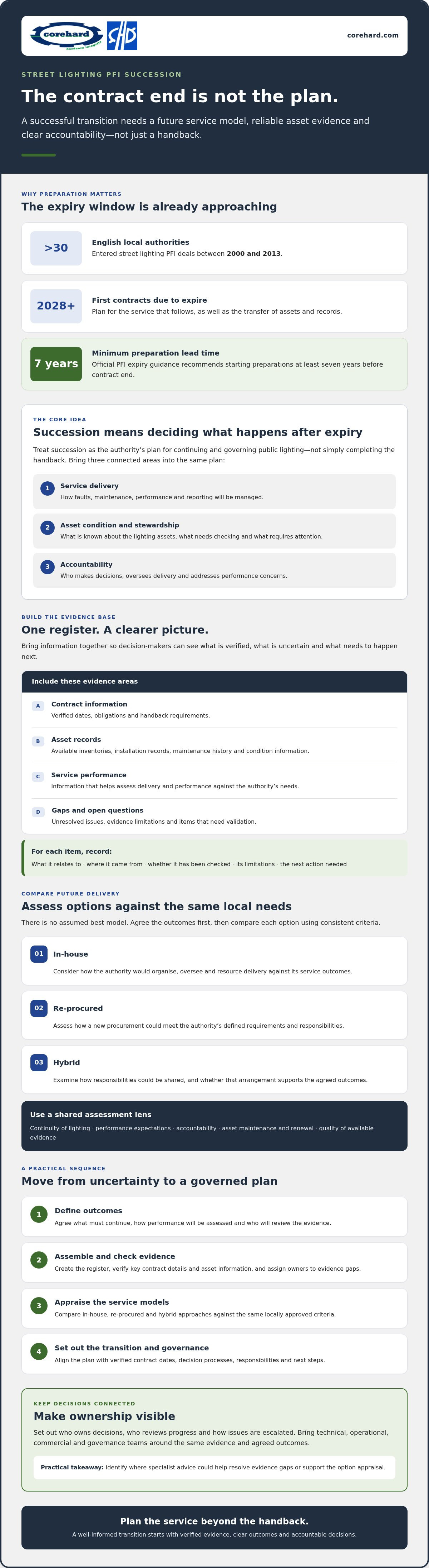
Create a sequenced PFI street lighting succession roadmap
A plan can look complete on paper yet stall if teams don’t know who owns each decision or what must happen first. A practical roadmap gives your authority a clear sequence from initial oversight to transition planning, while leaving room to respond as contract and asset evidence develops.
Use the PFI street lighting succession strategy to connect the workstreams rather than treating them as separate projects. The sequence should reflect verified contract dates and the authority’s own approval processes, not an assumed timetable.
How should authorities organise the planning work?
Bring together the relevant service, asset, finance, procurement and governance perspectives. Assign an accountable owner to each workstream, and maintain a shared decision log so teams can trace evidence, assumptions, approvals and outstanding actions. A flexible sequence could be:
- Establish governance: agree decision-making roles, reporting routes and how material issues will be escalated.
- Assemble evidence: organise contract, asset and service information, recording gaps and who will address them.
- Define outcomes: document the authority’s service priorities and how it will assess whether they are met.
- Compare options: assess locally identified models against the agreed outcomes and evidence, recording dependencies and assumptions.
- Plan the transition: set out responsibilities, handover activities, continuity arrangements and monitoring for the chosen approach.
These stages may overlap, but options are harder to compare fairly before the authority has agreed its objectives and understood the evidence. Where an unresolved issue could materially affect a decision, record it clearly and seek appropriate specialist review before relying on an assumption.
What should a transition plan make explicit?
The transition plan should turn the selected approach into owned actions. Record the intended service arrangements, who is responsible for oversight and delivery, dependencies between tasks, and any handback matters that remain unresolved. Explain how the authority will monitor continuity and performance during the changeover, including how issues will be reported and escalated.
Set review points around meaningful decision gates, such as completion of key evidence checks, an option appraisal or an approval. At each point, confirm whether new information changes an assumption, creates a dependency or requires a decision to be revisited. This keeps the roadmap responsive without imposing dates or statutory milestones that haven’t been verified against the authority’s records.
Corehard Ltd offers Street Lighting PFI Transition Advisory for authorities considering their transition planning. Confirm the proposed scope against your requirements.
Govern the succession and decide when to seek PFI transition advice
A sound plan can lose direction if nobody is clearly responsible for turning evidence into decisions. Governance keeps the succession process accountable by establishing who develops recommendations, who reviews the supporting information and who has authority to approve key choices. It also gives decision-makers a clear route for dealing with risks that could affect service continuity or the proposed future arrangement.
What governance helps maintain a controlled transition?
Use the authority’s existing decision-making arrangements where they fit, and document how they apply to succession. Name an owner for each workstream, set review points that align with the authority’s processes and maintain a decision log showing the evidence considered, approvals given and actions still open. This creates a traceable record and helps keep material assumptions visible as plans develop.
At each review, make sure decision-makers can see:
- Ownership: who prepares recommendations, checks evidence and approves decisions.
- Risks and uncertainty: what remains unverified, why it matters and who is responsible for resolving it.
- Escalation: how issues requiring senior or specialist consideration will be raised.
- Change: whether new evidence affects earlier assumptions or requires a decision to be revisited.
These arrangements don’t need to create a separate layer of bureaucracy. Their purpose is to ensure the right people can scrutinise important decisions at the right point, with a clear record of the reasoning behind them.
How can specialist PFI transition advice support the next step?
Specialist advice may be useful where evidence gaps are complex, asset condition is uncertain or the authority finds it difficult to compare future service options. The need may be focused: decision-makers might first need clarity on what information is missing before deciding whether further assessment or broader advice is appropriate.
Corehard Ltd provides Street Lighting PFI Transition Advisory. The scope and outputs should be agreed against the authority’s requirements, so the work addresses the specific questions that need resolving.
A practical next step is to write down the authority’s current planning question, such as how to address an unresolved asset record or what evidence is needed to compare service arrangements. Gather the relevant contract documents, asset information and service records, and note what remains uncertain. If specialist input would help, review Corehard Ltd’s Street Lighting PFI Transition Advisory and confirm whether the proposed scope is suitable.
Turn PFI expiry planning into a controlled transition
A well-governed transition starts before the handback, with clear decisions about what the future service must deliver and who will be accountable for it. The practical foundation is to bring contract, asset and service evidence together, distinguish verified information from assumptions, and use agreed objectives to compare locally suitable options.
A structured PFI street lighting succession strategy also gives the authority a sequence for moving from evidence gathering to option appraisal and transition planning. Named owners, documented decisions and regular reviews help keep uncertainties visible and allow the plan to respond as new information emerges.
Corehard Ltd provides Street Lighting PFI Transition Advisory, alongside asset surveys, condition assessments and reporting services. Confirm which support is relevant to your needs and agree the scope. Discuss your authority’s street lighting PFI transition planning with Corehard Ltd, starting with the key question you need to resolve and the records available to inform it.
Frequently Asked Questions
What is a PFI street lighting succession strategy?
A PFI street lighting succession strategy sets out how an authority will plan for public lighting after its PFI contract ends. It connects the service outcomes the authority wants to maintain with asset evidence, future operating arrangements and governance. This makes it broader than a handback checklist. The right approach depends on verified contract provisions, the authority’s priorities and the quality of available information, so assumptions should be identified rather than treated as facts.
When should an authority start planning for street lighting PFI expiry?
Start by checking the contract’s verified expiry date and handback provisions, then identify the decisions and evidence the authority needs to assemble. There isn’t one lead time that should be assumed for every authority. Planning can be arranged around the contract details and the authority’s own governance and procurement processes. Reviewing the position early gives teams a basis for identifying evidence gaps and deciding what work needs to happen next.
What should a street lighting PFI handback review cover?
A handback review should examine relevant contract provisions, asset records, service information and available condition evidence. It should identify gaps in the records, clarify responsibilities and connect findings to future service planning. For example, if inventory information is incomplete, record what is missing and how the authority intends to check it. A handback review informs succession planning, but it doesn’t by itself determine which future operating arrangement best suits the authority.
How does LED asset condition affect a PFI succession strategy?
LED asset condition can inform maintenance, renewal and future service-planning decisions, but it needs to be assessed using information about the specific assets. Review available installation, maintenance and condition records, and investigate uncertainties before drawing conclusions. The age or type of LED equipment may provide useful context, but it doesn’t establish its current condition or demonstrate that replacement is required. Use asset-specific evidence to support any decision about next steps.
What future service options should a local authority compare after PFI?
Compare the arrangements the authority considers realistic, such as an in-house, re-procured or hybrid approach, using the same criteria for each. Consider service continuity, accountability, asset evidence and governance, alongside the authority’s documented objectives and capacity. Review contract information before treating any option as feasible. Record assumptions and evidence gaps, and seek appropriate technical, commercial or legal input where questions remain unresolved, so decision-makers can understand the basis for the comparison.
Can specialist advisers help with a PFI street lighting transition?
Specialist advice may help an authority work through complex evidence gaps, uncertain asset condition or a difficult comparison of future service arrangements. Before appointing an adviser, confirm their relevant experience, proposed scope and deliverables against the authority’s needs. Corehard Ltd provides Street Lighting PFI Transition Advisory. Confirm the specific scope of support directly with the company rather than assuming particular surveys, assessments or work products are included.
How can an authority reduce risk during a street lighting PFI transition?
Make ownership clear, maintain a decision log and ensure risks, assumptions and unresolved issues remain visible to those making decisions. Check contract and asset information before relying on it, and use governance reviews suited to the authority’s processes. A sequenced plan can help teams coordinate work and monitor service continuity, but it should be based on verified contract dates and requirements. This gives the authority a clearer record of decisions and what still needs attention.


