
A defect found during street works only improves safety and compliance if it is recorded clearly, notified through the right process and followed through to verified closure. For highway authorities, dependable NRSWA defect inspection services need to connect each site observation with an evidence trail and a clear next action.
Category A inspections of works in progress are carried out to help ensure street works are safe, meet statutory requirements and cause minimum disruption to highway users. The process sits within the New Roads and Street Works Act 1991 (NRSWA) and the Traffic Management Act 2004 (TMA), alongside relevant inspection guidance.
This checklist explains how to prepare for a Category A inspection, assess the site, record and notify defects, and verify that required remedial work is complete. It covers the distinction between Immediate Danger and Non-Immediate Danger, the inspection outcome codes, and the records that must be uploaded to Street Manager or the authority’s inspection system.
Key Takeaways
- Assess NRSWA defect inspection services by their impartiality, evidence quality and ability to provide clear, accessible reporting.
- Use Category A inspections to review works in progress for safety, compliance and minimum disruption.
- Check that inspection outcomes use the prescribed codes: Pass, Pass with Observation, Fail (Dangerous) and Fail (Non-Dangerous).
- Review the full workflow, from the required pre-inspection checks and site evidence capture through to notification and verified follow-up.
- All inspection records must be uploaded to Street Manager or the authority’s inspection system.
Why NRSWA defect inspection services matter to highway authorities
Highway authorities need street works to remain safe and compliant. Effective oversight depends on more than attending a site: inspectors must record what they find, notify defects through the prescribed process and follow up until the required outcome is verified. Without a consistent record, it can be difficult to establish what was observed, what action was required and whether the issue was resolved.
NRSWA defect inspection services support this chain of activity through inspection, recording, notification and follow-up. They operate within the authority’s statutory framework and do not replace its responsibilities. The New Roads and Street Works Act 1991 (NRSWA) and the Traffic Management Act 2004 (TMA) provide the legislative context for street works and their management.
What an NRSWA defect inspection service covers
Category A inspections examine works in progress. Before attending, the inspector reviews the relevant permit or notice details, approved traffic management arrangements, works description and location, start and end dates, special conditions, previous inspection history and relevant TMA network-management considerations.
At the site, the inspector verifies the promoter or undertaker, works reference, location and current status. They assess safety, traffic management and permit compliance, then consider the effect on the surrounding network. The record must capture the inspection date and time, location, works reference, promoter, inspection category, findings, photographic evidence, defects and actions required.
A useful report makes a finding understandable and actionable. For example, it should describe the nature of a defect, include supporting photographs, state the remedial action required and identify the applicable response times. The record should distinguish between identifying a problem and confirming it has been corrected. Remedial work should not be treated as complete simply because it has been reported as done: closure requires verification that the defect has been rectified. An inspection is closed only when no defects are identified or all identified defects have been rectified and verified.
All defects, including those categorised as Immediate Danger or Non-Immediate Danger, must be recorded and notified through the prescribed process. Findings must be issued within prescribed timescales, and all records shall be uploaded to Street Manager or the authority’s inspection system. This keeps the inspection evidence and follow-up together from the initial observation to the outcome.
Why impartial evidence matters in street works
Clear evidence helps an authority review what happened at a site and decide what follow-up is required. Photographs support the written description, while recording the location and works reference connects the evidence to the correct site. A report should state what the inspector observed and what action is required, rather than relying on a broad label without explanation.
Consistency also supports audit and performance monitoring. When findings and outcomes are recorded in a clear, repeatable way, authorities can review actions and identify recurring compliance concerns. Professional judgement remains important; a complete record makes the basis for that judgement easier to understand and review.
Good inspection evidence shows what was observed, what action followed and how closure was verified.
For authorities managing inspection activity, the practical priority is to keep each stage connected. Evidence must inform decisions, notifications must follow the prescribed route and follow-up must establish whether the issue has genuinely been resolved.
How NRSWA and TMA defect inspections identify and handle defects
A Category A inspection follows a defined route from preparation to verified outcome. Under the New Roads and Street Works Act 1991 (NRSWA) and the Traffic Management Act 2004 (TMA), these inspections examine works in progress to help ensure safety, statutory compliance and minimum disruption to highway users. They allow the authority to assess conditions while work is under way.
The sequence is important: review the required records, inspect the site, record findings, notify defects through the prescribed process, then follow up and verify closure. Before site attendance, review the permit or notice details, approved traffic management arrangements, works description and location, start and end dates, special conditions, previous inspection history and relevant TMA network-management considerations. Findings must be issued within prescribed timescales, and all records shall be uploaded to Street Manager or the authority’s inspection system.
- Review the required information: Check every pre-inspection item, including permit or notice details, approved traffic management, works description and location, start and end dates, special conditions, previous inspection history and relevant TMA network-management considerations.
- Verify site details: Confirm the promoter or undertaker, works reference number, correct location and current works status.
- Inspect safety and compliance: Assess signing, guarding, lighting, pedestrian management, accessibility and site security. Check that pedestrian routes are safe, vulnerable users are accommodated, barriers are secure, signs are clean, visible and correctly positioned, and excavations are properly protected. Confirm that traffic management matches the approved permit, the working space is reasonable, the works remain within the approved duration, permit conditions are being met and required collaboration measures have been implemented.
- Review network management: Consider effects on traffic flow, congestion, public transport, emergency access, active travel routes and adjacent works.
- Record and notify findings: Document defects and evidence, state the required action and notify through the prescribed process.
- Follow up and verify closure: Monitor completion and arrange a follow-up inspection if necessary. Close the inspection only when no defects are identified or all identified defects have been rectified and verified.
Immediate Danger and Non-Immediate Danger
Use the defect categories to describe the nature of a finding and guide its handling, not to decide whether it should be recorded. Immediate Danger includes an unprotected excavation, missing barriers, a serious pedestrian hazard or unsafe traffic management. For an Immediate Danger defect, notify the promoter immediately, request urgent attendance, record the actions taken and escalate in line with local procedures.
Non-Immediate Danger includes missing or incorrect signage, minor traffic-management deficiencies and permit condition breaches. Record and notify these through the prescribed process. All defects must be recorded and notified, including findings that may appear minor. The category does not remove the requirement to document the issue and its required action.
A clear description helps the authority understand what was observed and what needs to happen next. For example, identify the particular signage issue or pedestrian hazard rather than relying on a general label. Keep the supporting photographs, notification and follow-up linked to the finding so its status can be tracked through to resolution.
What inspection closure requires
Closure is a decision supported by the inspection record, not simply an administrative status. Where a defect has been identified, the record should show the required action and that rectification has been verified. This gives the authority a clear basis for follow-up and audit, and prevents an unresolved finding from appearing complete.
An inspection may be closed only when no defects are identified, or when all identified defects have been rectified and verified.
Authorities can use Corehard’s NRSWA and TMA support to strengthen their compliance and inspection processes.
How to assess NRSWA defect inspection services before appointing support
When assessing inspection support, look beyond the number of site visits. Consider whether the service follows the Category A process, records findings clearly and supports notification and verified follow-up. The practical test is whether the approach fits the authority’s inspection regime and produces records that can be used to manage each finding.
Inspection process: Check that the approach covers the required pre-inspection review, verification of site details, safety assessment, permit compliance and network-management review. The steps should reflect the authority’s inspection regime and the relevant statutory framework.
Inspector capability: Assess relevant street-works inspection experience and how inspectors apply the process on site. Look for a clear explanation of how findings are recorded, notified and followed up, rather than relying on broad claims about service quality.
Evidence quality: Review whether reports identify the site and works, describe findings clearly, include photographic evidence and state required actions. The evidence should allow a reviewer to understand the finding without having been present at the inspection.
Record keeping: Confirm that required details are captured and all records are uploaded to Street Manager or the authority’s inspection system. Reports should make it straightforward to trace a finding through notification and follow-up.
Assess independence, competence and coverage
Consider how the inspection process supports objective assessment and whether the experience is relevant to the authority’s street-works requirements. Inspectors need to assess the site against its permit, conditions and relevant safety requirements, then record the evidence and any required action. Also review how any inspection support would fit the authority’s existing inspection regime and responsibilities.
Coverage should be considered alongside the selection sources and priorities in the authority’s regime. Category A inspections may be selected from Street Manager notifications, the live permit register, customer complaints, network-management concerns, high-risk or traffic-sensitive locations, and random sample selection in accordance with the authority’s inspection regime. Priority targets include traffic-sensitive streets, works causing significant occupation, sites with previous compliance failures and major works affecting network performance.
Assess reporting and evidence usability
Reports should provide the information needed to review a finding and decide what action is required. Check that the record includes the inspection date and time, location, works reference, promoter details, inspection category, findings, photographic evidence, defects and actions required. Findings should clearly state the nature of any defect, the remedial action required and the relevant response times.
Involve the people who will use the records in the assessment. Have operational and assurance colleagues review a sample report against the authority’s workflow: can they identify the works, understand the finding, see the supporting evidence and determine the next action? Can they trace whether the issue was notified and whether rectification was verified? This practical review can reveal gaps that a general description of the service may not make obvious.
Corehard provides specialist advisory, consultancy and development services aligned with NRSWA and TMA, including compliance audits, asset inspections and reporting. When assessing support, focus on how the service will fit the authority’s requirements and support consistent inspection records. Additional resource does not remove the need to follow the statutory process or verify closure.
A practical checklist for implementing and reviewing defect inspections
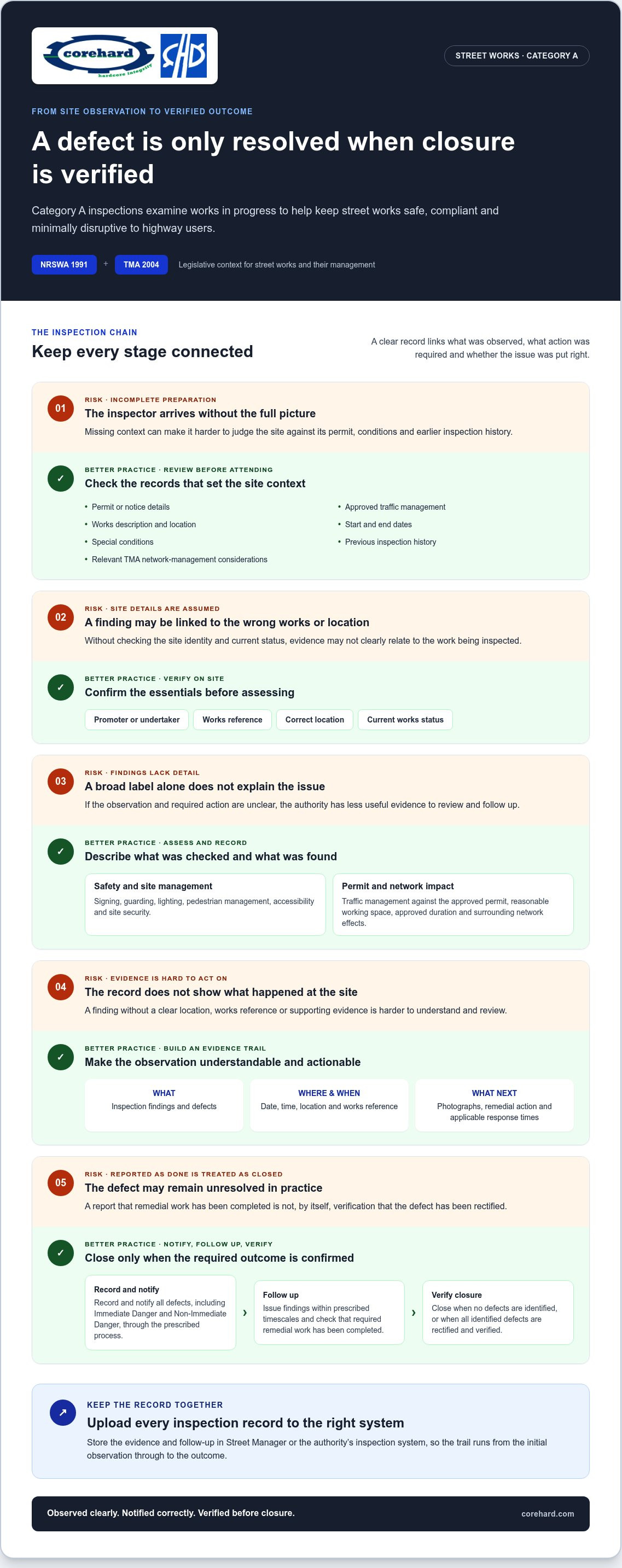
A reliable inspection workflow makes it clear what to review before attending, what to assess on site and how to track each finding to an evidenced outcome. Use the checklist below to review your authority’s process, including how Category A inspections are selected, recorded and followed up.
Prepare and review before site attendance
Review every required item before attending. This gives the inspector the context to assess the works against the relevant permit, conditions and network-management considerations. The review must cover the permit or notice details, approved traffic management arrangements, works description and location, start and end dates, special conditions, previous inspection history and relevant TMA network-management considerations.
- Check permit or notice details: Review the information that identifies the works and its authorised conditions.
- Understand the site and work: Check the works description and location, start and end dates, and any special conditions.
- Review previous inspection history: Consider earlier findings and relevant records as part of the required pre-inspection review.
- Consider network management: Review relevant TMA considerations before attending the site.
Check the site and capture usable evidence
At the site, confirm the promoter or undertaker, works reference number, location and current works status. Assess the safety arrangements, permit compliance and network impact, recording what you observe in clear, factual language. Include photographs that support the finding and help a reviewer understand its context.
- Assess safety: Check signing, guarding, lighting, pedestrian management, accessibility and site security. Confirm that pedestrian routes are safe, vulnerable users are accommodated, barriers are secure, signs are clean, visible and correctly positioned, and excavations are properly protected.
- Check permit compliance: Confirm that traffic management matches the approved permit, the working space is reasonable, works remain within the approved duration, permit conditions are met and required collaboration measures have been implemented.
- Review network effects: Consider traffic flow, congestion, public transport, emergency access, active travel routes and adjacent works.
- Record inspection details: Include the date and time, location, works reference, promoter details and inspection category.
- Document findings: Record defects and required actions, with supporting photographic evidence.
Notify, upload and follow up
Record and notify all defects through the prescribed process. For Immediate Danger, notify the promoter immediately, request urgent attendance, record actions and escalate in line with local procedures. For Non-Immediate Danger, record and notify through the prescribed process. Issue findings within prescribed timescales, upload all records to Street Manager or the authority’s inspection system, and monitor completion. Arrange a follow-up inspection if necessary. Do not close an inspection until no defects are identified or all identified defects have been rectified and verified.
- State the required action: Clearly explain the defect and the remedial action required, with supporting photographs and response times.
- Track outstanding issues: Monitor completion and retain relevant updates with the inspection record.
- Verify before closure: Confirm rectification before closing the inspection, rather than relying solely on a report that the work is complete.
Reviewing these steps can help identify gaps in inspection selection, site assessment, records or follow-up. Corehard’s NRSWA and TMA compliance support helps authorities strengthen their approach to assurance and reporting.
Corehard's independent NRSWA defect inspection support
Inspection support is most useful when it helps an authority apply a consistent process and maintain clear records. Corehard delivers specialist advisory, consultancy and development services aligned with NRSWA and TMA, alongside compliance audits, asset inspections, condition assessments and reporting services. These services support authorities’ assurance and compliance work while leaving statutory responsibilities and decisions with the authority.
Inspection and compliance support
Corehard’s work includes NRSWA and TMA advisory and development services, compliance audits, asset inspections and reporting. For authorities reviewing street-works oversight, a structured process should cover the full inspection cycle: prepare by reviewing the required records, assess the site, document findings, notify defects through the prescribed process and verify closure.
Category A inspection records should include the date and time, location, works reference, promoter details, inspection category, findings, photographic evidence, defects and actions required. All records shall be uploaded to Street Manager or the authority’s inspection system. Where a defect is found, the notification should clearly describe its nature and required remedial action, with supporting photographs and response times. Findings must be issued within prescribed timescales.
These requirements apply whether the authority carries out inspections itself or uses additional support. Immediate Danger requires immediate notification to the promoter, a request for urgent attendance, a record of actions and escalation in line with local procedures. Non-Immediate Danger findings must also be recorded and notified through the prescribed process. Closure requires either no defects to have been identified or all identified defects to have been rectified and verified.
Discuss inspection support with Corehard
A useful service discussion starts with the authority’s inspection regime and operational requirements. Identify how inspections are selected, what information needs to be reviewed before attendance, what the inspection record must contain and how findings are notified and followed up. This makes it easier to focus on practical requirements rather than inspection activity alone.
Corehard’s NRSWA defect inspection services can be discussed in relation to those priorities, including compliance audits, asset inspections and reporting. Set out how the current process handles inspection selection, evidence, defect notifications and verified closure to identify where advisory or assurance support could fit.
- Inspection process: Explain how Category A inspections are selected and how the authority’s inspection regime is applied.
- Evidence and records: Identify the information, photographs and records needed to support review and audit.
- Notification and follow-up: Describe how defects are notified, actions monitored and rectification verified.
To discuss NRSWA and TMA advisory, compliance audits, asset inspections or reporting support, contact Corehard about your authority’s requirements.
Make inspection quality part of routine assurance
Inspection assurance should continue beyond an individual site visit. Decide how your authority will review findings, identify recurring issues and use outcomes in performance monitoring and reporting. Clear ownership of records and follow-up helps ensure that each defect remains visible until it has been resolved and verified.
Use these reviews to assess whether the inspection regime is addressing the right risks. Consider the sources used to select inspections, the priority given to traffic-sensitive or high-impact works, and whether records provide a complete account of findings and actions. This gives the authority a practical basis for reviewing its approach while maintaining the requirements of NRSWA and TMA.
Discuss your NRSWA defect inspection requirements with Corehard as part of your authority’s inspection planning.
Frequently Asked Questions
What does NRSWA stand for?
NRSWA stands for the New Roads and Street Works Act 1991. The Traffic Management Act 2004 is a separate Act, referred to as TMA. Spell out each name on first use in inspection records and procedures, then use the abbreviations consistently. This helps distinguish the street-works legislative reference from the network-management context and makes documents easier to interpret during review.
What information should be reviewed before a Category A inspection?
Review the permit or notice details, approved traffic management arrangements, works description and location, start and end dates, special conditions, previous inspection history and relevant TMA network-management considerations. All these items should be reviewed before site attendance. Comparing the details can help identify inconsistencies in the inspection context, so observations are associated with the correct works.
Which records must be uploaded after an NRSWA defect inspection?
Record the inspection date and time, location, works reference, promoter details, inspection category, findings, photographic evidence, defects identified and actions required. All records shall be uploaded to Street Manager or the authority’s inspection system. Check that the works reference links the evidence and actions to the correct inspection record, making it easier to trace decisions and follow-up.
What inspection outcome codes are used for Category A inspections?
The outcome codes are Pass, Pass with Observation, Fail (Dangerous) and Fail (Non-Dangerous). Pass means fully compliant. Pass with Observation means there is no formal defect, but advisory comments are noted. Fail (Dangerous) requires immediate corrective action, while Fail (Non-Dangerous) requires corrective action within prescribed timescales. Use the code that matches the recorded finding, and retain the supporting details in the inspection record.
What can happen after repeated street-works compliance failures?
Repeated compliance failures may lead to increased inspection levels, performance monitoring, improvement plans, formal escalation through HAUC processes and consideration of permit enforcement measures. Review the inspection record for recurring findings and whether previous actions were followed through. This provides relevant evidence for consideration under local procedures.
Which network impacts should a Category A inspection consider?
Consider traffic flow, congestion, public transport, emergency access, active travel routes and adjacent works. Record the relevant site conditions and network context clearly, so reviewers can understand what the inspection evidence relates to. This helps distinguish the observed condition from the wider circumstances around the works.


