

Could a single skid resistance score tell you whether an airfield surface is performing as it should? Not on its own. Skid resistance testing airfield teams commission provides evidence about surface friction, but the result needs to be considered alongside the test method, the area assessed and the conditions at the time. Without that context, a figure can be difficult to interpret or apply to operational decisions.
If you’re planning or reviewing testing, it’s useful to ask what the method measures, how it differs from an assessment of surface texture, and what conclusions the findings can support. This article explains the purpose and scope of airfield skid resistance testing, the questions to resolve when defining a test, and how to use results responsibly as part of a wider surface assessment. Corehard provides slip resistance testing and independent technical support for airfield infrastructure, helping turn test evidence into a clearer basis for next steps.
Key Takeaways
- Use skid resistance testing airfield evidence to inform surface assessment, not as a standalone verdict on operational performance.
- Distinguish friction testing from texture-depth measurement: each provides evidence about a different aspect of the surface.
- Define the decision the test needs to support, the area to assess and the intended scope before planning the work.
- Interpret findings in light of the stated method and test context, then make next steps proportionate to the evidence gathered.
Why skid resistance testing matters for airfield surfaces
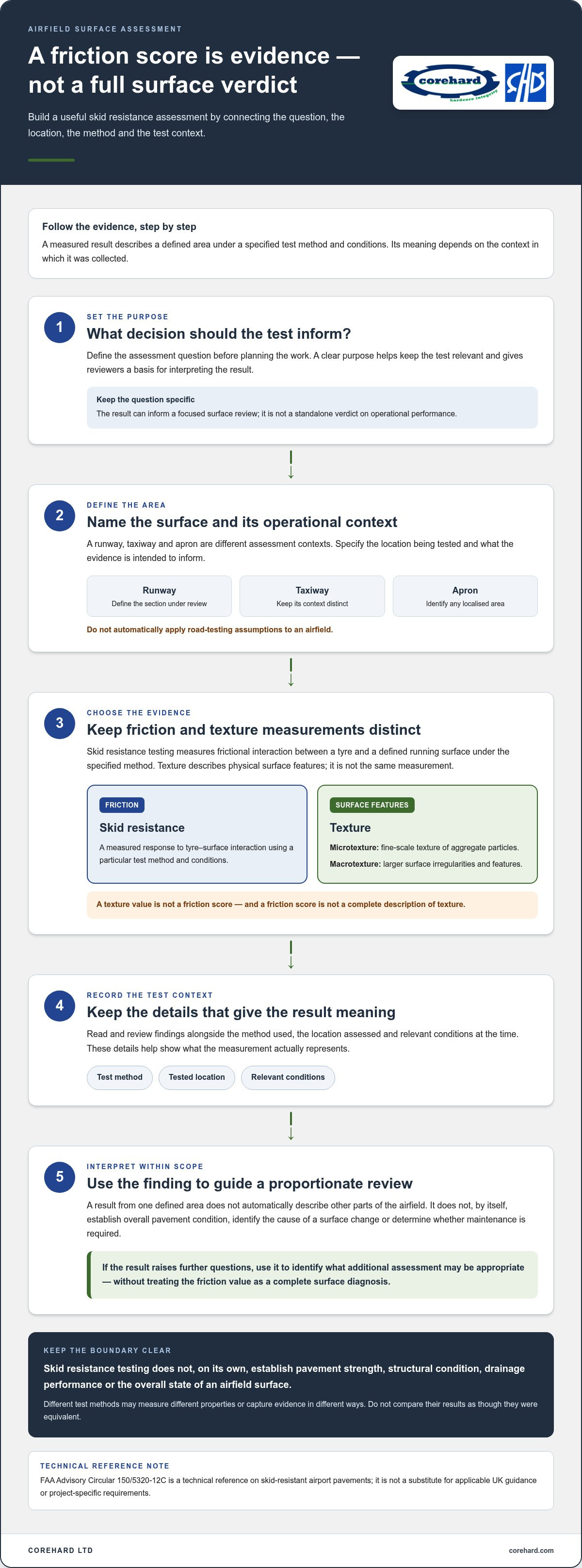
What can surface-friction evidence tell an airfield team? It provides information about how a defined area of pavement interacts with a moving tyre under the test method and conditions used. This evidence can help frame a surface review, but it does not describe every aspect of the pavement or determine, by itself, whether the surface is safe or suitable for every operation.
Skid resistance is a measured frictional property of a running surface. In practical terms, it concerns resistance to sliding where a tyre and the surface meet. Airfield testing therefore addresses a specific question about surface interaction, rather than producing a complete condition report. Interpret the result in light of the test method, the location assessed and the reason the work was commissioned.
What does skid resistance describe on an airfield?
Aircraft movement areas have distinct operational uses, so assessment questions may differ from those for a public road or other pavement. A runway, taxiway and apron are not interchangeable contexts, and road-testing assumptions should not automatically be applied to an airfield. The scope should identify the surface being assessed and explain what the evidence is intended to inform.
Skid resistance is a measured indication of the frictional interaction between a tyre and a defined running surface under a specified test method.
This definition sets a useful boundary around the result. A test does not, on its own, establish pavement strength, structural condition, drainage performance or the overall state of an airfield surface. These are separate characteristics that may require other evidence. Treating a friction value as a universal rating can obscure what was actually measured and lead to conclusions beyond the test’s scope.
Why surface context matters when assessing friction
Location and use help determine what the assessment needs to answer. For example, a team reviewing a particular runway section may have a different question from one examining a taxiway or a localised area of apron. Defining the area and purpose makes the testing relevant and gives reviewers a sound basis for interpreting the result.
Surface texture is useful context. Microtexture describes the fine-scale texture of individual aggregate particles, whilst macrotexture describes larger surface irregularities and features. These are different characteristics, and a friction test should not be treated as a direct measurement of both. Understanding which surface property the chosen method captures helps prevent a result being used to answer a question it was not designed to address.
For skid resistance testing airfield teams, the practical discipline is to connect the measurement to its assessment purpose rather than interpret it in isolation. A clear record of the tested location, stated method and relevant conditions makes the evidence easier to review. If the result raises further questions, it can help identify what additional assessment may be appropriate without being mistaken for a complete surface diagnosis.
How airfield surface texture relates to skid resistance results
A surface can have a visibly coarse texture and still produce a friction result that needs careful interpretation. Texture and skid resistance are related, but describe different things: texture concerns the physical features of the surface, whilst skid resistance is a measured response under a particular test method. Keeping that distinction clear helps airfield teams understand what a result can support and where further assessment may be needed.
Microtexture and macrotexture: two different surface features
Microtexture refers to the fine-scale roughness of aggregate particles at the surface. Macrotexture describes larger-scale surface features, including the spaces and irregularities between those particles. One way to picture the difference is to think of the individual grain surfaces as microtexture and the broader pattern formed by those grains as macrotexture. Both describe texture, but at different scales, and they should not be treated as interchangeable measurements.
Water makes this distinction relevant to friction assessment because its presence at the surface may affect how a tyre interacts with the pavement. Texture measurements can describe surface features, while a friction test records a response using its own method and conditions. Neither result should be assumed to predict the other. A texture value is not a friction score, and a friction score does not provide a complete description of texture.
What a test result can, and cannot, tell you
Every result represents the area tested under the method and conditions used. Read the report with its stated test method, location and relevant conditions in view. A measurement from one defined area does not automatically describe other parts of a runway, taxiway or apron, particularly where surface characteristics or assessment questions differ.
Skid resistance evidence should be interpreted alongside its test context, not as a standalone judgement of the whole pavement. A result can inform a focused review, but it does not by itself establish overall pavement condition, identify the cause of a surface change or determine whether maintenance is required. These conclusions need evidence appropriate to the question being considered.
Method matters, too. Different approaches may measure different properties or capture evidence in different ways, so results from separate methods should not be compared as though they were equivalent. The Runway Surface Friction - ICAO Annex 14 Vol1 Ch.10 provides a technical reference on skid-resistant airport pavements; it is not a substitute for applicable UK guidance or project-specific requirements.
In practice, record what was tested, how it was tested and the conditions relevant to interpreting the result. This creates a sounder basis for deciding whether the evidence answers the original question or whether another form of assessment would add useful context. For project-specific evidence, Corehard’s skid resistance testing can support airfield surface assessment.
Comparing airfield skid resistance testing methods without overreading them
Which method should an airfield team use? Start with the decision the evidence needs to support, not with a preferred device. Pendulum testing, GripTester surveys and texture-depth measurement do not produce interchangeable results: each describes a different aspect of the surface or captures evidence in a different way. The comparison below is a starting point, not a substitute for checking the project’s applicable requirements.
| Approach | Broad measurement focus | Question it may help address |
|---|---|---|
| Pendulum test | Frictional interaction between a rubber slider and the test surface | What friction evidence is obtained at the specific test location? |
| GripTester survey | Skid resistance evidence gathered through a survey | What does the survey indicate about the assessed area? |
| Texture-depth measurement | Surface texture depth | What evidence is available about the surface’s texture? |
Pendulum testing and continuous survey approaches
A pendulum test uses a rubber slider attached to a swinging arm. As the arm moves across the surface, the test provides friction evidence for the location assessed. A GripTester survey is another approach used in airfield skid resistance assessment, but it should not be treated as identical to a pendulum test or assumed to answer the same question. Neither method is universally preferable: the choice depends on the assessment objective and scope.
For example, if the concern relates to a defined area, specify that location and the evidence needed there. If the question concerns a broader surveyed area, clarify the intended coverage and reporting needs before choosing an approach. These examples frame the decision; they do not prescribe a method for every airfield.
When texture-depth measurement adds different evidence
Texture-depth measurement describes a surface characteristic, not friction itself. It may provide complementary evidence if the assessment question concerns both friction and texture, but report and interpret the results separately. A texture measurement cannot replace a friction result, and a friction measurement should not be presented as a direct measure of texture depth.
Before work begins, define what each method is expected to establish and how findings will be considered together if more than one type of evidence is needed. Avoid combining results into a single conclusion unless an applicable, verified approach supports that interpretation. Check standards, thresholds and method suitability against authoritative sources and relevant project requirements rather than inferring them from a comparison table.
Clear scoping is central to useful skid resistance testing airfield work: it links the chosen method to the question, the area and the intended use of the findings. Corehard provides slip resistance testing and independent technical support for airfield infrastructure, helping teams obtain evidence relevant to their surface assessment.
Planning airfield skid resistance testing: define the question first
A useful testing brief starts with a decision, not a device. Is the team establishing a baseline, reviewing a particular surface concern or gathering follow-up evidence? A clear objective helps define the area, method and reporting needed, so findings can be assessed against the reason for testing rather than treated as an isolated score.
Set the objective, location and scope
Before arranging skid resistance testing, airfield teams should agree what the evidence is intended to support. The assessment may concern a runway, taxiway, apron or another defined area; coverage should reflect the project question rather than assume runway-only testing. Record relevant site context and identify what the assessment can reasonably establish.
Use this sequence to shape the brief:
- Define the decision. State whether the work is an initial assessment, a condition review or a follow-up evidence exercise, and explain what decision the findings will inform.
- Identify the area. Name the relevant airfield surface and describe the boundaries or locations within the intended scope.
- Set the assessment question. Specify the surface property or concern under review, and distinguish it from broader questions that may require other evidence.
- Agree the method and conditions. Record the intended test approach and relevant conditions for interpreting the result. Check that the method suits the stated purpose and applicable requirements.
- Plan the reporting and review. State what information the report should convey, how locations and findings should be represented, and who will review the evidence.
Agree how evidence will be recorded and reviewed
A brief should make the expected output useful to the people responsible for technical review. Agree what location details, method information, conditions and findings need to be recorded, rather than assuming a result can be interpreted without supporting context.
It should also establish how locations will be identified and how results will be presented so they can be related to the area assessed. Set out the required format in the project brief, and avoid assuming a particular report layout or promising a specific format before it has been agreed.
- Confirm who is responsible for interpreting the findings.
- Clarify who will decide whether additional assessment or other action is appropriate.
- Keep the stated method and assessment scope visible alongside the reported results.
These arrangements help preserve the distinction between collecting evidence and making an operational or maintenance decision. The brief should not substitute an assumed frequency, sample size, threshold or closure plan for project-specific requirements; those matters need appropriate authority and context.
For independent evidence to support an airfield surface assessment, arrange Corehard slip resistance testing with the objective and scope clearly defined.
Using airfield skid resistance evidence and Corehard testing support
A test result becomes useful when it can be traced back to the question it was commissioned to answer. Reviewing a value without checking its location, method and recorded conditions risks giving it more weight than the evidence supports. A structured review keeps the measurement, its interpretation and any subsequent decision distinct.
From measured result to a proportionate technical decision
Start by comparing the findings with the original brief. Confirm that the area tested, stated method and information recorded align with the assessment objective. If the work was intended to provide follow-up evidence for a defined location, for example, check that the reported results relate to that location and can be understood in the context of the original concern.
Then consider what the results establish and where their limits lie. A finding may support the need for further technical review, but it does not automatically identify a cause, establish the condition of a wider area or prescribe a maintenance intervention. The next step should match the evidence available and the question still to be resolved.
A useful review separates three responsibilities:
- Test evidence: what was measured, where, by which stated method and under what recorded conditions.
- Technical interpretation: how the findings relate to the assessment objective, relevant context and any other available information.
- Decision-making: who has authority to determine whether further assessment or action is appropriate.
This separation supports clear accountability. If findings appear inconsistent with the original question, or available information leaves an important point unresolved, record that limitation rather than drawing a broader conclusion. Any follow-up can then be scoped to address the remaining uncertainty, with applicable requirements and operational context considered by the responsible parties.
Independent testing support for airfield infrastructure
Independent testing can provide objective evidence for an airfield surface assessment when the work is clearly tied to its intended purpose. Corehard provides slip resistance testing and technical support for airfield infrastructure, helping project teams obtain relevant evidence for their review. The scope and interpretation of a specific test should be understood from the agreed method and reported results.
Corehard operates a UKAS-accredited testing laboratory. This is a company-level fact and does not mean that a particular skid resistance test falls within the laboratory’s accreditation scope. Keeping that distinction clear helps readers assess evidence accurately and avoid treating accreditation as a substitute for checking the applicable test details.
For skid resistance testing airfield projects, the practical aim is a sound chain from a defined question to appropriately scoped evidence and a proportionate decision. Discuss airfield skid resistance testing with Corehard to consider testing support for your surface assessment.
Put the next assessment on a clear footing
Turn any remaining uncertainty into a focused assessment question. Before commissioning further work, identify what decision needs better evidence and how that evidence will be reviewed. This keeps skid resistance testing airfield projects aligned with practical priorities, while avoiding conclusions that extend beyond the scope of the measurement.
Where an independent assessment would help clarify the surface evidence, Corehard provides slip resistance testing and technical support for airfield infrastructure. A well-framed discussion can help establish the purpose and scope of the work, so the resulting evidence has a clear place in the wider technical review.
Discuss your airfield skid resistance testing requirements with Corehard and take the next step towards a more informed surface assessment.
Frequently Asked Questions
What is skid resistance testing on an airfield?
It is a way to gather evidence about friction at selected airfield surface locations. A team might commission testing to inform a review of a specific area, then use the findings alongside other relevant project records. Before work starts, clarify what decision the evidence is meant to support, so the test is not treated as a general-purpose assessment of the entire airfield.
Is skid resistance the same as surface texture?
No. They are separate surface properties, so the right evidence depends on the concern being investigated. If a review raises questions about both friction and the surface’s physical profile, state both in the brief rather than assuming one measurement answers the other. This distinction also helps the team avoid comparing results that describe different properties or presenting them as a single finding.
Can a pendulum test be used on an airfield surface?
A pendulum test may be suitable for an airfield surface depending on the purpose and location. The project brief should identify the area of interest and the question the test needs to inform. For a UK project, establish the applicable method requirements and relevant airfield guidance before relying on a particular procedure or interpreting its result.
How do GripTester surveys differ from pendulum skid tests?
They are different approaches, so their readings should not automatically be treated as directly comparable. When reviewing results collected at different times, note whether the method and scope were consistent; otherwise, a change in reported values may not represent a like-for-like comparison. The assessment record should state which approach produced each result and what area it covered.
Does a skid resistance result assess the whole condition of an airfield pavement?
No. A friction result alone cannot establish whether the pavement has other issues, such as visible deterioration or structural concerns. If the team is deciding on broader maintenance or asset-management action, consider what other condition evidence is available and whether further assessment is needed. Treat the friction finding as one input to that review, not as a complete pavement diagnosis.
What information should an airfield testing report provide?
A report should help its intended readers understand what the findings mean for the question under review. It should distinguish measured observations from interpretation and identify any limits that affect how confidently the result can be applied. This helps technical reviewers, asset managers and decision-makers use the same evidence without confusing a test finding with a recommendation or an authorised operational decision.
When should an airfield arrange skid resistance testing?
Arrange testing when a defined surface question requires friction evidence, such as when a new concern prompts a technical review or an existing assessment identifies an evidence gap. The timing and scope should reflect the decision at hand and applicable requirements, rather than an assumed universal interval. If the question or project scope changes, review whether the planned testing still addresses the issue that needs resolving.


