

Yes, infrastructure compliance consultancy in the UK can support national programmes and regionally focused projects. The right scope depends on the assets, locations and compliance responsibilities involved, rather than a one-size-fits-all approach.
Compliance work can feel fragmented when audits, monitoring, records and operational responsibilities sit across different teams or regions. A structured consultancy approach brings these elements together, identifies where attention is needed and turns findings into practical next steps.
This article explains what UK-wide and regional support can involve, from compliance audits and monitoring to documentation, health checks and the factors that shape fees. It also outlines how to assess the support your organisation needs, so you can approach infrastructure compliance with clearer priorities and stronger evidence.
Key Takeaways
- Define the assets, locations and responsibilities in scope to shape consultancy around your organisation’s operational needs.
- Use audits and monitoring to identify gaps, assess evidence and prioritise practical corrective actions.
- Keep compliance documents aligned with how work is actually managed, and make ownership and review processes clear.
- Plan health checks around the areas of greatest operational or compliance concern, then use the findings to set priorities.
- Understand how project scope, asset information and required outputs influence fees; Corehard’s NRSWA & TMA Advisory can support relevant street works and traffic management requirements.
Compliance audits and monitoring
A compliance audit tests whether project controls match documented requirements and site practice. Ongoing monitoring then tracks whether agreed actions remain effective as work progresses.
Applicable laws and regulations
Which UK laws and regulations apply depends on the infrastructure, work activity and location. For street works and traffic management, the New Roads and Street Works Act and Traffic Management Act provide relevant frameworks. According to the UK legislation register, CDM 2015 is the current revision of the Construction (Design & Management) Regulations.
Planning and environmental approval routes differ across UK nations, while safety reviews focus on the hazards and controls relevant to each project. First map the project’s locations, activities and delivery stages, then identify the requirements that apply to each work package.
A national programme may need a consistent audit method alongside records of region-specific approvals. For example, a project spanning more than one nation should identify which planning and environmental processes apply at each site, rather than assume one consent route covers every location.
Consultancy audit and monitoring services
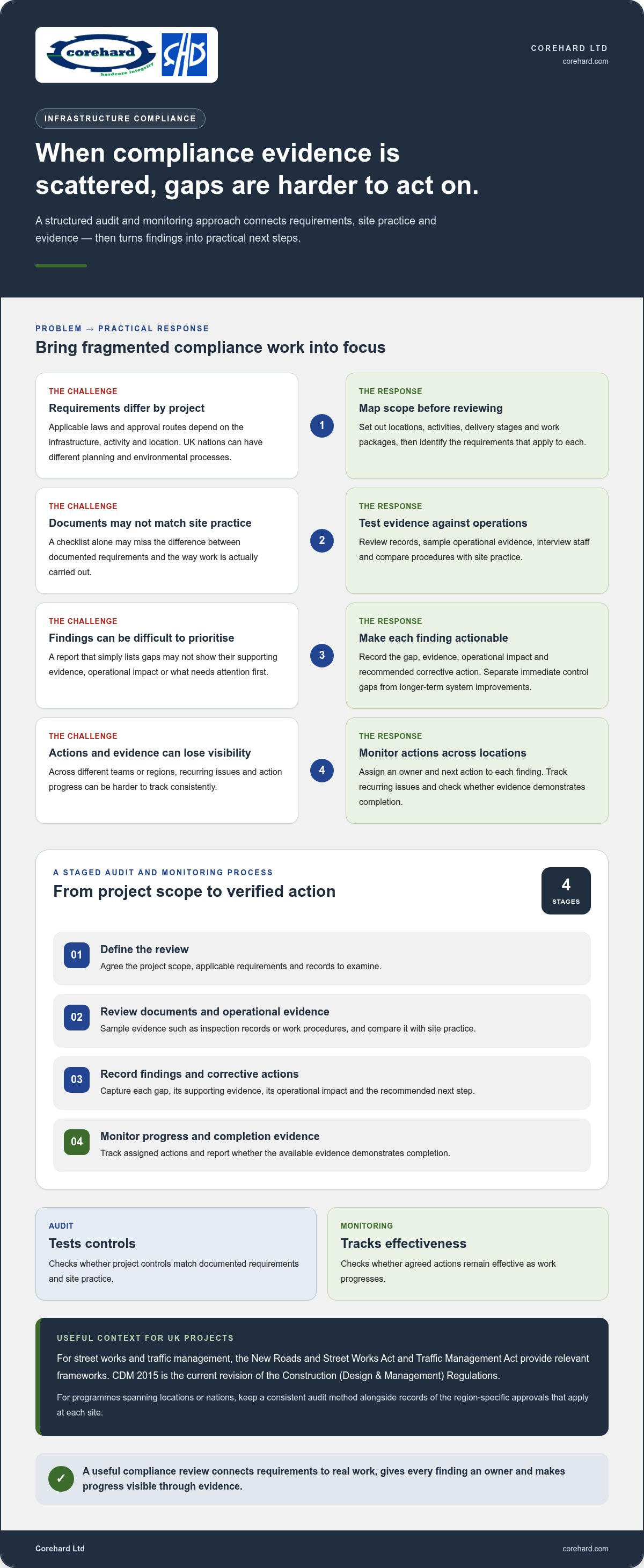
Consultancies can review strategy, operational processes and compliance evidence, then design or support improvement projects. An audit may sample records, interview staff and compare procedures with site practice. Monitoring can track actions, recurring issues and evidence of completion across locations.
Ask for findings that distinguish immediate control gaps from longer-term system improvements. A useful report assigns an owner and next action to each finding, so managers can track progress rather than simply file the audit.
In practice, this can involve a staged process:
- Define the project scope, applicable requirements and records to examine.
- Review documents and sample operational evidence, such as inspection records or work procedures.
- Record gaps, supporting evidence, operational impact and recommended corrective actions.
- Monitor assigned actions and report whether evidence demonstrates completion.
Dynamic Assurance & Compliance can help organisations maintain structured oversight as work and risks change. For example, a change in delivery arrangements can prompt a review of responsibilities, controls and evidence, rather than reliance on an old audit alone.
Look beyond a checklist. The audit method should connect regulatory requirements with the work teams actually perform, while monitoring should make emerging patterns visible. A repeated documentation gap across sites may point to unclear ownership or training needs, not just an isolated filing error.
Finally, assess how findings will reach operational teams and decision-makers. Clear reporting can strengthen compliance by explaining why a control matters, who maintains it and how evidence is recorded. It also helps distinguish substantiated findings from claims that lack supporting project records.
Compliance documentation, policies and procedures
Project documents are useful only when teams can apply them consistently. Clear ownership, controlled versions and practical procedures turn governance requirements into recorded working practices.
Steps to achieve regulatory compliance
For a UK infrastructure project, map its activities, locations and applicable requirements. Then assign owners, create controls, brief teams and retain evidence of how those controls operate. Review the records as the project changes to keep procedures aligned with delivery.
A practical sequence helps project teams move from requirements to evidence:
- Identify project activities, relevant requirements and accountable roles.
- Assess risks and record the controls needed for each work package.
- Prepare procedures, approval records and evidence templates before work begins.
- Brief contractors and employees, then record training and acknowledgements.
- Review changes, audit records and track corrective actions through to closure.
For example, a change to a street works package should trigger a review of responsibilities, method documents and affected records. This helps prevent teams from relying on superseded instructions.
Project compliance documentation
A project document set can include policies, risk assessments, procedures, inspection forms, training records and approval evidence. Each document should identify its owner, purpose, version and review point. A controlled register helps staff find current instructions and prevents outdated copies from circulating.
Compliance consulting can involve reviewing and updating policies and procedures, conducting risk assessments, and providing employee training. For UK employers with five or more employees, a written health and safety policy is required under section 2(3) of the Health and Safety at Work etc. Act 1974.
Keep the system usable. A procedure should state who performs each task, what evidence to record and where to store it. For example, an inspection form can link an observed defect to its location, responsible owner and follow-up action.
Document control also supports governance across contractors and project teams. Use a shared register to record approvals, revisions, distribution and action status. When a procedure changes, record what changed and brief the affected people, rather than simply replacing the file.
Set review triggers around project changes, audit findings and recurring gaps. A repeated missing record may indicate unclear responsibilities or a training need. For projects requiring continuing oversight, dynamic assurance and compliance can help connect documented controls with operational evidence.
Compliance health checks
A health check gives project leaders a structured view of how controls work in practice. It can reveal outdated processes, unclear ownership or missing evidence before these issues affect delivery. It can also help set priorities for ongoing regulatory compliance, beyond the findings of a single audit.
Start by defining the scope: a project, a specific activity or a particular set of controls. For example, a highways programme might examine inspection arrangements, work records and escalation routes. A clear scope keeps the review focused and makes findings easier to assign to responsible teams.
A practical review usually combines document checks with conversations and evidence sampling. Compare the written procedure with how a supervisor records an inspection or reports a defect. If records differ between locations, examine whether teams use different versions, understand responsibilities differently or follow inconsistent reporting steps.
Use the findings to distinguish urgent operational concerns from governance improvements. A missing approval record may need immediate attention, while an unclear document review process may require a revised procedure. Record each finding alongside its evidence, operational relevance, accountable owner and intended action.
Useful health-check stages include:
- Agree the review scope, project boundaries and decision-makers.
- Map applicable controls against current procedures and available evidence.
- Sample records, inspect relevant practices and discuss gaps with responsible teams.
- Rank findings by their operational significance and identify practical corrective actions.
- Assign owners, set review points and track evidence of completed actions.
For instance, a sample of street works records might show that completion evidence is stored inconsistently. The response could clarify which record is required, where it belongs and who is responsible for updating it. A later review can test whether the revised process is being used, rather than assume that issuing a new instruction resolved the gap.
Health checks should account for changes that alter project exposure. A new contractor, revised work sequence or asset handover can affect controls and responsibilities. Record the change, assess which procedures it affects and update relevant teams before relying on previous evidence.
Set the review frequency according to project change, operational risk and the time needed to complete corrective actions. A review after a significant process change may be more useful than relying only on a fixed calendar. Keep the approach proportionate: retail customer requirements, such as the Consumer Duty’s focus on good outcomes, apply in their relevant context, not as a substitute for infrastructure controls.
Good compliance support turns findings into decisions. A concise action register can show what needs attention, who owns each task and what evidence will demonstrate progress. This gives project leaders a usable view of control effectiveness and helps direct effort towards the most important gaps.
UK-wide and regional consultancy services
A programme spanning England, Scotland, Wales and Northern Ireland needs consistent oversight and locally relevant assessments. The right model combines a shared reporting framework with a scope that reflects each project’s location, asset type and delivery arrangements.
How do UK infrastructure compliance consultancies compare by sector and expertise? Compare their understanding of your sector, the assessments they undertake and how they turn findings into workable controls. A highways project, telecoms rollout and local government asset programme can have different operational risks and evidence needs.
For a national programme, define common requirements, reporting formats and escalation routes. Then identify where local delivery needs different procedures or records. For example, teams working across several regions can use one action register while recording site-specific approvals and responsibilities separately.
Regional support can help when project teams need close engagement with local operations, site conditions or delivery partners. The consultancy’s approach should make clear how site information informs decisions, who receives findings and how unresolved actions are escalated. This connection matters when teams work at a distance from central governance.
Compare expertise by asking what the work requires, rather than treating every consultancy as interchangeable. Relevant capabilities may include:
- Highways and street works assessments focused on operational controls and records.
- Engineering reviews that connect asset condition evidence with project decisions.
- Telecoms assessments that examine how contractors apply agreed procedures.
- Local government support that aligns reporting with asset ownership and oversight.
Financial services compliance is a separate specialism with its own regulatory context; expertise there alone does not demonstrate infrastructure capability. For infrastructure projects, assess experience against the assets, work activities and governance arrangements in scope. A consultancy should explain its assessment method, evidence requirements and reporting outputs in plain terms.
Before commissioning work, set out the project boundary, locations, stakeholders and intended decisions. Ask for a clear distinction between the national framework and regional adaptations. For instance, a shared reporting template can support comparisons across sites, while local teams document site-specific conditions and actions.
Finally, check that findings are useful to both senior decision-makers and operational teams. A concise report should connect each issue to evidence, an accountable role and a practical next step. This makes regional differences visible without losing the consistency needed to govern a national programme, addressing local variations and access requirements separately. Keep evidence traceable to the decisions it supports, and make responsibility for follow-up clear across regional teams. A provider’s background should be tested against the work being commissioned, rather than treated as a substitute for a project-specific method. Corehard Ltd says it has provided compliance consultancy services since 2000. Its founder overseeing engagements has more than 25 years’ experience of UK financial services regulation, which should not by itself be taken as evidence of infrastructure expertise.
The Construction Tech Review panel shortlisted providers after reviewing hundreds of technology service providers in the construction technology sector; that recognition does not establish suitability for a particular infrastructure assignment. The UK Infrastructure Bank Limited awarded the risk and compliance advisory services contract on 29 Sep 2021, and the contract expired on 30 Dec 2021. When reviewing such examples, check that the stated service, contract period and relevant expertise match the requirement at hand. Use references to assess the scope and delivery approach, while confirming that proposed assessments address the assets, locations and governance arrangements in your programme.
Compliance consultancy fees
Consultancy fees depend on the work’s scope, locations, evidence requirements and reporting outputs. For this service, the price depends on the case and is given after a quote request; the main cost factors are project complexity, site access, specialist input and the depth of assessment required.
A focused review of one procedure requires a different level of effort from a programme covering multiple assets and teams. For example, a desktop review may rely on supplied records, while site assessments require coordination, travel and examination of operational evidence. Define the intended outcome before seeking a proposal.
What qualifications and accreditations should UK infrastructure compliance consultants have? Look for relevant technical competence, experience in the project’s sector and a clear method for producing evidence-based findings. Match any accreditation to the specific activity it covers, rather than treating it as proof of every consultancy capability.
Accreditation matters when work involves a defined testing activity. A UKAS-accredited laboratory provides evidence of accreditation for its testing scope, but that does not automatically establish accreditation for broader advisory work. Assess how the proposed expertise relates to your assets, methods and required outputs.
Organisations can make fee proposals easier to compare by setting out the same scope for each assessment. Include:
- Project locations, asset types and operational activities.
- Records and procedures available for review.
- Site visits, sampling or specialist technical input required.
- Expected report format, findings and follow-up support.
These details help distinguish a proportionate proposal from work that includes unnecessary tasks or omits important outputs. If access requires prior consent, include the arrangements and responsibilities in the scope. Clarify whether the work ends with a report or includes action tracking, since each deliverable affects the effort required.
Check that the consultant’s skills match the issue. Financial crime compliance, for instance, is a distinct specialist discipline and does not by itself demonstrate infrastructure expertise. For infrastructure, assess experience against the project’s assets, operational controls and evidence needs.
Before commissioning work, agree responsibilities, information-sharing arrangements, assumptions and how changes to scope will be handled. A written proposal should explain activities, deliverables and exclusions in plain language. This gives project teams a clear basis for managing approvals and evaluating the completed work.
For infrastructure projects requiring structured assurance, discuss compliance support and define the scope around your assets, locations and required evidence.
Compliance Consultant quotes project work at a fixed fee after a scoping call, helping clients understand the agreed cost once the scope has been clarified.
Corehard: NRSWA & TMA Advisory
Corehard provides NRSWA & TMA Advisory for organisations managing street works and traffic management requirements. Turn to this support when project responsibilities, operational processes or compliance evidence need clearer alignment.
Where decisions also depend on asset information, Asset Surveys & Condition Reporting can provide relevant condition evidence. NRSWA & TMA Development and Dynamic Assurance & Compliance support project development and ongoing oversight, helping teams connect requirements with practical delivery.
To discuss how Corehard’s services could support your infrastructure project, contact Corehard or visit corehard.com.
Make compliance part of the next project decision
Build compliance into the point where your organisation sets project priorities, rather than treating it as a final review. This creates an opportunity to connect assurance needs with decisions about scope, delivery and accountability.
An infrastructure compliance consultancy in the UK can bring specialist perspective to that planning conversation. Start by identifying the decision ahead, the teams involved and the evidence they need to proceed with clarity.
That initial focus gives the discussion a practical purpose and helps shape support around your project’s priorities. It also gives decision-makers a clearer basis for agreeing the next step.
Contact Corehard about compliance support to discuss your project’s requirements and next steps.
Frequently Asked Questions
Do you work across the UK?
Yes. Corehard serves customers nationally across the UK, including organisations managing projects in different locations. For a programme spanning several areas, outline the assets, delivery teams and intended outputs together. This helps establish whether one coordinated scope or distinct work packages best suit the programme. National coverage supports highway and street works projects that need consistent technical support, while each site’s operational context can inform the work plan.
Why is regulatory compliance important for organisations in the UK?
Regulatory compliance helps organisations manage responsibilities, support safe operations and demonstrate that project controls are being applied. For an infrastructure operator, clear records can show how decisions were made and issues addressed. Consistent oversight also helps managers identify recurring weaknesses, allocate responsibility and plan improvements. Integrating checks into routine project governance makes compliance part of operational decision-making, rather than an exercise undertaken only when concerns arise.
What does infrastructure compliance consultancy cost in the UK?
Costs vary according to the work commissioned, so organisations should build consultancy into project planning rather than treat it as an unplanned overhead. Set an internal approval route for the proposed work and identify which deliverables are essential to the immediate decision. If additional work becomes useful later, separate it as a new instruction. This gives budget holders a clear record of what was approved and why.
What are the risks and penalties for non-compliance with UK infrastructure regulations?
Non-compliance can lead to corrective action, disruption to project delivery, increased scrutiny and reputational damage. Formal penalties may also apply under relevant requirements. Consequences depend on the obligation, the nature of the breach, its effects and the response taken. Incomplete evidence, for example, can make it harder to demonstrate that controls were followed. Maintaining clear records and addressing identified issues promptly supports better oversight and informed decisions.
Which UK infrastructure compliance consultants serve my region or project type?
For a project-specific discussion with Corehard, describe the asset type, work activities, locations and decision you need support with. Include any interfaces between project teams, contractors and asset owners, as these can affect the expertise and working approach required. A concise project brief helps focus the discussion on relevant requirements and useful outputs, whether the work concerns a single site or a programme spanning multiple areas.


