

Confidence in dynamic highways depends on evidence of how the whole system performs, not just whether an individual vehicle works as designed. Dynamic assurance for highways brings verification, validation and assurance together to assess vehicles, roadside and digital infrastructure, data services, connectivity and the organisations involved. Cybersecurity is part of that assessment.
For insurers, public authorities and road users, confidence should rest on transparent evidence rather than claims alone. The UK Connected and Automated Mobility assurance roadmap calls for practical frameworks that support early deployers and long-term operators, recognising that connected and automated mobility depends on multiple systems working together.
This article explains how verification, validation and assurance differ, how a framework can assess the wider highway environment, and why oversight must continue as services evolve. It also considers how objective reporting can make safety claims clearer to insurers and the public, and where specialist assurance and compliance support can help.
Key Takeaways
- Separate evidence about a vehicle from assurance of the wider highway system, including infrastructure, data, connectivity and operational interfaces.
- Use transparent, ongoing evidence to help insurers and the public understand how safety claims are assessed.
- Distinguish published network performance measures from evidence that an authority uses a particular dynamic assurance system.
- Compare dynamic assurance with traditional asset management by looking at how each handles changing conditions, system interactions and oversight.
- Assess implementation costs through the scope of the system, the evidence required and the work needed to integrate assurance into existing processes.
Confidence for insurers and the public
UK highways authorities report measurable outcomes through performance indicators, although these figures don’t prove that assurance alone caused changes. National Highways reports Road User Satisfaction as a percentage quarterly, using a 12-month rolling percentage. It also reports Average Delay in seconds per vehicle per mile, quarterly, using a 12-month rolling statistical period.
These measures give insurers and road users a structured view of service performance. Satisfaction reflects reported user experience, while average delay expresses journey disruption in a defined unit. Comparing reporting periods can show whether performance is changing, but figures need context. Roadworks, traffic demand and network conditions can affect results, so no single metric amounts to a complete safety assessment.
Network Availability adds another measurable indicator. National Highways reports it as a percentage monthly, using a 12-month rolling percentage. Roadworks Information, Timeliness and Accuracy is also reported monthly as a percentage, using a 12-month rolling percentage. Together, these measures help readers assess how available the network is and whether roadworks information is timely and accurate.
Other reported indicators show why assurance needs clear definitions. National Highways reports the Efficiency KPI quarterly as a ratio, while the Biodiversity KPI is reported annually for a one-year period. These measures concern different outcomes and should not be combined as if they describe one safety result. Insurers can use them to understand performance evidence alongside relevant operational and asset records.
Condition data can also make a claim easier to interpret. An illustrative road-pavement calculation uses 26,600 km of 27,500 km of lane length in good condition, producing 96.7%. The percentage is meaningful when its underlying measure and scope are visible. It does not, by itself, explain how condition was assessed or establish the performance of every road section.
For workforce safety, the manual defines accident frequency rate as the number of RIDDORs per 100,000 hours worked. This denominator supports comparison across different amounts of work, provided reporting uses consistent definitions. Insurers can examine the rate alongside incident records and relevant controls; the public can see how safety performance is measured. Neither audience should read one indicator as proof of overall safety.
Reliable assurance depends on traceable evidence, consistent measures and clearly defined reporting boundaries. A practical review identifies who produced each measure, the period it covers, and the assets or activities included. This helps distinguish a published performance result from a broader safety claim, giving insurers and the public a more balanced basis for confidence.
Reliable assurance therefore depends on CAM frameworks covering roadside and digital infrastructure, HD maps and digital twins, real-time V2X connectivity, and interfaces among private operators, public authorities and regulators.
Verification, validation and assurance frameworks
Connected highways rely on interacting technology, infrastructure and services, so evidence must examine more than the vehicle. The UK Connected and Automated Mobility Roadmap calls for practical, transparent frameworks for early deployers and long-term operators.
Authorities Using Dynamic Assurance
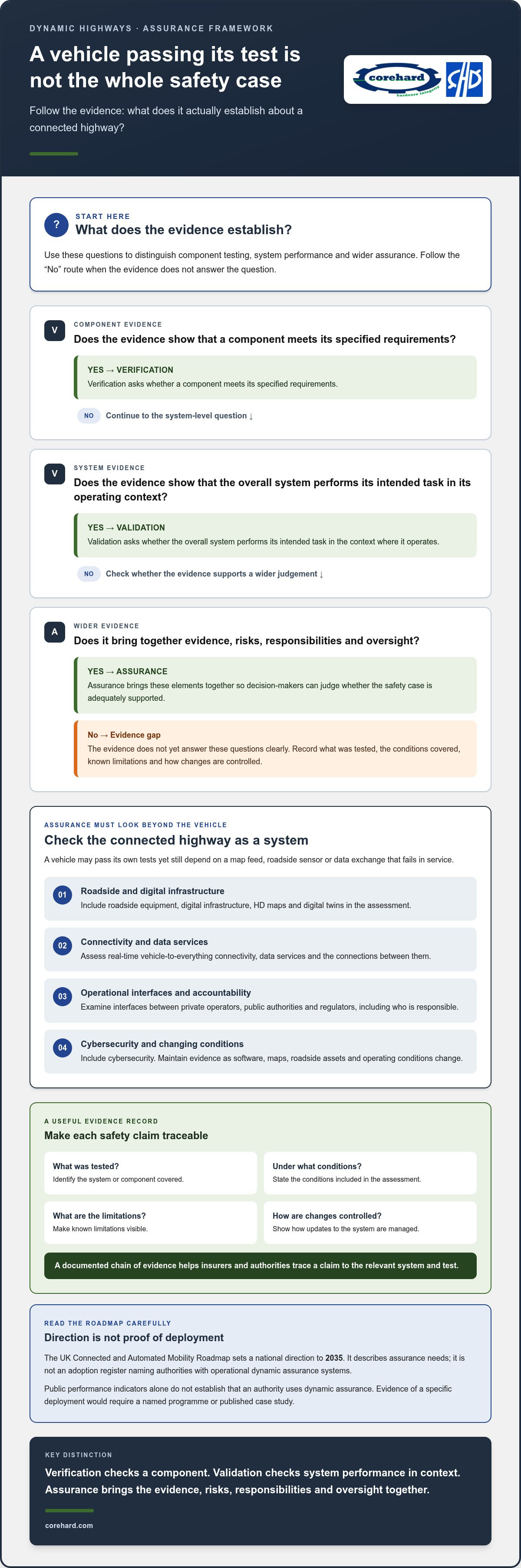
The UK Connected and Automated Mobility Roadmap sets a national direction to 2035, but it is not an adoption register naming authorities with operational systems. That distinction matters: a roadmap describes assurance needs, while evidence of a specific authority’s deployment would require a named programme or published case study. Public performance indicators alone don’t establish that an authority uses dynamic assurance.
A useful framework separates three questions. Verification asks whether a component meets its specified requirements. Validation asks whether the overall system performs its intended task in its operating context. Assurance brings together evidence, risks, responsibilities and oversight so decision-makers can judge whether the safety case is adequately supported.
For a connected highway, assessment should cover roadside equipment, digital infrastructure, HD maps, digital twins and real-time vehicle-to-everything connectivity. It should also examine interfaces between private operators, public authorities and regulators. A vehicle may pass its own tests yet rely on a map feed, roadside sensor or data exchange that fails in service.
That is why system-level assessment matters. Frameworks should record what was tested, the conditions covered, known limitations and how changes are controlled. Cybersecurity belongs within verification, validation and assurance because a compromised data service or connection can affect wider operations. A documented chain of evidence lets insurers and authorities trace a claim to the relevant system and test.
Risks and Limitations
Key risks include incomplete system boundaries, unreliable data, cyber vulnerabilities and unclear responsibilities between connected operators. These gaps can make a safety claim appear stronger than its evidence, or make it difficult to identify which component needs corrective action.
Dynamic assurance also requires evidence to be maintained as software, maps, roadside assets and operating conditions change. A test result for one configuration cannot automatically establish the performance of a changed system. Insurers should therefore look for documented assumptions, exclusions and change controls, rather than treating a single approval as permanent proof.
Introducing Dynamic Assurance to a Council Network
A UK council can begin by defining the service or safety claim it needs to assess, then mapping the vehicles, roadside assets, digital services and organisations involved. This establishes a clear system boundary and shows where evidence or ownership needs to be defined.
Next, set requirements for verification, validation, cybersecurity and operational oversight. Record the evidence for each requirement, test relevant interactions and document limitations. A staged introduction can begin with a defined corridor or service, using the findings to refine the framework before wider application. This creates a traceable basis for decisions and future reviews.
For councils, insurers and operators, the practical test is whether evidence remains connected to the system it describes. The UK roadmap’s emphasis on transparency supports scrutiny of performance claims and their limitations. Assurance is most useful when it explains what was assessed, which interfaces were included and how changes trigger a renewed review.
Which UK highways authorities use dynamic assurance systems?
A UK highways authority should be described as using a dynamic assurance system only when evidence demonstrates operational use, not merely an interest in connected mobility. A council’s innovation announcement, supplier trial or technology procurement can represent different stages of work. For readers comparing adoption, the key distinction is whether assurance forms part of an active service’s governance.
Consider three different records. A council press release about a proposed connected-road trial signals intent. A procurement notice may show that an authority is seeking a system or support. An operational report describing assurance activity in a live service provides stronger evidence of use. These examples are not interchangeable, and none proves more than the record states.
Local authority committee papers can clarify a project’s status. Check whether the paper describes a proposal, a controlled trial, a completed evaluation or an ongoing operation. A report recording lessons from a pilot demonstrates activity, but does not establish that the same approach covers the authority’s wider network. The stated scope and current status matter.
Procurement documents also need careful interpretation. A tender for assurance capability indicates a planned purchase or requirement, not necessarily an implemented system. Contract award information may show a supplier relationship, but the service description determines the work covered. For example, a contract for routine asset data should not automatically be classified as dynamic assurance for connected highway services.
For insurers and suppliers, an adoption comparison is most useful when it records evidence alongside each authority’s status. A simple register could distinguish “planned”, “trial” and “operational”, then cite the relevant public document and date. This avoids mistaking an announcement for a live deployment and gives readers a clear basis for understanding what each authority has undertaken.
Authorities can make adoption easier to interpret by describing a project’s purpose in plain terms. A council might state whether a system supports a specific service, which operational decisions it informs and how assurance activity is governed. Such descriptions help distinguish technology deployment from assurance practice without suggesting that one project represents an entire network.
There is no sound basis for naming authorities simply because they publish highway performance measures or refer to innovation. Use named examples only when their own documentation identifies the assurance activity and its status. For a national view, compare like with like: proposals with proposals, trials with trials, and live operations with live operations. This gives public bodies and industry a more defensible picture of adoption.
How does dynamic assurance differ from traditional highways asset management?
Traditional highways asset management focuses on physical assets such as road surfaces, bridges, signs and drainage. It helps authorities record condition, plan maintenance and prioritise investment across a network. Dynamic assurance addresses a different question: whether connected services and their supporting systems continue to perform as intended. Assessing a road surface informs maintenance planning, while assessing an automated service also considers its data feeds and roadside interfaces.
These approaches are related, not alternatives. Asset records provide important evidence about the infrastructure a connected service depends on. An assurance framework uses that information alongside evidence about software, communications, operating procedures and responsibilities. If a roadside sensor informs a vehicle’s decisions, the assessment should consider both the sensor’s condition and its interaction with the wider service.
Traditional asset management typically centres on identifiable assets and their condition over time. Dynamic assurance takes a system-wide view, asking how components interact and what happens when one changes or fails. Resurfacing changes a physical asset. A revised digital map, altered traffic signal interface or software update may change how a connected service behaves, even if the road remains unchanged.
- Asset management: records physical assets, condition and maintenance needs.
- Dynamic assurance: examines system performance, evidence, interfaces and operational oversight.
- Shared ground: asset condition can affect whether a connected service performs as expected.
- Practical implication: assurance needs change management when software, data or infrastructure changes.
For a council, this distinction affects the evidence it gathers. A condition assessment of a sign or road section may inform asset decisions, but cannot alone demonstrate that a connected mobility service is safe across its operating environment. The council also needs to understand relevant data services, connectivity and interactions with operators. This broader view can reveal dependencies an asset register may not capture.
Consider a hypothetical junction using connected signals and a digital traffic service. Asset management can record the signal equipment and its condition. Dynamic assurance would also examine whether the service receives accurate signal information, how changes are controlled and who oversees operations. If the equipment is replaced or the data connection changes, the assurance evidence may need review alongside the asset record.
In practice, authorities can align the disciplines by linking asset information to system boundaries, evidence records and change controls. Maintenance findings can then inform assurance, while assurance reviews can identify infrastructure dependencies for asset teams. Neither process replaces the other: asset management supports stewardship of physical infrastructure, while dynamic assurance evaluates confidence in changing, connected services across the highway system.
What are the costs of implementing dynamic assurance for a UK highways authority?
There is no single standard cost for a UK highways authority to implement dynamic assurance. The budget depends on what the authority needs to assess, the systems involved and the evidence required. A connected junction, for example, has a different scope from a network-wide service involving vehicles, roadside infrastructure and digital data.
Cost depends on the authority’s requirements, including scope, system complexity, testing, data integration and ongoing review. These factors also explain why a single headline figure is a poor basis for comparing projects. A council should first define the service and safety claims it intends to assess.
Scope is a major cost driver. A project covering roadside equipment, HD maps, digital twins and real-time connectivity requires a broader assessment than one examining a single component. Interfaces between a council, private operator and regulator can add work because evidence and responsibilities need coordination across organisations.
Testing and evidence requirements also affect the budget. Verification examines whether components meet requirements; validation examines performance in the intended context. A council may need to assess data quality, cybersecurity, operating procedures and interactions between systems. The work grows with the number of dependencies and the depth of evidence required to support the specific safety claim.
Integration with existing council processes is another consideration. When asset information, maintenance records and service data sit in separate systems, bringing relevant evidence together takes planning. For example, an assurance review of connected signals may need records about signal assets, data exchanges and operational oversight. The quality and accessibility of those records can affect the effort required.
Implementation planning should also account for ongoing oversight. Software updates, map changes, replacement roadside equipment or altered operating arrangements can affect earlier evidence. A council should decide how changes are recorded, who reviews them and when testing needs to be repeated. This ongoing governance is distinct from initial framework design and belongs in budget planning.
Before seeking a project estimate, authorities can prepare a concise scope covering:
- The service, safety claim and highway locations under review.
- Vehicles, infrastructure, data services and organisational interfaces involved.
- Available evidence, testing needs and cybersecurity considerations.
- Responsibilities for updates, monitoring and review after implementation.
This information supports a more useful comparison of proposed work than an unsupported average. A staged approach, beginning with a defined service or corridor, can help a council clarify requirements before widening the scope. The UK Connected and Automated Mobility Roadmap’s focus on practical, transparent assurance provides relevant context for authorities planning this work.
To scope assurance requirements for a highway network, discuss dynamic assurance support with a specialist team.
Corehard: NRSWA & TMA Advisory
Corehard provides NRSWA & TMA Advisory for authorities managing obligations and processes under the New Roads and Street Works Act and Traffic Management Act. Its Dynamic Assurance & Compliance service supports organisations seeking structured assurance across highway operations, while Asset Surveys & Condition Reporting can inform decisions about the physical network.
Turn to Corehard when you need to connect assurance requirements with street works compliance, asset evidence or organisational processes. NRSWA & TMA Development can also support development needs linked to these frameworks. The right support depends on the issue, whether strengthening assurance arrangements, reviewing asset condition or developing NRSWA and TMA processes.
Contact Corehard to discuss your highways assurance or advisory requirements.
Make assurance part of the next decision
The next step is to make assurance a working part of project governance, not just a technical document. Before a new service, system change or procurement decision, define the evidence decision-makers need and who will maintain it. Clear ownership helps keep safety claims connected to the system and operating conditions they describe.
For a council or infrastructure organisation, begin with a focused internal discussion: identify the decision ahead, the teams involved and the information needed to support it. Then agree how updates will be recorded and reviewed as the service evolves. This gives insurers, operators and public stakeholders a stronger basis for understanding the organisation’s approach to dynamic assurance for highways.
Corehard’s advisory and assurance expertise can support organisations looking to strengthen their processes and make the next decision with greater clarity. Contact Corehard to discuss your assurance requirements and identify a practical way forward for your organisation.
Frequently Asked Questions
What does dynamic assurance mean for UK highways?
Treat assurance as an active governance process, with defined records showing what decision-makers rely on and who maintains each record. For example, an evidence register can name the relevant system component, its supporting assessment and the responsible role. This clarifies accountability during project reviews and helps an authority identify gaps before relying on an assurance conclusion.
How does dynamic assurance work for highway inspections and maintenance?
For inspection and maintenance teams, assurance can connect a finding to its operational significance and recorded resolution. A report about damaged roadside equipment, for example, could identify the asset reference, record the maintenance action and retain evidence of completion. The authority can then maintain a clear audit trail from the original observation to close-out, supporting consistent handovers between inspection, maintenance and service teams.
What standards and regulations govern highway asset assurance in the UK?
No single named standard in the material provided governs every form of highway asset assurance. For street works inspections, relevant references include the New Roads and Street Works Act 1991 (NRSWA), the Traffic Management Act 2004 (TMA) and the Code of Practice for Street Works Inspections (2023). The applicable requirements depend on the activity, so authorities should identify the relevant legal and practice references for each inspection or assurance scope.


