

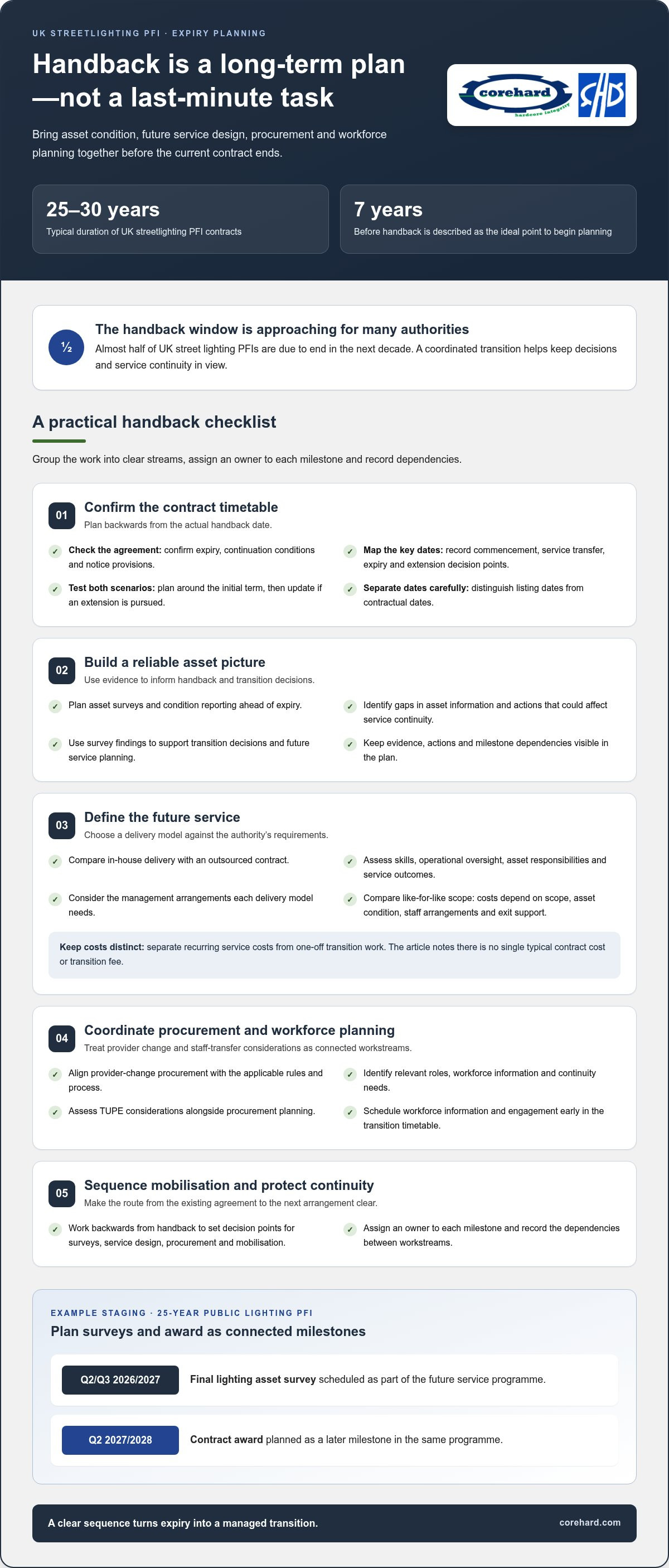
UK streetlighting PFI contracts typically last 25-30 years, so street lighting contract succession planning needs to account for the full contract term and the handback date. Seven years before PFI handback is described as the ideal point to begin planning. Starting early gives an authority time to assess its assets, define the future service and prepare the transition.
Contract expiry can feel distant until decisions about condition surveys, procurement and mobilisation converge. A clear plan sequences these workstreams and highlights information gaps or actions that could affect service continuity.
This article explains how commencement dates, contract duration, extensions and termination provisions shape succession planning. It also covers practical preparations for UK street lighting PFI expiry, including asset handback, future service requirements and the steps an authority can take to move from an existing agreement to its next operating arrangement.
Key Takeaways
- Map the commencement date, initial term, extension options and expiry provisions so the handover timetable reflects the contract’s actual structure.
- UK streetlighting PFI contracts typically last 25-30 years; begin handback planning well ahead, with seven years before PFI handback described as ideal.
- Build succession plans around reliable asset information, future service requirements and a clear transition sequence, rather than treating expiry as a single procurement milestone.
- Align provider-change procurement with the applicable rules, and include workforce-transfer considerations in transition planning.
- Use NRSWA and TMA advisory, asset surveys and condition reporting, development, and dynamic assurance and compliance support to strengthen the evidence behind transition decisions.
Contract commencement and duration
A contract’s commencement date is when its service obligations begin. UK streetlighting PFI contracts typically last 25-30 years, so authorities can use that date to plan backwards from expiry and sequence succession decisions.
An initial term is the first period agreed for a contract. One county authority’s street lighting contract was described as having an initial period of 181 months. Its opportunity description gave the period as 15 years and 2 months, unless terminated under the contract conditions. A listing showed 14/03/2016 as the start date and 31/03/2031 as the end date, while the opportunity description stated a commencement date of 1 February 2016. Distinguish listing dates from contractual dates when setting a timetable.
An extension is an option to continue a contract beyond its initial term, subject to its terms. That county contract allowed an extension of up to 120 months. The listing showed two available extensions, with none taken, and a total contract period of 301 months. Record each option, its decision point, notice requirements and effect on expiry, rather than assuming it will be used.
The total contract period is the full potential duration, including any applicable extensions. Compare the initial term, extension options and stated total period, then identify the controlling dates in the agreement. This helps governance teams distinguish the original commitment from possible additional periods.
Other arrangements have different terms. One borough contract has an initial term of seven years, extendable to twelve years. A county maintenance procurement proposed an initial term of up to 5 years and 8 months, with an optional extension of no more than 4 years. These examples show that service models and procurement decisions shape contract duration.
Commencement can differ from award or mobilisation. The county contract’s services were scheduled to transfer on 1 September 2018, unless the parties agreed to commission them earlier. Another county planned mobilisation from April to July 2024; its existing contract was due to end on 2nd August 2024, with the proposed replacement scheduled to start on 3rd August 2024. A public lighting PFI began in 2003, and its successor service is scheduled to commence on 2 July 2028.
For street lighting contract succession planning, keep a separate date register for each agreement. Record award, commencement, service transfer, expiry and extension decision dates, then test the handover timetable against contract terms and operational milestones.
For the London Borough of Hillingdon street lighting contract, the initial term is seven years, with a possible extension to twelve years. Treat the longer period as a conditional planning scenario, not the baseline commitment. Keep both the initial and potential extended end dates visible in the governance record, and make clear that the latter depends on an extension decision.
Before setting a succession timetable, check the agreement’s continuation conditions and identify who must make and document the decision. Align internal reviews with the contract’s notice provisions and the time needed to prepare a replacement service. If the extension is not pursued, plan around the initial term. If it is pursued, update the timetable and communicate the revised assumption to procurement, operations and oversight teams.
UK streetlighting PFI contract expiry planning
Expiry planning brings together asset, service, procurement and workforce decisions before a PFI ends. Almost half of UK street lighting PFIs are due to end in the next decade, making a coordinated route from current arrangements to future delivery important for authorities.
A 25-year public lighting PFI provides a practical example of how expiry work can be staged. Its future service programme includes a final lighting asset survey scheduled for Q2/Q3 2026/2027 and a planned contract award in Q2 2027/2028.
Street lighting succession planning
Succession planning is the process of preparing the next service arrangement before the current street lighting contract expires. Local authorities are advised to begin PFI handback planning years ahead, with 7 years before PFI handback described as ideal. Start by confirming the handback date, then work backwards to set decision points for asset surveys, service design, procurement and mobilisation. Assign an owner to each milestone and record dependencies.
Provider models and transition costs
A provider model sets out whether the authority delivers street lighting services in-house or through an outsourced contract. Compare options against the required skills, operational oversight, asset responsibilities and service outcomes, then assess the management arrangements each model needs. There is no single typical contract cost or transition fee: costs depend on scope, asset condition, staff arrangements and exit support. Compare like-for-like requirements, separating recurring service costs from one-off transition work.
Procurement requirements and staff transfers
Procurement requirements are the rules and process governing how an authority appoints a successor provider. A county council’s proposed maintenance contract used an open procurement process in compliance with PCR regs 2015. Staff-transfer planning should identify relevant roles, workforce information and continuity needs, with TUPE considerations assessed alongside the procurement. Include workforce tasks in the timetable so that information and engagement are not left until after provider appointment.
Handover of assets and records
Handover is the controlled transfer of the assets, information and rights needed to operate the service. The contract and asset register should identify lighting assets, condition records, inspection and maintenance history, fault information, drawings, system data and relevant intellectual property. Define formats, ownership, access rights and transfer dates, then reconcile the records against surveyed assets to give the incoming team a usable operational baseline.
An exit and transition plan should assign responsibilities, dates, dependencies, acceptance checks and escalation routes. Include surveys, records transfer, workforce planning, procurement milestones and mobilisation tasks. Contract clauses can set out cooperation, access to information, transition assistance, data formats, ownership and dispute escalation.
Support continuity with an agreed operating schedule, named decision-makers, up-to-date fault and maintenance records, and clear routes for urgent issues. Poor planning can leave asset information incomplete, work unresolved or accountability unclear. Staged surveys, reconciled registers and assigned responsibilities help reduce these risks.
Look for contract award and expiry details in local authority procurement and contract records, such as tender notices, award documents and council decision papers. Compare the records to identify published dates, contract terms and extension information for the relevant service.
What is succession planning for UK street lighting contracts?
A succession framework is the governance record that explains how an authority will evidence and approve decisions about its future lighting service. It makes the basis for those decisions clear, traceable and aligned with the authority’s stated responsibilities.
One governance consideration is the authority’s role in providing lighting. Under Section 97 of the Highways Act 1980, local highway authorities have the power, but not a statutory duty, to provide street lighting, according to The National Archives. Recording the authority’s chosen approach helps explain why its service requirements take a particular form.
Technical references can help translate service objectives into design requirements. For example, a future public lighting service may set design objectives in conformity with BS 5489-1:2020 and take account of BS 7671 and BS EN 13201. In the decision record, explain which requirements matter to the authority’s intended service and how they inform design, performance or electrical considerations.
Keep a decision log that captures the issue considered, evidence reviewed, responsible decision-maker and outcome. This creates an audit trail for choices that may otherwise appear disconnected, such as setting a lighting performance requirement and deciding how compliance will be assessed. Record the reason for material changes as the service specification develops.
Clear approval points strengthen governance. For each significant decision, identify who provides technical advice, who reviews the evidence and who can approve the outcome. For example, document a design requirement alongside its supporting standard, the operational objective it serves and the approval authorising its inclusion.
- Record the rationale: explain the service objective behind each material requirement.
- Link evidence to decisions: retain relevant surveys, assessments and technical references with the decision record.
- Clarify approvals: state who advises, reviews and authorises each decision.
- Track changes: document why requirements change and which approvals apply.
- Prepare an audit trail: organise records so future reviewers can follow the reasoning.
Other references can inform the design basis, including the Department for Transport’s Manual for Streets guidance and PAS 190 and 191 (2023) for multi-functional lighting columns. A governance record should show how such references relate to the authority’s chosen requirements, rather than merely listing standards. This gives technical and decision-making teams a common basis for reviewing proposals and recording any departures from the intended approach.
Which UK laws and procurement rules apply when a street lighting contract changes provider?
When changing providers, identify the procurement requirements that apply to the proposed contract. Use the service scope, estimated value and the authority’s chosen process to shape and document the approach.
A procurement framework is the set of rules and procedures governing how a public authority appoints a provider. Start by defining the service, asset responsibilities and required outcomes, then identify the requirements that apply to the procurement. Record the reasoning, approvals and process decisions so the authority can explain its approach.
PPN 06/21 applies to procurements in excess of £5M per annum. The note came into effect on 30th September 2021. Authorities should assess the annual procurement value against that threshold and record the calculation basis. Keep the assessment tied to the actual scope, rather than relying on a broad estimate that does not show which services are included.
Specification design is a practical part of procurement compliance. Describe service requirements in measurable terms, including the assets and activities covered, expected outputs, reporting arrangements and transition information. Separate essential requirements from elements that can be evaluated in tender responses. This helps the authority compare proposals against its operational needs.
Set evaluation arrangements before assessing submissions. Define the criteria, the evidence expected from bidders and how decisions will be recorded. A clear evaluation record links each score to the published requirement and supporting evidence. It also helps explain how the selected proposal meets the service specification and governance objectives.
- Define the requirement: set out scope, responsibilities, outputs and transition needs.
- Assess applicable rules: document the procurement route and relevant policy considerations.
- Record value assumptions: show the scope and calculation used to establish annual value.
- Set evaluation criteria: identify expected evidence and how proposals will be assessed.
- Retain decisions: keep approvals, evaluation records and reasons for key choices together.
Procurement planning must also connect with service readiness. Identify the information the successful provider will need, who will supply it and how outstanding questions will be handled. This lets the authority coordinate procurement decisions with mobilisation tasks, rather than treating provider appointment as the end of the transition.
A disciplined record gives the authority a traceable account of decisions, from defining the requirement through evaluation and award. Keep the specification, approvals and assessment evidence organised together so governance and operational teams can understand how the selected arrangement was developed.
For the Gloucestershire street lighting procurement, requested carbon reduction plans were to confirm suppliers' commitment to achieving Net Zero by 2050 in the UK. Where such plans form part of a procurement, the authority can consider them alongside the defined service scope and evaluation approach. Keeping a clear record of how the plans are considered helps make the assessment transparent and connects the commitment to the authority’s documented procurement decisions. Any related evidence can be retained with the approvals and evaluation records for the contract change.
How do TUPE rules affect staff transferring between street lighting contractors?
A contractor change can affect the workforce as well as street lighting assets and service arrangements. Plan for TUPE alongside procurement and mobilisation so workforce questions are addressed before the service transfers.
TUPE stands for the Transfer of Undertakings (Protection of Employment) Regulations, a framework considered when services move between organisations. Whether it applies depends on the circumstances of the particular transfer, so authorities should assess the proposed service change and its workforce implications as part of their transition planning.
Start by mapping the people involved in delivering the existing service. Identify roles connected with street lighting operations, maintenance, inspection, customer responses and contract management. The aim is to understand how the service currently operates, not to assume that every employee will transfer or that staffing arrangements will stay the same.
Next, establish a controlled process for workforce information. Planning records may include role descriptions, organisational structures, working arrangements and information needed to assess the service transfer. Limit access to authorised project personnel and coordinate workforce information with the procurement timetable. This keeps sensitive details managed while connecting staff planning with operational readiness.
For example, when an authority moves from one contractor to another, map the activities performed by the outgoing team and how the incoming service will cover them. This comparison can identify roles or responsibilities that need discussion before mobilisation. It also links workforce planning with practical matters such as fault reporting, maintenance scheduling and escalation routes.
Use a defined sequence for the workforce workstream:
- Map delivery: record the roles and activities supporting the current street lighting service.
- Assess the change: compare the existing arrangement with the proposed service and identify workforce questions.
- Coordinate information: set responsibilities, access controls and communication channels for workforce records.
- Plan engagement: schedule discussions with relevant parties and track questions to resolution.
- Test mobilisation: confirm the incoming operating model accounts for required activities and responsibilities.
Authorities should maintain a decision record showing the assessment, assumptions, owners and follow-up actions. This gives procurement, employment and operational leads a shared reference, while keeping sensitive information appropriately managed. It also makes unresolved workforce matters visible before service commencement, rather than allowing them to emerge during the handover itself.
Include workforce responsibilities in transition governance, with named leads and escalation routes for questions that affect service readiness. Keep the assessment connected to the contract timetable, information-transfer arrangements and the successor’s operating model. For structured support coordinating the wider expiry and handover process, explore street lighting PFI transition advisory.
Corehard: NRSWA & TMA Advisory
Corehard provides NRSWA & TMA Advisory to help authorities address compliance and governance questions related to street lighting contract transitions. Turn to this support when assessing how streetworks requirements, service arrangements and assurance processes fit together during succession planning.
When transition decisions depend on reliable asset evidence, Asset Surveys & Condition Reporting can help establish the condition information used for planning. NRSWA & TMA Development and Dynamic Assurance & Compliance can support the development and oversight of relevant processes. For authorities preparing for PFI expiry, Street Lighting PFI Transition Advisory is tailored to that transition context.
Contact Corehard to discuss advisory or transition support for your street lighting arrangements.
Put the transition plan into active governance
A transition plan is most useful when it guides decisions throughout the change, rather than sitting apart from the authority’s usual governance. Keep it as a live working document with an accountable owner, clear decision records and a regular review point. This gives project leads a shared view of progress and helps senior decision-makers see where direction or approval is needed.
Use street lighting contract succession planning to build a durable approach, not just manage one provider change. Capture lessons from each stage, including how assumptions were tested and how operational teams contributed. This record can inform future contract decisions and strengthen organisational knowledge when responsibilities or personnel change.
Where specialist input would help shape the next steps, Corehard’s work in this sector can support authorities developing their approach. Contact Corehard about contract planning to discuss the requirements of your transition. A clear governance process gives your team a practical foundation for moving forward with purpose.
Frequently Asked Questions
How are street lighting contract termination, extension and renewal options managed?
Manage termination, extension and renewal by following the contract’s notice provisions and decision processes. Assign an owner to track deadlines, identify who must approve each decision and record the authority’s rationale. An extension uses an existing contractual option, while renewal may require a new procurement process. Before deciding, assess service requirements, performance evidence, asset condition and the time needed to prepare a successor arrangement.
What are typical UK street lighting contract costs and transition fees?
There is no single typical contract cost or transition fee. Costs depend on scope, asset condition, staff arrangements and exit support. Compare like-for-like requirements, separating recurring service costs from one-off transition work.


