

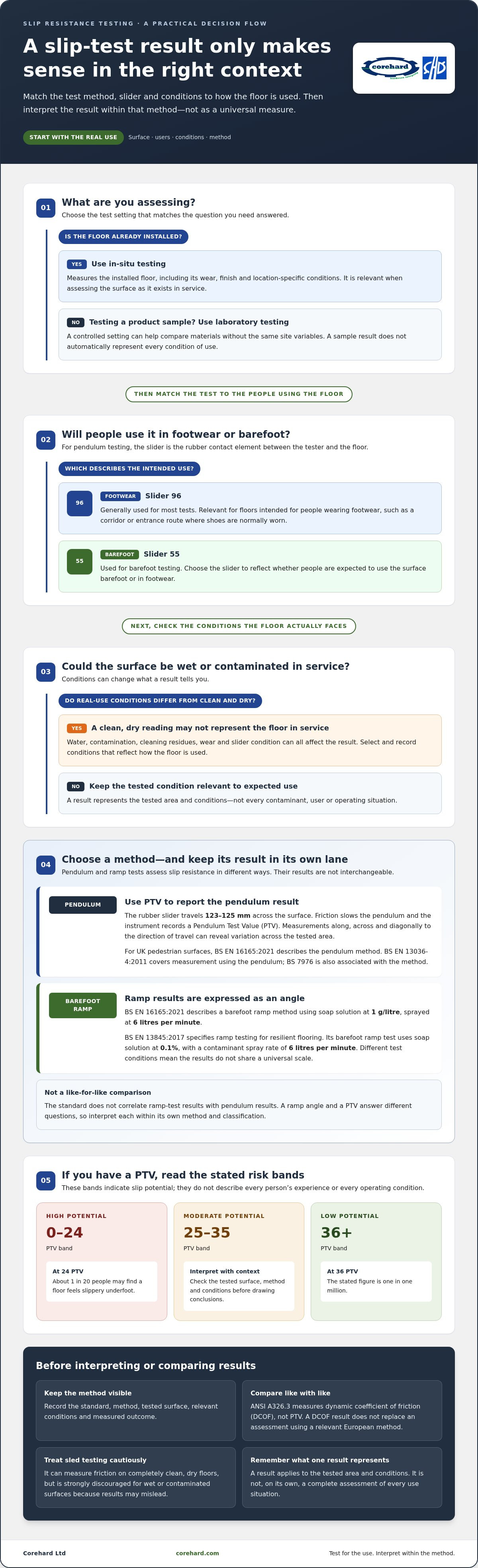
Slip resistance testing with a pendulum measures how a rubber slider interacts with a floor surface as it travels across it for 123-125 mm. The result is recorded as a Pendulum Test Value (PTV): in the stated risk scale, 36 PTV or above indicates low slip potential, 25-35 indicates moderate potential, and 0-24 indicates high potential.
A single result only makes sense when you know how the test was carried out and whether its conditions reflect the surface’s intended use. That is why the method, slider and classification matter when assessing floors for footwear or barefoot use.
This article explains how the pendulum tester works, how variable-angle ramp tests assess slip resistance, and when slider 96 or slider 55 is used. It also outlines how European methods classify results, so you can interpret test data with greater clarity and make more informed decisions about surface safety.
Key Takeaways
- Understand how a pendulum test assesses a floor’s resistance to slipping and what the resulting PTV bands indicate.
- See why the test method and conditions should reflect how the surface will be used.
- Learn when slider 96 or slider 55 is appropriate for footwear or barefoot testing.
- Compare pendulum and ramp methods without treating their results as interchangeable.
- Use European classifications as context for interpreting results, rather than as a substitute for assessing the intended setting.
How Does the Pendulum Tester Work?
A pendulum test assesses floor slip by measuring the friction between a moving rubber slider and a surface. In the UK, BS EN 16165:2021 defines the pendulum method for testing pedestrian surfaces.
Dynamic friction measurement
The tester swings a rubber slider across the floor, travelling 123-125 mm over the test surface. Friction slows the pendulum; the instrument records the resulting Pendulum Test Value (PTV), an indication of dynamic friction during movement. Measurements are taken along, across and diagonally across the direction of travel, helping reveal variation across the tested area.
In practice, slip resistance testing measures how a surface interacts with a standardised slider under defined conditions. Water, contamination, cleaning residues, wear and slider condition can all affect the result, so test conditions should reflect how the floor is used. A reading taken on a clean, dry surface may not represent a floor that becomes wet or contaminated in service.
PTV bands provide a practical indication of slip potential: 0-24 indicates high, 25-35 moderate, and 36 or above low. At 24 PTV, about 1 in 20 people may find a floor feels slippery underfoot; at 36 PTV, the stated figure is one in one million. These bands help interpret results, but don’t describe every person’s experience or every operating condition.
For UK testing, BS EN 13036-4:2011 covers measurement using the pendulum, while BS 7976 is also associated with the method. The UK Slip Resistance Group Guidelines Issue 5 (2016) provide operational guidance. The pendulum is the preferred equipment for floor-slip measurement for the Health and Safety Executive and the UK Slip Resistance Group.
In-situ and laboratory testing
In-situ tests measure the installed floor, including its wear, finish and location-specific conditions. Laboratory tests examine a sample in a controlled setting, which can help compare materials without the same site variables. The right option depends on whether you are assessing an existing floor or a product sample. Neither result automatically represents every condition of use.
Test floors after installation or refurbishment, when their condition or cleaning regime changes, or when a slip incident raises concerns. There is no single interval for every floor: set a sensible schedule based on its use, exposure and condition. Results also have limits. A pendulum reading represents the tested area and conditions, not every contaminant or user. When choosing a UK-accredited laboratory, check that its UKAS accreditation covers the relevant testing scope, and consider the inspectors’ competence and method.
European slip-resistance test methods
European test methods assess pedestrian slip using different equipment, surfaces and conditions. Their results answer different questions, so a classification from one method shouldn’t be treated as a direct equivalent of another.
Methods set out in European standards
BS EN 16165:2021 describes methods for assessing the slip resistance of pedestrian surfaces, including pendulum and ramp tests. Its barefoot ramp method uses a soap solution at 1g/litre, sprayed at 6 litres per minute. The standard does not correlate ramp-test results with pendulum results, so figures from each method must be interpreted separately.
BS EN 13845:2017 also specifies ramp testing for resilient flooring. Its barefoot ramp test uses a soap solution concentration of 0.1%, with a contaminant spray rate of 6 litres per minute. The difference in test conditions matters: a result relates to the method used, not to a universal scale shared by every standard.
Equipment setup and result interpretation
Before testing, identify the surface and its intended use, then choose a method and conditions that represent that use. Record the equipment configuration and any contaminant applied so the result can be understood in context. A ramp result may be expressed as an angle, while a pendulum result uses PTV. These outputs are not interchangeable.
Clear reporting helps readers act on results. A useful record identifies the standard and method, tested surface, relevant conditions and measured outcome. This helps facilities or engineering teams compare like with like, assess whether the method reflects the actual pedestrian environment, and plan further investigation without mistaking a single figure for a complete assessment.
How ANSI A326.3 fits into comparisons
ANSI A326.3 is a US test method, not a European standard. It measures dynamic coefficient of friction (DCOF), but the method states that DCOF shouldn’t be the only factor in deciding whether hard-surface flooring suits an application. For UK projects, keep this distinction clear: a DCOF result may provide context, but it doesn’t replace an assessment using a relevant European method.
Sled testing also has limits: it can measure friction accurately on completely clean, dry floors, but it’s strongly discouraged for wet or contaminated surfaces because results may mislead. Choose the method according to the surface’s intended use and likely conditions, then interpret its result within that method’s own classification. For project-specific evidence, slip resistance testing can help relate the selected method to the surface being assessed.
Slider types for footwear and barefoot testing
The slider is the contact element between a pendulum tester and the floor. Choosing the appropriate type helps ensure the test reflects whether pedestrians use the surface in footwear or barefoot. In the UK method, slider 96 is generally used for most testing, while slider 55 is used for barefoot testing.
Slider 96 for general pedestrian use
Slider 96 is described as a short pedestrian slider and is generally used for most tests. It is the relevant choice for assessing floors intended for people wearing footwear, such as a corridor or entrance route where shoes are normally worn. The result records the interaction between that slider and the tested surface under the chosen test conditions.
For a practical assessment, first identify how the floor is used, then select the slider that corresponds to that use. If a public walkway is normally used in shoes, slider 96 is the usual starting point. Record the slider type with the test result, because a PTV without its method details gives less context for comparison.
Slider 55 for barefoot areas
Slider 55 is used for barefoot testing, where the expected contact differs from footwear use. Examples include pedestrian areas intended for barefoot access. Applying slider 96 simply because it is commonly used for other floors would not represent the barefoot test specified for this purpose.
BS EN 16165:2021 includes testing methods for pedestrian surfaces, including a barefoot ramp test. The ramp method and pendulum method use different procedures, so their results should be interpreted within their respective methods. Choosing slider 55 for a barefoot pendulum test does not make a pendulum result interchangeable with a barefoot ramp classification.
Choose the test conditions to reflect how the surface is used, rather than treating slider choice as a minor equipment detail. Consider who uses the floor, whether they wear shoes and how they encounter the surface. A footwear test on a floor intended for barefoot use, or the reverse, may not answer the question being investigated.
- Footwear use: slider 96 is generally used for most pedestrian testing.
- Barefoot use: slider 55 is the slider identified for barefoot testing.
- Result records: note the slider and method so later comparisons retain their test context.
If an accident or change in floor use prompts an assessment, define the intended user conditions before testing. For example, assess a route used barefoot accordingly, rather than treating it as a standard shod area. This makes the evidence more relevant to the pedestrian activity under review.
Slip-resistance thresholds and classes
A classification is meaningful only in the context of its test method, material and intended use. For British projects, consider the technical class alongside the surface conditions and applicable standard, rather than treating one label as a universal measure of suitability.
Barefoot ramp classifications use angle bands. DIN 51097 classifies surfaces as Class A at 12° or more, Class B at 18° or more, and Class C at 24° or more. These categories apply to barefoot ramp testing, so they don’t establish how the same floor performs for people wearing footwear.
BS EN 13845:2017 sets combined criteria for resilient flooring. For shod areas, ESf classification requires a ramp-test angle of at least 20° and a pendulum result of at least 36. For barefoot areas, ESb requires an angle of at least 15° and a pendulum result of at least 36. Both criteria apply to the relevant flooring category.
Other standards set requirements for particular materials. Wet pendulum results can help assess natural-stone paving, but thresholds should be considered in the context of the product and its intended use. BS EN 1344:2013 sets a minimum result of 35 for clay pavers in class U1, and 45 for class U2. These thresholds relate to the named products and shouldn’t be transferred to unrelated floor types.
R ratings also require context. UK Health and Safety Executive guidance states that R10 flooring covers a coefficient-of-friction range from 0.18 to 0.34, representing a wide range of slip potential. It also notes that R9 flooring, and in some cases R10 flooring, may be slippery when wet or greasy. A rating alone therefore doesn’t settle suitability in contaminated conditions.
- Identify the method: distinguish barefoot ramp classes, pendulum results and R ratings.
- Match the application: check the material, expected footwear and likely surface conditions.
- Read all criteria: BS EN 13845:2017 uses both ramp and pendulum requirements for its ESf and ESb classes.
For example, a barefoot class under DIN 51097 doesn’t classify a shod walkway. Likewise, the clay-paver categories in BS EN 1344:2013 don’t determine the performance of another paving material. Sound interpretation keeps the standard, test conditions and intended application together, so decisions rely on relevant technical evidence rather than a label in isolation.
Other classifications reinforce the need to keep each result within its own scope. DIN 51097 classifies barefoot floors as Class A, B or C, according to their intended use, while BS 8445:2012 classifies bath mats as comfort at slip angles from 14 to 19 degrees, or slip resistant at 20 degrees and above. AS 4586:2013 is an Australian and New Zealand standard for classifying the slip resistance of new pedestrian surface materials.
Related guidance and requirements use different measures. Standards Australia HB 197:1999 recommends a minimum wet pendulum slip-resistance value of 54 for external ramps, whereas BS EN 13893:2002 requires a minimum dynamic coefficient of friction of 0.3 for CE marking. In a demonstration, the floor recorded 34 PTV in wet conditions, which the page classifies as moderate slip risk. These examples are not interchangeable thresholds: apply each only to the material, test and use addressed by its standard or classification.
Variable-angle ramp testing
A variable-angle ramp assesses how a person’s footing responds as a surface becomes steeper. It produces a slip angle, which can be used within the classification system for that method. For UK projects, understand the ramp setup and whether the footwear and contaminant used represent the surface’s intended use.
During a ramp test, the surface angle increases while an operator walks across it. The angle at which slipping occurs forms the basis of the result. In the variable-angle procedure, two operators each repeat the test three times, and the results are averaged. Repeating the process helps account for differences between operators, while keeping the result tied to the test conditions.
DIN 51130 classifies ramp-test angles into R ratings. An angle above 10° and up to 19° is R10; above 19° and up to 27° is R11. R12 covers angles above 27° and up to 35°, while angles above 35° fall into R13. These categories describe the DIN method and shouldn’t be treated as interchangeable with pendulum PTV results.
More than 150 safety criteria based on variable-angle ramps have been adopted in Germany and Australia for specific settings. That scale of use reflects the method’s value in defined applications, but the test conditions still matter. German national methods may use unusual contaminants and footwear, which can make their results less representative of other pedestrian environments.
For this reason, identify likely contaminants and footwear before applying a ramp classification to a real site. A result based on one contaminant may not represent a floor exposed to different substances or cleaning conditions. The report should include the method and conditions alongside the angle, rather than presenting the classification in isolation.
In the UK, the Health and Safety Executive and Health and Safety Laboratory use a ramp method in research on the causes and prevention of pedestrian slips. The British Standards Institution is developing a ramp test intended to use more applicable contaminants and footwear types. These developments underline why test guidelines and conditions should reflect how people encounter the surface.
Ramp testing can provide useful, accurate data, but its angle is not a universal prediction of on-site behaviour. Choose a method aligned with the floor’s use, then compare results only within the relevant classification. For project-specific assessment, arrange slip resistance testing using conditions suited to the surface and its intended environment.
Corehard: NRSWA & TMA Advisory
Corehard provides NRSWA & TMA Advisory for organisations managing streetworks responsibilities and related operational requirements. If slip-risk findings are part of a wider highways or streetworks assurance programme, its advisory and Dynamic Assurance & Compliance services can help bring relevant processes and oversight into focus.
Where asset condition also needs documenting, Asset Surveys & Condition Reporting provides structured information about infrastructure condition. NRSWA & TMA Development supports organisations developing practices in line with these Acts. These services are most relevant when a technical finding needs to be considered alongside broader compliance, asset management or streetworks processes.
Contact Corehard to discuss how its NRSWA and TMA services relate to your operational requirements, or visit corehard.com.
Turn test findings into a practical next step
A test result is most useful when it informs a clear decision about the surface, its use and its ongoing management. For a new installation, this may mean reviewing the evidence before opening an area to pedestrians. For an existing floor, it may mean recording the conditions behind the result and deciding whether further assessment is appropriate.
Keep the test report with relevant maintenance and site records so future reviews can account for changes in use, contamination or cleaning practices. This provides a more consistent basis for decisions than relying on a classification alone. Corehard’s slip resistance testing supports organisations seeking evidence about pedestrian surfaces as part of their wider operational oversight.
If you’re planning an assessment or need to discuss how testing relates to your site, outline your testing requirements to Corehard. A clear account of the surface and its intended use is a constructive place to begin.
Frequently Asked Questions
What is a pendulum test?
A pendulum test is a standardised way to assess a pedestrian surface’s slip performance. Its value is practical when comparing areas of the same floor, checking whether a maintenance change has affected performance, or investigating a reported concern. For a useful comparison, keep the surface type and relevant test conditions consistent, and interpret the result alongside how people use that area.
Which slip resistance test methods and standards are used in the UK?
UK assessments use pendulum and ramp methods, including those set out in BS EN 16165:2021. BS EN 13036-4:2011 covers pendulum testing, while BS EN 13845:2017 addresses resilient flooring criteria. The appropriate reference depends on the surface and use being assessed. For a procurement or refurbishment decision, specify the relevant method before comparing product data, so different test outputs aren’t treated as equivalent.
How are slip resistance test results and classifications interpreted?
Read a result alongside the tested material, surface condition and intended activity. Check whether the reported classification applies to that type of floor and whether the test conditions reflect its operating environment. For example, a result for a dry sample may not address concerns about a frequently contaminated entrance. Keep the report with maintenance records to support future comparisons and decisions.
What are the UK legal requirements for slip resistance in workplaces and public buildings?
There is no single slip-resistance class that applies to every UK workplace or public building. Standards include method- and material-specific classifications, while UK Health and Safety Executive guidance warns that some R-rated floors may be slippery when wet or greasy. Document why the selected floor is suitable for its setting, considering foreseeable use, contamination and cleaning, rather than relying on a label alone.
How is a slip resistance test carried out step by step?
Start by defining the decision the test must inform, such as comparing flooring options or investigating a site concern. Identify the areas and conditions relevant to that decision, then arrange testing using an appropriate method. Record the surface, location, condition and test reference with the findings. Finally, compare the evidence with the intended use and document any maintenance or further assessment actions arising from the result.


