

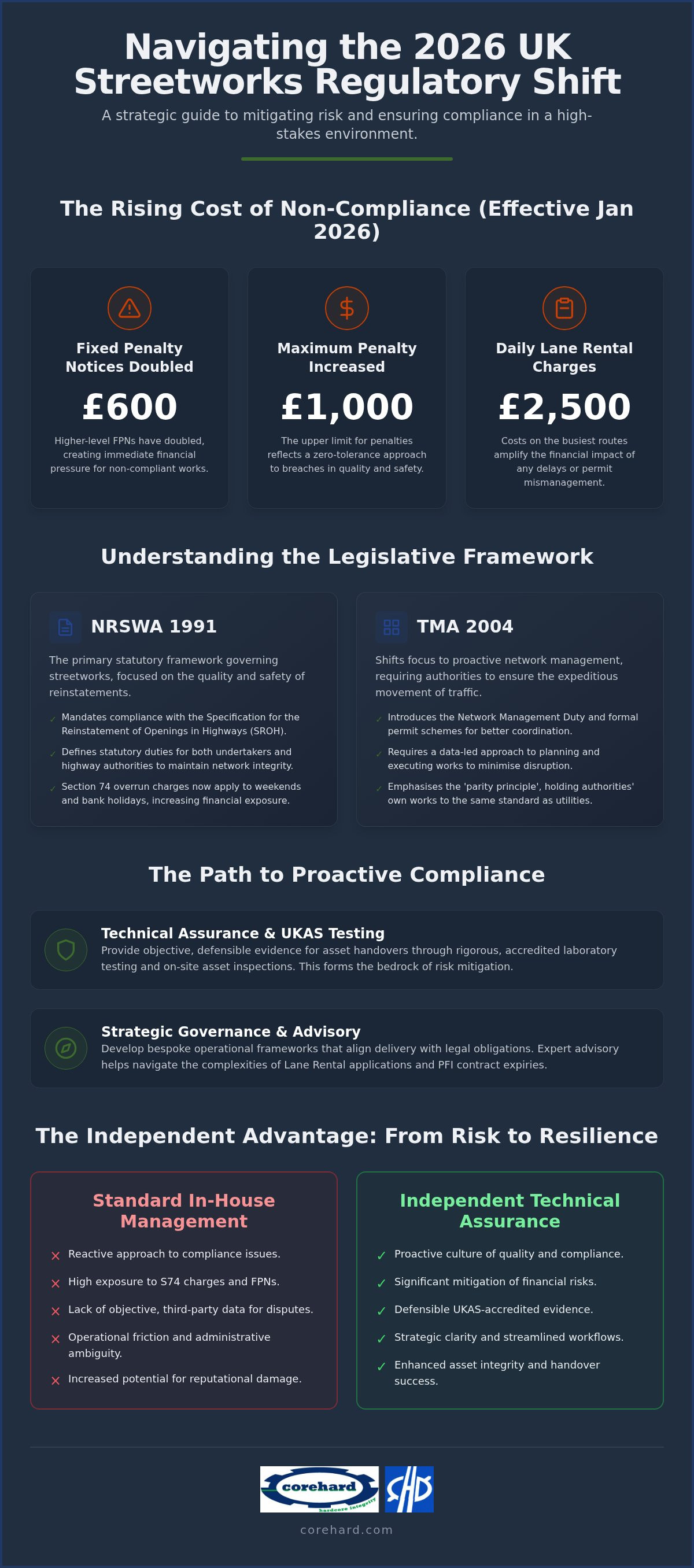
With higher-level Fixed Penalty Notices doubling to £600 and maximum penalties reaching £1,000 as of January 2026, the financial risks associated with streetworks non-compliance have reached a critical threshold. Deploying strategic NRSWA and TMA development services has transitioned from an operational luxury to a fundamental necessity for infrastructure providers seeking to protect their margins from escalating Section 74 charges and the £2,500 daily costs of Lane Rental Schemes. You recognise that the margin for error in reinstatement quality and permit management has narrowed significantly, leaving little room for technical ambiguity or administrative oversight.
By integrating expert advisory with rigorous technical assurance frameworks, you can master these regulatory complexities and secure a position of absolute compliance. This article explores the transition from operational friction to strategic clarity, demonstrating how independent technical data and UKAS-accredited testing provide the objective evidence required for defensible asset handovers. We will examine the methodologies that underpin successful Lane Rental applications and the robust governance needed to manage the high-stakes expiry of PFI contracts in 2026.
Key Takeaways
- Understand the 2026 regulatory landscape where doubled Fixed Penalty Notices and weekend overrun charges necessitate a more rigorous, evidence-based approach to streetworks compliance.
- Learn how bespoke NRSWA and TMA development services align operational delivery with legal obligations to mitigate the substantial financial risks associated with Section 74 charges.
- Discover the critical role of UKAS-accredited laboratory testing and asset inspections in providing the objective, defensible technical data required for successful infrastructure handovers.
- Master the complexities of Lane Rental Scheme applications and the strategic governance required to navigate the significant volume of PFI contract expiries scheduled for 2026.
- Identify why independent technical assurance and specialist advisory offer a superior level of risk mitigation and operational clarity compared to standard in-house management approaches.
The Legislative Landscape: Understanding NRSWA and TMA in 2026
Infrastructure management in 2026 demands a sophisticated understanding of the legislative pillars that govern the UK highway network. The New Roads and Street Works Act (NRSWA) 1991 remains the primary statutory framework, yet its application has evolved into a high-stakes environment where technical precision is the only safeguard against punitive financial penalties. Integrating strategic NRSWA and TMA development services allows organisations to align their operational workflows with these rigid legal requirements, ensuring that every excavation and reinstatement meets the exacting standards expected by highway authorities. This alignment isn't merely about administrative box-ticking; it's about protecting asset integrity through a disciplined, methodology-led approach.
NRSWA 1991: The Foundation of Streetworks Compliance
Statutory duties for both undertakers and authorities are anchored in the principle of maintaining a safe and durable highway. Central to this is the Specification for the Reinstatement of Openings in Highways (SROH), which dictates the technical parameters for every stage of the work. Under the Street and Road Works (Charges and Penalties) (Amendments) (England) Regulations 2025, which took effect on 5 January 2026, the financial consequences of failing these standards have intensified. Fixed Penalty Notices (FPNs) for higher-level offences have doubled to £600, whilst the maximum penalty now reaches £1,000. These increases reflect a clear trend towards using financial deterrence to enforce quality, making the role of independent technical assurance more vital than ever.
TMA 2004: Strategic Network Management and Permits
The Traffic Management Act 2004 introduced the Network Management Duty, requiring local authorities to secure the expeditious movement of traffic. This legislation shifted the focus from simple work notification to proactive coordination through permit schemes. In 2026, the parity principle ensures that authorities manage their own works with the same level of scrutiny applied to utility companies. However, the operational complexity of managing these permits can lead to significant friction. With Lane Rental charges on the busiest routes reaching £2,500 per day, the cost of a poorly managed permit application is immense. NRSWA and TMA development services bridge the gap between high-level legislative intent and daily operational reality by optimising permit workflows and ensuring all applications are backed by defensible data.
Legislative evolution has moved decisively away from reactive maintenance toward a model of proactive quality control. By adopting a framework that synthesises regulatory advisory with technical laboratory evidence, providers can navigate this landscape with confidence. This structured approach ensures that compliance is not an afterthought but a core component of the project lifecycle, reducing the risk of Section 74 overrun charges which, since January 2026, can now be applied to weekends and bank holidays as well as working days.
Core Elements of NRSWA and TMA Development Services
Transitioning from a reactive, penalty-focused mindset to a proactive culture of compliance requires a structured methodology that embeds regulatory standards into the very fabric of an organisation. Strategic NRSWA and TMA development services facilitate this shift by designing bespoke frameworks that align operational activities with high-level corporate governance. This approach ensures that technical assurance isn't a secondary consideration but a primary driver of project delivery, allowing infrastructure providers to maintain absolute control over their streetworks portfolio whilst minimising exposure to commercial and reputational risks. By focusing on the synthesis of regulatory advisory and technical data, these services transform complex obligations into clear, manageable workflows.
Developing Governance and Operational Frameworks
Establishing clear lines of accountability is paramount for managing the multi-layered requirements of the Traffic Management Act 2004 legislation. A robust operational framework organises reporting structures so that real-time compliance monitoring becomes an integral part of the project lifecycle. By developing internal standards that exceed the minimum statutory requirements of the Specification for the Reinstatement of Openings in Highways (SROH), organisations create a vital buffer against the inherent variability of site conditions. This disciplined structure ensures that every operative and supervisor understands their specific role in maintaining network integrity, which significantly reduces the likelihood of administrative errors that lead to avoidable Fixed Penalty Notices.
Compliance Auditing and Performance Reporting
Designing rigorous audit schedules is essential for identifying systemic weaknesses before they manifest as costly defects or overruns. Data-driven reporting allows management to move beyond anecdotal evidence, using verified technical data to justify operational changes and refine resource allocation. When specialist advisory is integrated into these auditing processes, it provides an independent layer of technical assurance that is often missing from in-house generalist approaches. This objective oversight is particularly valuable when managing Section 74 liabilities, as it provides the defensible evidence needed to challenge unreasonable charges or verify the accuracy of authority inspections. Organisations looking to sharpen their operational delivery often find that engaging with expert NRSWA advisory provides the steady hand needed to simplify these complex transitions and secure long-term asset quality.
The necessity of independent oversight cannot be overstated in the current regulatory climate. Whilst internal teams possess valuable institutional knowledge, they may lack the objective distance required to identify deep-seated procedural flaws or technical inconsistencies. Specialist NRSWA and TMA development services provide this external perspective, acting as a guardian of quality who can bridge the gap between complex legal obligations and practical on-site execution. This rigorous methodology ensures that the resulting compliance framework is not only legally sound but also operationally viable, providing a verified path to technical excellence and reduced operational friction.
Technical Assurance: UKAS Testing and Asset Inspections
Technical excellence in UK infrastructure isn't a subjective claim; it's a verifiable state achieved through rigorous empirical testing. Within the framework of NRSWA and TMA development services, the integration of objective evidence serves as a critical safeguard against the technical ambiguities that often lead to regulatory disputes. Relying solely on visual inspections or anecdotal site reports is insufficient in an era of heightened accountability. Instead, infrastructure providers must adopt a disciplined methodology that prioritises UKAS-accredited testing to ensure every reinstatement and asset handover meets the exacting requirements of the SROH.
UKAS Accredited Laboratory Testing for Reinstatements
UKAS accreditation, specifically under ISO/IEC 17025, represents the gold standard for laboratory competence. By utilising an independent testing laboratory, organisations can verify the quality of materials and compaction levels with absolute certainty. This technical support is indispensable for high-stakes environments such as airfield and highway infrastructure, where failure has severe safety and commercial implications. For instance, employing PANDA penetrometer testing allows for rapid, non-destructive site investigations, providing immediate data on layer stiffness and compaction quality without the delays associated with traditional coring. This level of precision ensures that technical assurance is grounded in objective laboratory data, which is fundamental to the Traffic Management Act 2004 legislation and its focus on network integrity.
Asset Surveys and Condition Reporting
Comprehensive inspections form the backbone of long-term asset management strategies. Organising detailed surveys for highways and street lighting allows providers to develop condition reports that identify potential issues before they escalate into systemic failures. These surveys must extend beyond basic structural checks to include specialised assessments like slip resistance testing. Ensuring the safety of the highway surface is a primary duty for any network manager; failing to provide evidence of adequate slip resistance significantly increases liability in the event of an incident. By integrating these surveys into broader NRSWA and TMA development services, organisations can create a defensible technical record that simplifies asset handovers and protects against future litigation. This methodological approach transforms technical complexity into operational clarity, providing the steady hand needed to navigate difficult regulatory environments.
Developing a robust condition assessment strategy requires a synthesis of field inspections and laboratory analysis. When laboratory data is integrated directly into service development, it provides a verified foundation for all operational decisions. This synergy ensures that asset managers aren't just reacting to defects but are proactively managing the lifecycle of their infrastructure with a level of precision that inspires confidence amongst stakeholders and regulators alike.
Strategic Governance: Lane Rental and PFI Expiry
Managing the intersection of high-density network occupation and complex contract expiries requires a level of strategic oversight that transcends basic streetworks coordination. As of 2026, the governance of UK infrastructure is defined by the dual pressures of Lane Rental Schemes, which can impose daily charges of up to £2,500 on the busiest routes, and the significant volume of Private Finance Initiative (PFI) contracts reaching their conclusion. Deploying specialist NRSWA and TMA development services provides the steady hand necessary to navigate these transitions, ensuring that operational disruption is minimised whilst protecting the public interest through rigorous technical auditing.
Lane Rental Scheme Application and Management
Securing approval for Lane Rental operational services demands a robust application process grounded in evidence-based impact assessments. Since January 2026, highway authorities are required to allocate 50% of net proceeds from surplus lane rental funds to highway maintenance, with the remainder dedicated to purposes intended to reduce the disruption caused by street works. This regulatory shift places greater scrutiny on how works are scheduled and coordinated. Governance frameworks must therefore prioritise network availability, using data-driven methodologies to justify occupation times and mitigate the financial impact of daily rental fees.
PFI Street Lighting Succession Planning
The expiry of approximately 5% of the government's PFI contract portfolio in 2026, representing 33 active contracts, presents a unique set of challenges for local authorities. Strategic advisory for PFI street lighting transition is essential for managing the handback process, where vague contractual standards in early agreements often lead to disputes over asset condition. Developing comprehensive condition assessments and technical assurance frameworks ensures that assets are returned to public control in a verifiable state of repair. This transition advisory facilitates a seamless move to succession contracts, preventing service gaps and ensuring that new providers inherit a transparent, well-documented asset base.
Navigating these multi-stakeholder environments requires a guardian of quality who can simplify complex transitions through disciplined methodology. For authorities and contractors facing these milestones, accessing expert PFI transition advisory ensures that every stage of the handback is supported by objective, defensible data. This proactive approach to strategic governance eliminates the ambiguity that often characterises contract expiries, providing a clear path to long-term operational stability and regulatory alignment.
Partnering for Compliance: The Corehard Advantage
Identifying systemic risks in UK infrastructure requires more than just internal oversight. Whilst in-house teams possess institutional knowledge, they often lack the objective distance and specialised equipment required to challenge authority inspections or verify complex material compliance. Independent specialist advisory offers a superior level of technical assurance by acting as an external guardian of quality. This objectivity is vital when navigating the doubled Fixed Penalty Notices and weekend overrun charges that now define the 2026 regulatory environment, where the margin for error has effectively vanished. By outsourcing the development of compliance frameworks, organisations gain access to a level of technical mastery that ensures operational delivery remains aligned with the highest industry standards.
A Strategic Partnership Approach
Transitioning from a service provider to a strategic compliance advisor allows for a more integrated approach to risk management across the entire project lifecycle. Corehard Ltd acts as the steady hand in difficult regulatory environments, simplifying the complex transition from construction to asset handover through disciplined methodology. For national infrastructure projects, bespoke development services ensure that every operational action is grounded in a broader framework of industry standards. This methodical approach replaces administrative friction with operational clarity, ensuring that compliance is a verified outcome rather than a reactive struggle against escalating penalties and Section 74 liabilities.
The Value of Technical Mastery and Reliability
Leveraging experience founded in 2011, the synergy between a UKAS-accredited testing laboratory and regulatory consultancy provides a unique advantage that generalist firms cannot replicate. This combination ensures that technical mastery and precision are non-negotiable components of every project, from minor reinstatements to major airfield developments. By providing independent technical support, Corehard Ltd secures long-term asset integrity through a lexicon of certainty and objective evidence. Precision in technical testing isn't just a safety requirement; it's a commercial necessity that protects against the £2,500 daily charges of Lane Rental Schemes and ensures defensible data for asset handovers. This rigorous focus on quality protects both the physical integrity of the highway and the commercial interests of the provider.
Contacting Corehard Ltd to discuss your NRSWA and TMA development services allows you to align your operations with the highest standards of technical assurance and strategic governance. By choosing a partner that values objectivity and evidence above all else, you secure the disciplined methodology required to navigate the complexities of modern UK infrastructure management with absolute confidence.
Securing Technical Integrity in a High-Stakes Regulatory Environment
The 2026 infrastructure landscape demands a level of precision that transcends basic coordination. Protecting your commercial margins from doubled Fixed Penalty Notices and the £2,500 daily costs of Lane Rental Schemes requires a disciplined, methodology-led approach. By deploying strategic NRSWA and TMA development services, you can align your operational delivery with the most stringent legal obligations whilst ensuring that every asset handover is supported by objective, defensible data.
Since 2011, Corehard has acted as a guardian of quality, providing independent technical support and a UKAS Accredited Testing Laboratory to verify the integrity of reinstatements across the UK. From specialist PFI Street Lighting expiry advisory to the management of complex Lane Rental applications, our focus remains on delivering the technical mastery required to simplify difficult transitions. This rigorous framework ensures that your organisation maintains calm control over its regulatory duties, providing a steady hand in an increasingly punitive environment.
Enquire about our NRSWA and TMA development services to secure a position of absolute compliance and long-term asset reliability. We look forward to helping you master these complexities with technical certainty.
Frequently Asked Questions
What are NRSWA and TMA development services exactly?
NRSWA and TMA development services are strategic frameworks designed to align operational streetworks with the New Roads and Street Works Act 1991 and the Traffic Management Act 2004. These services include the creation of governance structures, permit optimisation workflows, and technical assurance protocols. By integrating regulatory advisory with technical laboratory evidence, providers ensure that compliance is embedded into the project lifecycle, reducing financial exposure to Fixed Penalty Notices and overrun charges.
How does a Lane Rental Scheme affect my streetworks permits?
Lane Rental Schemes introduce significant financial and operational constraints by charging up to £2,500 per day for works on the busiest parts of the network during peak times. These schemes require a more rigorous permit application process where you must demonstrate a commitment to reducing disruption. Effective management involves using data-driven methodologies to justify occupation times, whilst ensuring that all works are coordinated to maximise network availability and minimise rental liabilities.
Why is UKAS accreditation important for highways testing?
UKAS accreditation is the essential benchmark for laboratory competence, specifically under the ISO/IEC 17025 standard. It provides the objective evidence required to verify that material testing and site investigations are conducted to the highest technical standards. In the context of 2026 regulations, having UKAS-accredited data is vital for defending against technical disputes or Section 74 charges, as it offers a verified level of certainty that non-accredited facilities cannot provide.
What happens at the end of a PFI Street Lighting contract?
The conclusion of a PFI contract triggers a complex handback process where assets must be returned to the authority in a contractually specified condition. This transition requires specialist advisory to manage asset surveys and condition reporting, ensuring that any defects are identified and rectified before succession. Given that 33 PFI contracts are set to expire in 2026, proactive governance is necessary to protect the public interest and ensure a seamless service transfer.
Can Corehard help with Section 74 mitigation?
Yes, Corehard provides the technical assurance and compliance auditing required to mitigate Section 74 overrun charges effectively. By using independent laboratory data and rigorous site inspections, we identify the root causes of delays and verify the accuracy of authority claims. This methodology provides you with the defensible evidence needed to challenge unreasonable charges, whilst our development services help refine your operational workflows to prevent overruns from occurring in the future.
What is the role of a PANDA penetrometer in site investigation?
A PANDA penetrometer is a specialised tool used for rapid, non-destructive site investigations to assess the compaction and stiffness of reinstatement layers. It provides immediate, accurate data on material performance without the need for traditional, time-consuming coring. This technology is particularly valuable for infrastructure providers who require real-time technical assurance to verify that works meet the SROH standards, thereby reducing the risk of future defects and ensuring long-term asset integrity.
How do development services improve network management duty compliance?
NRSWA and TMA development services improve compliance by translating the high-level obligations of the Network Management Duty into practical, operational workflows. These services establish clear lines of accountability and reporting structures, ensuring that permit applications and site activities align with the Traffic Management Act 2004. By fostering a culture of proactive coordination and quality control, organisations can meet their statutory duty to facilitate traffic movement whilst reducing the operational friction associated with complex portfolios.
What technical support is available for airfield infrastructure?
Specialist technical support for airfield infrastructure includes independent laboratory testing of materials and UKAS-accredited asset surveys to ensure safety and durability. Given the high stakes of airfield environments, we provide rigorous technical assurance frameworks that cover everything from slip resistance testing to structural condition reporting. This objective evidence is vital for verifying that all works meet the exacting standards required for airfield handovers, protecting both the operator's reputation and the safety of the facility.


