

A single administrative oversight under the New Roads and Street Works Act can now trigger financial penalties that far outweigh the commercial value of the original project. You likely recognise that maintaining the integrity of the nation's highways requires more than just physical delivery; it demands a rigorous, evidence-based approach to governance and material quality. Securing expert infrastructure technical support UK is no longer a luxury but a strategic necessity for those navigating the heightened scrutiny of the Street and Road Work Charges and Penalties Regulations 2025 and the updated 2026 permit schemes.
We understand that the pressure to deliver operational excellence whilst mitigating the risk of punitive fines creates an increasingly volatile environment for infrastructure leads. This guide demonstrates how specialist technical assurance and UKAS-accredited laboratory testing can transform these regulatory burdens into a disciplined framework for long-term asset health. We'll explore the transition from complex NRSWA obligations to operational clarity, ensuring your projects achieve full compliance and extended lifespans through meticulous oversight and independent verification.
Key Takeaways
- Master the rigorous alignment with NRSWA and TMA regulations to mitigate the risk of punitive financial penalties whilst enhancing overall network productivity.
- Recognise why it's essential to utilise UKAS-accredited laboratory testing for providing the objective evidence required to maintain material integrity and technical assurance.
- Understand how specialist infrastructure technical support UK facilitates the seamless transition of PFI street lighting contracts through disciplined methodology and strategic oversight.
- Implement sophisticated asset condition reporting to secure the long-term viability of physical infrastructure and ensure the efficient allocation of maintenance budgets.
Defining Technical Support in the Context of UK Physical Infrastructure
In modern technical discourse, the term "infrastructure" is frequently co-opted by the digital sector to describe cloud architecture and server networks. Within the built environment, however, infrastructure technical support UK refers to the rigorous engineering, regulatory, and material oversight of tangible assets. This includes the national highway network, airfield pavements, and the complex utility systems that sit beneath our streets. This discipline ensures that physical structures remain safe, compliant, and operationally resilient throughout their entire lifecycle. It's the steady hand that translates high-level policy into site-level precision.
Providing technical oversight isn't merely a matter of operational preference; it's a statutory obligation. The management of streetworks by Statutory Undertakers is governed by strict legal frameworks that prioritise public safety and network fluidity. When these standards aren't met, the consequences range from catastrophic structural failures to severe financial penalties. Specialist consultants act as the vital conduit between contractors and authorities, ensuring that the "big picture" of national infrastructure health is maintained without sacrificing granular technical accuracy.
The Pillars of Physical Infrastructure Support
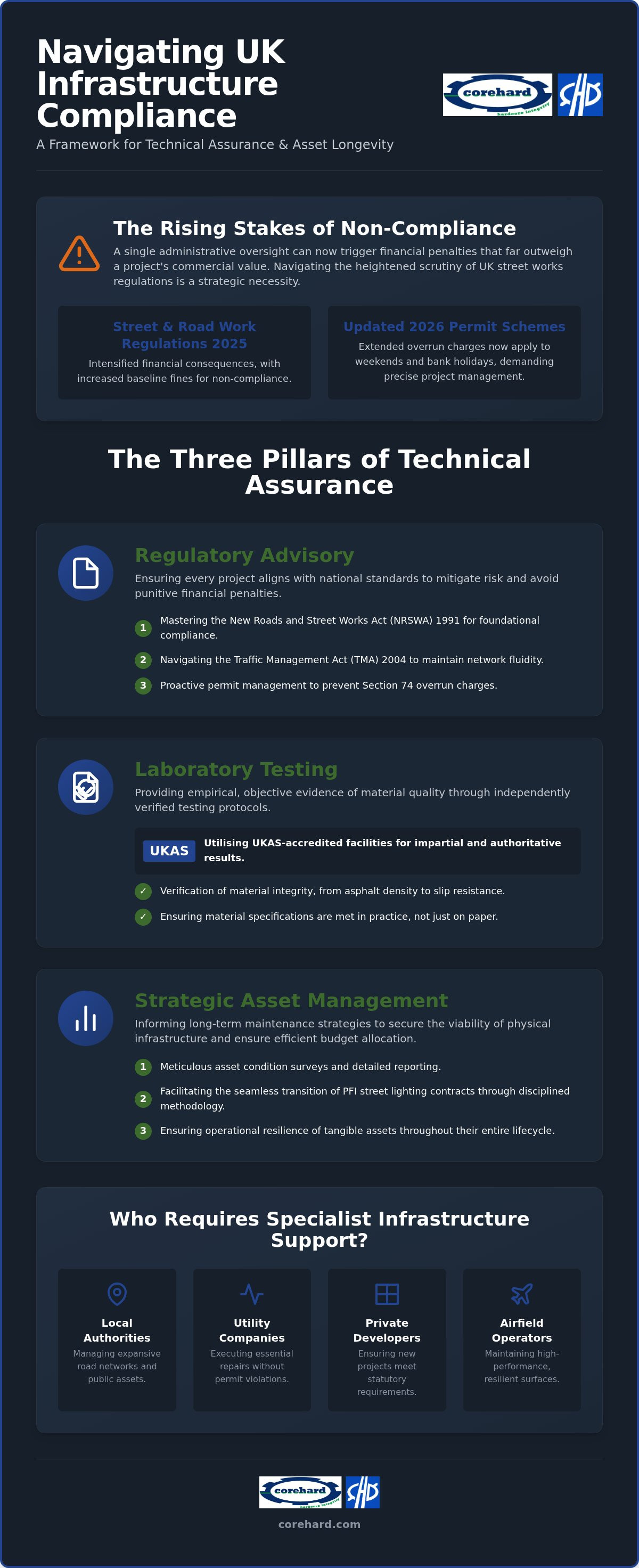
Technical support in this sector rests upon three critical foundations that guarantee project integrity and long-term viability:
- Regulatory Advisory: Navigating the intricate requirements of the New Roads and Street Works Act (NRSWA) and the Traffic Management Act (TMA) to ensure every project aligns with national standards.
- Laboratory Testing: Utilising UKAS-accredited facilities to provide empirical, objective evidence of material quality, covering everything from asphalt density to slip resistance.
- Asset Management: Conducting meticulous condition surveys and reporting that inform long-term maintenance strategies and facilitate smooth PFI transitions.
Who Requires Specialist Infrastructure Support?
The requirement for specialist intervention spans several high-stakes sectors where precision is non-negotiable. Local authorities rely on these services to manage expansive road networks whilst ensuring that third-party works don't compromise public assets. Utility companies require precise infrastructure technical support UK to execute essential repairs without falling foul of permit schemes or causing unnecessary disruption. Private developers and airfield operators also utilise these services to maintain high-performance surfaces that must withstand extreme operational stresses. By providing an independent layer of assurance, specialists ensure that material specifications aren't just met on paper but are verified through rigorous testing protocols.
Navigating the NRSWA and TMA Regulatory Frameworks
Navigating the statutory obligations of UK streetworks requires a disciplined understanding of the New Roads and Street Works Act 1991. This foundational legislation, in conjunction with the Traffic Management Act 2004, dictates the legal parameters for every excavation and reinstatement on the public highway. With the introduction of the Street and Road Work Charges and Penalties Regulations 2025, the financial consequences of non-compliance have intensified. These regulations have not only increased the baseline for fines but also extended overrun charges to weekends and bank holidays, making the precision of infrastructure technical support UK a vital component of commercial risk management.
The impact of the Traffic Management Act on network productivity is profound. It shifts the focus from individual work sites to the holistic performance of the road network, demanding a transition from reactive permit management to proactive compliance. Technical support mitigates the risk of Section 74 charges by ensuring that works are completed within agreed durations and that all notifications are synchronised with actual site activities. When organisations fail to align their operational delivery with these statutory timelines, they don't just face financial penalties; they suffer a degradation of their relationship with local authorities and the public.
Operational Excellence through Compliance Auditing
Achieving operational excellence necessitates a rigorous approach to site inspections that verify alignment with the Specification for the Reinstatement of Openings in Highways (SROH). Independent compliance audits provide an objective layer of assurance that internal contractor-led monitoring often lacks. By establishing a robust reporting framework, organisations can monitor performance trends and identify systemic failures before they escalate into regulatory breaches. Utilising professional NRSWA & TMA Advisory services ensures that every audit is grounded in the latest 2026 codes of practice, providing the steady hand needed to navigate complexity.
Lane Rental Schemes and Network Impact
The proliferation of Lane Rental Schemes across high-traffic routes adds another layer of complexity to project planning. Applying for these schemes requires a sophisticated understanding of network impact and a commitment to operational governance that minimises road user disruption. Successful scheme management involves balancing essential maintenance with the need to maintain traffic flow, often requiring works to be executed during off-peak hours or through innovative engineering solutions. Specialist oversight ensures that these applications are technically sound and that the subsequent works adhere to the stringent conditions imposed by the authority, protecting both public funds and corporate reputation.
The Role of UKAS Accredited Laboratory Testing in Quality Assurance
Empirical data serves as the bedrock of physical asset integrity, providing the objective proof that material performance aligns with design specifications. While the regulatory frameworks discussed previously establish the legal boundaries of a project, UKAS-accredited laboratory testing delivers the scientific certainty required to verify that those boundaries are respected. Within the context of the New Roads and Street Works Act 1991, comprehensive infrastructure technical support UK must integrate UKAS-accredited testing to ensure that reinstatements and new constructions possess the structural resilience to withstand decades of operational stress. This accreditation represents the gold standard of technical competence, signifying that a laboratory operates under the rigorous standards of ISO/IEC 17025:2017.
Relying on contractor-led quality control often introduces an inherent conflict of interest that can compromise the long-term viability of an asset. Independent laboratory testing removes this risk by providing a third-party perspective grounded in objective evidence. Whether analysing asphalt density, soil compaction through California Bearing Ratio (CBR) testing, or the slip resistance of a newly laid footway, independent verification ensures that contractors don't merely meet the minimum visible requirements but achieve the deep-seated material standards necessary for safety. This analytical rigour is particularly critical for airfield pavements and high-speed carriageways, where even minor material deficiencies can lead to catastrophic surface failures.
Specialist Testing Services for Infrastructure
Maintaining the safety and longevity of the UK's transport network requires a suite of specialised investigative tools. Slip resistance testing, conducted using the Pendulum Test Value (PTV) method, is essential for mitigating pedestrian and vehicular risk on varied surface types. Beyond surface-level checks, pavement investigation and material condition assessments allow for a granular understanding of an asset's health. Utilising advanced technology like the PANDA penetrometer enables rapid, non-destructive site investigations that provide immediate data on soil strength and layer thickness. These insights allow for more precise maintenance scheduling, preventing the premature degradation of expensive infrastructure assets.
The Value of Independent Technical Support
High-level infrastructure technical support UK prioritises the removal of conflict of interest through impartial, third-party analysis. When disputes arise regarding material failure or non-compliance, the objective evidence provided by a UKAS-accredited facility becomes the definitive point of reference for resolution. This level of technical assurance protects public funds by ensuring that reinstatements are performed correctly the first time, reducing the need for costly remedial works. UKAS accreditation is the essential benchmark for infrastructure safety. By grounding every decision in verified data, asset managers can move from speculative maintenance to a model of disciplined, evidence-based asset governance.
Strategic Asset Management: From Condition Surveys to PFI Transitions
Strategic asset management within the UK's built environment requires a shift from superficial observation to a methodology grounded in empirical evidence. Effective infrastructure technical support UK facilitates this transition by implementing rigorous asset condition assessments that move beyond simple visual inspections. By utilising precision reporting, local authorities and private operators can prioritise maintenance expenditure based on the actual structural health of their assets rather than arbitrary timelines. This disciplined approach ensures that national highway maintenance strategies are both fiscally responsible and technically sound, providing a clear roadmap for long-term financial stability.
The complexity of this task is significantly amplified when managing the expiry of Private Finance Initiative (PFI) contracts. In 2026, a substantial wave of these contracts is reaching the end of its lifecycle, with 33 active PFI contracts scheduled for expiry across the year. Navigating the handback process for major assets, particularly street lighting networks, requires a sophisticated understanding of both technical compliance and contractual obligations. Without specialist oversight, authorities risk inheriting assets that don't meet the required standards for longevity, leading to immediate and unforeseen maintenance liabilities.
Condition Assessment and Lifecycle Planning
Precision reporting acts as the catalyst for effective lifecycle planning, allowing asset managers to identify "at-risk" infrastructure before failure occurs. Detailed asset surveys provide the objective data needed to justify maintenance budgets and secure capital investment for large-scale renewals. This is particularly vital when managing the transition of street lighting assets back to local authority control, where the technical condition of every column and luminaire must be verified. By establishing a clear baseline of condition, organisations can develop succession plans that ensure service continuity whilst protecting the public purse from the costs of deferred maintenance.
PFI Expiry and Succession Strategies
Succession planning for expiring PFI contracts is a high-stakes exercise in risk mitigation and technical governance. The handback phase often reveals discrepancies between the expected and actual condition of infrastructure, making independent technical assurance an essential requirement for contract closure. Specialist advisory services bridge the gap between outgoing providers and incoming management teams, ensuring that every asset transferred meets the stringent technical specifications defined at the project's inception. To ensure a seamless transition and protect against future structural liabilities, authorities should engage with expert Street Lighting PFI Transition Advisory services well in advance of contract termination.
The Case for Specialist Infrastructure Technical Support
The increasing volatility of the UK’s regulatory environment, exemplified by the updated 2026 permit schemes and the Planning and Infrastructure Act 2025, necessitates a shift towards high-level technical oversight. Engaging specialist infrastructure technical support UK allows decision-makers to move from a state of regulatory uncertainty to one of operational clarity. This transition is achieved through the implementation of rigorous, evidence-based methodologies that identify latent risks before they manifest as site failures or legal disputes. Independent assurance shouldn't be viewed as a discretionary cost. It's a strategic investment that safeguards the integrity of physical assets and ensures the efficient allocation of public funds whilst maintaining public safety.
Protecting the long-term health of the nation's highways and utilities requires more than just adherence to minimum standards. It demands a commitment to technical mastery that spans from initial site investigation to the final handback of major contracts. Specialist advisory services provide the steady hand needed to manage these complexities, ensuring that every material reinstatement and asset survey is grounded in empirical data. By prioritising rigour and compliance, organisations can mitigate the risk of punitive fines and extend the operational lifespan of their most critical assets.
Moving from Complexity to Clarity
Simplifying the regulatory landscape for decision-makers involves translating dense statutory requirements into actionable strategic plans. Professional technical support provides the peace of mind that every project aligns with the New Roads and Street Works Act and the Traffic Management Act. This clarity is essential for maintaining network productivity and avoiding the financial pitfalls of non-compliance. Independent assurance acts as a guardian of quality, providing the objective evidence needed to verify that contractor delivery matches the high standards expected by local authorities and the public.
Selecting a Technical Support Partner
Choosing a consultancy requires careful consideration of their accreditation, experience, and independence. A partner must possess UKAS accreditation for its laboratory testing facilities to ensure that all data is beyond reproach. Since its founding in 2011, Corehard Ltd has maintained a focus on rigorous methodology and regulatory alignment, positioning itself as a strategic advisor rather than a mere service provider. A partner who understands the "big picture" of UK infrastructure can provide the oversight needed to manage everything from Lane Rental Scheme applications to complex PFI transitions. To secure the integrity of your next project, consult with Corehard Ltd for specialist infrastructure support and ensure your operations meet the highest standards of technical excellence.
Securing the Future of National Physical Assets
The governance of the built environment demands a shift from reactive repairs to a culture of technical assurance. We've explored how aligning with the New Roads and Street Works Act and the Traffic Management Act prevents the financial erosion caused by non-compliance. Integrating UKAS-accredited testing and precise asset surveys ensures that physical infrastructure remains resilient against the stresses of modern operation. By prioritising infrastructure technical support UK, organisations can navigate the complexities of PFI transitions and regulatory overhauls with absolute certainty.
Reliability in this sector is built upon objective evidence and professional rigour. It's essential to have a specialist partner who ensures that quality and safety remain non-negotiable throughout every project phase. This disciplined approach protects public funds and guarantees that infrastructure assets meet their intended lifespan without incurring unforeseen liabilities.
Secure your infrastructure project with specialist advisory from Corehard Ltd. Our team of NRSWA and TMA experts, supported by our UKAS accredited laboratory and specialist PFI transition advisory, provides the steady hand needed to achieve operational excellence. We look forward to helping you protect the integrity and longevity of your critical assets.
Frequently Asked Questions
What does infrastructure technical support include for UK highways?
Infrastructure technical support UK encompasses a broad range of specialist services designed to maintain the integrity of the physical road network. It includes rigorous NRSWA and TMA advisory to ensure regulatory alignment, UKAS-accredited laboratory testing for material verification, and detailed condition surveys. These services provide the objective evidence required to manage highway assets effectively, ensuring that every reinstatement and maintenance activity meets national safety and quality standards whilst minimising operational risk.
Why is UKAS accreditation important for highways testing?
UKAS accreditation serves as the essential benchmark for technical competence and impartiality in materials testing. It confirms that a laboratory operates under the rigorous ISO/IEC 17025:2017 standards, providing the scientific certainty needed to verify asphalt density and soil compaction. Without this accreditation, testing results lack the authoritative weight required for legal compliance and dispute resolution, potentially leaving local authorities vulnerable to structural failures and financial liabilities. It's the gold standard for technical assurance.
How does NRSWA compliance consultancy reduce project costs?
Specialist consultancy reduces project costs by identifying and mitigating regulatory risks before they manifest as punitive financial penalties. By ensuring that works are completed within statutory timelines and that all notifications are accurate, consultants help organisations avoid Section 74 overrun charges and fixed penalty notices. Additionally, rigorous technical oversight ensures that reinstatements are performed correctly the first time, eliminating the high costs associated with premature asset failure and remedial construction work.
What are the risks of PFI street lighting contract expiry?
The primary risk involves inheriting assets that don't meet the required technical standards for long-term longevity. Discrepancies between the expected and actual condition of street lighting columns and luminaires can lead to immediate, unforeseen maintenance liabilities for local authorities. Specialist advisory is required to manage the handback phase, ensuring that technical compliance is verified at the point of transfer and that succession planning protects the public purse from deferred maintenance costs and structural failures.
Can specialist advisory help with Lane Rental Scheme applications?
Yes, specialist advisory is vital for navigating the complex requirements of Lane Rental Schemes on high-traffic routes. Consultants provide the sophisticated understanding of network impact needed to develop successful applications that balance essential works with the requirement to minimise road user disruption. This oversight ensures that operational governance remains disciplined and that all works adhere to the stringent conditions imposed by the authority, protecting both public funds and the reputation of the organisation involved.
What is the difference between a condition assessment and a standard inspection?
A standard inspection typically involves a superficial visual check of an asset's appearance, whereas a condition assessment is an empirical, data-driven methodology. Condition assessments utilise advanced tools like the PANDA penetrometer and UKAS-accredited testing to determine the structural health and remaining lifespan of infrastructure. This deeper level of analysis allows for precise lifecycle planning and the prioritisation of maintenance expenditure based on objective evidence rather than subjective observation or arbitrary timelines. It's about clarity.
How does independent laboratory testing benefit local authorities?
Independent laboratory testing provides local authorities with a third-party layer of assurance that removes the inherent conflict of interest found in contractor-led monitoring. By utilising UKAS-accredited facilities, authorities obtain objective proof that material performance aligns with design specifications. This analytical rigour ensures that infrastructure technical support UK delivers verifiable results, protecting public assets from the long-term consequences of substandard materials whilst providing the definitive evidence needed for regulatory enforcement and dispute resolution.
What role does the Traffic Management Act play in infrastructure support?
The Traffic Management Act 2004 shifts the focus of infrastructure support towards holistic network productivity and the minimisation of congestion. It provides the legal framework for permit schemes and gives authorities the power to coordinate streetworks more effectively. Specialist support ensures that organisations transition from reactive site management to proactive compliance, aligning their operational delivery with the Act's requirements to maintain traffic flow and reduce the societal impact of essential maintenance works across the network.


