

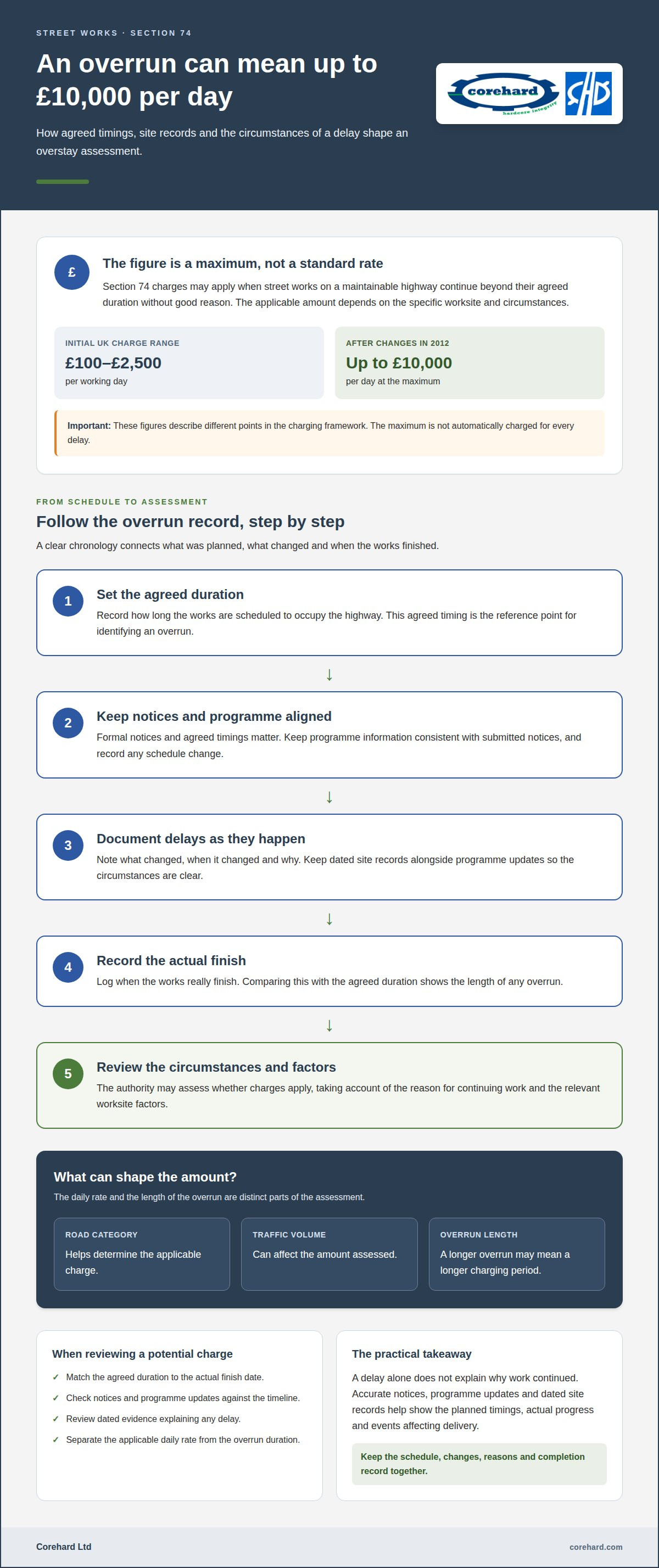
A street works overrun can create a daily financial exposure: changes made in 2012 led to Section 74 charges of up to £10,000 per day. On maintainable highways, charges may apply when works run beyond their agreed duration without good reason. The amount depends on factors including the road category, traffic volume and length of the overrun.
That makes programme control more than a scheduling issue. Formal notices and agreed timings are central, and a valid reason for delay can affect whether charges apply. For those responsible for utility or highway works, understanding the rules clarifies potential costs and compliance responsibilities.
This guide explains how the charging mechanism works, when it may apply and what can affect the amount due. It also covers ways to manage overrun risk through clear planning, accurate notices and robust records, helping you make informed decisions throughout street works.
Key Takeaways
- Understand how overstay charges relate to agreed work durations and why accurate notices matter.
- Identify the factors that can influence the charge, including road category, traffic volume and the length of the overrun.
- Learn who may be affected by the rules when carrying out street works on maintainable highways.
- Recognise why emergency issues, severe weather and public safety concerns may affect how an overrun is assessed.
- See how specialist advisory and compliance support can help bring greater control to street works planning and delivery.
Charges for street works on maintainable highways
A maintainable highway is a road where overstay charges may apply. Section 74 allows highway authorities to impose charges when street works exceed their agreed schedule without good reason. It does not create a standard penalty for every delay. Formal notice and timing agreements are relevant to its application. The agreed duration, the reason for continuing work and the recorded circumstances all help shape an assessment.
An overstay charge is a daily amount linked to work continuing beyond its agreed duration. The initial UK charge range was £100 to £2,500 per working day. Changes in 2012 led to maximum charges of up to £10,000 per day. These figures describe different points in the charging framework, not one universal rate. The applicable amount depends on the road category, traffic volume and length of the overrun. The stated maximum is not automatically charged for every delay.
Road category helps determine the applicable charge, while traffic volume and overrun length also matter. Two worksites may therefore face different assessments. For example, a brief delay on one road may not produce the same charge as a longer overrun elsewhere. Section 74 charges depend on the specific circumstances and applicable factors. A single daily figure cannot represent every maintainable highway or worksite.
The agreed duration provides a reference point for assessing an overrun. It records how long the works are scheduled to occupy the highway. Once that period is exceeded, the authority may consider whether charges apply. A delay alone does not explain why work continued. Keep notices, programme changes and dated site records together to show planned timings, actual progress and events affecting delivery.
Consider utility works scheduled to finish on an agreed date. If a delay extends the work beyond that schedule, the authority can assess the overrun and its circumstances. Road category, traffic volume and duration can affect the charge. A prompt finish shortens the overrun period, while continued occupation may lengthen it. This example shows why accurate programme updates and completion information matter. It does not set a fixed charge for every site.
For operational control, connect the notice, programme and site record. Record the agreed timing at the outset, update the programme when circumstances change, and document the reason and timing of each delay. Record when the works actually finish. These steps make the chronology easier to understand if charges are assessed and distinguish the original schedule from later events using records, not recollection.
When reviewing a potential charge, separate the daily rate from the total exposure. The applicable rate reflects road category and traffic conditions, while the overrun duration affects how long charges may accrue. Check that the scheduled duration and actual finish date match across records, then review evidence explaining any delay. This structured review clarifies the factors behind the amount and supports better planning for future street works on maintainable highways.
Section 74 of the New Roads and Street Works Act
The New Roads and Street Works Act 1991 provides a statutory framework for managing street works on public highways. Its provisions cover the coordination and control of works, including charges for overruns. The timing recorded for planned works is therefore operationally important. Notices, programmes and delivery records help show how the work was intended to proceed and what happened on site.
In England, Section 74 of the New Roads and Street Works Act 1991 was amended by the Traffic Management Permit Scheme (England) Regulations 2007 from 1 April 2008, according to the UK legislation register. This change sits within England’s permit scheme framework. It is relevant when considering how permitted works and overstay charges interact. The permit and the work’s agreed timing remain key parts of the operational record.
A permit scheme is a system for controlling specified street works. The Traffic Management Act 2004 forms part of the wider legislative context. In England, Street Manager has served as the Department for Transport’s central street works register from 2020. Recording information consistently helps connect notices with work taking place. It also gives teams a shared record for reviewing planned activity and changes.
Notice systems differ across the UK. EToN describes two-way transmission of notices in Wales, dating from 1999. Street Manager is the named central register in England from 2020. Teams coordinating work across nations need to use the relevant system for each location. Whichever system applies, accurate entries help align the notice, programme and actual work. A mismatch can make later review more difficult.
The Act’s history provides useful context. The New Roads and Street Works Act 1991 was enacted in September 1993. The street-works charging provision was introduced in 2001 alongside EToN 2. This enabled highway authorities to assess and challenge durations on works notices through EToN. In practice, this means that recorded durations may receive scrutiny. Programme assumptions should be clear and supportable.
Compliance begins with aligning work plans and notices. State the intended duration clearly and keep programme changes consistent with submitted information. If the schedule changes, record what changed, when and why. A dated chronology can help explain an overrun and provide a clearer basis for reviewing whether the work followed its planned sequence.
To comply with Section 74 or challenge a decision, retain notices, agreed durations, programme updates and dated records, then compare the assessment with that timeline. If someone receives notice that a sum has been registered under section 71 for enforcement against them as a fine, the Act provides a specific application route.
A review should focus on the decision’s underlying record. Identify the relevant notice, agreed duration and actual work period. Then set out recorded changes and reasons for delay. This can distinguish a timing disagreement from incomplete or inconsistent information. The route concerning a section 71 registration is specific, so it should not be treated as a general review process for every charge assessment.
For organisations managing notices and assurance across multiple works, Dynamic Assurance & Compliance can support a structured approach to compliance oversight and evidence management.
Who does Section 74 apply to?
A works promoter is the organisation responsible for arranging notified street works. Section 74 concerns works on maintainable highways where formal notice and timing agreements apply. Utility companies are a key example of promoters. The highway authority assesses the work’s duration and any overrun. Contractors may also be involved in delivering the work, so teams should distinguish site activity from formal responsibility for the works record.
A utility company may plan work through its own teams or contractors. For example, a contractor could carry out a repair while the utility company remains the named promoter. The organisation named in the work records is therefore an important starting point: it helps establish who arranged the works and can explain the planned programme. The contractor’s site records can then provide details of delivery.
The highway authority is the public body responsible for the relevant highway. Its role is to consider the notified duration and assess an overrun, not to manage the contractor’s daily work. For a particular site, the authority needs a clear account of the planned work and its progress. The promoter and delivery team each hold information that can help explain the sequence.
A contractor is the organisation carrying out work on site. Its practical role may include reporting progress, delays and completion information to the promoter. For instance, a crew may find that a planned repair requires additional work. A timely account of the change helps the promoter understand what happened and keep its records coherent. The contractor’s operational knowledge complements the formal work information.
Several teams may contribute to one works record. A planning team may set the proposed programme, a permit or street works team may handle formal information, and a delivery team may report site progress. These functions can sit within one organisation or across several. Assigning an owner to each record helps prevent gaps. A project contact list can show who holds programme, notice and site information.
For a contractor warned about a possible charge, the first practical step is to identify the work reference and named promoter. Then establish who can provide the relevant programme and site chronology. The contractor can supply delivery details, while the promoter coordinates the formal work record. This division helps assemble a consistent account without assuming every participant has the same responsibility.
For utility companies managing multiple worksites, a responsibility map can support routine oversight. Link each site to its promoter, delivery contractor and internal record owner. Note who reports progress and updates the central work record. If teams change during delivery, update those contacts. This helps prevent important information from remaining with one individual or team when another needs it.
At close-out, the promoter and delivery team can reconcile their records. Compare the planned work description with the activities completed, then confirm that completion information has reached the person maintaining the formal record. If a contractor’s account differs from the promoter’s programme, resolve the discrepancy using dated site information. Clear ownership and coordinated records help each party explain its role if the highway authority reviews the work.
What are the key exemptions or exceptions under Section 74?
An exception is a circumstance that may affect charge assessment. Emergency utility issues, severe weather and public safety concerns are possible reasons for exemption, but they are not automatic exemptions in every case. The specific circumstances and supporting records matter. Distinguish the cause of a delay from its duration to explain what happened at the site.
Emergency utility issues are urgent problems requiring prompt work. A fault that threatens an essential service is one example. The emergency context may affect how an overrun is considered. Record when the issue arose and what response followed, keeping the work chronology consistent with notices and the programme. For example, note when the urgent repair began, what work it required and when the immediate issue was addressed. These records help separate urgent response activity from later work.
Severe weather means weather conditions that disrupt planned site activity. Heavy conditions may affect access, working conditions or safe progress. Record the dates affected and the practical impact on the work. A general reference to poor weather gives little detail; a dated site record can show which activities were interrupted and whether work continued where conditions allowed. Link the weather record to the relevant tasks and timing.
Public safety concerns are risks that may require a change in work activity. For example, a newly identified hazard could require additional action before the site is completed. Record the concern, response and period affected, keeping relevant site notes alongside programme updates. This makes the link between the safety issue and the delay easier to understand. Safety records should describe the issue clearly without assuming it automatically removes charges.
Assess each circumstance against the actual timeline. A useful record should answer three points: what happened, when it happened and how it affected progress. For an emergency utility issue, record the fault and response. For severe weather, note disrupted tasks. For a public safety concern, document the hazard and required action. These details provide context for the authority’s consideration.
- Record the event. Use dated notes identifying the issue and worksite.
- Explain the effect. Connect the event to delayed or changed activities.
- Keep supporting records together. Link site notes with notices and programme updates.
- Update the timeline. Record when work resumed and when it finished.
Consider a utility repair disrupted by severe weather. The weather record should identify affected dates and tasks, while the programme should show the resulting change. If a public safety concern also arises, document it separately. Distinct records prevent several causes from being collapsed into one vague explanation. A clear sequence shows how each event affected delivery.
Exceptions require careful evidence, not assumptions. An emergency, weather disruption or safety concern may provide relevant context, but its effect depends on the circumstances recorded. Keep the explanation factual and tied to the work’s chronology. For a structured review of compliance evidence and records, review your assurance and compliance approach.
Corehard
Corehard Ltd helps organisations strengthen street works compliance and delivery. Its NRSWA & TMA Advisory and NRSWA & TMA Development services support teams reviewing procedures, notices and operational arrangements. Dynamic Assurance & Compliance can strengthen oversight, while Asset Surveys & Condition Reporting supports informed asset assessments. These services can help when overstay risks reveal gaps in planning, records or assurance. The focus is on understanding operations and improving information management, rather than assuming every delay has the same cause. Contact Corehard Ltd to discuss your street works compliance and assurance requirements.
Build stronger control into future works
Use the next planning cycle to turn Section 74 requirements into a consistent operational process. Bring programme assumptions, notice information and site records together early, so teams can identify timing risks before work begins. After completion, review any delays and their causes; this can help improve planning and evidence management for future schemes.
Where responsibilities cross teams or projects, clear record ownership supports coherent oversight. Corehard helps organisations assess their NRSWA and TMA processes and identify practical areas for development. This support can translate complex requirements into more consistent working arrangements, while recognising that every site and delay is different.
Contact Corehard about your street works compliance needs to discuss a practical next step. A structured approach can help your teams plan with greater clarity and manage future works with confidence.
Frequently Asked Questions
How Much Could a Section 74 Overstay Charge Cost?
There is no single fixed sum for every case. To understand a specific assessment, distinguish the applicable daily charge from the overall amount claimed. Compare the dates used in the calculation with the work records and note any difference clearly. A headline maximum does not predict the amount for an individual worksite. The assessment and its supporting chronology are the useful starting points.
I am a contractor and have been warned about receiving a Section 74 - what is it?
It means a potential charge relating to street works has been raised. A warning is not, by itself, the final assessed amount. Identify the work reference and issuing authority, then establish which organisation is named as the works promoter. Pass the relevant site chronology to that promoter, including changes to planned activities and completion information, so the response can be coordinated with the formal work record.
What Are the Benefits of Section 74?
It gives highway authorities a mechanism for addressing prolonged occupation and encourages promoters to manage work durations responsibly. For delivery teams, its practical value is a clear reason to plan realistic programmes and maintain oversight as work progresses. Better coordination can help limit unnecessary disruption to highway users. Its value depends on consistent planning and accurate records, not charges alone.
What Is Section 74 of the Street Works Act?
It is the street works charging provision in the New Roads and Street Works Act 1991. It is a statutory provision, not the name of a separate notice or permit. That distinction helps contractors understand what a warning refers to: the law provides the framework, while work records and authority communications relate to a particular site and assessment.
Why Do Overrun Charges Exist Under Section 74?
They are intended to encourage utility companies to plan better and carry out street works more efficiently. In practice, the charging mechanism gives programme duration a financial consequence, encouraging teams to monitor delivery and respond to emerging delays. This supports management of highway occupation and helps authorities address works that continue beyond their agreed schedule without good reason.
What does Section 74 refer to in UK law?
The reference depends on the legislation named. In this article, it means the street works provision in the New Roads and Street Works Act 1991. The same section number appears in other Acts: the Sexual Offences Act 2003 addresses consent, while the Road Traffic Offenders Act 1988 section relates to time-limit provisions. Naming the full Act prevents confusion between unrelated legal rules.
What does Section 74 require or allow?
For street works, it allows highway authorities to impose charges for qualifying overruns. Separately, regulations may make failure to give a required notice a summary offence, punishable by a fine not exceeding level 4 on the standard scale. That offence concerns a notice requirement, not simply the fact that works have overrun, so the two consequences should not be conflated.
What are the penalties or consequences for breaching Section 74?
The main financial consequence is an overstay charge assessed for the relevant works. A separate consequence may arise if regulations make failure to give a required notice a summary offence. For a warning or assessment, distinguish the alleged overrun from any notice issue, and keep related correspondence and work records together. This helps clarify what action is being considered and which facts are relevant.


