

What if a soil core gives a misleading picture, not because the ground is unusual, but because the sampling approach obscures its layers? Core sampling preserves a column of soil for analysis, but the result is only useful if you choose a suitable depth and diameter and protect the sample’s structure and identity.
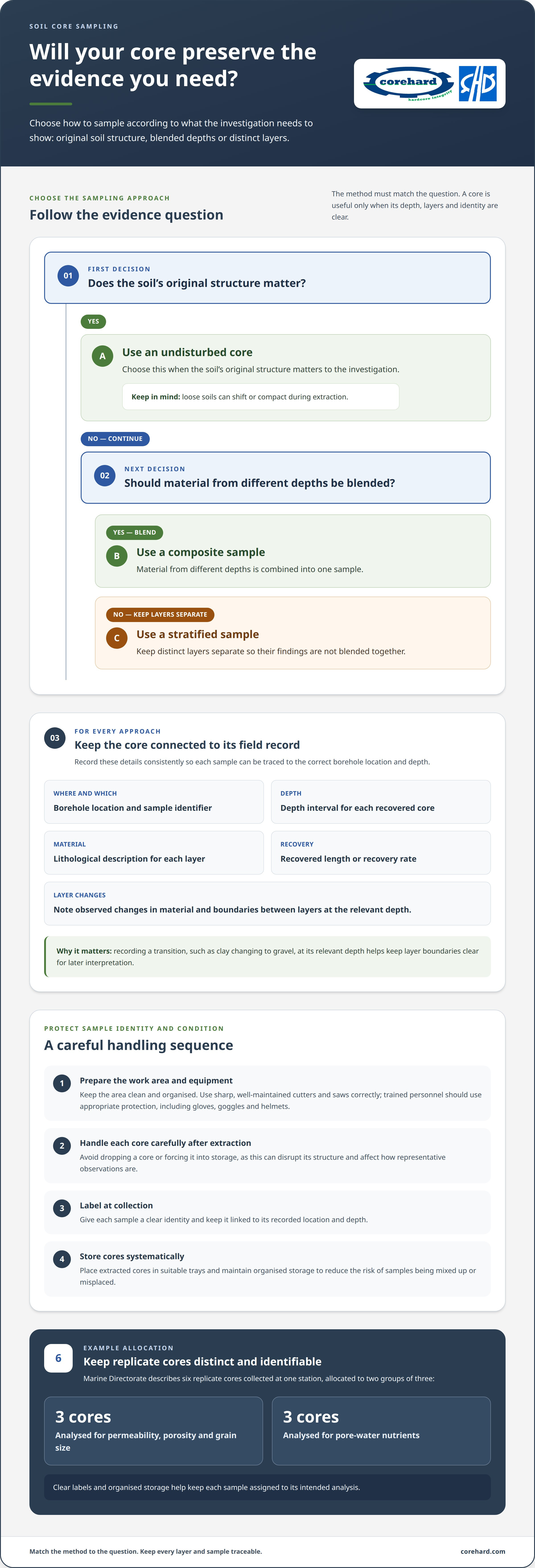
Extracting material is not enough: the method must match the question. A composite sample blends material from different depths, while a stratified sample keeps distinct layers separate. That choice affects what the findings can show.
This guide explains how core drills support soil sampling, what to consider when selecting drilling depth and diameter, and how to limit contamination and document layers clearly. It also covers when undisturbed, composite and stratified cores are useful, so you can match the sampling method to the evidence your project needs.
Key Takeaways
- Match drilling depth and diameter to the investigation’s objective and the layers or conditions it needs to examine.
- Protect sample integrity through careful handling, clear labels and organised storage from collection onwards.
- Record depth, soil description and recovery consistently so each sample can be traced to its borehole location.
- Use undisturbed cores when the soil’s original structure matters, while recognising that loose soils can shift or compact during extraction.
- Choose composite samples to combine material from different depths, or stratified samples to keep distinct layers separate.
Core handling and contamination prevention
Contamination, breakage or incorrect handling can compromise core samples and weaken the evidence available for analysis. Risks include injury from cutting equipment and changes to the sample. Trained personnel, suitable protective equipment, a clean work area and careful storage help manage these risks.
Safe Core Handling
Safe handling protects both personnel and the recovered material. Before work begins, personnel should be trained to use the equipment, and the work area should be clean and organised. Gloves, safety goggles and helmets provide appropriate protection during sampling. These precautions help reduce injury risks, while controlled handling helps prevent damage that could affect later analysis.
For example, a poorly maintained or incorrectly operated core cutter can damage a sample during extraction. Sharp, well-maintained cutters and core saws, used correctly, support retrieval while limiting avoidable breakage. Careful handling after extraction matters too: dropping a core or forcing it into storage can disrupt its structure and make observations less representative.
Preventing Sample Contamination
Preventing contamination means limiting contact with materials or equipment that could alter a sample’s composition. Collection procedures should minimise contamination while preserving the core’s physical integrity. Use sharp, properly maintained cutters and saws correctly, so they do not drag against or damage material during extraction. These controls help ensure results reflect the sampled ground rather than interference introduced during collection.
Keep the work area clean and organised, and handle each core in a controlled sequence. Label samples clearly at collection to distinguish them and maintain traceability. When several cores are collected at one station, Marine Directorate describes six replicate cores: three are analysed for permeability, porosity and grain size, and three for pore-water nutrients. Keeping each sample separate and identifiable supports this allocation.
Storage protects the sample; it is not an administrative afterthought. Place extracted mining cores systematically in core trays to reduce the risk of samples being mixed up or misplaced. Manage and store them to preserve their integrity for analysis. Label each sample at collection and keep its identity linked to the tray and recorded location as it moves from the work area.
A practical handling sequence links extraction, identification and storage:
- Operate sharp, well-maintained cutting equipment correctly to limit sample damage.
- Keep the sampling area clean and organised, with gloves, goggles and helmets used as appropriate.
- Label each core at collection, then place it systematically in a suitable tray.
- Maintain organised storage so samples remain identifiable and suitable for analysis.
These controls preserve the link between a core and its intended analysis. A clearly labelled tray, for example, helps keep replicate samples assigned to their specific tests, rather than confusing material intended for grain-size analysis with material intended for pore-water nutrients. Consistent handling protects both sample condition and the usefulness of the resulting evidence.
Documentation of sample depth and lithology
A core is only useful if you know where it came from and what it contains. Record sample depth, lithological description and recovery rate in a standardised format, so observations can be interpreted against the correct borehole location.
Depth records locate each recovered interval within the ground profile. Lithology describes the material, such as a change from clay to gravel, while recovery records how much material was retrieved. Together, these entries distinguish observed geology from gaps or incomplete recovery. Without that context, it can be difficult to place a sample result accurately within the site model.
Maintain a consistent log as drilling progresses, linking each description to its depth interval and sample identity. If a borehole passes from one soil type into another, for example, record the transition at the relevant depth instead of describing the whole core as a single material. This preserves layer boundaries for later interpretation and comparison between boreholes.
A useful record should connect field observations with the physical sample. Include:
- The borehole location and sample identifier.
- The depth at which each core interval was retrieved.
- A lithological description for each identified layer.
- The recovered length or recovery rate for the sampled interval.
- Any observed change in material or boundary between layers.
Mining core boxes also need labels showing essential information, including the depth at which each core was retrieved. This links the stored material to its borehole position, even when it is reviewed away from the drilling location. Keep the box information consistent with the corresponding log: a mismatch can make a correctly described core difficult to trace.
Duplicate logs offer another way to check and validate observations. Geologists may collect half-core samples from drill holes and maintain precise duplicate logs to support analysis of mineral distribution and validation of assay results. The duplicate record should use the same depth references and descriptions, allowing reviewers to compare records while preserving the link to the original interval.
Consistency matters throughout the borehole, not just at notable changes. If one log records a layer boundary and another uses a different description or depth reference, comparisons become less reliable. A standardised format helps align entries from separate boreholes, supports clear review of recovery and gives later analysis a traceable geological context.
Traceable records also support construction of a reliable geological model. A model depends on linking each observation to its position and material, rather than treating samples as isolated results. For infrastructure investigations, clear depth and lithology records help reviewers understand which ground conditions were encountered and where they changed. Where field evidence feeds wider assurance processes, structured compliance oversight can help connect records with operational review.
Benefits of undisturbed samples
Core sampling with a drill retrieves cylindrical soil sections that can retain their original structure. Compared with a blended sample, a core preserves material in sequence, helping show how soil changes with depth. That distinction matters when the investigation needs to examine individual layers rather than an overall mixture.
The main advantage of a core is access to a physical profile for analysis. It can help identify variations in soil type, minerals, moisture content and traces of contamination. A visible change from one soil type to another, for example, can be related to its position in the recovered column rather than concealed in a blended sample.
An undisturbed sample does not mean every core remains unchanged. Loose or unconsolidated soils can become disturbed or compacted during extraction, altering the material’s structure. Interpret the result in light of the recovered sample’s condition, especially where the ground is loose.
Cores are useful when the relationship between layers matters. A core keeps material arranged along the extracted column, whereas a composite soil sample blends material collected from different depths. The blend can represent combined material, but it cannot show which distinct layer contained a particular feature.
For practical interpretation, a core can provide evidence about:
- Changes in soil type between successive layers.
- The location of minerals or moisture within the recovered material.
- Whether traces of contamination appear in a particular part of the core.
- Possible disturbance or compaction in loose, unconsolidated soils.
These approaches answer different questions. If an investigation needs to identify where a material change occurs, the core’s sequence is informative. If the aim is to assess combined material from several depths, a composite approach may be more relevant, but it loses the separate layer context.
Sample condition also affects what you can conclude. A core that retains its structure gives a more direct view of the original sequence than material that has shifted or compacted. If loose soils make preservation difficult, note the disturbance when interpreting the core rather than treating every recovered section as unchanged ground.
Core evidence is strongest when the method matches the investigation’s purpose. Use an intact cylindrical sample to examine layer relationships and material variation; use a blended sample when combined material is the focus. Neither approach answers every question. This distinction helps teams select suitable evidence while recognising that extraction can affect loose soils.
Choosing drilling depth and diameter
The investigation’s objective should determine how far drilling goes and which core diameter to select. A topsoil assessment and a study of deeper geological layers require different sampling plans.
Selecting Drilling Depth
Drilling depth is the planned distance into the ground needed to collect relevant material. Shallow drilling may suit agricultural assessments focused on topsoil quality and nutrient content. Geological or environmental investigations may need deeper, controlled drilling to examine distinct layers or trace pollutants. Setting depth according to the study objective helps avoid collecting material that cannot answer the central question.
Choosing Core Diameter
Core diameter is the width of the cylindrical soil section retrieved by the drilling equipment. Select it in relation to the material and the required analysis, and ensure the equipment suits the site’s geological conditions. A diameter suitable for one ground type may not suit another. The objective and the ground conditions should both inform equipment selection.
Plan depth around the evidence you need. For an agricultural study focused on topsoil nutrients, shallow drilling may capture the material of interest. If the question concerns changes between deeper layers, the borehole needs to reach those layers rather than stop within surface soil. The selected depth should reflect what the investigation must distinguish.
Environmental work may focus on pollutant traces, while geological work may examine stratification. In either case, a controlled depth plan links each recovered interval to the area under investigation. If the target layer lies below surface material, stopping too early will leave the question unanswered. Drilling deeper without a clear objective may also collect material outside the intended scope.
Diameter decisions also depend on the equipment and ground. Available core drills range from handheld units to truck-mounted drill rods capable of drilling hundreds of metres into the Earth. This range shows why one equipment format cannot suit every site. Geological conditions and the intended sample analysis should guide the choice.
Depth and diameter work together, but serve different planning needs. Depth determines which part of the ground profile is reached; diameter determines the width of the recovered core. A study of several soil layers, for example, needs a depth plan that reaches those layers, while the diameter must suit the sampling and analysis objectives.
- Define whether the investigation concerns topsoil, deeper layers or pollutant traces.
- Match planned drilling depth to the location of the material under study.
- Select equipment suited to the site’s geological conditions and sampling objective.
- Align core diameter with the material and analysis requirements.
Consider depth and diameter together before drilling begins. A depth chosen for topsoil assessment will not answer a question about deeper strata, and equipment unsuited to site conditions may not retrieve the intended material effectively. Clear objectives give the drilling plan a practical basis, linking the investigation’s question to the sample it needs.
Composite and stratified core sampling
The sampling design determines what conclusions the results can support. Set it against the investigation’s objective, the expected variability across the site and the decisions the evidence must inform.
In the UK, the cost depends on the project and is provided after a quote request. Factors include the investigation’s scope, ground conditions, collection plan and required analysis.
Steps in the Sampling Procedure
A sampling procedure turns the investigation’s question into a collection plan. First, define the property or condition being assessed and how the evidence will be used. Then plan collection locations and intervals to represent the area of interest, and keep samples linked to their intended tests. A clear design makes the findings more relevant to the decision at hand.
A site-wide assessment and an investigation focused on a suspected localised change need different collection patterns. The plan should reflect that distinction, rather than treating every point as equally informative.
Analysing and Interpreting Cores
Analysis measures or describes the properties selected for investigation; interpretation considers what the results mean for the site. Relate each finding to the sampling plan and its purpose rather than viewing a laboratory result in isolation. This helps distinguish an observed condition from a broader conclusion about the ground.
A result from one collection point, for instance, describes that sample, not automatically the whole site. Compare findings with the investigation’s other evidence before using them to inform design or operational decisions.
Sampling design should account for variability. Conditions can differ across a site, so collection locations need to reflect the area or feature under review. A plan concentrated on one accessible location may offer limited insight into a wider area. Conversely, an investigation focused on a specific concern should direct sampling towards it.
Agreeing the analytical purpose early helps prevent a mismatch between collection and interpretation. If the project assesses a defined material characteristic, the selected tests should address it. If the decision concerns a broader site condition, the evidence needs to support conclusions at that scale. Clear alignment makes findings easier to apply.
Interpretation should reflect the limits of the collection plan. A result supports conclusions about the material tested; applying it to other locations requires evidence to justify that step. Where results differ, the pattern may point to ground variability or differences between the samples collected. Careful interpretation helps avoid conclusions that go beyond the evidence.
For project-level support aligning sampling decisions with assurance requirements, discuss compliance support.
Corehard
Corehard Ltd can help connect ground-investigation evidence with wider infrastructure assurance and asset decisions. Where sampling findings inform condition assessments or compliance processes, its Asset Surveys & Condition Reporting and Dynamic Assurance & Compliance offerings provide relevant support. NRSWA & TMA Advisory and NRSWA & TMA Development can also help organisations address the wider streetworks and traffic-management context of their projects.
This support is relevant when teams need to bring technical evidence into a broader programme of asset oversight, assurance or compliance. Corehard Ltd’s role is not to replace the investigation’s sampling method; it is to support related advisory, development, survey and assurance needs.
For support with your project, contact Corehard Ltd.
Turn sampling evidence into a clear next step
Before committing to an investigation, define the decision it needs to support and who will use the findings. This gives the project team a practical basis for aligning technical work with design, maintenance or compliance planning. It also keeps discussions focused on the evidence needed, rather than collecting information without a clear purpose.
For infrastructure programmes, Core sampling can form part of a wider evidence-led decision process. Consider how the results will be assessed alongside other project information and what action they may inform. A clear brief can connect investigation findings to your organisation’s operational priorities.
If you’re ready to discuss how your project evidence fits its wider requirements, contact Corehard Ltd. A focused conversation can help you identify a practical direction for your next step.
Frequently Asked Questions
What is the Role of Core Drills in Soil Sampling?
Core drills provide access to soil below the surface for investigations that cannot be answered by inspecting exposed ground alone. Their value depends on matching the equipment and collection approach to the question. For volatile organic compound analysis, UK Government guidance says miniature coring mainly applies to fine- to medium-grained cohesive or moderately cohesive soils, excluding coarse and non-cohesive soils.
What is core sampling and how does it work?
Core sampling obtains material from below ground for examination and testing. The investigation defines which properties matter and how the results should be assessed. Marine Directorate, for example, describes allocating replicate cores from a station to different analyses: some are tested for permeability, porosity and grain size, while others are used for pore-water nutrients. This illustrates how a sampling plan can link material to specific analytical purposes.
What are the main types of core sampling?
The main types discussed here are undisturbed, composite and stratified sampling. Suitability depends on the investigation’s purpose and the material being studied, as well as how the samples are arranged. For example, a volatile organic compound investigation may use miniature coring for suitable cohesive soils, but not coarse or non-cohesive soils, according to UK Government guidance. The sampling method should fit both the analytical question and the ground.
What equipment is used for core sampling?
Equipment varies with the investigation and ground conditions, so no single kit is suitable for every site. Miniature coring may be relevant for certain cohesive soils assessed for volatile organic compounds, while other ground conditions call for a different approach. The analytical purpose matters too: collecting material for pore-water nutrients differs from collecting it for grain-size assessment, as the Marine Directorate example illustrates.
What UK regulations and permissions apply to core sampling?
Permissions depend on the site, who controls access and the proposed work. Before planning an investigation, establish the relevant landowner’s or site operator’s access requirements and consider whether the location is part of an active infrastructure or streetworks project. The project context can affect coordination and oversight. Do not assume one permission or approval applies nationally to every site; define the proposed activity and location first.


